Next Friday vs This Friday confusion in meetings scheduled for next Friday or this Friday often leads people to arrive on the wrong day today. Ok, I have seen this kind of confusion many times when a meeting is scheduled for next Friday or this Friday, and people quietly show up on a completely different day. You might have thought everything was clear, only to realize the other person meant something else. This is one of those most common misunderstandings in English that happens in workplaces, schools, and even family conversations.
The reason is not complicated. English does not have a single strict rule, so meaning depends on context, language habits, and personal interpretation. A missed interview, a delayed project, or even a restaurant reservation can start from this small uncertainty. When someone says This Friday, they may mean the coming Friday, while Next Friday can shift depending on how a person counts the week or days. I’ve personally noticed that even careful planners can get tripped up when they rely on instinct instead of asking for clarification.
In daily life, people use phrases like next Friday vs this Friday without thinking, but the meaning can change based on the day of the week, the timing, and the context of the conversation. This is why simple planning can suddenly turn into confusion, especially in text messages, group chats, or office planning. The safest habit I’ve learned is to confirm the exact date, because a small misunderstanding can easily lead to being late, showing up on the wrong Friday, or missing plans completely.
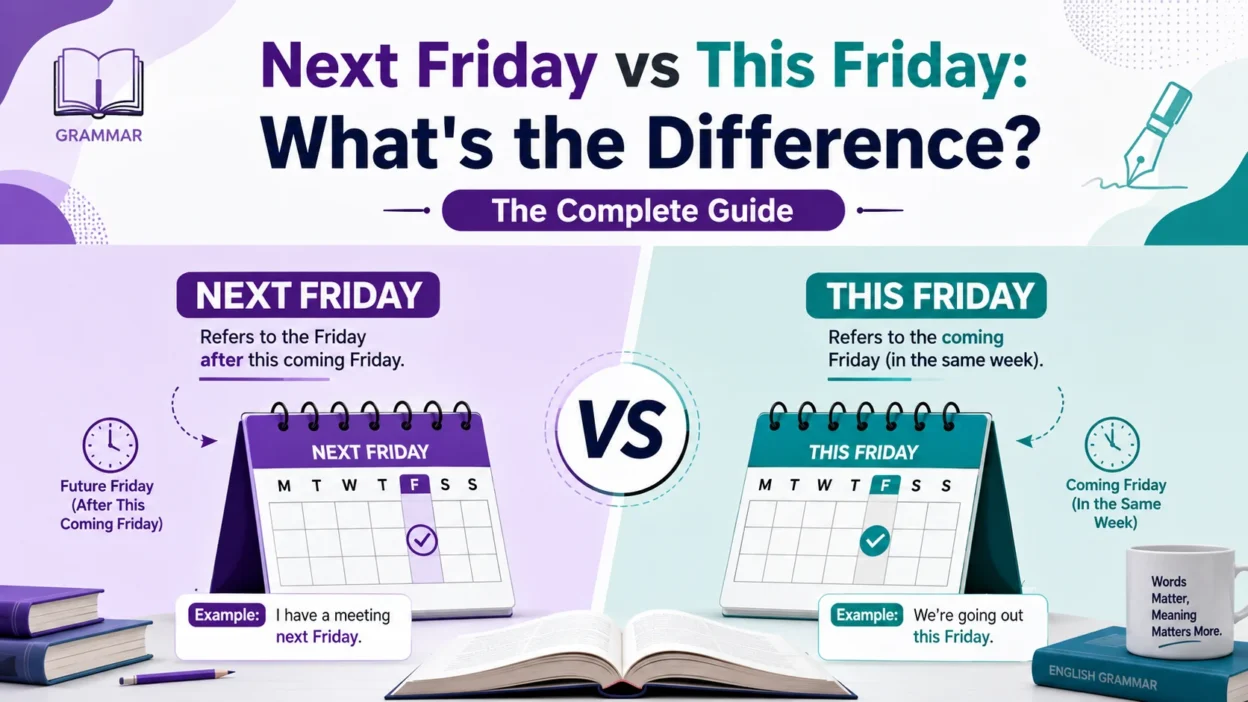
Next Friday vs This Friday: The Short Answer
If you’re looking for a quick explanation of Next Friday vs This Friday, here’s the general rule most English speakers follow.
| Phrase | Most Common Meaning |
| This Friday | The nearest upcoming Friday. |
| Next Friday | The Friday after this coming Friday. |
For example, imagine today is Monday.
- This Friday means the Friday that arrives in a few days.
- Next Friday means the Friday one week later.
That sounds straightforward. However, real conversations aren’t always that predictable.
Many people use next Friday to mean the very next Friday that appears on the calendar, regardless of whether it’s this week or next week. Others always reserve next Friday for the following week’s Friday.
Neither group is intentionally wrong. They simply learned different speaking habits.
Because of this, the safest option is always to include the calendar date whenever accuracy matters.
Instead of saying:
“Let’s meet next Friday.”
Say:
“Let’s meet on Friday, July 17.”
One extra detail removes every possible misunderstanding.
Next Friday vs This Friday: Why So Many People Get Confused
If you’ve ever searched for Next Friday vs This Friday, you’re certainly not alone.
Millions of English speakers ask the same question because the language itself creates ambiguity.
Unlike numbers or calendar dates, words like this and next depend on perspective.
Consider these examples:
- this morning
- next month
- this weekend
- next year
Each expression works because everyone agrees on the time frame.
Weekdays don’t work the same way.
When someone says Friday, there are always multiple Fridays on the calendar.
The question becomes:
Which Friday are they talking about?
That’s where personal interpretation begins.
Some people think about the calendar.
Others think about the current week.
Still others think about whichever Friday comes next chronologically.
Each interpretation sounds logical.
Why English Doesn’t Have a Universal Rule
Unlike mathematical formulas, English develops naturally over centuries.
Native speakers don’t memorize strict rules for every phrase.
Instead, they learn patterns from family, friends, teachers, television, and everyday conversation.
That’s why someone raised in one city may use next Friday differently from someone raised somewhere else.
Neither speaker is necessarily using incorrect English.
They’re simply following the language patterns they grew up hearing.
This flexibility makes English expressive.
It also makes scheduling meetings surprisingly difficult.
Next Friday vs This Friday: What Does “This Friday” Mean?
In most situations, this Friday refers to the nearest Friday that hasn’t happened yet.
If today is Monday, Tuesday, Wednesday, or Thursday, nearly everyone understands this Friday to mean the upcoming Friday.
For example:
Today is Monday.
Your manager says:
“Can you finish the proposal this Friday?”
Nobody expects the proposal next week.
Everyone naturally assumes the deadline is only a few days away.
That’s because the word this usually points toward something inside the current time frame.
Think about these expressions.
- this afternoon
- this evening
- this month
- this week
- this weekend
Each refers to the present period rather than a future one.
The same pattern generally applies to weekdays.
This Friday Usually Means the Closest Friday
In everyday conversation, this Friday almost always means the nearest Friday.
Here are several examples.
At Work
Manager:
“Let’s review the project this Friday.”
Employees understand the meeting will happen during the current workweek.
At School
Teacher:
“The assignment is due this Friday.”
Students know the deadline is approaching quickly.
Among Friends
“Want to grab dinner this Friday?”
Most people immediately think about the upcoming weekend.
Within Families
“We’re visiting Grandma this Friday.”
Again, everyone usually pictures the closest Friday on the calendar.
Next Friday vs This Friday: What Happens If Today Is Already Friday?
Friday itself creates the biggest source of confusion.
Imagine it’s Friday morning at 8:00 a.m.
Someone asks:
“Are we still meeting this Friday?”
Almost everyone understands what they mean today.
Now imagine it’s Friday night at 10:30 p.m.
A friend says:
“Let’s meet this Friday.”
Some people still interpret that as today, even though the day is nearly over.
Others immediately assume they mean the Friday of the following week.
This illustrates an important point.
The closer you get to the end of Friday, the more likely people are to interpret the phrase differently.
Next Friday vs This Friday: What Does “Next Friday” Really Mean?
Now we reach the phrase that causes the most disagreement.
For many English speakers, next Friday means:
The Friday after this coming Friday.
Imagine today’s date is Monday.
The calendar looks like this:
- Friday, July 10
- Friday, July 17
If someone says:
“Let’s meet next Friday.”
Many people assume they’re referring to July 17.
This interpretation is especially common in professional settings because it avoids confusion between the current week and the following week.
However, that’s not the only interpretation you’ll hear.
Why Some People Use “Next Friday” Differently
Some speakers focus on the word next itself.
To them, next Friday simply means:
The next Friday that arrives.
That could be only three or four days away.
For example:
Today is Tuesday.
Someone says:
“We’re leaving next Friday.”
One listener thinks they mean this week’s Friday.
Another listener thinks they mean the Friday after that.
Neither interpretation is unreasonable.
That’s why these conversations often require clarification.
Next Friday vs This Friday: Day-by-Day Examples
The meaning of these phrases becomes much easier to understand when you look at each day of the week separately.
Next Friday vs This Friday on Monday
Monday is one of the easiest days.
If today is Monday:
- This Friday usually means four days away.
- Next Friday usually means eleven days away.
Example:
“Our interview is this Friday.”
Everyone prepares for the nearest Friday.
If someone says:
“The interview is next Friday.”
Most people expect the following week’s Friday instead.
Next Friday vs This Friday on Tuesday
Tuesday follows almost the same pattern.
The current week’s Friday still feels close.
Therefore:
- This Friday means the nearest Friday.
- Next Friday usually means the Friday after that.
Business meetings scheduled on Tuesdays rarely create misunderstandings when people include the calendar date.
Next Friday vs This Friday on Wednesday
Wednesday sits in the middle of the week.
At this point, Friday is only two days away.
Most native speakers have little difficulty understanding this Friday.
However, next Friday can still create uncertainty if the speaker doesn’t specify the date.
Next Friday vs This Friday on Thursday
Thursday leaves almost no doubt about this Friday.
If someone says:
“Let’s finish everything this Friday.”
Everyone understands what they mean tomorrow.
But saying next Friday usually shifts attention to the following week.
Next Friday vs This Friday on Friday
Friday itself produces the greatest disagreement.
Early in the morning:
- This Friday almost always means today.
Later in the afternoon:
Some speakers continue using this Friday.
Others switch to next Friday, even though the day hasn’t officially ended.
This difference explains why many businesses avoid using either phrase in formal communication without including a date.
Next Friday vs This Friday on Saturday
Saturday marks the beginning of another gray area.
Many people mentally consider the previous workweek finished.
As a result, they often begin referring to the upcoming Friday as next Friday instead of this Friday.
Others still call it this Friday because it belongs to the current calendar week.
Again, context matters.
Next Friday vs This Friday on Sunday
Sunday often feels like the start of a new week, even though calendars differ around the world.
Because of that:
Some speakers say:
“This Friday.”
Others naturally say:
“Next Friday.”
Neither choice surprises native English speakers.
The important thing is making sure everyone understands the same date.
Next Friday vs This Friday: Side-by-Side Comparison
Now that you understand the basic difference, it’s helpful to compare Next Friday vs This Friday in several common situations. Looking at the phrases side by side makes it much easier to see why misunderstandings happen.
| If Today Is… | “This Friday” Usually Means | “Next Friday” Usually Means |
| Monday | The upcoming Friday | The Friday after this week |
| Tuesday | The upcoming Friday | The following Friday |
| Wednesday | The upcoming Friday | The following Friday |
| Thursday | Tomorrow | Eight days later |
| Friday (Morning) | Today | The following Friday |
| Friday (Evening) | Today or next week’s Friday (depends on context) | Usually the following Friday |
| Saturday | The upcoming Friday (varies by speaker) | Sometimes the Friday after that |
| Sunday | Usually the upcoming Friday | Often the following Friday |
One thing becomes obvious when looking at the table: the closer you get to Friday, the more room there is for interpretation.
That is exactly why experienced professionals rarely rely on these phrases when scheduling important events.
Next Friday vs This Friday: Why Native English Speakers Disagree
Many learners assume there must be one official grammar rule that settles the debate. Surprisingly, there isn’t.
Unlike verb tenses or punctuation rules, “this Friday” and “next Friday” belong to everyday spoken English. Their meaning depends heavily on context.
Imagine three coworkers discussing an upcoming meeting.
Emma: “Let’s meet next Friday.”
James: “Perfect. I’ll see you in ten days.”
David: “Wait, I thought you meant this coming Friday.”
All three people speak fluent English.
None of them is making grammatical mistakes.
They’re simply interpreting the phrase differently.
This explains why disagreements about Next Friday vs This Friday happen even among native speakers.
Why Context Matters More Than Grammar
English relies on context more than many people realize.
For example, if someone says:
“I’ll call you later.”
The word later doesn’t have an exact definition.
It could mean:
- Five minutes
- One hour
- Tonight
- Tomorrow
The listener understands the meaning from the situation.
The same principle applies to this Friday and next Friday.
The surrounding conversation often determines which Friday the speaker intends.
For example:
“We have two more days to finish the project. Let’s review everything this Friday.”
The deadline makes it obvious they mean the nearest Friday.
Now compare that with this sentence:
“We’ll finish Phase One this Friday and begin testing next Friday.”
Here, the second Friday clearly refers to the following week.
Context removes the ambiguity.
Personal Speaking Habits Influence Meaning
Language habits often develop during childhood.
People naturally repeat the expressions they hear from parents, teachers, and friends.
As a result, two people from the same country may use next Friday differently simply because they grew up in different households.
This isn’t unusual.
English contains many expressions that vary between communities.
Examples include:
- Soda vs. pop
- Vacation vs. holiday
- Elevator vs. lift
- Apartment vs. flat
Similarly, Next Friday vs This Friday can vary from one speaker to another.
Next Friday vs This Friday: What Dictionaries and Language Experts Say
Many people search dictionaries hoping to find a single definitive answer.
While dictionaries explain the meanings of this and next, they generally acknowledge that real-world usage depends on context.
Language experts agree on several important points.
“This Friday”
Most dictionaries define this Friday as:
- The Friday of the current week.
- The nearest upcoming Friday.
This definition matches how most native speakers use the phrase.
“Next Friday”
Most dictionaries describe next Friday as:
- The Friday following the current week’s Friday.
- The Friday in the following week.
However, many also recognize that some speakers use it to mean the next Friday that occurs chronologically.
That’s why dictionaries often include examples instead of absolute rules.
What Style Guides Recommend
Professional writing guides generally encourage writers to avoid ambiguity whenever dates matter.
Instead of writing:
The meeting will be held next Friday.
They recommend writing:
The meeting will be held on Friday, October 16.
This approach removes every possible misunderstanding.
It’s also considered best practice in:
- Business communication
- Academic writing
- Government documents
- Legal contracts
- Medical appointments
Next Friday vs This Friday in American English
American English generally follows a predictable pattern.
If today is Monday:
- This Friday means the upcoming Friday.
- Next Friday usually means the Friday of the following week.
Most Americans use these expressions this way in everyday conversation.
However, informal speech varies.
Some Americans use next Friday to mean simply “the next Friday that arrives.”
That’s especially common when making casual plans with family or friends.
For example:
“Let’s go fishing next Friday.”
Without additional context, listeners may ask:
“Do you mean this week or next week?”
This question isn’t unusual.
In fact, it’s often the smartest response.
Next Friday vs This Friday in British English
British English follows many of the same patterns as American English.
Most speakers understand:
- This Friday is the upcoming Friday.
- Next Friday is the Friday after that.
However, conversational British English also allows flexibility.
Some speakers prefer saying:
- This coming Friday
- Friday next week
- Friday week
The expression Friday week deserves special attention.
For example:
If today is Monday and someone says:
“We’ll see you Friday week.”
They almost always mean:
The Friday of next week, not the nearest Friday.
Although this phrase isn’t common everywhere, you’ll still hear it in parts of the United Kingdom, Ireland, Australia, and New Zealand.
Next Friday vs This Friday: Which Phrase Is Less Confusing?
If your goal is clear communication, one phrase stands above all others.
Use the actual calendar date.
Compare these examples.
Less Clear
- Let’s meet this Friday.
- Let’s meet next Friday.
- I’ll send the report Friday.
- The interview is next Friday morning.
Now compare them with these.
Much Clearer
- Let’s meet on Friday, October 16.
- I’ll send the report on Friday, October 16.
- Your interview is Friday, October 16, at 10:00 a.m.
Notice how there is nothing left to interpret.
The listener doesn’t need to guess.
Better Alternatives to “Next Friday” and “This Friday”
Sometimes the simplest solution is avoiding both expressions altogether.
Here are alternatives that native speakers frequently use.
| Phrase | Best Used When |
| This coming Friday | Referring to the nearest Friday |
| Friday of next week | Referring to the following Friday |
| This upcoming Friday | Informal conversations |
| Friday, July 18 | Business and formal writing |
| One week from Friday | Emphasizing the following week |
These alternatives reduce confusion dramatically.
For example:
Instead of saying:
“Let’s schedule training next Friday.”
You could say:
“Let’s schedule training for Friday of next week.”
Even better:
“Let’s schedule training for Friday, July 18.”
No clarification needed.
How Businesses Avoid Next Friday vs This Friday Confusion
Large companies rarely depend on weekday names alone.
Instead, they combine the weekday with the exact date.
For example:
✔ Meeting: Friday, July 18
✔ Deadline: Friday, July 18, by 5:00 p.m.
✔ Presentation: Friday, July 18, Conference Room B
Notice that the weekday still appears.
However, the date confirms exactly which Friday everyone should expect.
This practice reduces scheduling mistakes and improves communication across international teams.
Case Study: How One Simple Phrase Delayed a Project
Imagine a marketing agency with employees working remotely.
On Monday morning, the project manager sends this message:
“Please submit the final draft by next Friday.”
Half the team interprets the deadline as this week’s Friday.
The other half assumes the manager means the following Friday.
By Friday afternoon, only part of the project has been completed.
The manager becomes frustrated.
The employees believe they still have another week.
Who made the mistake?
Technically, no one.
The wording allowed two reasonable interpretations.
Now imagine the manager had written:
“Please submit the final draft by Friday, October 16, before 5:00 p.m.”
Every employee would have understood the deadline immediately.
Conclusion
Understanding Next Friday vs This Friday is important because even a small misunderstanding can change an entire plan. In real life, people often rely on context, habits, and quick assumptions instead of checking the exact date. This leads to confusion in meetings, workplaces, and daily communication. The safest approach is always to confirm clearly, so no one ends up on the wrong Friday or misses important plans.
FAQs
Q1. What is the main difference between next Friday and this Friday?
This Friday usually means the coming Friday.Next Friday may mean the Friday after that, depending on context.
Q2. Why do people get confused with these phrases?
Because English has no fixed rule for these terms.Meaning depends on context and personal interpretation.
Q3. Where does this confusion happen most?
It often happens in workplaces, schools, and group chats.Even small misunderstandings can lead to missed plans.
Q4. How can I avoid this confusion?
Always confirm the exact date instead of relying on phrases.Clear communication removes most misunderstandings easily.
Q5. Do native speakers also get confused?
Yes, even native speakers misinterpret these phrases.Context changes how each person understands the timing