On a Wing and a Prayer is an idiom for doing something with hope in a shaky situation, when success stays uncertain and the outcome is not really in control. It often describes moments where people move forward even when things feel unstable or incomplete.
It carries a strong sense of risk and uncertainty, and it asks people to rely on faith, prayer, confidence, and sometimes even pure belief when there is a thin margin for error and not much chance of success. The phrase feels powerful because it turns a difficult situation into a simple mental image. That is why the phrase sticks: it creates a vivid picture and a concrete image that feels easy to remember and share.
The phrase has wartime roots and a long cultural life, which is why it still appears in conversation, headlines, business writing, and storytelling. It can describe an old car breaking down, a failing plan still pushed forward, or any effort moving ahead with luck, good luck, miracle, or divine help. The wing does the heavy lifting in the image, showing something barely holding together but still moving. Because of this strong imagery, people continue to use this expression even today, especially when describing situations where things are barely working but still somehow continue.
What Does “On a Wing and a Prayer” Mean?
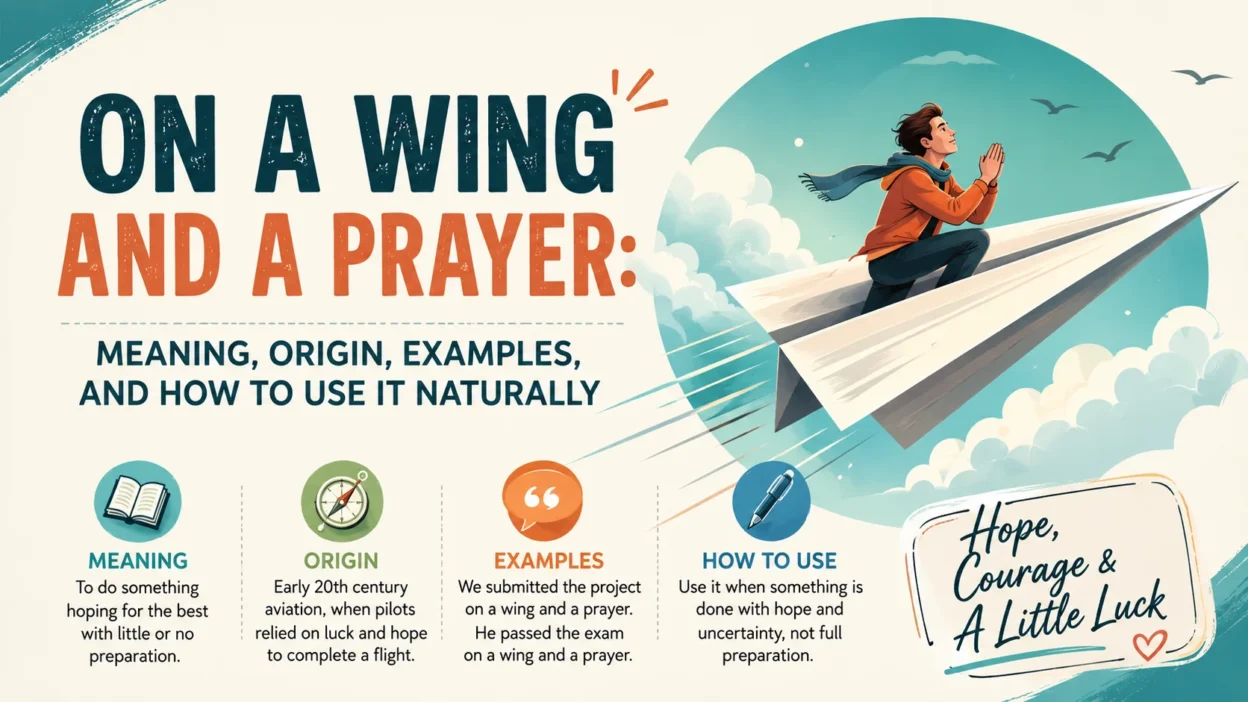
At its simplest, on a wing and a prayer means doing something with very little support, preparation, or chance of success. It often carries the idea that the person involved is relying on luck, hope, courage, or sheer determination to get through. In other words, the situation is fragile, and the outcome is far from guaranteed.
The phrase is usually informal. That matters because idioms do a lot of social work. They do not just describe facts. They add tone. Here, the tone is usually a mix of anxiety and resilience. A person can sound nervous, resourceful, determined, or all three at once.
The expression is not strictly positive or negative. It depends on context.
- In a crisis, it can sound grim.
- In a success story, it can sound admiring.
- In a casual story, it can sound lightly humorous.
That flexibility is part of why the idiom has lasted so long. It can describe a nearly impossible situation without sounding dry or mechanical.
A Simple Meaning in Plain English
If you want the plainest possible version, it means:
“We barely had enough to make it, but we hoped for the best.”
That small sentence captures the emotional center of the idiom. It is about hope under pressure, not confidence. It is about making do, not perfect planning. It also describes a result that feels almost miraculous because the odds were not in your favor.
What the Idiom Suggests
The phrase usually suggests three things:
- Risk: The situation is unstable.
- Hope: People still believe success is possible.
- Improvisation: Someone is patching things together as they go.
That combination gives the idiom its punch. People do not use it to describe a routine task. Instead, they use it when they are hanging on by their fingertips.
The Origin of “On a Wing and a Prayer”
The idiom’s modern popularity traces back to World War II and the 1943 song “Comin’ in on a Wing and a Prayer.” The song described a damaged bomber trying to return home after a mission. That powerful image helped establish the phrase in everyday English. Some historians also point to an earlier wartime film line, suggesting the expression may have existed before the song made it widely known.
That historical background matters. The phrase did not come from a casual conversation. It emerged during a period when people regularly faced danger and uncertainty. A damaged aircraft struggling to make it home became a symbol of courage, perseverance, and hope.
The Wartime Image Behind the Phrase
The song’s central image combines two forms of support:
- The wing represents physical weakness or damage.
- The prayer represents hope, faith, and emotional strength.
Together, they create a memorable picture of survival when practical resources are nearly gone.
Why the Phrase Lasted
Many idioms disappear because they become outdated. This one survived because the experience behind it remains timeless. People still face situations where they are underprepared, underfunded, or overwhelmed. While circumstances change, the feeling remains the same, which explains why the phrase still resonates today.
A Note on the Origin
There is one important detail to remember. Experts do not completely agree on the phrase’s earliest appearance. While the 1943 song popularized it, some evidence suggests it appeared in a 1942 film. Regardless of its exact first use, the expression became firmly associated with World War II and has remained part of the English language ever since.
When to Use “On a Wing and a Prayer”
This idiom works best when someone is trying to succeed with very limited support. It is especially useful when success depends more on hope, luck, or determination than careful preparation.
Some common situations include:
- A startup launches with almost no funding.
- A student finishes an assignment after staying up all night.
- A traveler barely catches a connecting flight.
- A small team completes a project despite major setbacks.
- A family repairs an old car just enough to get home.
In every example, the central idea remains the same: the person keeps moving forward despite difficult circumstances.
When It Sounds Right
The phrase works especially well when you want to emphasize both danger and hope.
For example:
- “We launched the website on a wing and a prayer.”
- “The rescue team worked on a wing and a prayer until help arrived.”
- “The small business survived the winter on a wing and a prayer.”
These examples work because they communicate pressure without requiring a lengthy explanation.
When to Avoid It
The idiom sounds unnatural when the situation is well planned and fully supported. If someone has plenty of time, money, and resources, saying they succeeded on a wing and a prayer exaggerates the situation.
Likewise, highly formal documents often benefit from more direct language such as “under-resourced” or “with limited preparation.”
Examples of “On a Wing and a Prayer” in Sentences
Everyday Conversation
- “I went into the interview on a wing and a prayer because I barely prepared.”
- “Their vacation plans stayed together on a wing and a prayer after the hotel canceled.”
- “We finished the project on a wing and a prayer, but somehow it worked.”
Workplace Examples
- “The department ran on a wing and a prayer after two employees resigned.”
- “We pitched the client on a wing and a prayer, and they accepted.”
- “The product launch happened on a wing and a prayer because testing wasn’t complete.”
Business Examples
- “The startup survived its first year on a wing and a prayer.”
- “The company’s expansion moved forward on a wing and a prayer after investors backed out.”
- “They kept the business alive on a wing and a prayer until sales recovered.”
Academic Examples
- “He passed the class on a wing and a prayer after missing several lectures.”
- “The student submitted the assignment on a wing and a prayer just before the deadline.”
- “Her thesis defense happened on a wing and a prayer after the presentation software failed.”
Travel and Everyday Life
- “We reached the airport on a wing and a prayer after sitting in traffic.”
- “The old truck got us home on a wing and a prayer.”
- “The weekend trip happened on a wing and a prayer because every plan changed.”
Sports Examples
- “The team finished the season on a wing and a prayer after multiple injuries.”
- “They won the championship on a wing and a prayer.”
- “The goalkeeper kept the team alive on a wing and a prayer.”
Real-Life Scenarios Where the Idiom Fits Best
The idiom is strongest when the stakes are real. It is not simply about poor preparation. It describes moving forward despite uncertainty because there is no better option.
A Useful Way to Think About It
Imagine crossing a bridge that is only partly finished. You know it is risky, but turning back is not an option. That image captures the emotional meaning of on a wing and a prayer.
Case Study: A Startup Launch
A three-person startup has just enough money to launch its app. The developers work late into the night fixing bugs while the founders debate whether to delay the release. They decide to launch anyway because waiting could cost them valuable customers.
People could accurately describe that launch as happening on a wing and a prayer because success depended more on determination than ideal conditions.
Case Study: A Family Vacation
A family experiences flight delays, loses a hotel reservation, and struggles to find transportation. Despite every obstacle, they eventually reach their destination just in time for an important wedding.
Friends might later say they arrived on a wing and a prayer, highlighting both the uncertainty and the perseverance involved.
What the Idiom Really Suggests
The expression means more than simply “barely.”
It Suggests Uncertainty
The outcome is unclear, and success is far from guaranteed.
It Suggests Improvisation
People solve problems as they appear because there is no perfect plan.
It Suggests Hope Under Pressure
Despite the challenges, people continue believing things will work out.
That combination makes the idiom powerful. It captures determination without ignoring the risks.
Similar Idioms and Expressions
| Idiom | Core Meaning | Best Used When |
| On a wing and a prayer | Succeeding with little support or preparation | Emphasizing hope and uncertainty |
| By the skin of your teeth | Barely succeeding | Highlighting a narrow escape |
| Against all odds | Succeeding despite extreme difficulty | Celebrating an unlikely victory |
| Hanging by a thread | Being in serious danger | Describing instability |
| A leap of faith | Acting without certainty | Stressing trust rather than preparation |
How They Differ
- On a wing and a prayer focuses on surviving with limited resources.
- Against all odds emphasizes an unlikely victory.
- By the skin of your teeth highlights a very narrow success.
- Hanging by a thread focuses on danger.
- A leap of faith emphasizes trust and belief.
Opposite Expressions
Several expressions communicate the opposite idea:
- Leave nothing to chance
- Well prepared
- A sure thing
- Fully funded
- According to plan
These phrases suggest confidence, preparation, and control rather than uncertainty.
Common Mistakes People Make
Using It Without Real Risk
If a project is carefully planned and well funded, using this idiom feels exaggerated.
Confusing It with General Hope
The phrase means more than simply hoping for success. It specifically suggests limited preparation or resources.
Assuming It Is Always Religious
Although the word prayer has religious roots, modern speakers usually use the idiom figuratively.
Using It in Very Formal Writing
Business reports, legal documents, and academic papers often benefit from more direct wording.
“On a Wing and a Prayer” in Modern English
The idiom remains common because the situations it describes still exist. Businesses operate on tight budgets, students race to meet deadlines, and travelers overcome unexpected problems every day.
Its vivid imagery also helps it survive. A wing suggests movement, while a prayer symbolizes hope. Together, they create a memorable expression that continues to resonate with English speakers.
Tips for Using the Idiom Effectively
- Use it when success feels uncertain.
- Pair it with situations involving limited resources.
- Include concrete details to strengthen the image.
- Avoid using it when everything is going according to plan.
- Keep the tone conversational rather than overly formal.
For example:
“The team pushed the proposal through on a wing and a prayer, with almost no time and even less sleep.”
Conclusion
“On a Wing and a Prayer” is a vivid idiom that captures moments of uncertainty, risk, and hope when success is far from guaranteed. It reflects situations where people continue moving forward despite limited resources, fragile conditions, or uncertain outcomes. Rooted in wartime aviation imagery, the phrase has evolved into a widely used expression in everyday language, symbolising resilience and belief in pushing through even when chances are slim. Its lasting power comes from its strong visual metaphor and emotional depth, making it easy to understand, remember, and apply in both personal and professional contexts.
FAQs
Q1. What does “On a Wing and a Prayer” mean?
It means doing something with hope and faith in a situation where success is uncertain or unlikely.
Q2. Where did the phrase come from?
It is commonly linked to wartime aviation, especially damaged aircraft trying to return safely during World War-era flights.
Q3. When do people use this idiom today?
It is used when someone continues an effort with limited support, resources, or confidence, but still hopes for success.
Q4. Is it used only in aviation contexts?
No, today it is used in many areas like business, personal struggles, and everyday challenges, not just flying.
Q5. Why is this phrase so popular?
Because it creates a strong visual image and emotional sense of persistence, struggle, and hope in difficult situations.