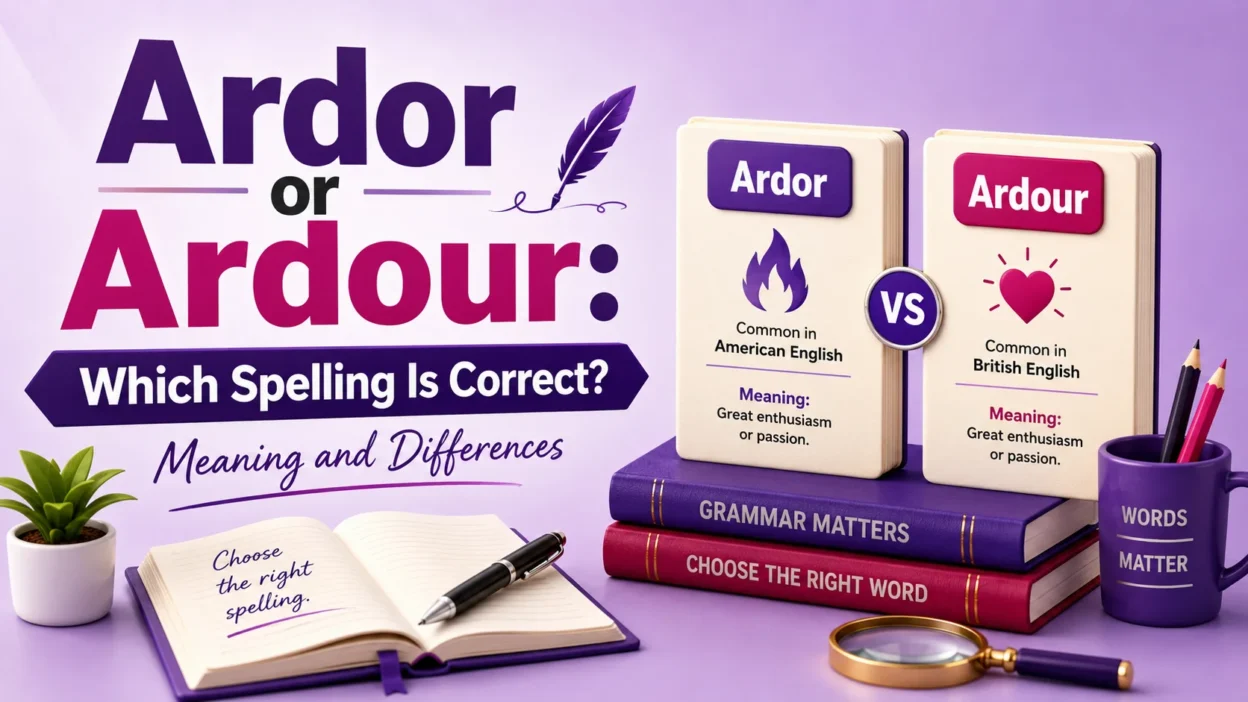
If Ardor or Ardour ever makes you stop while writing, the answer is simple: both spellings are correct, but each belongs to a different variety of English. In American English, ardor is the preferred spelling, while British English uses ardour as the standard form. They share the same pronunciation, definition, history, and meaning, so the only real difference is the audience you are writing for. I learned early in my editing work that choosing one spelling and using it consistently makes writing look more natural, polished, and professional.
The term comes from the Latin verb “ardere,” meaning “to burn,” which explains why it represents passion, strong passion, intense passion, enthusiasm, strong enthusiasm, and a powerful burning desire. As a noun, it describes a state of emotion, intense emotion, or lasting dedication toward a person, goal, or activity. Whether someone has ardor for music, social justice, or a challenging project, the word expresses sincere commitment and energetic feeling. That connection between fire and emotion also makes the word easier to remember.
Using the correct spelling depends on your context, audience, and regional English. Readers in the United States naturally expect ardor, while those in the United Kingdom and many Commonwealth countries are more familiar with ardour. Good usage, careful grammar, and consistent spelling patterns help your communication stay clear and your writing remain professional. Instead of worrying about which form is “right,” focus on matching the spelling to your readers. Once you understand that simple rule, you’ll avoid common spelling mistakes and write with greater confidence every time.
Ardor or Ardour: Which Spelling Is Correct?
The short answer is easy.
Both “ardor” and “ardour” are correct English words. Neither spelling is more accurate than the other. The choice depends entirely on the type of English you’re using.
Think of this spelling pair the same way you think about color and colour or honor and honour. The words share the same meaning, but different English-speaking countries prefer different spellings.
Here’s a quick comparison.
| Feature | Ardor | Ardour |
| Correct spelling | ✅ Yes | ✅ Yes |
| Meaning | Passion, enthusiasm, intense feeling | Passion, enthusiasm, intense feeling |
| Pronunciation | Same | Same |
| Preferred in American English | ✅ Yes | Rare |
| Preferred in British English | Rare | ✅ Yes |
| Accepted in formal writing | ✅ Yes | ✅ Yes |
The most important rule is consistency. If you begin writing with ardor, continue using ardor throughout your article. Likewise, if you choose ardour, avoid switching back and forth.
Professional editors often notice inconsistent spelling before they notice grammar mistakes. Maintaining one spelling style throughout your work creates a smoother reading experience.
Both Spellings Are Correct
Many English learners believe one spelling must be outdated or incorrect because dictionaries often display one version first. In reality, reputable dictionaries recognize both spellings as standard English.
American dictionaries typically list ardor as the primary spelling because it follows American conventions.
British dictionaries usually list ardour first because it reflects traditional British spelling.
International dictionaries often include both versions, clearly noting the regional preference for each.
That means you don’t need to worry about choosing the “wrong” word. Instead, focus on choosing the spelling that matches your audience.
The Difference Comes Down to Regional English
Regional spelling differences appear throughout English.
Over time, English evolved differently in the United States and the United Kingdom. While pronunciation often stayed the same, spelling gradually changed.
American English simplified many words by removing silent letters that no longer affected pronunciation. British English retained many traditional spellings that reflected French and historical influences.
As a result, readers naturally expect different spellings depending on where they live.
For example:
| American English | British English |
| Color | Colour |
| Honor | Honour |
| Labor | Labour |
| Favor | Favour |
| Humor | Humour |
| Ardor | Ardour |
These aren’t different words. They’re simply regional spellings of the same vocabulary.
Which Spelling Should You Choose?
The easiest way to decide is to think about your readers.
Choose ardor when writing for:
- American readers
- U.S. businesses
- American universities
- U.S. newspapers
- American blogs
- Content targeting U.S. search traffic
Choose ardour when writing for:
- United Kingdom readers
- Australia
- New Zealand
- Ireland
- South Africa
- Many Canadian publishers
If your audience includes readers from several countries, choose one spelling style and stay consistent from beginning to end.
Consistency builds trust with readers and demonstrates careful editing.
What Does Ardor or Ardour Mean?
Understanding the spelling difference is only half the story. To use the word confidently, you also need to understand what it actually means.
Both ardor and ardour describe strong emotion, enthusiasm, or passion. The word often suggests energy, commitment, warmth, and wholehearted dedication toward a person, idea, cause, or activity.
Unlike ordinary excitement, ardor usually implies a deeper emotional connection. It describes feelings that are sincere, powerful, and long-lasting rather than temporary bursts of enthusiasm.
You’ll often see the word used in literature, speeches, biographies, history books, academic writing, and journalism because it conveys emotion with elegance and precision.
Clear Definition in Plain English
In simple terms, ardor means great passion or enthusiasm.
It can describe someone’s emotional intensity, energetic commitment, or deep affection.
Dictionary definitions commonly include ideas such as:
- Intense passion
- Great enthusiasm
- Strong devotion
- Warm affection
- Energetic commitment
- Zealous interest
Here’s a simple comparison.
| Everyday Expression | Using Ardor |
| She loves painting. | She pursues painting with remarkable ardor. |
| He enjoys science. | He studies science with great ardor. |
| They support the cause. | They support the cause with unwavering ardor. |
Notice how ardor makes each sentence sound richer without changing its meaning.
Emotional Meaning and Common Connotations
The word often carries emotional warmth.
It suggests someone isn’t merely interested. They’re deeply invested.
Depending on the situation, ardor may describe:
- Romantic love
- Religious devotion
- National pride
- Intellectual curiosity
- Artistic inspiration
- Career ambition
- Competitive spirit
- Personal dedication
Because of these emotional associations, writers frequently choose ardor instead of simpler words like interest or enthusiasm.
Consider the difference.
Simple sentence
The athlete trained hard.
More expressive sentence
The athlete trained with extraordinary ardor, refusing to let setbacks slow progress.
The second sentence creates a stronger mental image and reveals the athlete’s emotional commitment.
Synonyms and Closely Related Words
English offers many words with similar meanings, but each carries a slightly different nuance.
| Word | Meaning | Typical Use |
| Passion | Deep emotional feeling | General situations |
| Enthusiasm | Excited interest | Everyday conversation |
| Zeal | Energetic dedication | Professional or religious contexts |
| Fervor | Intense emotion | Formal writing |
| Devotion | Loyal commitment | Relationships or beliefs |
| Dedication | Persistent effort | Work or study |
| Commitment | Strong responsibility | Professional settings |
| Ardor | Passion with emotional warmth | Literary and formal writing |
Although these words overlap, ardor often sounds more expressive and elegant than everyday alternatives.
Antonyms and Opposite Ideas
Understanding opposite meanings helps clarify the word even further.
Common antonyms include:
- Apathy
- Indifference
- Coldness
- Disinterest
- Detachment
- Unconcern
- Passivity
- Indifference
Compare these examples.
With ardor
The volunteers rebuilt the community with incredible ardor after the disaster.
Without ardor
The committee showed little interest and completed the project with obvious indifference.
The emotional difference is immediately clear.
Ardor vs. Ardour: What’s the Difference?
This is the question most readers ask.
Surprisingly, the answer is much simpler than many grammar debates.
There is no difference in meaning between ardor and ardour.
Both words refer to intense enthusiasm, passion, affection, or dedication. They belong to the same part of speech, share the same pronunciation, and originate from the same historical word.
The only difference is spelling preference based on regional English.
Meaning Comparison
Whether you write ardor or ardour, your readers understand exactly the same idea.
Both spellings express:
- Strong passion
- Great enthusiasm
- Emotional warmth
- Sincere dedication
- Energetic commitment
- Deep affection
For example:
Her ardor for teaching inspired every student.
This sentence means exactly the same as:
Her ardour for teaching inspired every student.
Nothing changes except the regional spelling.
Spelling Difference Explained
The spelling difference follows a familiar English pattern.
American English prefers the ending -or.
British English prefers -our.
You already know dozens of words that follow the same rule.
| American English | British English |
| Color | Colour |
| Honor | Honour |
| Favor | Favour |
| Humor | Humour |
| Neighbor | Neighbour |
| Ardor | Ardour |
Once you recognize this pattern, remembering ardor versus ardour becomes much easier.
Pronunciation: Do They Sound the Same?
Yes.
Both words are pronounced exactly the same.
Pronunciation: AR-der
The silent “u” in ardour has no effect on pronunciation.
This explains why many English learners become confused after hearing the word spoken before seeing it written. Without visual context, there’s no way to know which spelling someone intends.
Side-by-Side Comparison Table
| Feature | Ardor | Ardour |
| Meaning | Passion, enthusiasm | Passion, enthusiasm |
| Pronunciation | Same | Same |
| Part of Speech | Noun | Noun |
| Origin | Latin | Latin |
| American English | Preferred | Less common |
| British English | Less common | Preferred |
| Formal Writing | Yes | Yes |
| Informal Writing | Yes | Yes |
| Correct English | ✅ Yes | ✅ Yes |
Ardor in American English
If your audience is in the United States, ardor is almost always the preferred spelling. You’ll find it in American newspapers, university textbooks, novels, business documents, government publications, and online articles.
The spelling fits naturally with other American English conventions that remove the silent u from words ending in -our. As a result, American readers instantly recognize ardor as the familiar and expected form.
Using ardour in American writing isn’t technically incorrect. However, it may stand out as foreign or inconsistent unless the publication intentionally follows British English. Professional writers, editors, and marketers generally match their spelling to their audience because doing so creates a smoother reading experience and strengthens credibility.
Ardour in British English
If you’re writing for readers in the United Kingdom, ardour is the preferred spelling. British English has preserved the traditional -our ending in many words, including colour, honour, favour, labour, and ardour.
You’ll regularly see ardour in British newspapers, novels, academic journals, government publications, and educational materials. Readers in the UK recognize this spelling immediately because it follows the conventions taught in schools and used by major publishers.
Many Commonwealth countries also favor ardour, although some regions, particularly Canada, may accept both spellings depending on the publication’s style guide.
Why British English Uses “Ardour”
British spelling preserves many historical forms that entered English through Old French and Middle French after the Norman Conquest.
The ending -our reflects this linguistic heritage. While pronunciation gradually changed over the centuries, British spelling retained many traditional letter combinations.
As a result, ardour became the standard spelling throughout Britain long before American English developed its own spelling conventions.
Today, British publishers continue using ardour because consistency matters. Readers expect familiar spellings, and changing them would create unnecessary confusion.
Usage Across the UK and Commonwealth Countries
Although British English serves as the foundation, several countries also prefer ardour, including:
- United Kingdom
- Australia
- New Zealand
- Ireland
- South Africa
- Many Canadian publishers
Canadian English deserves special attention. Canadian writers often blend American and British spelling conventions. One publication may use colour and ardour, while another follows American spelling throughout.
The safest approach is to follow the publication’s editorial style guide.
Examples from British Publications
Here are a few examples that reflect natural British usage.
- The young scientist pursued her research with remarkable ardour.
- Fans cheered with patriotic ardour throughout the championship.
- His ardour for classical music inspired generations of students.
- The volunteers worked with renewed ardour after receiving community support.
Notice that the meaning never changes. Only the spelling reflects regional preference.
Why English Has Two Spellings
Many people wonder why English allows two spellings for the same word.
The answer lies in the language’s long and complex history. English borrowed vocabulary from Latin, French, Germanic languages, Greek, and many others. As these influences blended together, spelling evolved differently on opposite sides of the Atlantic.
The story of ardor and ardour illustrates how language changes without altering meaning.
Latin Origins of the Word
The word ultimately comes from the Latin noun ardor, meaning flame, burning heat, or passionate emotion.
It developed from the Latin verb ardere, which means to burn.
Originally, the word described literal fire or intense heat. Over time, writers began using it figuratively to represent emotional intensity.
That metaphor still shapes modern English.
When someone speaks with ardor, they aren’t physically burning. Instead, their passion burns brightly, much like a flame.
This connection between fire and emotion appears in many languages.
For example:
- Burning desire
- Fiery determination
- Passion ignites action
- A spark of inspiration
These expressions share the same metaphorical foundation.
The French Influence on English Spelling
After the Norman Conquest in 1066, French became the language of government, law, and the educated classes in England.
Thousands of French words entered English during the following centuries.
Many retained spellings that later became standard British English.
Examples include:
| French Influence | Modern British English |
| Colour | Colour |
| Honour | Honour |
| Favour | Favour |
| Labour | Labour |
| Ardour | Ardour |
Although pronunciation continued evolving, spelling remained remarkably conservative.
That’s why many British spellings preserve silent letters that no longer affect pronunciation.
Noah Webster and American Spelling Reform
One person played a major role in shaping American spelling.
Noah Webster, the famous American lexicographer, believed English spelling should be simpler, more logical, and easier to learn.
During the early nineteenth century, Webster promoted several spelling reforms.
Some of his most successful changes included:
| Traditional Form | American Form |
| Colour | Color |
| Honour | Honor |
| Labour | Labor |
| Favourite | Favorite |
| Ardour | Ardor |
Not every proposed reform succeeded, but many became standard American English.
Today, millions of people use these spellings without realizing they originated from Webster’s efforts.
Why Both Forms Remain Standard Today
Unlike many spelling differences that eventually disappear, ardor and ardour continue to coexist because each serves a different audience.
Global communication has actually strengthened both spellings.
American publishers continue using ardor.
British publishers continue using ardour.
International companies simply choose one version based on their target market.
Rather than competing with each other, the two spellings exist side by side.
When Should You Use Ardor or Ardour?
Knowing both spellings are correct is helpful.
Knowing when to use each one is even more valuable.
The best choice depends on your readers, your publication, and your writing goals.
Academic Writing
Universities usually expect students to follow one spelling system consistently.
If you’re studying at an American university, use ardor unless your instructor requests British English.
If you’re enrolled at a British university, choose ardour throughout your paper.
Mixing both spellings in the same assignment can create an impression of careless editing.
Creative Writing and Fiction
Creative writers enjoy greater flexibility.
If your novel takes place in New York, ardor fits naturally.
If your story unfolds in London, ardour may better match the setting and dialogue.
Historical fiction should also reflect the language conventions appropriate for its audience.
Consistency helps maintain immersion.
Business and Professional Communication
Businesses should always match the language of their customers.
For example:
- An American software company should write ardor.
- A British consulting firm should write ardour.
- A multinational company should establish a corporate style guide.
Consistent branding creates professionalism and strengthens credibility.
Website Content and Blogging
Bloggers and SEO writers often ask which spelling performs better.
The answer depends entirely on search intent.
If your website targets American traffic, optimize for ardor.
If your visitors primarily come from the United Kingdom, optimize for ardour.
Changing spellings simply to include more keywords usually reduces readability.
Search engines value natural language and consistent writing.
International Audiences and Brand Style Guides
Large organizations often serve readers across multiple countries.
Instead of switching spellings from page to page, they establish a style guide.
A style guide defines:
- Preferred spelling
- Grammar rules
- Capitalization
- Tone of voice
- Formatting standards
This ensures every article reflects the same editorial standards regardless of who writes it.
Ardor vs. Ardour in Popular Style Guides
Professional editors rarely choose spellings randomly.
Most publications follow established editorial style guides that define acceptable language for specific audiences.
Understanding these guides helps writers produce cleaner, more consistent content.
AP Style
The Associated Press Stylebook (AP Style) dominates American journalism.
Because AP Style follows American English conventions, it favors ardor.
Newspapers, news websites, and media organizations across the United States generally use this spelling.
Chicago Manual of Style
The Chicago Manual of Style also follows American spelling unless a publication specifies otherwise.
Books, academic publishers, and many nonfiction authors therefore write ardor.
Chicago emphasizes consistency above all else.
Oxford Style and British Publishing
British publishers commonly follow Oxford, Cambridge, or other UK editorial standards.
These style guides naturally recommend ardour because they follow British spelling conventions.
Readers expect those spellings throughout books, newspapers, and academic journals.
Why Style Guides Prioritize Consistency
Imagine reading an article that contains these spellings:
- Ardor
- Colour
- Honor
- Labour
The mix immediately feels inconsistent.
Now compare it with either of these systems.
American English
- Ardor
- Color
- Honor
- Labor
British English
- Ardour
- Colour
- Honour
- Labour
Each version feels polished because every spelling follows the same convention.
Consistency makes writing appear more professional than constantly switching between regional forms.
Examples of Ardor and Ardour in Sentences
The easiest way to understand these words is to see them used naturally.
Everyday Conversation
American English:
- She spoke with genuine ardor about protecting wildlife.
- His ardor for cooking inspired everyone around him.
- The children approached the science fair with incredible ardor.
British English:
- She spoke with genuine ardour about protecting wildlife.
- His ardour for cooking inspired everyone around him.
- The children approached the science fair with incredible ardour.
Literature and Storytelling
Writers often choose ardor because it conveys emotional depth.
Examples include:
- The knight defended his kingdom with fearless ardor.
- Her artistic ardor transformed every canvas into something unforgettable.
- His youthful ardor gradually matured into steady determination.
The word adds richness without becoming overly dramatic.
Professional and Academic Contexts
Formal writing also benefits from precise vocabulary.
Examples include:
- The research team pursued the project with remarkable ardor.
- The professor admired the student’s intellectual ardor.
- The organization renewed its environmental efforts with fresh ardor.
These examples show that the word fits comfortably in professional contexts as well as literary ones.
Formal vs. Informal Examples
| Informal | More Formal |
| She loves teaching. | She teaches with exceptional ardor. |
| They worked really hard. | They worked with unwavering ardor. |
| He enjoys history. | His ardor for history shaped his career. |
| The fans were excited. | The crowd celebrated with patriotic ardor. |
Replacing everyday expressions with ardor creates a stronger emotional impact while preserving clarity.
Common Collocations With Ardor and Ardour
Certain words naturally appear alongside ardor and ardour. These combinations, known as collocations, make your writing sound more fluent and natural. Native English speakers use these phrases frequently in literature, journalism, academic writing, and speeches.
Learning common collocations also helps you use the word with confidence instead of forcing it into awkward sentences.
Burning Ardor
The phrase burning ardor emphasizes overwhelming passion or enthusiasm. It draws on the word’s original connection to fire and heat.
Examples:
- She defended human rights with burning ardor throughout her career.
- His burning ardor for scientific discovery never faded.
Religious Ardor
This collocation describes deep spiritual commitment or devotion.
Examples:
- The pilgrims worshipped with sincere religious ardor.
- Her religious ardor inspired those around her.
Patriotic Ardor
Writers often use patriotic ardor when discussing national pride, military history, or public celebrations.
Examples:
- The speech filled the audience with patriotic ardor.
- Citizens celebrated Independence Day with renewed patriotic ardor.
Romantic Ardor
In literature, romantic ardor expresses deep affection or passionate love.
Examples:
- His romantic ardor appeared in every letter he wrote.
- The novel captures the excitement of youthful romantic ardor.
Revolutionary Ardor
Historical writing frequently combines ardor with political movements.
Examples:
- The young leaders approached reform with revolutionary ardor.
- Their revolutionary ardor changed the course of history.
Youthful Ardor
This phrase highlights the enthusiasm, optimism, and ambition often associated with youth.
Examples:
- Her youthful ardor impressed every mentor she met.
- Time softened his youthful ardor into quiet confidence.
Common Mistakes People Make
Although ardor and ardour are simple once you understand regional spelling, writers still make several common mistakes.
Avoiding these errors will improve both readability and professionalism.
Mixing American and British Spellings
The most common mistake is switching between regional spelling systems.
For example:
❌ Incorrect
His ardor for science reflected the colour of his imagination.
This sentence mixes American and British spelling.
Choose one system instead.
American English
His ardor for science reflected the color of his imagination.
British English
His ardour for science reflected the colour of his imagination.
Consistency is far more important than the spelling you choose.
Assuming They Have Different Meanings
Many learners believe ardor and ardour describe different emotions.
They don’t.
Both words mean:
- Passion
- Enthusiasm
- Intense feeling
- Emotional warmth
- Strong dedication
The spelling changes.
The meaning does not.
Using the Wrong Spelling for the Audience
Imagine publishing a website aimed entirely at American readers while using ardour throughout every page.
Readers would still understand the content, but the spelling might seem unfamiliar.
Likewise, British readers naturally expect ardour.
Matching your audience creates a smoother reading experience.
Confusing Ardor With Similar Emotional Words
Although related, these words are not perfect substitutes.
| Word | Primary Meaning |
| Ardor | Passion with emotional warmth |
| Zeal | Energetic dedication |
| Enthusiasm | Excitement and interest |
| Passion | Strong emotion or love |
| Fervor | Intense feeling, often formal |
Choosing the most precise word strengthens your writing.
Ardor Compared With Similar Words
English contains many words that express strong emotion, but each one carries its own shade of meaning.
Understanding these differences helps you choose the best word for every situation.
Ardor vs. Passion
Both words describe intense feeling.
However, passion is broader.
It can refer to love, hobbies, careers, beliefs, or emotions in general.
Ardor usually emphasizes energetic enthusiasm or emotional intensity.
Example
- She has a passion for music.
- She performs with remarkable ardor.
The first describes interest.
The second highlights emotional energy.
Ardor vs. Enthusiasm
Enthusiasm is common in everyday conversation.
Ardor sounds slightly more literary and expressive.
Compare these examples.
- The students showed enthusiasm during class.
- The students approached every lesson with intellectual ardor.
The second sentence creates a stronger emotional image.
Ardor vs. Zeal
Both words imply dedication.
However, zeal often focuses on determined effort or commitment.
Ardor emphasizes emotional warmth.
Examples:
- The lawyer defended the case with zeal.
- The artist painted with creative ardor.
Ardor vs. Fervor or Fervour
These words are very close in meaning.
Both describe intense emotion.
Fervor often appears in religious, political, or patriotic contexts.
Ardor frequently appears in literature, romance, and personal dedication.
Neither word is inherently better.
Context determines the strongest choice.
Which Word Best Fits Your Context?
Use this guide when choosing between similar words.
| Situation | Best Choice |
| Romantic writing | Ardor |
| General excitement | Enthusiasm |
| Strong dedication | Zeal |
| Emotional intensity | Passion |
| Formal speeches | Fervor |
| Literary description | Ardor |
Real Examples From Books, Newspapers, and Modern English
One reason ardor remains popular is its flexibility.
You’ll find it in novels, biographies, editorials, academic journals, and speeches.
Although it isn’t an everyday conversational word, it continues to enrich formal and expressive writing.
Literary Examples
Novelists often use ardor to portray emotion without sounding repetitive.
Examples include descriptions of:
- Young love
- Heroic determination
- Artistic inspiration
- National pride
- Personal ambition
Because the word carries emotional depth, it helps readers visualize a character’s motivation.
Newspaper and Magazine Usage
Journalists occasionally use ardor when reporting on politics, sports, or public events.
Typical examples include:
- Campaign speeches delivered with ardor
- Fans cheering with patriotic ardor
- Volunteers working with renewed ardor
The word adds color without sacrificing clarity.
Academic Publications
Researchers and historians frequently use ardor when discussing:
- Political movements
- Religious history
- Social reform
- Cultural change
Its formal tone fits naturally within scholarly writing.
Digital Content and Online Writing
Modern blogs increasingly use ardor because it conveys emotion while remaining concise.
Writers discussing motivation, leadership, education, or creativity often prefer ardor over repetitive words like passion.
Case Study: Choosing the Right Spelling for an International Blog
Consider a travel company launching two English-language websites.
The first targets visitors from the United States.
The second serves readers in the United Kingdom.
At first, both sites mixed spellings throughout their articles.
For example:
- Ardor
- Colour
- Honor
- Labour
Editors noticed inconsistent language across the website.
They decided to separate the content.
The American site adopted:
- Color
- Honor
- Labor
- Ardor
The British site adopted:
- Colour
- Honour
- Labour
- Ardour
The result was simple but effective.
Readers experienced smoother, more natural content because every page followed familiar regional conventions.
Lesson: Consistency builds credibility.
How Search Engines and SEO Treat Ardor and Ardour
Many writers wonder whether Google prefers one spelling over the other.
The answer depends on search intent.
Search engines recognize regional spelling differences and generally understand that ardor and ardour represent the same concept.
However, optimizing for your audience still matters.
Search Intent Differences
Someone searching from the United States is more likely to type:
- Ardor meaning
- Ardor definition
- Ardor pronunciation
Someone searching from the United Kingdom may search for:
- Ardour meaning
- Ardour definition
- Ardour pronunciation
Understanding your audience helps you select the most relevant primary keyword.
Choosing the Right Keyword for Your Audience
A simple strategy works best.
Make ardor your main keyword if your audience is American.
Optimize for ardour if your target audience is British.
Naturally offer both spellings while maintaining article consistency if you cater to a global readership.
Should You Include Both Spellings?
Yes—but thoughtfully.
A comparison article like this one benefits from mentioning both spellings because readers actively search for the difference.
Outside comparison articles, use one spelling consistently.
Avoid alternating spellings simply to increase keyword density.
Natural writing always performs better.
Quick Reference Table: Ardor vs. Ardour
| Feature | Ardor | Ardour |
| Correct English | ✅ Yes | ✅ Yes |
| Meaning | Passion, enthusiasm | Passion, enthusiasm |
| Pronunciation | Same | Same |
| Part of Speech | Noun | Noun |
| Preferred Region | United States | United Kingdom, Australia, New Zealand, Ireland |
| Formal Writing | Yes | Yes |
| Informal Writing | Yes | Yes |
| Dictionary Accepted | Yes | Yes |
| Same Meaning | ✅ Yes | ✅ Yes |
Easy Memory Trick to Remember the Difference
You don’t need to memorize complicated grammar rules.
A simple association works every time.
Think “OR” for America
Remember that ardOR ends with OR.
Think:
- OR = America
The spelling matches other American words such as:
- Color
- Honor
- Labor
Think “OUR” for Britain
Now look at ardOUR.
Think:
- OUR = United Kingdom
It follows the same British spelling pattern as:
- Colour
- Honour
- Labour
- Favourite
A Simple Rule You’ll Remember
If you can remember color vs. colour, you can remember ardor vs. ardour.
The pattern never changes.
Expert Insight
“Consistency is one of the clearest signs of professional writing. Readers rarely notice consistent spelling, but they quickly notice inconsistent spelling.”
This principle applies whether you’re writing a novel, a business proposal, a research paper, or an online article.
Choosing one spelling system and following it throughout your work makes your writing look polished and trustworthy.
Conclusion
Choosing between Ardor and Ardour is much easier once you understand that the difference is based on regional spelling rather than meaning. Ardor is the preferred spelling in American English, while Ardour is the standard form in British English and many Commonwealth countries. Both words describe the same idea of strong passion, enthusiasm, or deep emotional commitment. By matching your spelling to your audience and staying consistent throughout your writing, you can communicate more clearly and present polished, professional content.
FAQs
Q1. Is Ardor or Ardour correct?
Both are correct. Ardor is used in American English, while Ardour is the preferred spelling in British English.
Q2. Do Ardor and Ardour have different meanings?
No. Both words have the same meaning, pronunciation, and origin. They refer to intense passion, enthusiasm, or strong emotional commitment.
Q3. Where does the word Ardor come from?
The word comes from the Latin verb ardere, meaning “to burn,” which explains its connection with passion and burning desire.
Q4. Can I use Ardor and Ardour in formal writing?
Yes. Both spellings are appropriate in formal writing as long as you use the version that matches your target audience and remain consistent.
Q5. How can I remember which spelling to use?
A simple trick is to remember that Ardor is for American English, while Ardour, with the extra “u,” follows the spelling pattern commonly used in British English. Consistency is the key.