“A” or “An” Before a Number? becomes simple once you follow the first sound, not the written number, making every choice clear and natural. Learning A, An, and the correct article before a number starts with one idea. Every article, article choice, article selection, and article usage follows grammar, English grammar, grammar rules, simple rule, pronunciation rule, and grammar usage. In English, spoken English, and written English, the decision depends on spoken sound, sound, vowel sound, or consonant sound, not the first letter, digit, or number.
Better writing comes from knowing that pronunciation matters more than appearance. A vowel, consonant, vowel letter, number pronunciation, number format, number itself, and the pronunciation-based rule explain why a hundred, an eight, 8-hour shift, one-time payment, 18-month warranty, hundred, eight, eleven, eighteen, 1, 8, and 18 all follow the first sound you hear. These examples, real-world examples, and real-world usage fit naturally into academic writing, business writing, professional writing, email writing, email, emails, important email, business documents, resumes, a tweet, every phrase, and similar phrases you write, say, or use before numbers
Many common mistakes, grammar mistakes, and every common conundrum happen because people focus on what is written instead of what is spoken or pronounced. Always remember what begins, starts, follows, and depends on the opening sound. Keep this guide in mind whenever you use an indefinite article before a singular noun. It helps remove hesitation, doubt, and moments of doubt that leave your pen paused or have you scratching your head over a small fry grammar problem that can make writers trip up.
The Simple Rule: Do You Use “A” or “An” Before a Number?
The rule is surprisingly straightforward.
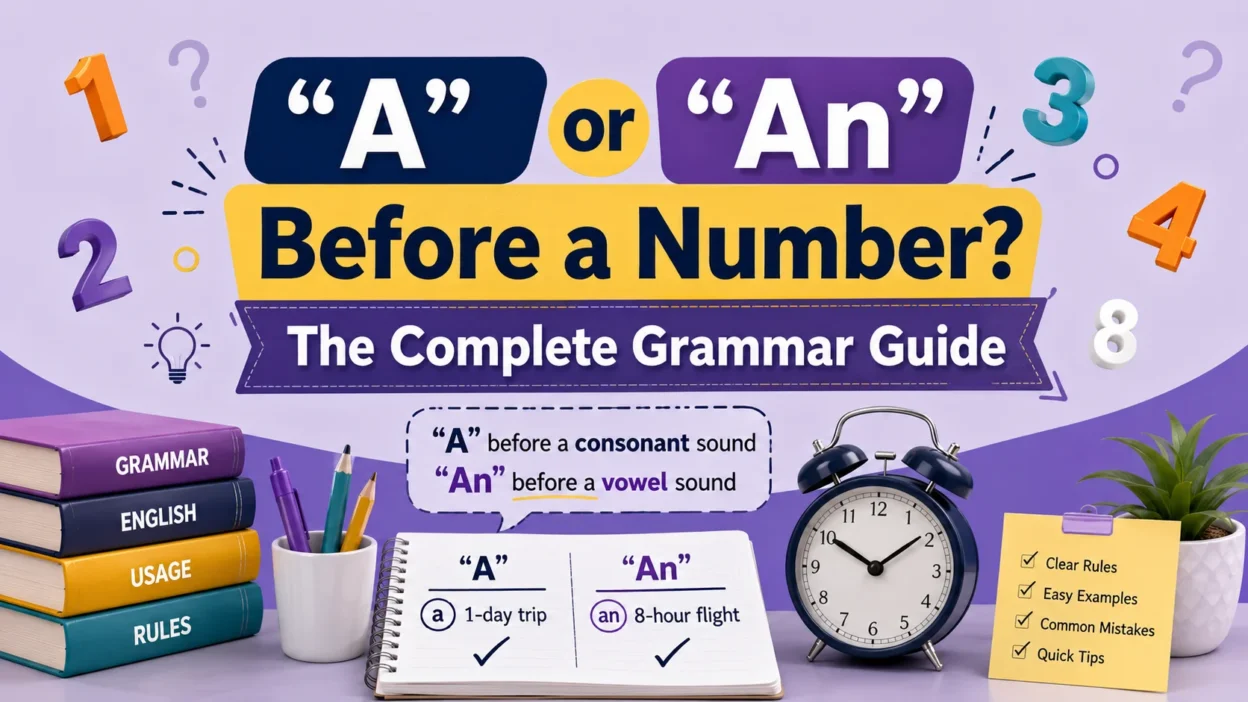
Use “a” before a consonant sound.
Use “an” before a vowel sound.
Notice that the rule refers to sound, not the first letter or digit you see on the page. English articles follow pronunciation rather than spelling.
For example:
| Correct | Why It Is Correct |
| a one-day trip | One begins with a /w/ sound. |
| an 8-hour shift | Eight begins with a vowel sound. |
| an 18-month warranty | Eighteen starts with a vowel sound. |
| a 20-minute meeting | Twenty starts with a /t/ sound. |
| an 11-player team | Eleven begins with a vowel sound. |
A helpful trick is to ignore the written number for a moment. Instead, say it aloud. The first sound you hear tells you whether to use a or an.
A Quick Memory Trick
Ask yourself one question:
What is the first sound I hear when I say the number?
If the sound is a consonant, choose a.
If the sound is a vowel, choose an.
That single habit eliminates almost every mistake.
How Indefinite Articles Work Before Numbers
Before looking at specific numbers, it helps to understand why English uses a and an in the first place.
An indefinite article introduces a singular noun that isn’t specific. It refers to one item among many rather than identifying a particular one.
Consider these examples:
- I bought a book.
- She owns an apartment.
- We scheduled an 8-hour training session.
- He signed a one-year lease.
In each sentence, the article introduces one singular thing. The only difference is the sound that follows the article.
Pronunciation Always Wins
Many grammar rules depend on spelling. This one doesn’t.
Compare these examples.
| Phrase | Pronunciation | Correct Article |
| one-hour project | won-hour | a |
| eight-page report | eight-page | an |
| eleven-day trip | eleven-day | an |
| twenty-mile drive | twenty-mile | a |
Although one begins with the letter O, it sounds like won. Because won starts with the consonant sound /w/, English uses a.
Meanwhile, eight begins with a silent E that produces a vowel sound. Therefore, it takes an.
This pronunciation-first approach also explains why we say:
- a university
- a European vacation
- an umbrella
- an MBA graduate
- a U.S. citizen (when “U” is pronounced you)
The same principle applies to numbers.
Numbers That Take “A”
Most numbers begin with consonant sounds, so they naturally take a.
Here are some of the most common examples.
| Number | Example |
| 1 | a one-year contract |
| 2 | a two-hour drive |
| 3 | a three-bedroom house |
| 4 | a four-page essay |
| 5 | a five-minute break |
| 6 | a six-week course |
| 7 | a seven-day vacation |
| 9 | a nine-mile trail |
| 10 | a ten-dollar bill |
| 12 | a twelve-month subscription |
| 13 | a thirteen-point checklist |
| 14 | a fourteen-day trial |
| 15 | a fifteen-minute presentation |
| 16 | a sixteen-year-old building |
| 17 | a seventeen-game season |
| 19 | a nineteen-year partnership |
| 20 | a twenty-minute interview |
Why Does “One” Use “A”?
This is the question that causes the most confusion.
The word one begins with the letter O, yet English treats it like a word beginning with W.
Listen carefully.
One sounds like won.
The first sound is /w/.
Since /w/ is a consonant sound, the correct article is a.
Examples include:
- a one-time fee
- a one-bedroom apartment
- a one-page summary
- a one-way ticket
- a one-hour delay (Notice that “hour” loses because the article follows “one,” not “hour.”)
This pattern remains the same whether the number appears as a word or a digit.
For example:
- a 1-year warranty
- a one-year warranty
Both are correct because both begin with the spoken word one.
Common Expressions With “One”
You’ll encounter these phrases frequently in everyday English.
| Expression | Example Sentence |
| one-time | We paid a one-time fee. |
| one-year | She accepted a one-year contract. |
| one-page | Please submit a one-page report. |
| one-room | They rented a one-room cabin. |
| one-way | He bought a one-way ticket. |
Even experienced writers occasionally hesitate before these expressions. Remember the pronunciation rule and the decision becomes automatic.
Numbers That Take “An”
Only a handful of commonly used numbers begin with vowel sounds. These require an.
The most common examples are:
- 8
- 11
- 18
- 80
- 800
- 18,000
- Any larger number whose spoken form begins with eight, eleven, eighteen, or eighty
Here are several examples.
| Number | Correct Usage |
| 8 | an 8-hour shift |
| 8 | an 8-inch display |
| 8 | an 8-year-old child |
| 11 | an 11-player team |
| 11 | an 11-hour flight |
| 18 | an 18-month lease |
| 18 | an 18-hole golf course |
| 80 | an 80% success rate |
| 800 | an 800-seat auditorium |
Why Do These Numbers Use “An”?
Each of these numbers starts with a vowel sound when spoken.
Listen to them aloud.
- eight
- eleven
- eighteen
- eighty
Every one begins with an open vowel sound rather than a consonant.
Because English articles respond to pronunciation, the correct choice is always an.
The Silent Letter Effect
English contains many words with silent letters. Numbers are no exception.
Although eight begins with the letter E, the spoken word starts immediately with the long A sound.
That explains these examples:
- an 8-year-old student
- an 8-ounce serving
- an 8-inch tablet
- an 18-month payment plan
- an 11th-hour decision
- an 80-acre farm
Notice how naturally each phrase flows. Using a instead would sound awkward because it interrupts the rhythm of spoken English.
Grammar Tip: If saying an eight-hour shift feels uncomfortable when spoken aloud, your ears are telling you the correct answer. Native speakers often rely on this instinct because English articles developed around pronunciation rather than spelling.
Complete List of Common Numbers and the Correct Article
The following table provides a quick reference for the numbers you are most likely to use in everyday writing.
| Number | Correct Article | Example |
| 1 | a | a one-bedroom apartment |
| 2 | a | a two-hour meeting |
| 3 | a | a three-day workshop |
| 4 | a | a four-page proposal |
| 5 | a | a five-minute break |
| 6 | a | a six-month internship |
| 7 | a | a seven-year warranty |
| 8 | an | an 8-hour shift |
| 9 | a | a nine-mile hike |
| 10 | a | a ten-dollar bill |
| 11 | an | an 11-player team |
| 12 | a | a twelve-month membership |
| 13 | a | a thirteen-step process |
| 14 | a | a fourteen-day return policy |
| 15 | a | a fifteen-minute discussion |
| 16 | a | a sixteen-year-old vehicle |
| 17 | a | a seventeen-point improvement |
| 18 | an | an 18-month agreement |
| 19 | a | a nineteen-year career |
| 20 | a | a twenty-minute presentation |
Key Facts to Remember
- Pronunciation always determines whether to use “a” or “an.”
- Digits and spelled-out numbers follow the same grammar rule.
- Most numbers take “a” because they begin with consonant sounds.
- The most common exceptions are 8, 11, 18, and numbers beginning with 80 or 800 because they begin with vowel sounds when spoken.
- If you’re unsure, read the phrase aloud. Your ears will usually reveal the correct article.
Does the Rule Change When Numbers Are Written as Digits?
No. Whether you write a number as a digit or spell it out, the rule stays exactly the same.
Many writers assume the numeral itself determines the article. It doesn’t. English still follows the spoken pronunciation of the number.
Compare these examples.
| Written Form | Correct Usage | Reason |
| 8-hour shift | an 8-hour shift | Eight starts with a vowel sound. |
| eight-hour shift | an eight-hour shift | Same pronunciation. |
| 1-year warranty | a 1-year warranty | One starts with the /w/ sound. |
| one-year warranty | a one-year warranty | Same pronunciation. |
| 18-month plan | an 18-month plan | Eighteen begins with a vowel sound. |
| eighteen-month plan | an eighteen-month plan | Same pronunciation. |
The written format never changes the grammar. Your ears—not your eyes—make the decision.
Examples in Everyday Writing
You’ll often see numbers written as digits in business, journalism, and technical documents.
Examples include:
- We signed a 2-year contract.
- She completed an 8-hour certification course.
- The company offers a 30-day free trial.
- They approved an 18-month extension.
- He purchased a 100-page notebook.
Each sentence follows the pronunciation rule rather than the appearance of the numeral.
Special Cases That Often Confuse Writers
Numbers don’t always appear by themselves. They often combine with abbreviations, measurements, percentages, time, or money. Fortunately, the same pronunciation rule still applies.
Numbers With Measurements
Measurements appear everywhere, from recipes to engineering reports.
| Correct Usage | Why |
| an 8-inch screen | Eight begins with a vowel sound. |
| an 18-foot ladder | Eighteen begins with a vowel sound. |
| a 20-mile drive | Twenty starts with a consonant sound. |
| a 5-pound bag | Five begins with a consonant sound. |
| an 8-ounce bottle | Eight begins with a vowel sound. |
Whether you’re discussing distance, length, weight, or volume, the pronunciation rule never changes.
Numbers With Ages
Age expressions create another common source of confusion because they often function as compound adjectives.
Correct examples include:
- an 8-year-old student
- an 18-year-old athlete
- a 2-year-old dog
- a 10-year-old tradition
- a one-year-old puppy
Notice that one-year-old still takes a because one begins with the /w/ sound.
Numbers With Percentages
Percentages follow the same pronunciation rule.
| Correct Phrase | Explanation |
| an 80% increase | Eighty begins with a vowel sound. |
| an 18% discount | Eighteen begins with a vowel sound. |
| a 25% improvement | Twenty-five starts with /t/. |
| a 30% increase | Thirty starts with /th/. |
| a 90% success rate | Ninety starts with /n/. |
Although the percentage symbol appears after the number, it has no effect on the article.
Numbers With Time Expressions
Time expressions frequently appear in schedules, reports, and news articles.
Examples include:
- an 11-hour flight
- an 8-hour workday
- a 12-hour shift
- a 20-minute presentation
- a 5-minute break
Read each phrase aloud and the correct article becomes obvious.
Numbers With Money
Money amounts can look tricky, especially when they include a dollar sign. Once again, pronunciation decides.
| Correct Usage | Reason |
| an $80 payment | Eighty dollars begins with a vowel sound. |
| an $18 ticket | Eighteen dollars begins with a vowel sound. |
| a $20 fee | Twenty dollars begins with a consonant sound. |
| a $100 deposit | One hundred dollars starts with /w/. |
| a $1 charge | One dollar starts with /w/. |
The dollar sign doesn’t change the grammar because you still pronounce the amount as words.
“A” or “An” Before Numbers in Professional Writing
Choosing the correct article isn’t just a grammar exercise. It also affects how polished and credible your writing appears.
Professional writers, editors, and proofreaders pay close attention to these details because small mistakes can distract readers.
Business Writing
Companies frequently use numbers in reports, contracts, proposals, and presentations.
Examples include:
- We offer a 12-month warranty.
- Customers receive an 18-month service plan.
- The project requires a 3-week timeline.
- Employees complete an 8-hour safety course.
Accurate grammar helps businesses communicate clearly and professionally.
Academic Writing
Students and researchers regularly describe data, experiments, and timelines.
Examples:
- The study involved an 11-week observation period.
- Participants completed a 10-question survey.
- Researchers conducted an 18-month clinical trial.
- The paper includes a 25-page appendix.
Using the correct article improves readability and demonstrates strong language skills.
Journalism
News writers often include measurements, statistics, and dates.
Examples:
- Officials approved an 80-acre development project.
- Rescue teams completed an 11-hour operation.
- The company announced a 20% price reduction.
- Engineers built an 18-mile pipeline.
Even small grammatical details contribute to professional reporting.
Marketing and Advertising
Marketing copy depends on concise, persuasive language.
Common examples include:
- a 30-day money-back guarantee
- an 8-week fitness challenge
- a one-time discount
- an 18-month financing option
These phrases appear naturally because they follow spoken English.
Common Mistakes and How to Avoid Them
Many errors happen because writers look at the first letter or digit instead of saying the phrase aloud.
The table below highlights some of the most common mistakes.
| Incorrect | Correct | Explanation |
| an one-time payment | a one-time payment | One begins with the /w/ sound. |
| a 8-hour shift | an 8-hour shift | Eight begins with a vowel sound. |
| a 11-player team | an 11-player team | Eleven begins with a vowel sound. |
| a 18-month lease | an 18-month lease | Eighteen begins with a vowel sound. |
| an 20-minute meeting | a 20-minute meeting | Twenty begins with a consonant sound. |
| an 100-page report | a 100-page report | One hundred begins with the /w/ sound. |
Case Study: A Small Grammar Error With a Big Impact
Imagine two product descriptions on an online store.
Version A
Get a 8-week training program today.
Version B
Get an 8-week training program today.
Most readers immediately notice that the first version sounds awkward. Even if they can’t explain the grammar rule, they recognize that something feels off.
The second version reads smoothly because it matches natural English pronunciation.
Small corrections like this improve clarity, strengthen credibility, and create a more polished impression—especially in business writing, advertising, and published content.
Conclusion
Choosing “A” or “An” Before a Number? becomes easy once you focus on pronunciation instead of spelling. The first sound you hear always determines the correct article. If the number begins with a vowel sound, use an. If it begins with a consonant sound, use a. This simple habit helps you avoid common grammar mistakes and makes your writing sound more natural.
Whether you’re writing an email, a school assignment, a business report, or a social media post, following this pronunciation-based rule will improve your accuracy and confidence. Whenever you’re unsure, read the phrase aloud. Your ears will usually guide you to the correct choice, making this one of the easiest English grammar rules to remember.
FAQs
Q1. Do you choose “a” or “an” before a number?
Choose a or an based on the first sound of the number, not the digit or spelling. Use an before vowel sounds, such as an 8-hour shift, and a before consonant sounds, such as a one-time payment.
Q2. Why do we say “an 8-year-old” but “a one-year-old”?
The word eight begins with a vowel sound, so it takes an. The word one begins with a /w/ sound, which is a consonant sound, so it takes a.
Q3. Does the rule change if the number is written as a digit instead of a word?
No. The rule stays the same whether the number is written as 8 or eight, 1 or one. Pronunciation—not appearance—always determines the correct article.
Q4. Is it correct to write “an 11-hour flight” and “an 18-month contract”?
Yes. Both eleven and eighteen begin with vowel sounds, so an is the correct article in each phrase.
Q5. What’s the easiest way to remember when to use “a” or “an” before a number?
Say the number aloud before writing it. If the first sound is a vowel, use an. If the first sound is a consonant, use a. This quick pronunciation test works in everyday writing, academic papers, business documents, and professional communication.