Have You Seen vs. Did You See becomes much easier when you connect each question to the right time and situation in daily English use. Many English learners find this grammar point confusing because both questions seem similar at first. From my experience teaching and editing English content, the easiest way to remember the difference is to focus on time.
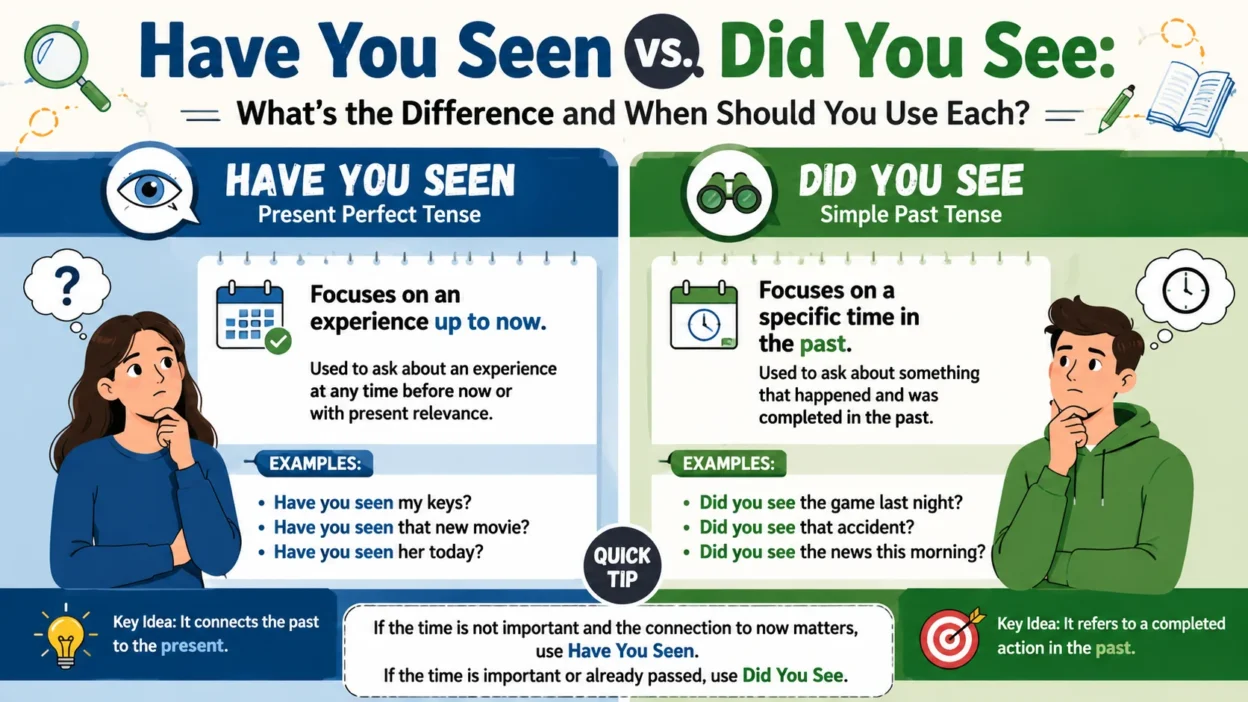
“Have you seen” uses the present perfect tense when you are talking about an experience or something connected to the present, but “did you see” uses the simple past when the event happened at a specific time in the past. For example, you can ask, “Have you seen” this movie?” because you are asking about someone’s experience, but you should ask, “Did you see the movie last night?” because the time is already finished.
A helpful habit is to listen to everyday conversations and notice how native speakers choose each form naturally. With regular practice, you will begin to recognize whether a question refers to an unfinished time or a completed moment. This small change improves your grammar, builds confidence in spoken English, and helps you communicate more clearly in both personal and professional conversations.
Have You Seen vs. Did You See: Quick Answer
If you only remember one rule from this article, make it this one.
| Question | Use It When | Example |
| Have you seen…? | The action has a connection to the present. The exact time isn’t important. | Have you seen my wallet? |
| Did you see…? | You’re asking about a specific, finished time in the past. | Did you see my wallet on the kitchen counter this morning? |
Here are two more examples:
✅ Have you seen the latest episode yet?
The speaker doesn’t care exactly when you watched it. They only want to know whether you’ve watched it by now.
✅ Did you see the game last night?
The speaker refers to one completed event that happened at a specific time.
A simple way to think about it is this:
- Present perfect (have seen) = experience or result up to now
- Simple past (did see) = finished event at a known time
The Real Difference Between “Have You Seen” and “Did You See?”
Many articles explain the grammar but never explain the thought process behind it. That’s why learners often memorize rules without knowing how to apply them in conversation.
Here’s the real difference.
One Connects the Past to the Present
When you ask “Have you seen…?”, you’re not simply asking about the past.
You’re asking whether something that happened in the past still matters now.
Consider this example.
Have you seen Sarah?
You’re probably looking for Sarah right now. If the other person has seen her recently, that information helps you in the present.
Notice that the question isn’t about when they saw Sarah.
It’s about whether they’ve seen her at all.
The exact time is irrelevant.
Here are more examples.
- Have you seen my glasses?
- Have you seen the email from the manager?
- Have you seen this news article?
- Have you seen the new restaurant downtown?
In every case, the answer affects the current situation.
The Other Refers to a Finished Moment in the Past
Now compare that with:
Did you see Sarah at the meeting yesterday?
This question focuses on one completed event.
The meeting has ended.
Yesterday has passed.
You’re asking about something that happened during a specific period that’s already over.
The result doesn’t necessarily affect the present anymore.
Examples include:
- Did you see Tom at the conference?
- Did you see the fireworks last night?
- Did you see the announcement during class?
- Did you see what happened after lunch?
Each question points to one finished occasion.
Why This Distinction Matters in Everyday English
Native speakers don’t consciously think about grammar rules every time they speak.
Instead, they naturally ask themselves questions like these:
- Does this matter now?
- Am I talking about one finished event?
- Does the exact time matter?
Once you start thinking the same way, choosing the correct phrase becomes much easier.
Here’s a comparison.
| Situation | Natural Question |
| Your friend can’t find their phone. | Have you seen my phone? |
| You’re discussing yesterday’s soccer match. | Did you see the game yesterday? |
| You want to know if someone watched a movie at any point. | Have you seen Inception? |
| You’re asking whether they watched it at last Friday’s movie night. | Did you see Inception on Friday? |
The grammar follows the meaning.
Not the other way around.
Understanding the Grammar Behind Both Questions
Understanding the grammar makes everything else easier.
Fortunately, the rules aren’t complicated.
English simply uses two different tenses because they answer two different kinds of questions.
“Have You Seen” Uses the Present Perfect
The present perfect follows this structure.
| Subject | Helping Verb | Past Participle |
| You | have | seen |
Formula:
Have + subject + past participle?
Examples:
- Have you seen this movie?
- Have you heard the news?
- Have you finished your homework?
- Have you met our new neighbor?
Notice something important.
The verb isn’t see.
It isn’t saw, either.
It’s seen, which is the past participle.
Here’s the verb form.
| Base Verb | Past Simple | Past Participle |
| See | Saw | Seen |
Many learners confuse these forms because English verbs don’t always follow predictable patterns.
“Did You See” Uses the Simple Past
The simple past question has a different structure.
Formula:
Did + subject + base verb?
Examples:
- Did you see the movie?
- Did you finish the report?
- Did you call your parents?
- Did you hear the announcement?
Notice something that surprises many learners.
After did, the verb returns to its base form.
Not this:
❌ Did you saw?
Instead:
✅ Did you see?
The helping verb did already tells us the action happened in the past.
The main verb doesn’t need another past ending.
Why “Have You Saw” Is Always Incorrect
This is one of the most frequent grammar mistakes in English.
Let’s look at the verb again.
| Verb Form | Correct? |
| See | Base verb |
| Saw | Simple past |
| Seen | Past participle |
Present perfect always requires the past participle.
That means:
✅ Have you seen it?
❌ Have you saw it?
Think of it this way.
Whenever you use have, the verb changes into its third form.
The same rule applies to hundreds of verbs.
| Correct | Incorrect |
| Have you eaten? | Have you ate? |
| Have you written? | Have you written? |
| Have you gone? | Have you gone? |
| Have you seen it? | Have you seen it? |
Learning this pattern will improve much more than just one grammar question.
When to Use “Have You Seen”
The present perfect appears everywhere in everyday English.
Although grammar books often describe it as difficult, native speakers use it naturally because it expresses several common situations.
Let’s look at the most important ones.
You’re Looking for Someone or Something
This is probably the most common use.
Imagine you can’t find your backpack.
You ask:
Have you seen my backpack?
You’re asking whether anyone has seen it recently because you need it now.
Examples include:
- Have you seen my phone?
- Have you seen the remote?
- Have you seen Alex?
- Have you seen my notebook?
Notice what’s missing.
There’s no specific time.
You’re not asking about yesterday or last week.
You’re asking whether they’ve seen it at any point that’s relevant now.
You’re Asking About Life Experiences
The present perfect is also used to discuss experiences.
Examples:
- Have you seen the Grand Canyon?
- Have you seen the Northern Lights?
- Have you seen that documentary?
- Have you ever seen a whale?
These questions don’t ask when the experience happened.
Whether someone visited last year or ten years ago doesn’t matter.
The experience itself is the focus.
Compare these questions.
Have you ever seen a total solar eclipse?
You’re asking whether the experience has happened in that person’s life.
Did you see the eclipse in April?
Now you’re asking about one particular event.
You’re Referring to Recent News or Events
Suppose a major announcement just happened.
You might ask:
Have you seen the latest update?
Or:
Have you seen the breaking news?
The speaker wants to know whether you’ve become aware of something that’s still relevant.
More examples:
- Have you seen today’s headlines?
- Have you seen the company’s new logo?
- Have you seen the weather forecast?
- Have you seen the latest software update?
The emphasis isn’t on when you saw it.
It’s on whether you know about it now.
The Exact Time Doesn’t Matter
This is one of the easiest ways to decide.
Ask yourself:
Does the exact time matter?
If the answer is no, the present perfect is often the better choice.
Examples:
- Have you read this book?
- Have you tried sushi?
- Have you visited Chicago?
- Have you watched this series?
The listener doesn’t need to say:
“I watched it at 7:45 p.m. on March 18.”
Any time in the past is acceptable.
The Result Still Matters Now
This is the heart of the present perfect.
Imagine this conversation.
Emma: Have you seen the client email?
James: Yes, I have.
Emma isn’t conducting a history lesson.
She needs to know whether James has the information now.
The same idea appears in countless conversations.
- Have you finished the report?
- Have you submitted the application?
- Have you booked the hotel?
- Have you spoken with the manager?
Each question focuses on the current result.
Case Study: Finding Lost Keys
Imagine this situation.
Your roommate can’t leave for work because their keys are missing.
Which question sounds natural?
❌ Did you see my keys?
It sounds incomplete.
A native speaker usually asks:
✅ Have you seen my keys?
Why?
Because the keys are still missing.
Finding them matters right now.
Now imagine a different conversation later that evening.
Did you see my keys on the kitchen counter this morning?
Now you’re asking about one particular moment earlier in the day.
The context changed.
So did the grammar.
Memory Tip: If you’re trying to solve a problem happening now, “Have you seen…?” is often the natural choice.
When to Use “Did You See”
The simple past is usually easier for learners because it refers to completed events.
Even so, many speakers overuse it because it feels straightforward. Understanding when it fits and when it doesn’t will make your English sound much more natural.
You’re Asking About a Specific Event
Use “Did you see…?” when both speakers know which event they’re discussing.
Examples:
- Did you see the fireworks last night?
- Did you see the teacher after class?
- Did you see the presentation this morning?
- Did you see the concert on Saturday?
In each example, the event happened at a known time and has already ended.
Unlike “Have you seen…?”, the question isn’t about an ongoing situation. It’s about one completed occasion.
The Time Is Known or Implied
Sometimes the sentence doesn’t mention the time directly, but the context makes it obvious.
For example:
A: The championship game was incredible!
B: Did you see it?
Even without saying “last night,” both speakers understand which game they’re discussing.
That’s enough to make the simple past the natural choice.
Other examples include:
- Did you see what happened after lunch?
- Did you see the email I sent this morning?
- Did you see the accident outside the office?
The time may be implied rather than stated, but it’s still specific.
Conclusion
Understanding the difference between Have You Seen vs. Did You See is an important step toward speaking and writing more natural English. The key is to pay attention to time. Use Have You Seen when talking about experiences or actions that still relate to the present, and use Did You See when referring to a completed event at a specific time in the past. With regular practice and real-life examples, choosing the correct tense will soon become a natural part of your everyday communication.
FAQs
Q1. What is the main difference between Have You Seen and Did You See?
Have You Seen uses the present perfect tense and asks about experiences or actions connected to the present. Did You See uses the simple past tense and asks about an event that happened at a specific time in the past.
Q2. Can I use Have You Seen with a specific time?
No. You should not use Have You Seen with finished time expressions such as yesterday, last night, or last week. In those cases, Did You See is the correct choice.
Q3. Which tense is more common in everyday conversations?
Both are common in everyday English. The correct choice depends on the meaning you want to express. Native speakers naturally switch between them based on whether they are talking about a past experience or a completed event.
Q4. How can I remember which one to use?
A simple trick is to ask yourself whether you mention a specific past time. If the answer is yes, use Did You See. If there is no specific time and you are asking about someone’s experience, use Have You Seen.
Q5. Do these rules apply in both spoken and written English?
Yes. The difference between Have You Seen and Did You See is the same in both spoken and written English. Learning when to use each one correctly will make your grammar more accurate and your communication more natural.