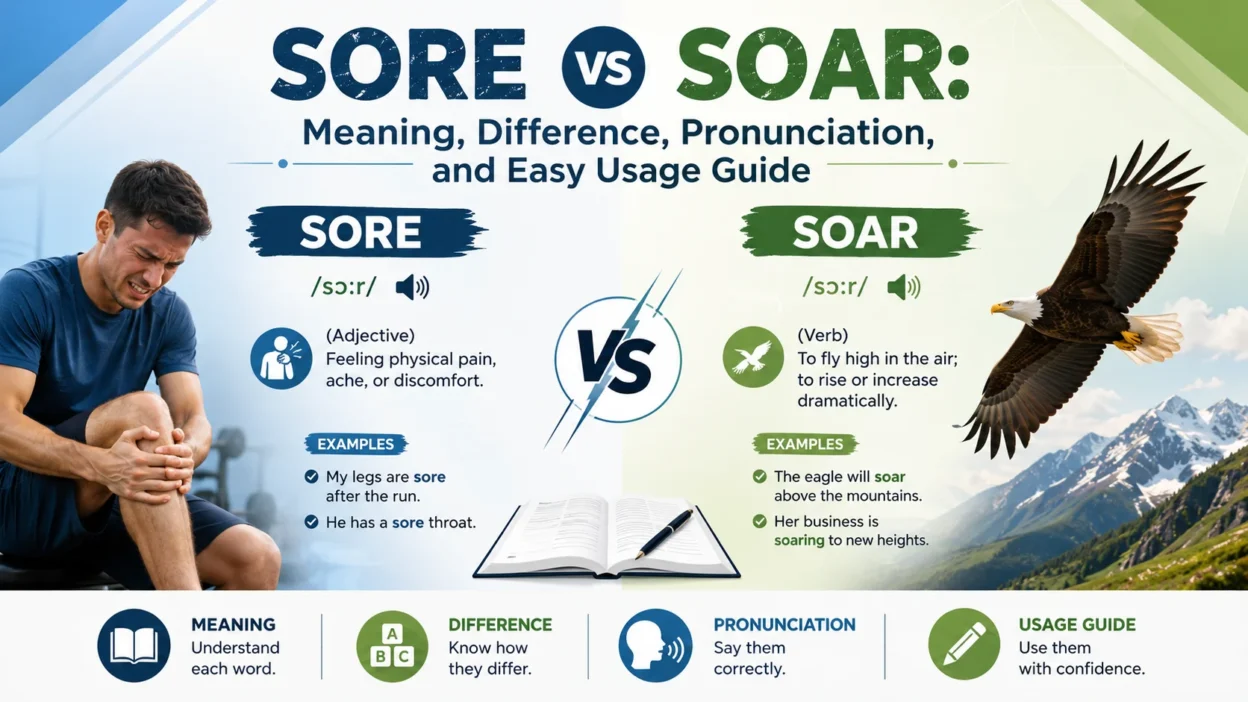
Sore vs. soar can confuse many people because the words sound alike, share the same pronunciation, and are homophones, yet their meanings are completely different. From my experience teaching English language learners, I have seen both learners and native speakers mix them up in writing and speaking. This guide offers a clear breakdown of the difference, distinction, and sore vs. soar meaning through dictionary definitions, sentence examples, real-life examples, comparison, context clues, and memory tricks.
“Sore” is mainly an adjective, although it can also be a noun, while “soar” is a verb. Sore describes feeling pain, injury, discomfort, emotional discomfort, or physical discomfort after exercise, a long run, or another activity. You may have a sore throat, sore muscles, sore feet, sore legs, muscle pain, or muscle discomfort and sometimes even feel offended or experience emotional irritation. In contrast, Soar means to fly, rise, rise high, or rise rapidly through the air and sky, just like birds enjoying the freedom of flight.
A simple way I help students remember this pair is by imagining twins at birth taking a unique journey. One reminds you of pain, while the other brings images of freedom, heights, and upward movement. This small story makes distinguishing the two words much easier, helps you avoid confusion, and reduces common mistakes..
Sore vs Soar: Quick Answer
Here is the fastest way to tell them apart:
| Word | Part of speech | Main meaning | Simple example |
| sore | adjective, sometimes noun | painful, tender, irritated, or emotionally hurt | My legs are sore after the workout. |
| soar | verb | to rise, fly high, or increase quickly | The eagle can soar above the trees. |
The easiest shortcut is this:
- Sore = pain, tenderness, discomfort
- Soar = rise, fly, climb, increase
One word points downward into discomfort. The other points upward into motion or growth.
What Does Sore Mean?
The word “sore” most often describes pain or tenderness. Something sore usually feels sensitive, aching, raw, or irritated.
You might hear it after a long run, a tough workout, a cold, or even an argument. The word can describe both the body and feelings. That makes it useful. It also makes it easy to misuse if you are not paying attention.
Sore as physical pain or discomfort
This is the most common use.
Examples:
- My throat is sore.
- His shoulders were sore after lifting boxes.
- She had a sore ankle from practice.
- The skin around the cut felt sore.
In these cases, “sore” means a part of the body hurts or feels tender.
That feeling can be mild or strong. It does not have to mean serious injury. Sometimes it simply means something is inflamed, tired, or overused.
Sore as emotional hurt or irritation
Sore can also describe feelings. It often means upset, offended, resentful, or wounded.
Examples:
- He still felt sore about losing the game.
- She sounded sore after the disagreement.
- They were sore at the way things ended.
This use appears often in informal speech. It can suggest someone is emotionally stung. Not shattered. Not dramatic. Just bothered in a way that lingers.
Sore as a noun
Less commonly, “sore” can function as a noun. In that case it means a painful spot or wound.
Examples:
- The doctor checked the sore on his lip.
- A sore can take time to heal.
This noun use is less common in everyday writing, but it does appear in medical or descriptive contexts.
Common meanings of sore
Here is a simple breakdown of the word’s main senses:
- Painful or tender: sore muscles, sore throat, sore feet
- Irritated or inflamed: a sore spot, a sore patch of skin
- Emotionally hurt: sore after criticism, sore about a loss
- A painful place or wound: a sore on the skin
Sore examples in sentences
These examples show how flexible the word can be:
- I am sore from carrying heavy bags.
- Her eyes were sore after crying.
- The runner felt sore the next morning.
- He was sore about being left out.
- That area became sore after the bandage rubbed against it.
Notice the pattern. Sore stays tied to discomfort in every case.
What Does Soar Mean?
The word soar means to rise, fly high, or increase rapidly. It gives you a sense of lift. Movement. Expansion. Freedom.
If sore feels heavy, soar feels airy.
Soar as flying or gliding upward.
This is the literal meaning.
Examples:
- The hawk soared over the field.
- The plane soared into the clouds.
- A kite can soar in strong wind.
In these sentences, something moves upward or stays high in the air. The motion feels smooth and elevated.
Soar as rising quickly
This is the figurative meaning, and you will see it everywhere.
Examples:
- Prices soared last year.
- Her confidence soared after the speech.
- Temperatures soared in the afternoon.
- The company’s profits soared.
Here, soar means to increase sharply or rise fast. The word often appears in news stories, business writing, weather reports, and sports coverage.
Soar in emotional and abstract contexts
People also use “soar” for emotions, hopes, or results.
Examples:
- His spirits soared when he heard the news.
- Their excitement soared as the concert began.
- Her grades soared after she started studying regularly.
That is the beauty of SOAR. It works in physical and abstract settings. A bird soars. A stock price soars. A mood soars. A voice can even seem to soar in a song.
Common meanings of soar
Here are the main uses:
- Fly high: birds, planes, kites
- Rise quickly: prices, temperatures, numbers
- Become intense or strong: emotions, hopes, energy
- Move smoothly upward: often used in writing to create a vivid image
Soar examples in sentences
- Eagles soar on warm air currents.
- The balloon soared above the city.
- Sales soared after the new product launch.
- Her confidence soared before the interview.
- The music seemed to soar through the room.
Again, the feeling is upward. “Soar” never means “pain.” It means lift, rise, or growth.
Sore vs Soar: Key Differences Explained Clearly
At first glance, “sore” and “soar” may look almost identical. They share four letters. They sound the same in standard English. That makes them classic homophones.
But their meanings sit at opposite ends of the experience spectrum.
| Feature | sore | soar |
| Meaning | pain, tenderness, emotional hurt | fly high, rise, increase rapidly |
| Part of speech | adjective, sometimes noun | verb |
| Feeling | discomfort, irritation, soreness | uplift, height, growth |
| Common examples | sore muscles, sore throat, sore feelings | soar high, soar above, sales soar |
| Mental picture | something that aches | something that lifts |
The simple rule
If the sentence talks about pain, use sore.
If it talks about rising, use soar.
That is the heart of the sore vs. soar difference.
A fast test
Ask yourself one question:
- Is this about hurting or being tender? sore
- Is this about flying or going up fast? soar
That little check solves most mistakes.
Sore vs Soar: Pronunciation Guide
People often confuse these words because they sound the same in most accents.
How to pronounce sore
A common pronunciation is
- /sôr/
It rhymes with:
- more
- door
- floor
How to pronounce soar
A common pronunciation is
- /sôr/
It sounds the same as “sore” in standard pronunciation.
That is why they are homophones.
Why pronunciation matters
When words sound alike, your ear cannot always save you. Context has to do the work.
For example:
- My throat is sore.
- The eagle can soar.
Same sound. Very different meanings.
This is why writers and students sometimes mix them up. Speech gives no clue. Writing does.
Why Sore and Soar Get Confused
The confusion usually comes from three things.
They sound identical
That is the obvious reason. If two words sound the same, people naturally blur them together.
They are both common in everyday English
You might see “sore” in health conversations and “soar” in weather, business, or sports talk. Since both words show up often, the brain keeps them close.
Context moves fast
When you read or write quickly, the sentence may feel obvious in your head. But the spelling decision still matters.
For example:
- “The team is sore after the match” is wrong if you mean emotional disappointment or physical exhaustion. You probably don’t want to be sore unless you mean pain.
- “The team’s hopes soared after the match” works if you mean confidence rose.
The same sound can hide two different ideas. That is the trap.
Sore vs Soar Examples in Sentences
Examples help the difference stick. Here are side-by-side comparisons.
| Correct word | Example sentence | Why it fits |
| sore | My feet are sore after walking all day. | It describes pain or tenderness. |
| soar | The hawk can soar for hours. | It describes flying high. |
| sore | He felt sore about the criticism. | It describes emotional hurt. |
| soar | Temperatures may soar tomorrow. | It describes a fast rise. |
| sore | She woke up with a sore throat. | It describes discomfort. |
| soar | Their sales soared this quarter. | It describes rapid growth. |
More natural examples of sore
- After hiking, my calves were sore.
- The inside of my nose felt sore from the cold.
- She was sore about missing the trip.
- He had a sore back from lifting furniture.
More natural examples of soar
- The bird soared above the river.
- Interest in the event soared after the announcement.
- His mood soared when he got the call.
- The rocket soared into the sky.
A good habit is to picture the action. If the image climbs, “soar” probably fits. If it aches, “sore” probably fits.
Real-Life Usage of “Sore” vs. “Soar”
Grammar gets easier when you see it in the wild. The “sore” vs. “soar” pair appears in real conversation more often than people think.
In health and fitness
Sore is common after exercise.
- My arms are sore from push-ups.
- Her legs were sore after the race.
- He felt sore the day after basketball practice.
This use is simple and very common. If the body worked hard and now feels tender, “sore” is the word.
In news and business
Soar appears constantly in reporting.
- Oil prices soared.
- The market soared after the announcement.
- Sales soared during the holiday season.
Writers use “soar” because it is vivid and compact. It adds energy without extra words.
In emotional writing
Both words can appear in emotional contexts, but they mean different things.
- Sore: He was sore about being excluded.
- Soar: Her hopes soared when she heard the update.
That contrast is useful. One word describes hurt. The other describes the lift.
In creative writing
Authors like soar because it creates motion and height.
- The bird soared across the sunset.
- Her voice soared above the orchestra.
The word feels elegant. Almost cinematic.
Sore, on the other hand, grounds the story in discomfort.
- His hand was sore from gripping the rope.
- She rubbed her sore ankle.
Used well, the two words create a strong emotional contrast.
Why Learning Homophones Matters
Homophones are words that sound alike but have different meanings and spellings. “Sore” and “soar” are a perfect example.
Learning them matters for a few practical reasons.
It improves writing clarity
When you choose the wrong spelling, readers may pause. Even if they understand the meaning, the mistake interrupts the flow.
It builds credibility
Small spelling errors can make writing look rushed. Clean word choice makes your work feel more polished.
It helps in school, work, and everyday life
You use words like these in essays, emails, social posts, and messages. Getting them right saves embarrassment and confusion.
It sharpens your ear for context
When you learn one homophone pair well, you get better at others too.
That means fewer mix-ups with pairs like
- there / their / they’re
- to / too / two
- break / brake
- bare / bear
The payoff goes beyond this one word pair.
Memory Tricks to Never Mix Up Sore and Soar Again
A good memory trick should be fast. It should feel silly enough to stick.
Here are the best ones.
Associate sore with pain
Think:
- sore muscles
- sore throat
- sore feet
The word “sore” sounds like something that hurts. It is the word you reach for when something feels tender or achy.
Associate “soar” with “sky.”
Think:
- birds soar
- planes soar
- kites soar
The word “soar” sounds like the sky. It belongs above ground.
Use a letter clue
Look at the first letters:
- “Sore” starts with “s” and often sticks to “suffering.”
- “Soar” starts with “s” and often goes to the sky
That is not a formal rule. It is just a helpful mental hook.
Picture the scene
Ask yourself:
- Does the picture show pain, red skin, or a stiff neck? Use sore.
- Does the picture show height, wings, wind, or speed upward? Use soar.
Your brain remembers images faster than abstract definitions. That is why this trick works so well.
Try a mini rhyme
- “Sore” means hurt to the core.
- “Soar” means to rise evermore.
It is a little playful. That is the point. Weird little rhymes stick.
Sore vs Soar: Common Mistakes to Avoid
Even confident writers make these mistakes. The good news is that most are easy to fix.
| Mistake | Why it is wrong | Better version |
| My prices are so low. | Prices do not hurt. | My prices are soaring. |
| The bird soared over the lake. | Birds do not feel soreness in this context. | The bird soared over the lake. |
| I feel sore after the workout. | Workout pain needs to be sore. | I feel sore after the workout. |
| Her hopes soared after the award. | Hopes do not become painful. | Her hopes soared after the award. |
Mistake: confusing sound with meaning
Because the words sound alike, some writers choose the spelling they see first in their head. That is risky. Always check the context.
Mistake: using “soar” for anything upward
Not everything that moves up is best described with soar.
For example:
- A balloon may rise.
- A kite may float.
- Prices may soar.
All three are upward ideas. But soar usually sounds stronger, faster, and more dramatic.
Mistake: using “sore” when you mean “disappointed”
This one is common.
- If someone feels physically pained or emotionally irritated, sore can work.
- If someone is simply disappointed in a neutral way, “disappointed” may be better.
Context decides.
Case Study: How a Student Fixed “Sore” vs. “Soar”
A middle school student wrote this sentence in an essay:
“The birds soar above the mountain.”
The teacher marked it wrong. The writer meant flying high, not pain.
The fix was simple:
“The birds soar above the mountain.”
Why did the error happen? The student knew both words sounded the same. Under pressure, the brain chose the wrong spelling. That is normal.
The lesson is useful. When you hear the word in your head, stop and ask:
- Am I talking about pain? Use sore.
- Am I talking about rising or flying? Use soar.
That two-second check can prevent a lot of mistakes.
Case Study: A Fitness Blog and the Power of the Right Word
A fitness blogger wrote:
“Your legs may soar after leg day.”
That sentence sounded odd. Readers noticed. The blogger meant that legs might feel sore after exercise.
The corrected version was:
“Your legs may feel sore after leg day.”
That small change made the sentence clear and natural.
Now compare the impact:
- Sore tells readers the muscles hurt.
- “Soar” would suggest the legs were flying upward.
One letter changes the entire picture. That is why spelling matters so much in homophones.
Sore vs Soar in Writing: Style Differences You Should Know
These words do more than carry meaning. They also create different tones.
Sore sounds grounded
It feels plain, physical, and direct.
Use it when you want honesty and clarity:
- sore muscles
- sore throat
- sore feelings
“Soar” sounds vivid and energetic
It feels spacious and active.
Use it when you want movement or excitement:
- soar above
- soar quickly
- soar to new heights
When to choose one over the other
Use “sore” for discomfort, tenderness, or emotional sting.
Use “soar” for lifting, climbing, flying, or rising fast.
That choice shapes the reader’s whole experience.
Sore vs Soar: Quick Reference Table
Here is a fast cheat sheet you can return to anytime.
| Word | Meaning | Part of speech | Best clue |
| sore | painful, tender, irritated, emotionally hurt | adjective, sometimes noun | think hurt |
| soar | fly high, rise quickly, increase sharply | verb | think sky |
Memorize this one sentence:
The sore hurts. Soar rises.
That tiny line carries the core difference.
Practice Quiz: Test Your Sore vs Soar Skills
Pick the right word for each sentence.
Fill in the blank
- My throat feels ___ after the cold.
- The eagle began to ___ over the cliffs.
- Sales may ___ during the holiday season.
- He was still ___ about the argument.
- The balloon seemed to ___ higher and higher.
Answer key
- sore
- soar
- soar
- sore
- soar
Quick challenge
Now try reading these aloud and deciding instantly:
- sore muscles
- soaring prices
- sore feelings
- soaring confidence
Notice how the meaning shifts almost instantly. That is the power of context.
Common Questions About Sore vs Soar
What is the main difference between sore and soar?
“Sore” means painful, tender, or emotionally hurt. “Soar” means to fly high, rise, or increase quickly.
Yes, “sore” and “soar” are pronounced the same?
Yes, in standard English they are homophones. They sound the same but have different spellings and meanings.
Can sorrow describe emotions?
Yes. It can describe feelings like being hurt, offended, or resentful.
Can “soar” describe things other than birds or planes?
Absolutely. It often describes prices, temperatures, confidence, hopes, sales, and other things that rise quickly.
What is the easiest way to remember the difference?
Use this rule:
Sore = pain. Soar = sky.
That short pairing is simple and effective.
Deep Dive: Why This Word Pair Matters in Everyday English
At first, “sore” vs. “soar” may seem like a tiny grammar issue. It is not.
Small language choices affect how clearly you communicate. They also affect how polished your writing looks. A single wrong word can break the flow of a sentence. Worse, it can change the meaning.
Imagine reading:
- My knees are sore.
- The market is sore.
Both feel wrong because the wrong word creates an absurd image. That kind of error pulls readers out of the text.
Now compare:
- My knees are sore.
- The market is soaring.
Both work well. They both appear natural. Both have the right meaning.
That is why homophones deserve attention. They’re tiny. They are cunning. They are important.
A Simple Framework for Choosing Between Sore and Soar
When you are stuck, use this three-step check:
Step one: Identify the meaning
Ask what the sentence is trying to say.
- Pain or tenderness? sore
- Flying or rising? soar
Step two: Check the grammar
Ask what part of speech you need.
- Describing a feeling or body part? sore
- Describing an action or movement? soar
Step three: Picture it
- If the image is a sore shoulder, sore throat, or sore mood, choose sore.
- If the image is a bird, plane, rocket, or price chart moving up, choose soar.
This method works because it uses meaning, grammar, and visual memory together. That combination is hard to beat.
Conclusion
Understanding “sore” vs. “soar” becomes much easier once you remember that “sore” is linked to pain, discomfort, or an injury, while “soar” describes something that flies, rises, or increases quickly. Although they have the same pronunciation and are homophones, their meanings are very different. With regular practice, real-life examples, and careful attention to context, you can choose the right word with confidence. The more you read, write, and speak English, the more natural using Sore and Soar will become.
FAQs
Q1. What is the main difference between Sore and Soar?
“Sore” refers to pain, physical discomfort, or emotional discomfort, while “soar” means to fly, rise high, or increase rapidly. They sound alike but have different meanings.
Q2. Are Sore and Soar homophones?
Yes. “Sore” and “soar” are homophones because they have the same pronunciation but different spellings and meanings.
Q3. How can I remember the difference between Sore and Soar?
Think of “sore” as something that hurts, like sore muscles after exercise. Think of “soar” as a bird flying high in the sky or temperatures and prices rising quickly.
Q4. Can Sore and Soar be used in the same sentence?
Yes. For example, after the long hike, my legs were sore, but watching the eagle soar through the sky made the trip worthwhile.
Q5. Why do people confuse Sore and Soar?
People often confuse them because they are homophones with the same pronunciation. Learning their meanings, reading examples, and practicing regularly helps avoid mistakes.