“I’ve added” vs. “I added” is a common grammar topic that often confuses English learners because both phrases use the same verb but express different time meanings. When you understand the difference between “I’ve added” and “I added,” choosing the correct form becomes much easier. The main distinction is timing. “I added” refers to a completed action at a definite time in the past, while “I’ve added” connects a past action to the present. Learning this contrast improves your grammar, sentence clarity, and overall confidence in everyday English. Once you recognize the time reference, selecting the correct tense becomes much more natural.
From my experience teaching English, many learners initially think I’ve added and I added have the same meaning. In reality, the choice depends on context, time, and the speaker’s intention. I Added is used with specific past time expressions such as yesterday, last week, or a few minutes ago, showing that the action is finished. I’ve Added, however, is used when the result is still relevant now, even if the exact time is not mentioned. Understanding this small difference helps learners improve their sentence structure, sound more natural, and avoid one of the most common grammar mistakes.
In this article, we’ll explain I’ve Added vs I Added with clear rules, simple examples, and practical tips. You’ll learn when to use the present perfect and when the simple past is the better choice. We’ll also look at common situations, compare both forms side by side, and highlight mistakes that English learners frequently make. By the end, you’ll understand how timing, context, and meaning work together, allowing you to choose the correct phrase confidently in both writing and conversation.
Quick Answer – I’ve Added vs I Added Meaning Explained
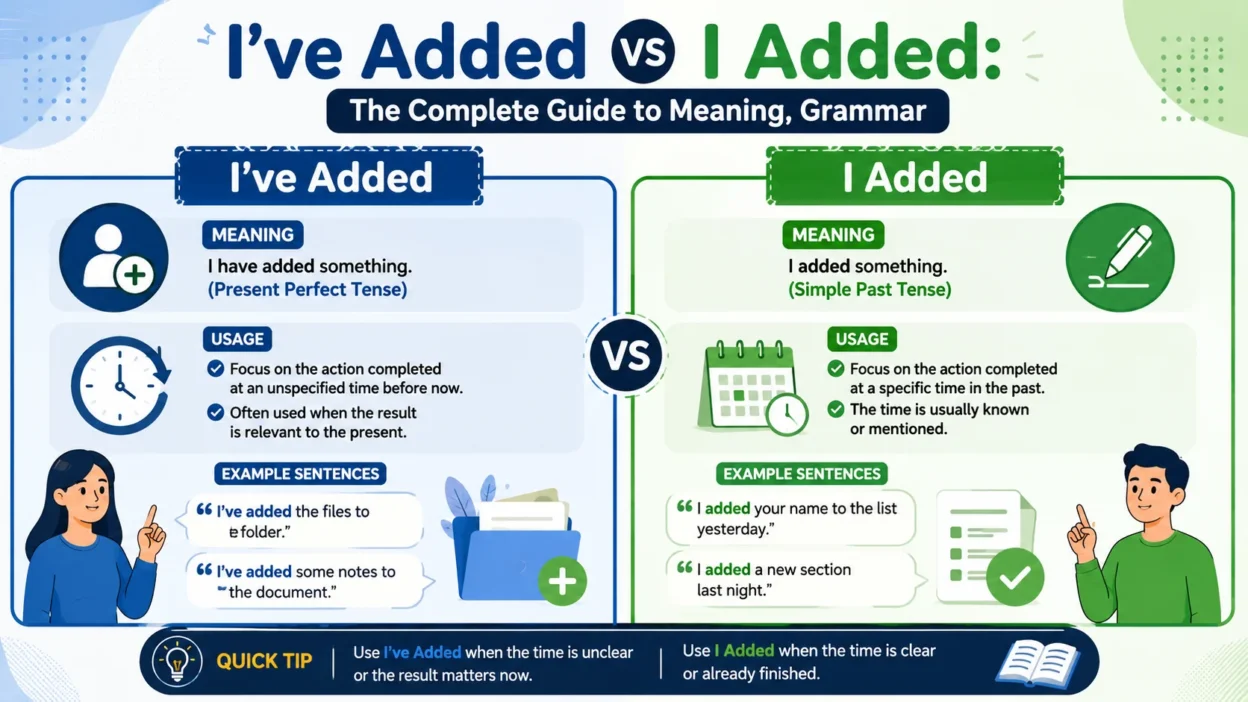
“I’ve added” (Present Perfect) connects a past action to the present moment. It focuses on result and relevance now.
“I added” (Simple Past) describes a finished action in the past. It focuses on when something happened.
Simple version:
I’ve added = What’s the result now?
I added = When did it happen?
Example:
I’ve added your name to the list → It is included now
I added your name yesterday → It happened in the past
That small shift changes everything in meaning and tone.
Why English Has Two Past Forms Like “I’ve Added” and “I Added”
English does not treat all past actions the same. It splits time into two mental categories that reflect how people actually think.
One category cares about timing. The other cares about impact.
So instead of one past tense, English uses two main options:
Simple Past → finished events with time
Present Perfect → past events connected to now
For example:
I fixed the bug yesterday → time matters
I’ve fixed the bug → result matters
A developer does not always care when the bug was fixed. They care that it is fixed now. That’s why Present Perfect shows up so often in real communication like tech updates, emails, and reports.
Understanding “I’ve Added” (Present Perfect in Real English)
“I’ve added” uses this structure:
I + have + past participle (added)
But grammar alone does not explain it. Meaning does the real job here.
“I’ve added” tells the listener three key things:
Something changed
The result is active now
The exact time is not important
What “I’ve Added” Really Means in Daily Use
When someone says:
“I’ve added your email to the system.”
They are not focusing on the past moment.
They are saying:
Your email is in the system now
That is the real function. It connects a past action to a present result without caring about when it happened.
When You Should Use “I’ve Added”
Use “I’ve added” when:
You want to show updates or changes
The result matters more than time
You are reporting completion with present relevance
Time is not mentioned
Common time signals that pair with it:
just
already
recently
so far
yet
Real-Life Examples of “I’ve Added”
I’ve added new security settings to your account
I’ve added your request to the queue
I’ve added extra notes for clarity
I’ve added a new section to the document
Workplace Case Study – Why Professionals Prefer “I’ve Added”
Imagine a project manager sending an update to a team:
“I’ve added the client feedback to the shared file.”
Why not “I added”?
Because the team does not care about timing. They care about availability right now.
This is why Present Perfect dominates modern workplace communication:
Emails
Slack messages
Jira updates
Google Docs comments
It signals one thing very clearly. The change is active now and ready to use.
Understanding “I Added” (Simple Past in Real English)
“I added” uses a simple structure:
Subject + past verb
It focuses on:
Completed action
Specific time
Finished event
This form always answers one question clearly: when did it happen?
What “I Added” Conveys in Real Communication
When you say:
“I added your file yesterday.”
You are saying:
The action is finished and it happened at a known time
There is no need to connect it to the present moment.
When You Must Use “I Added”
Use “I added” when:
You mention exact time
You tell a story
You describe past events
You report logs or history
Common time expressions include:
yesterday
last week
in 2022
at 5 PM
two hours ago
Real-Life Examples of “I Added”
I added sugar to the coffee this morning
I added the file yesterday afternoon
I added comments during the meeting
I added the contact last week
Case Study – Storytelling vs Reporting
Think about two real situations.
A storyteller says:
“I added the final piece and the puzzle was complete.”
A project tracker says:
“I added the final piece at 3 PM.”
Same action. Different purpose.
One creates a story. The other records a fact.
Time Expressions That Decide Between “I’ve Added” and “I Added”
Time words are one of the fastest ways to choose the correct form.
Time Words That Require “I Added”
These always point to Simple Past:
yesterday
last night
last month
in 2019
at 6 AM
two days ago
Example:
I added your name yesterday
Time Words That Fit “I’ve Added”
These usually pair with Present Perfect:
just
already
recently
ever
never
so far
Example:
I’ve just added your name
Important Rule Most Learners Miss
If you see a specific finished time, do not use Present Perfect.
Wrong:
I’ve added yesterday the file
Correct:
I added the file yesterday
This single rule removes most common mistakes instantly.
Side-by-Side Comparison of “I’ve Added” vs “I Added”
| Feature | I’ve Added | I Added |
| Tense | Present Perfect | Simple Past |
| Focus | Result now | Completed past action |
| Time needed | No | Yes |
| Usage style | Updates and news | Stories and reports |
| Example | I’ve added your email | I added your email yesterday |
Same Sentence, Different Meaning
I’ve added your request → It is processed now
I added your request last week → It happened earlier
Small grammar shift. Big meaning shift.
Where You Will Actually Use Each Form in Real Life
Grammar only matters when it works in real situations. Let’s look at where you will actually hear both forms.
Workplace Communication
I’ve added your file to the folder
I’ve added changes to the report
I added the notes during yesterday’s meeting
Workplaces switch between both forms depending on urgency and time reference.
Social Interaction
I’ve added you on Instagram
I’ve added that song to my playlist
I added him last night
Present Perfect feels immediate and relevant now. Simple Past feels like a story you are telling.
Academic and Technical Writing
Research papers often use:
I added data in 2023
I’ve added new findings
Reports and lab notes mix both forms depending on structure and focus.
We added 200 participants in Phase 1
We’ve added new analysis tools to improve accuracy
Common Mistakes with “I’ve Added” vs “I Added”
Mixing Time Words Incorrectly
Wrong:
I’ve added yesterday the file
Correct:
I added the file yesterday
Overusing Present Perfect
Wrong habit:
I’ve added everything yesterday
Natural English prefers:
I added everything yesterday
Ignoring Context
Grammar always depends on intention. Ask yourself:
Am I reporting?
Am I telling a story?
Am I giving an update?
That question often gives you the right answer faster than memorizing rules.
Simple Tricks to Remember the Difference
Timeline Trick
If you can draw a timeline, use Simple Past.
If it feels connected to now, use Present Perfect.
Result Test
Does this matter right now?
Yes → I’ve added
No → I added
Question Test
When did it happen? → I added
What is the result? → I’ve added
Practice Section – Build Real Skill
Fill in the Blanks
I ___ (add) your email yesterday
I ___ (add) new features to the app
Sentence Correction
I’ve added the file yesterday → I added the file yesterday
I added your request → depends on context
Write Your Own Examples
Create one workplace update
Create one social message
Create one past story
Switch between both forms on purpose until it feels natural.
Conclusion
Understanding “I’ve Added vs I Added” is really about one thing: how English handles time and meaning. When you use I’ve added, you connect an action to the present moment, so the result feels alive right now. When you use I added, you close the action in the past and keep it tied to a specific time.
Once you stop thinking of them as “similar verbs” and start seeing them as “different time signals,” everything becomes easier. You don’t just speak correctly—you speak clearly, naturally, and with intent. That’s what makes your English sound real instead of mechanical.
FAQs
Q1. What is the main difference between “I’ve added” and “I added”?
“I’ve added” connects the action to the present result, while “I added” shows a completed action in the past with a clear or implied time.
Q2. When should I use “I’ve added”?
Use it when the exact time is not important and the result still matters now, like updates, changes, or recent actions.
Q3. When should I use “I added”?
Use it when you mention a specific time such as yesterday, last week, or a clear past moment.
Q4. Can I use both in the same conversation?
Yes. Native speakers switch between them depending on whether they are focusing on results or timing.
Q5. Why do learners confuse “I’ve added” and “I added”?
Because both refer to past actions, but the difference in time focus (present relevance vs completed past) is subtle and often overlooked.