When I first learned the English language as a second language, I realized that “put two and two together” is more than an idiom. Native speakers use it in everyday English, spoken English, written English, and communication to describe reasoning and logical thinking. As I explored the Put Two and Two Together meaning, I found that this common idiom and widely used phrase has a deeper phrase meaning than its words suggest. Learning its definition, idiom definition, and figurative meaning through examples, storytelling, and literature improved my language learning, vocabulary, language skills, and overall understanding.
Using this expression becomes easier when you focus on information, clues, evidence, and connect the dots. Paying attention to facts, hidden clues, hints, and context helps you build logical reasoning, critical thinking, and inference. Over time, you learn to analyze, draw conclusions, and reach a reasonable conclusion. As the pieces begin to fit, everything makes sense, turning every real-life situation into a valuable lesson through practical application and everyday use.
I have seen this idiom improve communication, writing, speaking, and communication skills in business meetings, classrooms, movies, and news reports. It encourages problem-solving, natural language, everyday expression, and greater confidence in English. Even a simple puzzle, a forgotten umbrella in a rainstorm, or a few unusual details can help you Put Two and Two Together. By following a good guide, reading a clear explanation, using practical tips, and continuing to explore, this expression soon becomes a natural part of everyday English
What Does “Put Two and Two Together” Mean?
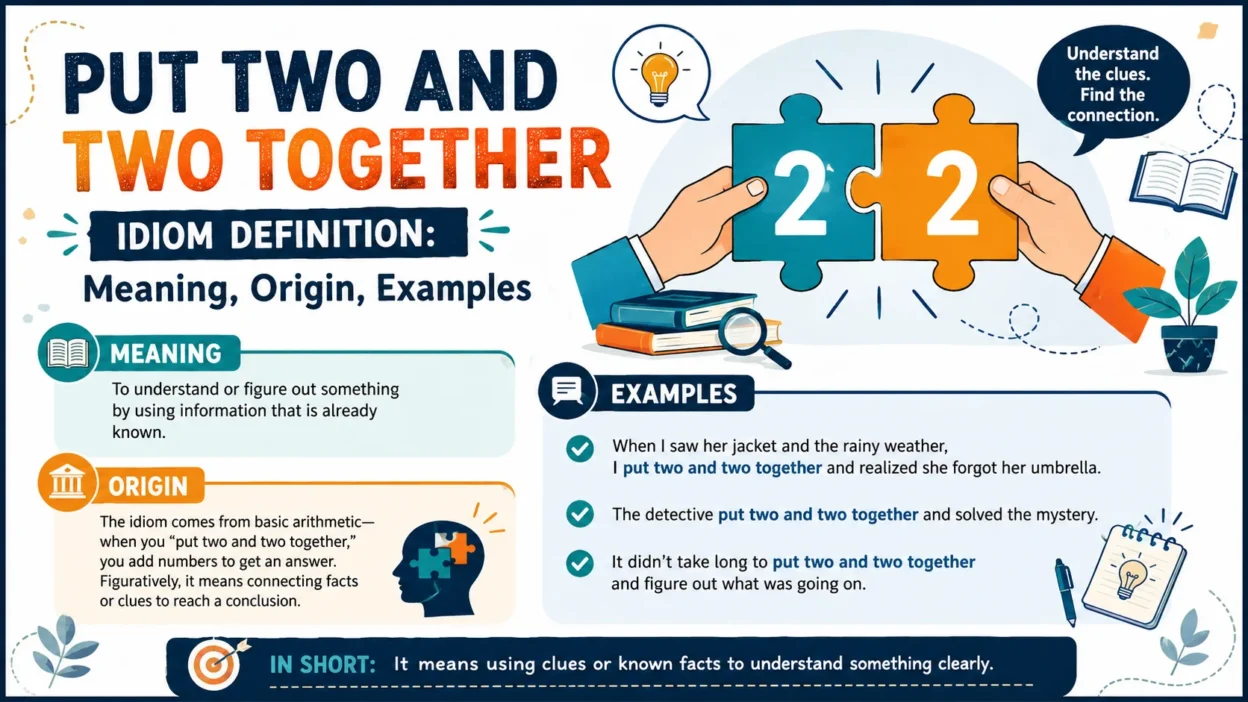
The idiom put two and two together means to connect separate clues, facts, or observations in order to reach a logical conclusion.
Instead of someone giving you the answer directly, you examine the available information and work out what most likely happened. The expression describes a process of reasoning rather than guessing.
Simple Definition
Put two and two together: To infer or realize something by connecting different pieces of information.
For example, imagine you notice balloons in the living room, a birthday cake in the kitchen, and family members whispering behind closed doors. No one tells you what’s happening, but you put two and two together and realize they’re planning a surprise birthday party.
The idiom highlights careful observation and logical thinking. It suggests that the answer becomes clear once you connect the available clues.
Literal Meaning vs. Figurative Meaning
The phrase begins with something everyone understands: 2 + 2 = 4.
Because the answer is obvious after adding the numbers together, English speakers began using this simple calculation as a metaphor for reaching an obvious conclusion after combining different pieces of information.
| Literal Meaning | Figurative Meaning |
| Adding 2 + 2 equals 4 | Connecting clues to reach a logical conclusion |
| Mathematics | Logical reasoning |
| Exact calculation | Intelligent inference |
| Numbers | Facts and observations |
The figurative meaning has nothing to do with mathematics. Instead, the “two and two” represent separate facts that become meaningful when viewed together.
What Does the Idiom Suggest?
When someone says they put two and two together, they usually mean they:
- Noticed several important clues
- Recognized a meaningful pattern
- Connected related events
- Reached a logical conclusion
- Understood something without being told
- Solved a mystery using evidence
The idiom always emphasizes reasoning based on facts rather than luck or coincidence.
Why Is This Idiom So Popular?
English contains thousands of idioms, yet put two and two together remains one of the most widely used because it describes something people experience almost every day.
People constantly connect information when they:
- Solve problems
- Understand hidden intentions
- Notice unusual behavior
- Discover surprises
- Identify inconsistencies
- Make important decisions
Whether you’re watching a detective solve a mystery or realizing why your coworker suddenly took vacation leave, you’re putting clues together to understand the situation.
Everyday Meaning in Plain English
Imagine this scenario.
Your neighbor suddenly starts buying baby furniture.
A few days later, a crib is delivered to the house.
Then family members begin visiting more frequently.
Nobody tells you they’re expecting a baby.
You simply put two and two together and reach that conclusion on your own.
That’s exactly how this idiom works.
Common Signs Someone Has “Put Two and Two Together”
Native speakers often use this expression after someone suddenly understands what’s happening.
You might hear sentences like:
- “She finally put two and two together.”
- “I guess you put two and two together.”
- “He quickly put two and two together.”
- “Everyone eventually put two and two together.”
Each sentence suggests that the person reached a logical conclusion after connecting several clues.
Quick Answer at a Glance
If you’re looking for a quick overview, this table summarizes the essential facts.
| Feature | Details |
| Idiom | Put two and two together |
| Meaning | Connect clues to reach a logical conclusion |
| Type | English idiom |
| Tone | Neutral |
| Formality | Suitable for both informal and professional communication |
| Common Use | Everyday conversations, business, education, literature, media |
| Skill Involved | Observation and logical reasoning |
| Opposite Idea | Missing obvious clues or jumping to conclusions |
| Similar Expressions | Connect the dots, read between the lines, figure it out |
Pronunciation
Put two and two together
/pʊt tuː ænd tuː təˈɡɛðər/
Native speakers usually pronounce the phrase smoothly and quickly during conversation because it’s such a familiar expression.
Is the Idiom Positive or Negative?
The idiom itself is neutral. Its tone depends entirely on the situation.
Positive Example
Emma noticed several scholarship announcements, reviewed the eligibility requirements, and put two and two together to realize she qualified for financial aid.
Here, the idiom highlights intelligence and careful observation.
Neutral Example
The manager reviewed several shipping reports and put two and two together, realizing the deliveries had been delayed because of weather conditions.
The sentence simply describes logical reasoning.
Negative Example
The detective examined the fingerprints, security footage, and witness statements before putting two and two together and identifying the suspect.
Although the outcome is serious, the idiom itself remains neutral.
Common Situations Where the Idiom Is Used
One reason this expression has remained popular for generations is its versatility. Native speakers use it in a wide variety of situations.
Everyday Life
Friends and family often use the idiom when talking about surprises, celebrations, relationships, or unexpected events.
Example:
“You saw the engagement ring, the flowers, and the fancy dinner reservation. Didn’t you put two and two together?”
Workplace
Professionals often connect information before making business decisions.
Example:
“After reviewing the quarterly reports, the finance team put two and two together and discovered the accounting error.”
Education
Teachers encourage students to infer information instead of memorizing isolated facts.
Example:
“The teacher asked the students to examine the evidence and put two and two together before answering the question.”
Crime Investigations
Detectives and investigators rely heavily on observation and logical reasoning.
Example:
“The investigator put two and two together after examining the surveillance footage and fingerprint evidence.”
Journalism
Reporters often analyze multiple sources before understanding the full story.
Example:
“Readers quickly put two and two together after the company announced unexpected layoffs.”
When Native Speakers Usually Say It
A subtle point that many English learners miss is when native speakers actually use this expression.
Most people don’t say it while they’re still searching for clues.
Instead, they use it after reaching the conclusion.
For example:
❌ Less Natural
“I’m putting two and two together.”
✅ More Natural
“I finally put two and two together.”
This small difference makes your English sound much more fluent because the idiom usually describes the moment of realization rather than the thinking process itself.
How to Use “Put Two and Two Together” Correctly
Understanding the meaning is only the beginning. To use this idiom naturally, you also need to know its grammar and sentence patterns.
Fortunately, it’s a very flexible expression that works in both spoken and written English.
Standard Sentence Structure
The most common structure is:
Subject + put + two and two together + conclusion
Examples:
- She put two and two together.
- They finally put two and two together.
- We quickly put two and two together.
- I immediately put two and two together.
Often, the conclusion follows the idiom.
Example:
Lisa put two and two together and realized her passport had been left at home.
Another example:
Everyone put two and two together after hearing the announcement.
Common Verb Tenses
The idiom works naturally in almost every English tense.
| Tense | Example |
| Present | I put two and two together whenever I see enough evidence. |
| Past | She put two and two together yesterday. |
| Present Perfect | They’ve put two and two together already. |
| Past Perfect | He had put two and two together before anyone explained the situation. |
| Future | You’ll put two and two together once you hear the full story. |
Only the helping verb changes. The core idiom remains the same.
Common Grammar Patterns
Pattern One
Subject + put two and two together
Example:
The audience put two and two together.
Pattern Two
Subject + put two and two together + and + realized
Example:
Michael put two and two together and realized he’d been scammed.
This is one of the most common sentence structures because it clearly explains the conclusion.
Pattern Three
Subject + finally + put two and two together
Example:
She finally put two and two together after reading the email.
Adding finally emphasizes that the realization took time.
Pattern Four
Once + subject + put two and two together…
Example:
Once they put two and two together, everything suddenly made sense.
This pattern appears frequently in novels, movies, and storytelling because it builds suspense before revealing the conclusion.
Formal vs. Informal Usage
Unlike many idioms that belong only in casual conversation, put two and two together works well in both informal and professional settings.
Informal Conversation
I put two and two together after seeing his new car and packed suitcases.
Business Communication
The audit team put two and two together after reviewing the financial statements.
Academic Writing
Although formal research papers often prefer words like infer, deduce, or conclude, this idiom still appears naturally in discussions about literature, language, and communication.
Example:
Readers gradually put two and two together as the novel approaches its climax.
Real-Life Examples of the “Put Two and Two Together” Idiom
The best way to understand an idiom is to see it in real situations. While definitions explain what an expression means, examples show how native English speakers naturally use it in everyday conversations.
One thing you’ll notice in every example is that the conclusion comes from evidence, not from a random guess. That’s what makes this idiom so useful and widely understood.
Everyday Conversations
This idiom frequently appears in daily conversations because people often notice clues before anyone explains what’s happening.
Example 1
Sarah noticed balloons hidden in the garage, a decorated cake in the refrigerator, and several family members arriving much earlier than usual.
Without asking any questions, she put two and two together and realized they were planning a surprise birthday party.
Example 2
David’s coworker suddenly started cleaning out his desk, updating his résumé online, and saying goodbye to several colleagues.
David quickly put two and two together and realized his coworker had accepted a new job.
Example 3
Emily noticed that her best friend kept asking about wedding venues, discussing flower arrangements, and browsing bridal magazines.
She eventually put two and two together and realized an engagement announcement was coming soon.
These examples show how people naturally connect several small observations until the answer becomes obvious.
Workplace and Business Communication
Professionals often rely on observation and logical thinking when making important decisions. That’s why this idiom appears regularly in business environments.
Imagine a company where managers notice several unusual events.
- Hiring suddenly stops.
- Business travel is reduced.
- Department budgets are frozen.
- Executive meetings become more frequent.
After reviewing the company’s financial reports, the leadership team puts two and two together and realizes the business is preparing for an economic slowdown.
Here’s another example.
An online store experiences a sharp decline in sales.
The marketing team notices:
- Website traffic remains steady.
- Shopping cart abandonment increases.
- Customers complain about slow checkout.
After analyzing the data, they put two and two together and discover that a recent software update caused technical problems during payment.
Instead of blaming poor marketing, they identify the actual issue through logical reasoning.
School and Academic Settings
Teachers encourage students to develop inference skills rather than simply memorizing information.
Consider a literature class.
A novel repeatedly mentions:
- Dark clouds
- Broken windows
- Empty streets
- Silent neighborhoods
A student puts two and two together and recognizes that the author is creating a gloomy atmosphere before introducing a major conflict.
The teacher never states this directly.
The student reaches the conclusion by analyzing the clues.
History classes also rely on this type of reasoning. Students compare letters, historical records, newspaper articles, and government documents before drawing conclusions about important events.
Family and Relationships
Families often communicate through actions rather than words.
Suppose your parents suddenly ask about your vacation schedule.
Later, you notice travel brochures on the kitchen table.
A few days afterward, new luggage appears in the hallway.
Without anyone explaining anything, you put two and two together and realize they’re planning a family vacation.
The same thing happens with surprise celebrations, anniversaries, graduations, and holiday gatherings.
News and Current Events
Journalists frequently gather information from multiple sources before understanding the complete story.
Imagine a technology company announces:
- A new chief executive officer
- Office closures
- Budget reductions
- Company restructuring
Investors begin reading financial reports and market analyses.
Many quickly put two and two together and conclude the company is undergoing a major transformation.
Professional journalists, however, verify the evidence before presenting their conclusions as facts. That’s an important distinction between logical inference and speculation.
Crime and Detective Stories
Few genres illustrate this idiom better than detective fiction.
A detective discovers:
- Muddy footprints outside a window
- Fingerprints on a broken vase
- Missing jewelry
- Security camera footage
Each clue seems ordinary on its own.
Together, they reveal what really happened.
The detective puts two and two together and solves the case.
This storytelling technique keeps readers engaged because they enjoy solving the mystery alongside the main character.
Case Study: Solving a Workplace Problem Through Observation
Let’s look at a realistic example that demonstrates how logical reasoning works in everyday business.
The Situation
A customer service department suddenly experiences declining productivity.
Managers initially assume employees have become less motivated.
One supervisor, however, notices several unusual details.
- Employees repeatedly restart their computers.
- Customer calls take longer than usual.
- Software freezes every afternoon.
- Technical support tickets increase dramatically.
Instead of blaming the staff, the supervisor investigates further.
After reviewing the IT reports, she puts two and two together and discovers that a recent network upgrade introduced compatibility issues with the customer management software.
The Outcome
Once the technical issue is fixed:
- Productivity improves.
- Customer wait times decrease.
- Employee satisfaction increases.
- Customer complaints decline.
The lesson is clear.
Good decisions often begin with careful observation rather than quick assumptions.
How Writers and Filmmakers Use the Idiom
Authors and screenwriters frequently use put two and two together during important moments in a story.
Instead of revealing every detail immediately, they scatter clues throughout the plot.
Readers might notice:
- An old photograph
- A missing letter
- An unusual phone call
- A mysterious stranger
- Repeated references to a forgotten event
Each clue builds suspense.
Eventually, both the main character and the audience put two and two together, creating a satisfying moment of discovery.
This storytelling technique appears in mystery novels, psychological thrillers, crime dramas, and suspense films because it rewards careful attention.
Where Did “Put Two and Two Together” Come From?
Although the idiom feels perfectly modern, its roots extend back more than a century.
Its lasting popularity comes from one simple truth.
Everyone understands that two plus two equals four.
Because the calculation is universally recognized, English speakers gradually transformed it into a metaphor for logical reasoning.
Instead of talking about numbers, the phrase came to describe connecting separate facts until the answer became obvious.
The Origin of the Idiom
The figurative use of put two and two together became widely established during the late nineteenth century.
Writers, journalists, and public speakers began using the phrase to describe situations where someone recognized a connection between separate events.
As newspapers became more popular and literacy rates increased, the expression spread rapidly throughout English-speaking countries.
By the early twentieth century, it had become a familiar part of everyday speech.
Today, it remains one of the most recognizable idioms in modern English.
Why Basic Arithmetic Became a Powerful Metaphor
The strength of this idiom lies in its simplicity.
Every child learns that:
2 + 2 = 4
The answer is obvious once the numbers are combined.
English speakers borrowed that certainty and applied it to logical reasoning.
Just as numbers combine to produce a clear answer, clues combine to reveal the truth.
| Arithmetic | Logical Reasoning |
| Two numbers create one answer. | Several clues reveal one conclusion. |
| Every number contributes to the result. | Every observation contributes to understanding. |
| The solution becomes obvious after calculation. | The conclusion becomes obvious after connecting evidence. |
This comparison explains why the idiom remains so memorable.
How the Expression Evolved
Unlike many expressions that disappear over time, put two and two together has remained remarkably consistent.
Its meaning has changed very little over the years.
Today, people use it in:
- Everyday conversations
- Business meetings
- Classroom discussions
- Newspapers
- Television interviews
- Podcasts
- Mystery novels
- Courtroom discussions
- Corporate presentations
Because the expression is so versatile, it works naturally in almost every type of communication.
Why This Idiom Works So Well
This idiom reflects one of the brain’s most important abilities: recognizing patterns.
Humans constantly connect separate pieces of information without consciously realizing it.
Every day, you:
- Recognize familiar faces.
- Predict someone’s next action.
- Understand jokes.
- Notice changes in behavior.
- Solve problems.
- Learn from experience.
All of these activities depend on connecting information.
That’s exactly what this idiom describes.
The Psychology Behind Connecting Clues
Psychologists refer to this process as inferential reasoning.
Inference allows people to reach conclusions without receiving direct explanations.
Imagine walking into your kitchen.
You notice:
- Fresh cookie crumbs
- A warm baking tray
- An empty glass of milk
- Chocolate on your child’s face
Nobody tells you what happened.
Yet you immediately infer that someone recently baked and ate cookies.
You naturally put two and two together.
Inference vs. Guessing
Many English learners mistakenly believe these ideas mean the same thing.
They don’t.
| Inference | Guessing |
| Based on evidence | Based on little or no evidence |
| Uses observation | Relies on chance |
| Supported by facts | May have no supporting facts |
| Produces logical conclusions | Produces uncertain assumptions |
The idiom always refers to inference, not guessing.
That’s one of its defining characteristics.
The Importance of Pattern Recognition
Pattern recognition helps people make better decisions.
It allows us to:
- Detect problems early.
- Recognize opportunities.
- Understand relationships.
- Learn more efficiently.
- Avoid repeating mistakes.
- Identify unusual behavior.
Without this ability, solving even simple problems would become much more difficult.
At the same time, good critical thinking requires verifying evidence before reaching conclusions.
Connecting clues is valuable, but confirming those conclusions is equally important.
Synonyms and Similar Idioms
English has several expressions that share a similar meaning with put two and two together, but each one emphasizes a different aspect of understanding or reasoning. Knowing the differences will help you choose the most natural expression for every situation.
| Expression | Meaning | Best Used When | Difference |
| Connect the dots | Link several pieces of information | Investigations, business, research | Focuses on combining many clues into one complete picture. |
| Read between the lines | Understand an implied message | Conversations, books, emails | Focuses on hidden meaning rather than observable evidence. |
| Figure it out | Solve a problem or understand something | Everyday conversations | More general and doesn’t always involve connecting clues. |
| Catch on | Begin to understand | Informal conversations | Describes gradual understanding over time. |
| See the bigger picture | Understand the overall situation | Leadership and decision-making | Focuses on the broader context rather than individual clues. |
| Draw a conclusion | Reach a logical decision | Academic and professional writing | A formal alternative to the idiom. |
| Infer | Reach a conclusion from evidence | Education and formal writing | A single verb with a similar meaning. |
Although these expressions overlap, put two and two together remains one of the clearest and most widely used idioms for describing the process of connecting clues to reach a logical conclusion.
Opposite Expressions
Understanding the opposite meaning helps you use the idiom more accurately.
These expressions describe situations where someone either ignores evidence or reaches an incorrect conclusion.
| Expression | Meaning |
| Miss the point | Fail to understand the main idea |
| Be in the dark | Lack important information |
| Take something at face value | Accept information without questioning it |
| Ignore the obvious | Overlook clear evidence |
| Jump to conclusions | Decide without enough evidence |
The biggest contrast is between put two and two together and jump to conclusions.
Someone who puts two and two together carefully analyzes the available facts.
Someone who jumps to conclusions makes a decision before collecting enough evidence.
“Put Two and Two Together” vs. Similar Expressions
Many English learners confuse this idiom with other common expressions. While they may seem similar, each one has a distinct meaning.
Put Two and Two Together vs. Connect the Dots
These two expressions are closely related.
Put two and two together emphasizes recognizing clues and reaching a logical conclusion.
Example:
Sarah put two and two together after reading the emails and realized the meeting had been canceled.
Connect the dots focuses on linking several pieces of information into one complete picture.
Example:
The investigators connected the dots after reviewing financial records, phone logs, and surveillance footage.
Although both idioms involve reasoning, connect the dots often suggests analyzing a larger amount of information.
Put Two and Two Together vs. Read Between the Lines
These expressions both involve understanding something that isn’t directly stated, but they rely on different types of evidence.
Read between the lines refers to discovering hidden meaning in spoken or written communication.
Example:
A manager says,
“We’ll need to review staffing levels next quarter.”
Employees read between the lines and realize layoffs may be coming.
By contrast, put two and two together focuses on connecting observable facts.
Example:
Employees notice hiring has stopped, budgets have been reduced, and overtime has been eliminated.
They put two and two together and realize the company is cutting costs.
Put Two and Two Together vs. Figure It Out
These expressions often appear in everyday conversation, but they aren’t always interchangeable.
Figure it out simply means solving a problem.
Examples include:
- Solving a math question
- Fixing a computer
- Learning new software
- Understanding directions
Put two and two together specifically involves connecting clues before reaching a conclusion.
Every time you put two and two together, you figure something out, but not every problem requires connecting clues.
Put Two and Two Together vs. Jump to Conclusions
This comparison highlights the importance of evidence.
Someone who puts two and two together:
- Reviews the facts.
- Looks for patterns.
- Thinks logically.
- Reaches a reasonable conclusion.
Someone who jumps to conclusions:
- Makes assumptions.
- Acts too quickly.
- Ignores missing information.
- May reach the wrong answer.
For example, seeing a coworker leave early once doesn’t necessarily mean they’re unhappy with their job.
Assuming they’re planning to resign would be jumping to conclusions.
Waiting until you notice additional evidence before deciding would be putting two and two together.
Is “Put Two and Two Together” Always Correct?
Although this idiom encourages logical thinking, it doesn’t guarantee that every conclusion is correct.
Even experienced investigators, scientists, and business leaders verify their conclusions before accepting them as facts.
Good reasoning depends on both observation and confirmation.
When the Idiom Fits Perfectly
Use this expression when:
- Multiple clues point toward one conclusion.
- Evidence supports your reasoning.
- The answer becomes clear after connecting facts.
- Someone understands something without being told directly.
When You Should Avoid It
Don’t use the idiom when:
- You’re making a random guess.
- There isn’t enough evidence.
- You’re relying on rumors.
- Important facts are missing.
- The conclusion is based only on emotion.
A good rule to remember is simple.
If there aren’t enough clues to support the conclusion, another expression is probably more appropriate.
Common Collocations
Native English speakers often combine this idiom with certain words. Learning these common combinations will make your English sound much more natural.
| Collocation | Example Sentence |
| Finally put two and two together | I finally put two and two together after reading the report. |
| Quickly put two and two together | She quickly put two and two together during the interview. |
| Immediately put two and two together | They immediately put two and two together after seeing the evidence. |
| Slowly put two and two together | He slowly put two and two together as more details became available. |
| Eventually put two and two together | The audience eventually put two and two together before the final chapter. |
| Help someone put two and two together | The teacher asked several questions to help students put two and two together. |
| Start putting two and two together | Investors started putting two and two together after the company’s earnings report. |
These combinations frequently appear in books, newspapers, business communication, and everyday conversations.
Tips for Using the Idiom Naturally
Learning an idiom isn’t just about memorizing its definition. You also need to know how native speakers use it.
These practical tips will help you sound more fluent.
Use It After the Realization
The idiom usually describes the moment after someone understands the situation.
Natural Example
I finally put two and two together and realized why everyone was acting strangely.
Mention the Clues
Including the evidence makes your sentence stronger and easier to understand.
Instead of writing:
She put two and two together.
Write:
After seeing the packed suitcases, canceled appointments, and travel itinerary, she put two and two together and realized the family was moving overseas.
Don’t Overuse the Idiom
Although it’s a common expression, repeating it too often can make your writing sound repetitive.
Alternate with words such as:
- Realized
- Inferred
- Concluded
- Recognized
- Determined
- Discovered
Using a variety of expressions keeps your writing engaging and natural.
Conclusion
Understanding Put Two and Two Together is about more than learning another English idiom. It teaches you how to connect information, recognize clues, apply logical thinking, and reach a reasonable conclusion based on the facts available. Whether you hear it in everyday conversations, business settings, books, or movies, this expression helps you communicate more naturally and confidently. By practicing its meaning and using it in real-life situations, you’ll strengthen your vocabulary, improve your communication skills, and sound more like a native English speaker.
FAQs
Q1. What does Put Two and Two Together mean?
Put Two and Two Together means to connect different pieces of information or clues and reach a logical conclusion without someone directly telling you the answer.
Q2. Is Put Two and Two Together a literal expression?
No. It is a figurative idiom, not a mathematical expression. It refers to using reasoning, observation, and common sense to understand a situation.
Q3. How can I use Put Two and Two Together in a sentence?
You can say, “After seeing the empty parking space and the office lights turned off, I put two and two together and realized everyone had already left.”
Q4. Why is Put Two and Two Together important in English?
It is a common expression that helps you describe logical thinking, problem-solving, and the process of understanding something from available evidence and context. Using it correctly makes your English sound more natural.
Q5. Where is Put Two and Two Together commonly used?
You will hear it in everyday conversations, business communication, classrooms, books, movies, TV shows, and news reports whenever people talk about discovering or realizing something from the available facts.