Benefiting or Benefitting often makes writers pause, but knowing the right spelling makes writing easier and more professional every day.From my experience, this spelling question appears more often than people expect.
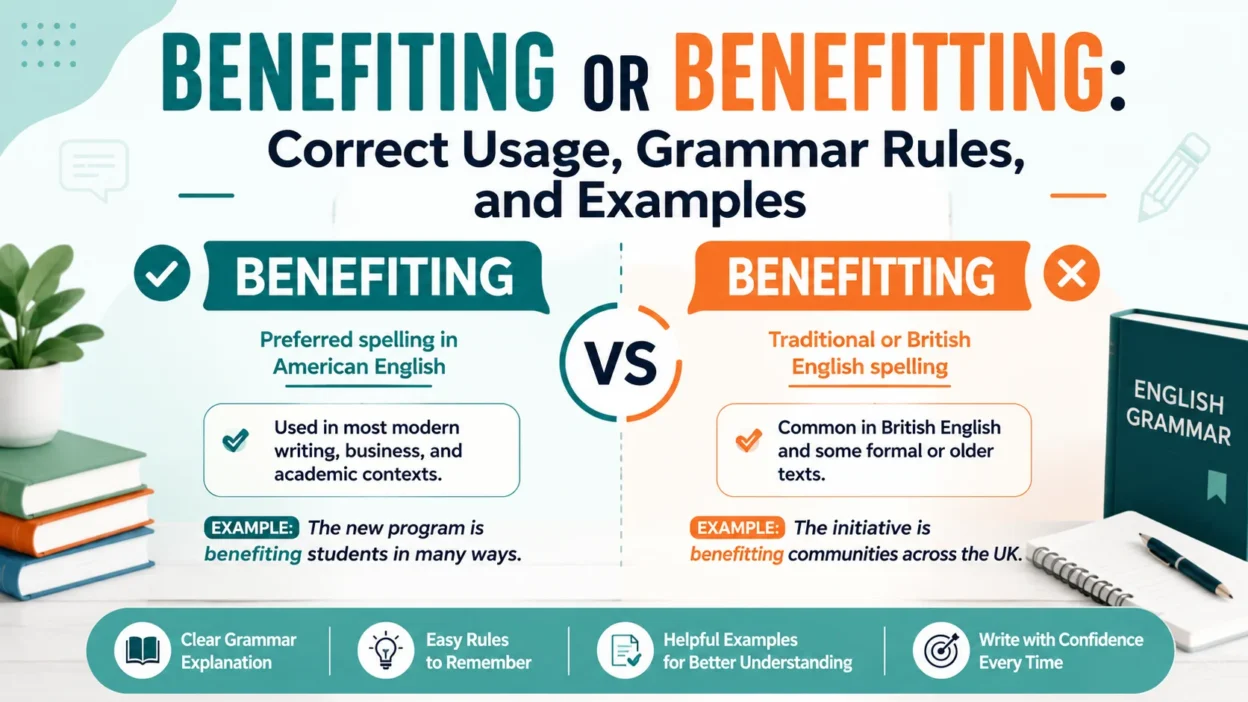
Both benefiting and benefitting come from the verb benefit, but American English usually prefers benefiting, while British English may use benefitting as well. The difference comes from spelling rules about doubling a final consonant before adding -ing. Looking at examples in trusted dictionaries helps you understand which variant fits your audience and keeps your communication clear.
If you write emails, reports, essays, blog posts, or other professional documents, choosing one spelling and using it consistently improves readability and builds confidence. I always check the expected style before editing because regional preferences matter. Once you understand the rule, the confusion disappears, your grammar becomes stronger, and your writing looks polished and accurate.
Benefiting or Benefitting: The Quick Answer
If you need a simple rule, use this:
| Spelling | Correct? | Recommended Use | Example |
| Benefiting | Yes | Standard spelling in American English and the most common form overall | “Employees are benefiting from the new training program.” |
| Benefitting | Sometimes accepted | Less common variant, mainly used in some British English contexts | “The company is benefitting from increased customer demand.” |
For most readers, benefiting will look more natural.
If you are writing for an American audience, use benefiting almost every time.
Examples:
✅ Correct:
“Students are benefiting from smaller class sizes.”
✅ Correct:
“The company is benefiting from improved technology.”
⚠️ Less common:
“Students are benefitting from smaller class sizes.”
The meaning does not change. Only the spelling changes.
What Does Benefiting Mean?
Before comparing benefiting vs. benefitting, it helps to understand the word itself.
Benefiting is the present participle form of the verb benefit. It describes receiving an advantage, improvement, help, or positive result.
The word can describe people, businesses, organizations, communities, or even ideas.
Examples:
- “She is benefiting from regular exercise.”
- “Small businesses are benefiting from online sales.”
- “The community is benefiting from the new public transportation system.”
The word benefit can also function as a noun.
Examples:
- “One benefit of remote work is flexibility.”
- “The health benefits of regular sleep are well documented.”
The difference is simple:
| Word Form | Meaning | Example |
| Benefit (noun) | An advantage or positive result | “The benefit of this plan is lower costs.” |
| Benefit (verb) | To receive an advantage | “Many people benefit from this service.” |
| Benefiting | Currently receiving an advantage | “Many people are benefiting from this service.” |
| Benefited | Received an advantage in the past | “Many people benefited from this service.” |
Why Is Benefiting Spelled With One “T”?
The biggest reason people wonder about benefiting or benefitting is the English consonant-doubling rule.
English often doubles the final consonant when adding -ing.
Examples:
- Run → running
- Sit → sitting
- Stop → stopping
- Plan → planning
So why not:
- Benefit → benefitting?
The answer involves syllable stress.
The word benefit has three syllables:
BEN-e-fit
The stress falls on the first syllable:
BEN-e-fit
Because the final syllable is not stressed, English normally does not double the final consonant.
That gives us:
✅ benefit → benefiting
rather than:
❌ benefit → benefitting
A similar pattern appears in other words:
| Base Word | Correct -ing Form | Incorrect Form |
| Visit | Visiting | Visitting |
| Open | Opening | Openning |
| Offer | Offering | Offerring |
| Benefit | Benefiting | Benefitting |
The spelling follows the sound pattern of English rather than simply adding another letter.
The English Rule Behind Benefiting vs. Benefitting
English spelling rules are not always perfect. They developed over centuries from different languages, including Old English, French, Latin, and Greek.
The consonant-doubling rule mainly applies when a short word ends with a stressed consonant-vowel-consonant pattern.
For example:
One-syllable words
These usually double the final consonant:
- Hop → hopping
- Drop → dropping
- Swim → swimming
The structure looks like this:
Consonant + vowel + consonant
Example:
hop
h = consonant
o = vowel
p = consonant
Add -ing:
hop → hopping
Multi-syllable words
Longer words usually double the consonant only when the final syllable carries stress.
Examples:
- Begin → beginning
- Prefer → preferring
Why?
Because the stress falls at the end:
be-GIN
pre-FER
But:
BEN-e-fit
The stress does not fall on “fit,” so the consonant usually stays single.
Is Benefitting Ever Correct?
Yes, but it is much less common.
Some dictionaries list benefitting as an accepted spelling variation. It appears occasionally in British English and other English-speaking regions.
However, acceptance does not always mean preference.
Many English words have multiple accepted spellings, but one version usually becomes dominant.
Examples:
- Color / Colour
- Theater / Theatre
- Traveling / Travelling
- Benefiting / Benefitting
Both may appear in writing, but usage patterns differ by region.
For most modern American writing:
Benefiting wins.
Benefiting vs. Benefitting in American English
American English strongly favors the single “t” spelling.
Major publications, businesses, schools, and online platforms typically use:
✅ benefiting
Examples:
- “Customers are benefiting from faster delivery.”
- “Employees are benefiting from improved workplace policies.”
- “The company is benefiting from strong market growth.”
Using benefitting in an American document may not make the sentence wrong, but many readers will notice it as unusual.
Think of it like wearing a formal suit to a casual event. Nobody may criticize it, but it stands out.
Benefiting vs. Benefitting in British English
British English is more flexible with some doubled consonant forms.
You may see:
- Travelling
- Modelling
- Cancelled
However, benefiting remains widely used in British English too.
The choice depends on the writer, publication, and style preference.
For example:
A British newspaper may use:
“The organization is benefiting from increased investment.”
Another writer may choose:
“The organization is benefitting from increased investment.”
Both communicate the same idea.
The important thing is consistency.
Benefiting vs. Benefited: What Is the Difference?
Another common mistake involves confusing benefiting and benefited.
The difference is time.
Benefiting = happening now
Use benefiting when someone or something currently receives an advantage.
Examples:
- “The company is benefiting from new technology.”
- “Students are benefiting from online resources.”
- “The environment is benefiting from conservation efforts.”
The action is ongoing.
Benefited = happened in the past
Use benefited when the advantage already happened.
Examples:
- “The company benefited from strong sales last year.”
- “Thousands of people benefited from the program.”
- “The town benefited from the new highway.”
A simple timeline:
| Time | Word | Example |
| Past | Benefited | “The project benefited the community.” |
| Present | Benefiting | “The community is benefiting from the project.” |
| Future | Will benefit | “The community will benefit from the project.” |
How to Use Benefiting Correctly in a Sentence
The best way to understand a word is to see it in action.
Business Examples
Businesses often use benefiting when describing growth, improvements, or advantages.
Examples:
- “Small businesses are benefiting from digital payment systems.”
- “Companies are benefiting from automation tools.”
- “Retailers are benefiting from changing customer habits.”
Education Examples
Schools and students often benefit from new resources.
Examples:
- “Students are benefiting from personalized learning programs.”
- “Teachers are benefiting from better classroom technology.”
- “Schools are benefiting from increased funding.”
Technology Examples
Technology creates many situations where people or companies gain advantages.
Examples:
- “Businesses are benefiting from artificial intelligence tools.”
- “Consumers are benefiting from faster internet speeds.”
- “Developers are benefiting from improved software platforms.”
Everyday Examples
The word also works in normal conversations.
Examples:
- “I’m benefiting from having more time to prepare.”
- “You’re benefiting from the experience you gained.”
- “Many people are benefiting from healthier routines.”
Common Mistakes When Writing Benefiting
Many writers confuse benefiting with similar forms like benefitting or use it incorrectly in a sentence. In American English, benefiting (with one t) is the standard spelling because the final consonant isn’t doubled when adding -ing. Another common mistake is using benefiting without clearly stating who or what receives the benefit, which can make the sentence vague. To keep your writing clear, use benefiting only when the context makes the advantage or recipient obvious.
Mistake 1: Automatically Doubling the “T”
Many writers think:
“Benefit ends in T, so adding another T must be correct.”
That assumption causes the spelling mistake.
The correct form is:
✅ benefiting
Not:
❌ benefitting
Mistake 2: Thinking More Letters Mean More Correct
English spelling does not always work that way.
Adding extra letters does not make a word more formal or accurate.
For example:
- Benefit → benefiting
- Not → benefitting
Simple spelling is often the correct spelling.
Mistake 3: Mixing Both Spellings
A document should not switch between:
- benefiting
- benefitting
Choose one style and keep it consistent.
Mixed spelling makes writing look less polished.
How to Remember the Correct Spelling of Benefiting
A simple memory trick:
Benefit keeps its single “t” when it becomes benefiting.
Think:
“The benefit is already complete. It doesn’t need an extra T.”
Another trick:
Remember similar words:
- Visit → visiting
- Profit → profiting
- Benefit → benefiting
They follow the same pattern.
Benefiting or Benefitting: Which One Should You Use in Professional Writing?
Choosing between “benefiting” or “benefitting” can be confusing, especially in professional writing where spelling accuracy matters. Both forms are considered correct, but “benefiting” is the more widely accepted and preferred spelling, particularly in American English. Understanding the difference helps you write clearly and confidently in emails, reports, articles, and business documents.
Benefiting
Why?
- It is more common.
- It matches American English conventions.
- Most readers expect it.
- It avoids unnecessary spelling questions.
Examples:
Good resume wording:
- “Created training programs benefiting more than 500 employees.”
- “Developed systems benefiting customer service operations.”
Good business writing:
- “The company is benefiting from increased efficiency.”
Conclusion
Choosing between Benefiting or Benefitting is easier once you know the spelling rules behind each form. Benefiting is the preferred spelling in American English, while Benefitting is also accepted in British English. Neither is automatically wrong—the best choice depends on your audience and the style guide you follow. By staying consistent and checking regional preferences when needed, you can write with greater confidence and avoid unnecessary spelling mistakes.
FAQs
Q1. Which is correct: Benefiting or Benefitting?
Both spellings are correct. Benefiting is more common in American English, while Benefitting is also used in British English.
Q2. Why are there two spellings of the same word?
The difference comes from regional spelling conventions and rules about doubling the final consonant before adding -ing.
Q3. Is “Benefitting” wrong?
No. Benefitting is an accepted spelling, especially in British English. However, it is less common in American English.
Q4. Should I use Benefiting or Benefitting in professional writing?
Use the spelling that matches your audience or your organisation’s style guide. Consistency throughout the document is more important than switching between the two.
Q5. How can I remember which spelling to use?
If you write primarily for an American audience, use Benefiting. If you follow British English conventions, Benefitting may also be appropriate. When in doubt, check the dictionary or style guide you are using.