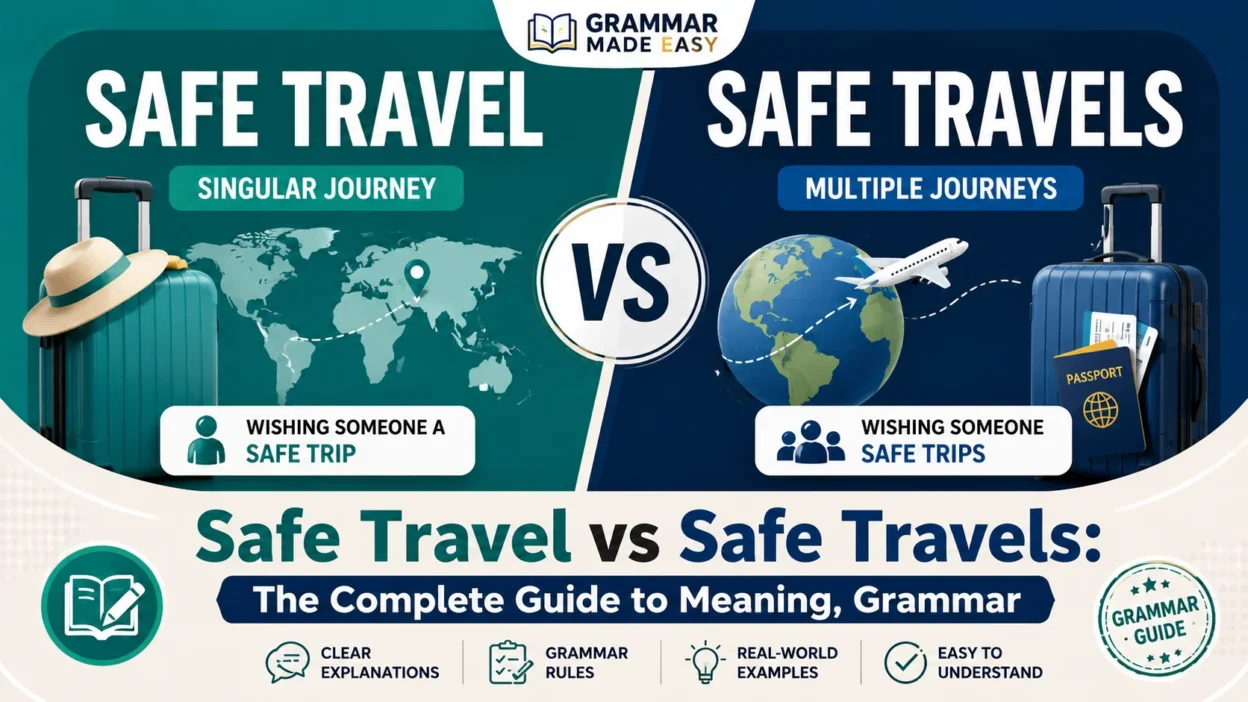
Safe Travel vs Safe Travels is a common question when people want to send a warm wish before someone leaves for a trip, and the first choice depends on context, tone, and meaning. Many English speakers use safe travels as a natural expression when saying goodbye, while safe travel often refers to the general idea of secure journey experiences. Both phrases are understandable, but choosing the right words can make your message sound more thoughtful and appropriate.
In everyday communication, safe travels feels more personal because it connects with the different moments of a person’s trip, including the beginning, stops, and arrival. I have noticed while editing emails, professional documents, and casual messages that a simple phrase can change the warmth of a sentence. Using the correct travel expression helps create better connection, shows care, and adds a friendly tone to a farewell.
When writing for different situations, consider your audience and the purpose of your message. A professional email may need a polished style, while a personal note can use a warmer approach. Understanding this small grammar difference improves confidence and helps you choose language that sounds natural, clear, and meaningful.
Safe Travel vs Safe Travels: Quick Answer
If someone is leaving for a vacation, business trip, flight, road trip, or international journey, the natural phrase is:
“Safe travels!”
It works like other friendly expressions such as:
- “Best wishes!”
- “Congratulations!”
- “Happy holidays!”
- “Good luck!”
The plural form feels like a complete farewell wish. It covers the entire experience, including the trip, the journey, and everything that happens along the way.
On the other hand, “safe travel” usually describes the idea of traveling safely.
For example:
| Phrase | Meaning | Example |
| Safe travels | A personal wish for someone’s journey | “Have a great vacation. Safe travels!” |
| Safe travel | The concept of traveling safely | “These tips encourage safe travel during winter.” |
A simple way to remember the difference:
Safe travels = speaking to a traveler.
Safe travel = speaking about travel safety.
What Does “Safe Travels” Mean?
The phrase “safe travels” means “I hope your journey goes safely and smoothly.”
People usually say it when someone is about to leave or has already started a journey.
Examples:
- “Enjoy your trip to Italy. Safe travels!”
- “Thanks for visiting. Safe travels home!”
- “Good luck with your move. Safe travels to your new city.”
Although travels is plural, it does not necessarily mean someone is taking several separate trips.
English often uses plural words in expressions that represent a broader experience.
For example:
- “Best wishes” does not mean you have many wishes.
- “Congratulations” does not mean someone is congratulating you multiple times.
- “Safe travels” does not mean someone must be traveling repeatedly.
The phrase focuses on the whole journey rather than one specific moment.
A flight, a train ride, a road trip, and the arrival at the destination all become part of the “travels.”
What Does “Safe Travel” Mean?
The phrase “safe travel” refers to the practice or concept of traveling safely.
It usually appears in informational, educational, or official contexts.
Examples:
- “Safe travel requires proper planning.”
- “The website provides safe travel advice for tourists.”
- “The company created safe travel guidelines for employees.”
In these examples, the writer is not wishing someone goodbye. Instead, they are discussing travel safety as a topic.
Think about the difference between these two sentences:
“Safe travels on your flight tomorrow.”
This is a personal farewell.
“Safe travel depends on preparation and awareness.”
This is general advice.
The meaning changes because the purpose changes.
Why Is “Safe Travels” More Popular? The Grammar Explained
The popularity of “safe travels” comes from both grammar and tradition.English speakers often use plural forms when talking about experiences, journeys, or repeated possibilities. Over time, some phrases become fixed expressions because people naturally prefer them.
Travel as an Uncountable Noun
The word travel often works as an uncountable noun.
An uncountable noun describes something we think of as a general activity rather than an individual item.
Examples:
- “Travel teaches people about different cultures.”
- “Air travel has become faster and more accessible.”
- “International travel requires preparation.”
In these sentences, travel means the overall activity.
You normally would not say:
- “I enjoy many travels.” ❌
Instead, you would say:
- “I enjoy traveling.” ✅
- “I enjoy travel.” ✅
Because of this, safe travel naturally sounds like a general concept.
Travel as a Countable Noun: “Travels”
The word travels can become countable when it refers to specific journeys or adventures.
Examples:
- “She wrote a book about her travels through Asia.”
- “His travels took him across several continents.”
- “Their travels created unforgettable memories.”
Here, “travels” refers to experiences and journeys.
That idea connects well with the farewell expression:
“Safe travels!”
The phrase carries the feeling of:
“I hope all parts of your journey go well.”
Idiomatic Expressions Matter in English
English is full of phrases that do not follow strict word-for-word logic.
Native speakers often choose expressions because they sound natural, not because they follow a mathematical grammar formula.
Consider:
- “Good luck”
- “Best regards”
- “Many thanks”
- “Happy holidays”
These expressions developed through common usage.
“Safe travels” became popular because it sounds warm, complete, and personal.
Language is not only about rules. It is also about patterns people recognize and repeat.
When Should You Use “Safe Travels”?
Use “safe travels” when you want to wish someone a safe and successful journey. It works best when a person is leaving for a trip, vacation, business visit, or long-distance adventure. The phrase has a warm and friendly tone, making it perfect for conversations, messages, emails, and farewell moments. Whether someone is catching a flight or starting a road trip, “safe travels” is a natural way to show you care about their journey.
When Someone Is Leaving for a Trip
This is the most common use.
Examples:
- “Have fun on your vacation. Safe travels!”
- “Enjoy your weekend getaway. Safe travels.”
- “I hope you have an amazing trip. Safe travels!”
It works for almost any type of journey.
When Someone Is Taking a Long Journey
Long-distance travel often makes the phrase feel more appropriate.
Examples:
- Moving to another state
- Flying across the country
- Taking a long road trip
- Traveling for several weeks
Example:
“Congratulations on your new job in California. Safe travels during your move!”
The phrase acknowledges that the journey involves more than simply getting from one place to another.
When Someone Is Traveling Internationally
International trips often involve more planning, uncertainty, and distance.
That makes “safe travels” a thoughtful expression.
Examples:
- “Have an incredible time in Japan. Safe travels!”
- “Enjoy your European adventure. Safe travels and take lots of photos.”
It works well because it sounds caring without being overly formal.
When Writing Emails or Messages
You can use “safe travels” in many professional and personal messages.
Examples:
Professional:
“Thank you for attending the conference. Safe travels home, and we hope to work with you again soon.”
Friendly:
“Have an amazing vacation! Safe travels!”
However, in highly formal writing, alternatives such as “I wish you a safe journey” may sound more suitable.
When You Want a Warm Emotional Tone
“Safe travels” feels more personal than simply saying:
- “Travel safely.”
- “Have a safe trip.”
The phrase carries kindness and goodwill.
It tells someone:
“I hope your journey goes smoothly.”
When Is “Safe Travel” Acceptable?
The phrase “safe travel” is acceptable when you are talking about travel safety as a general idea rather than wishing someone goodbye. It commonly appears in travel guides, safety advice, company policies, and official recommendations. For example, phrases like “safe travel tips” or “safe travel guidelines” describe ways to reduce risks during a journey. While it sounds less personal than “safe travels,” it is the correct choice when discussing travel practices and procedures.
In Travel Safety Advice
When discussing safety practices, “safe travel” is appropriate.
Examples:
- “Safe travel starts with careful planning.”
- “These tips help families enjoy safe travel.”
- “Travel insurance can support safer travel experiences.”
The phrase describes a goal or condition.
In Policies and Guidelines
Organizations often use “safe travel” in official documents.
Examples:
- “Employees must follow safe travel procedures.”
- “The company provides safe travel resources.”
- “The government issued safe travel recommendations.”
Formal documents usually focus on systems and standards rather than personal wishes.
In Corporate and Government Language
Businesses, universities, and government agencies often discuss safe travel as a category.
Examples:
- “The university offers safe travel information for students studying abroad.”
- “The organization created safe travel protocols for employees.”
The singular form fits because the topic is travel safety itself.
When It Modifies Another Noun
“Safe travel” frequently appears before another noun.
Examples:
- safe travel tips
- safe travel checklist
- safe travel practices
- safe travel recommendations
- safe travel guidelines
In these cases, “safe” describes the type of travel.
Common Mistakes With Safe Travel and Safe Travels
Many people confuse “safe travel” and “safe travels” because the difference looks small. The biggest mistake is using “safe travel” as a goodbye phrase, where most native speakers would naturally say “safe travels.” Another common error is assuming “travels” means someone must take multiple trips, when it actually refers to the overall journey experience. Understanding the context makes it easier to choose the right phrase.
Using “Safe Travel” as a Goodbye
This is the most common mistake.
Someone might write:
“Have a great vacation. Safe travel!”
People will understand the meaning. However, it sounds slightly unnatural to many native speakers.
Better options:
- “Safe travels!”
- “Have a safe trip!”
- “Travel safely!”
Assuming “Travels” Means Multiple Trips
The plural form confuses many learners because it seems literal.
However, English expressions often work differently.
“Safe travels” refers to the entire journey experience.
A person can take one trip and still receive the message:
“Safe travels!”
Using Formal Language in Casual Situations
Sometimes people choose “safe travel” because it sounds professional.
However, casual conversations usually need warmth rather than formality.
A friend leaving for vacation would usually hear:
“Safe travels!”
rather than:
“I wish you safe travel.”
Examples of Safe Travels and Safe Travel in Real Sentences
Understanding the difference between “safe travels” and “safe travel” becomes easier when you see them used in real situations. The phrase “safe travels” usually appears in personal messages or farewells, while “safe travel” is more common when discussing travel safety, advice, or guidelines. Here are practical examples that show how each phrase works naturally in everyday English.
Examples of “Safe Travels”
Casual Conversations
- “Have fun at the beach. Safe travels!”
- “Enjoy your trip. Send pictures when you arrive.”
Workplace Messages
- “Thank you for visiting our office. Safe travels back home.”
- “Good luck with your conference presentation. Safe travels.”
Social Media Captions
- “A new adventure begins tomorrow. Safe travels!”
- “Heading somewhere new. Here’s to safe travels and great memories.”
Examples of “Safe Travel”
Travel Articles
- “Safe travel requires awareness, preparation, and flexibility.”
Company Policies
- “Employees should review the safe travel policy before international assignments.”
Educational Resources
- “This guide provides safe travel tips for first-time travelers.”
Safe Travels vs Other Common Travel Expressions
| Expression | Best Used For | Tone |
| Safe travels | General farewell | Warm and friendly |
| Have a safe trip | Direct goodbye | Casual and natural |
| Travel safely | Advice or farewell | Simple and clear |
| Have a safe journey | Longer trips | Slightly formal |
| Bon voyage | Travel farewell | Traditional |
Regional Usage of “Safe Travels”
The phrase “safe travels” is understood across many English-speaking regions.
However, different areas may prefer different expressions.
| Region | Common Expression |
| United States | Safe travels, have a safe trip |
| Canada | Safe travels, travel safely |
| United Kingdom | Safe journey, safe travels |
| Australia | Safe travels, have a good trip |
There is no strict rule that one region owns the phrase. Language changes through everyday communication, media, and culture.
Case Studies: How Context Changes the Phrase
Workplace Email
Situation:
A manager emails an employee traveling for a conference.
Less natural:
“Safe travel to Chicago.”
Better:
“Have a successful conference. Safe travels to Chicago!”
The second version feels more personal.
Airline or Tourism Message
A travel company might say:
“We wish you safe travels.”
This creates an emotional connection.
However, on a safety webpage, the same company might write:
“Follow these safe travel guidelines.”
The purpose determines the phrase.
Government Advisory Document
A government website may discuss:
- Safe travel requirements
- Safe travel recommendations
- Safe travel procedures
It would rarely end a document with:
“Safe travels!”
because official communication usually focuses on information rather than personal greetings.
How to Remember Safe Travel vs Safe Travels
Use this simple rule:
Talking to a traveler? Use “safe travels.”
Talking about travel safety? Use “safe travel.”
Another memory trick:
“Travels” are for people. “Travel” is for policies.
Examples:
✅ “My parents are flying tomorrow. Safe travels!”
✅ “The website offers safe travel advice.”
Conclusion
Understanding Safe Travel vs Safe Travels becomes simple once you know the difference in usage and context. Safe travels is the more common choice for personal wishes, farewells, and everyday conversations, while safe travel is often used when talking about travel safety in a general sense. Both expressions can be understood, but choosing the phrase that matches your audience, tone, and situation makes your communication sound more natural and thoughtful.
FAQs
Q1. Is “Safe Travel” or “Safe Travels” correct?
Both Safe Travel and Safe Travels can be correct, but they are used differently. Safe Travels is more common when wishing someone well before a journey, while Safe Travel usually refers to the idea of traveling safely.
Q2. Why do people say “Safe Travels” instead of “Safe Travel”?
People often use Safe Travels because the plural form sounds more natural as a farewell wish. It suggests the entire travel experience, including different parts of a journey.
Q3. Can I use “Safe Travel” in a message or email?
Yes, but Safe Travels is usually warmer for personal messages, goodbye wishes, and friendly communication. Safe Travel works better when discussing travel safety, advice, or general concepts.
Q4. Is “Safe Travels” grammatically correct?
Yes, Safe Travels is grammatically accepted and widely used in modern English. It has become a common expression among native English speakers.
Q5. Which phrase should I use in professional communication?
For most professional emails and messages, Safe Travels is a suitable choice when wishing someone a good journey. However, always consider your audience, tone, and the purpose of your communication.