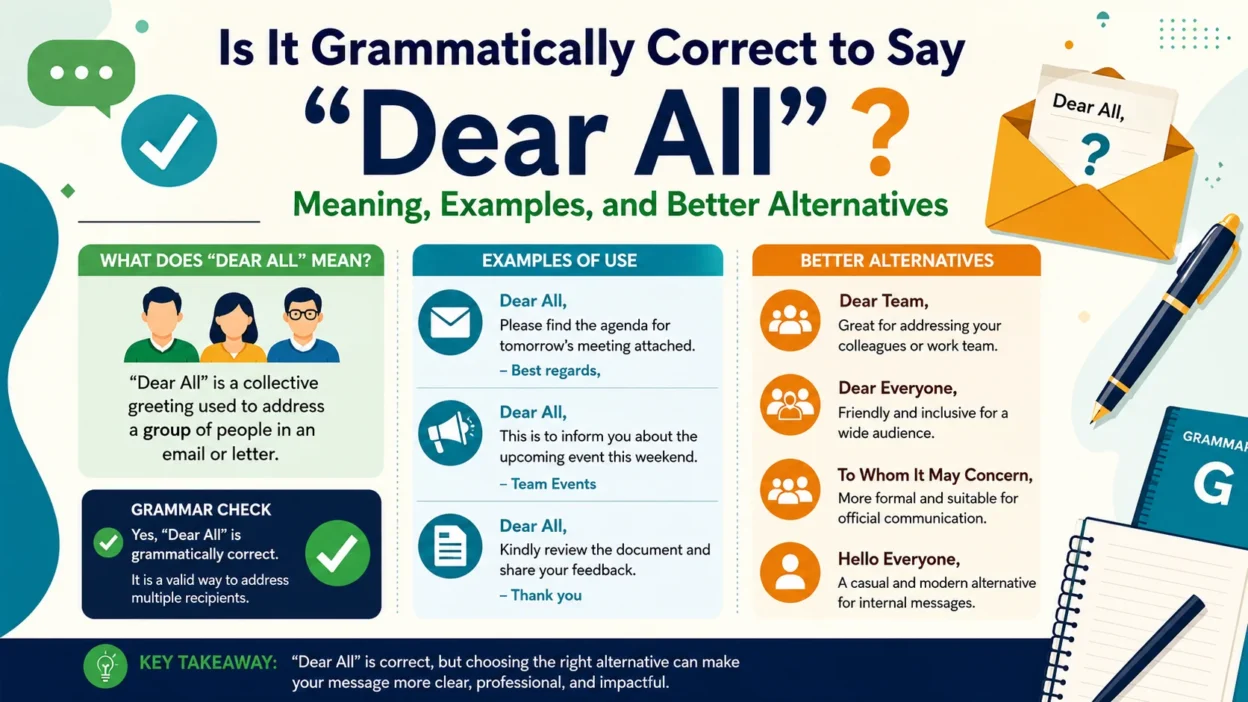
Is It Grammatically Correct to Say “Dear All” is a common question in modern writing, especially when people handle email messages in a business setting and feel unsure while typing greetings like Dear All in real communication flow. In my early writing days, I often found myself hesitating, trying to match the right context and appropriate phrase so the message would not feel off. Over time, I learned it is actually acceptable and correct, depending on the overall goal, level of formality, and how you choose the right greeting for your addressees.
The phrase Dear All include the indefinite pronoun “all,” which can feel both informal and casual in a note and also be a formal approach in a professional setting when addressing group communication. In digital spaces, people focus on clarity, connection, and inclusivity, which leads to stronger participation and smoother correspondence. That’s why greetings like Hello Everyone, Greetings Team, Hi All, Attention Everyone, To the Group, and Greetings All are used based on context-dependent usage. The choice shapes tone, builds message structure, and supports respectful, clear intention in emails.
From my own experience, while drafting a memo or writing a printed letter, I realized that different greetings like “Team Members,” “To Whom It May Concern,” or “Warm Regards to All” change how the message feels and improve the welcoming atmosphere. The email recipients, tone, and context-dependent choices help shape better communication in group email situations. A simple, acceptable salutation like “Dear All” still works, but it becomes more effective when aligned with your style, audience, and overall message structure for clear and natural writing.
Quick Answer: Is “Dear All” Correct in English?
Yes, “Dear All” is correct English.
The word “dear” is a traditional salutation used to address someone politely in letters and emails. The word “all” refers to every member of a group. Together, the phrase means the following:
“I am addressing everyone who receives this message.”
From a grammatical standpoint, there is nothing wrong with it.
For example:
- Dear All, Please submit your reports by Friday.
- Dear All, The office will remain closed next Monday.
- Dear All, Thank you for your hard work this quarter.
All of these examples are correct.
However, language isn’t only about grammar. Tone, culture, and context matter just as much.
What Does “Dear All” Mean?
The expression is simply a group greeting.
Instead of addressing one person, the writer addresses everyone in the email at the same time.
Definition and Purpose of the Greeting
“Dear All” is commonly used when:
- Sending emails to a team
- Announcing company updates
- Contacting students or colleagues
- Writing to a group whose individual names are unknown
It functions as a polite introduction before the main message begins.
Why “All” Refers to a Group of Recipients
The pronoun “all” means every person within a specific group.
Examples:
- All employees
- All students
- All customers
- All members
When someone writes “Dear All,” the intended meaning is
Dear everyone reading this email.
How the Expression Became Common in Workplace Emails
The phrase became popular because it is
- Quick
- Inclusive
- Easy to use
- Suitable for large groups
As email became the primary method of business communication, professionals needed a simple way to greet multiple recipients. “Dear All” filled that role.
Is “Dear All” Formal or Informal?
The answer is it falls somewhere in the middle.
It isn’t extremely formal, but it isn’t casual either.
| Greeting | Level of Formality |
| Dear Sir or Madam, | Very Formal |
| Dear Colleagues, | Formal |
| Dear All, | Semi-Formal |
| Hello Everyone, | Neutral |
| Hi Everyone, | Informal |
Using “Dear All” in Formal Communication
You can use it in many professional settings:
- Internal business emails
- Department announcements
- Team instructions
- Committee communications
Example:
Dear All, Please review the updated policy document before our meeting.
Using “Dear All” in Semi-Formal and Casual Emails
It also works in less formal situations.
Example:
Dear All, Thank you for joining yesterday’s workshop.
Situations Where the Greeting Sounds Too Generic
Sometimes the phrase feels impersonal.
Imagine receiving this email:
Dear All, Thank you for your support during this difficult time.
A more personal greeting may sound warmer and more sincere.
When Should You Use “Dear All”?
The phrase works best when addressing groups rather than individuals.
Emails to Team Members
This is probably the most common use.
Example:
Dear All, Please remember to submit your expense reports.
Company-Wide Announcements
Businesses often use the phrase for the following:
- Holiday schedules
- Policy updates
- New procedures
- Office closures
Example:
Dear All, Our offices will close at 3 p.m. on Friday.
Internal Workplace Communication
Managers frequently use “Dear All” because it includes everyone equally.
Messages to Groups Whose Names Are Unknown
Suppose you need to contact twenty participants in a workshop. Typing every name can become impractical.
“Dear All” offers a simple solution.
When Should You Avoid Saying “Dear All”?
Even though the phrase is correct, there are situations where another greeting works better.
Emails to Clients and Customers
Customers often expect a more personalized approach.
Instead of:
Dear All,
Consider:
Dear Valued Customers,
or
Dear Members,
Academic and Professional Correspondence
Professors and researchers usually prefer specific greetings.
Example:
Dear Students,
or
Dear Faculty Members,
Sensitive or Highly Personalized Messages
Bad news, condolences, or personal updates deserve a warmer tone.
Situations Where Individual Names Are Available
If there are only two or three recipients, naming them individually is usually better.
Example:
Dear Sarah and Michael,
This sounds far more personal than “Dear All.”
Why Some People Dislike the Phrase “Dear All”
Despite its popularity, not everyone likes this greeting.
It Can Sound Impersonal
Some readers feel like just another name on a mailing list.
It May Feel Outdated or Bureaucratic
Certain professionals view the phrase as the following:
- Stiff
- Corporate
- Old-fashioned
- Generic
Cultural and Workplace Preferences
Different workplaces have different communication styles.
A technology startup may prefer:
Hi Team,
A law firm may still use:
Dear All,
Neither is wrong.
Better Alternatives to “Dear All”
Sometimes another greeting creates a better impression.
Dear Team,
Excellent for workplace communication.
Example:
Dear Team, congratulations on another successful quarter.
Hello Everyone,
Friendly and professional.
Example:
Hello Everyone, I hope you’re having a great week.
Hi Everyone,
Casual and approachable.
Greetings, Everyone.
Suitable for semi-formal emails.
Good Morning, Everyone
Adds warmth and personality.
Hello Colleagues,
Ideal for professional settings.
Dear Colleagues,
Slightly more formal than “Dear All.”
Dear Students,
Perfect in educational environments.
Addressing a Group by Department or Role
Examples:
- Dear Marketing Team
- Dear Sales Representatives
- Dear Project Members,
Specific greetings usually feel more personal.
“Dear All” vs. “Hello Everyone”: Which Is Better?
Both expressions are correct.
However, they create different impressions.
| Feature | Dear All, | Hello Everyone, |
| Formality | Moderate | Moderate |
| Warmth | Average | High |
| Corporate Feel | Strong | Light |
| Friendliness | Medium | High |
| Modern Usage | Moderate | High |
Which One Should You Choose?
Use “Dear All” when:
- Writing formal internal emails
- Communicating with large teams
- Making announcements
Use “Hello, Everyone” when:
- You want a friendly tone
- The environment is relaxed
- You know the recipients well
“Dear All” vs. “Dear Everyone”
Many people wonder whether these greetings are interchangeable.
Grammatical Differences
Both are grammatically correct.
However, “Dear Everyone” sounds slightly more conversational.
Which Expression Sounds More Natural?
Native English speakers often prefer the following:
- Hello, Everyone
- Hi Everyone
“Dear Everyone” appears less frequently in professional emails.
Which Greeting Do Native Speakers Prefer?
Business communication has gradually shifted toward friendlier language.
As a result, greetings like “Hello, everyone” have become increasingly common.
“Dear All” vs. “Dear Team”
This comparison is especially important in workplaces.
Tone and Inclusiveness
“Dear Team” creates a stronger sense of belonging.
It suggests:
We are working together toward a common goal.
Workplace and Corporate Usage
Many organizations prefer “Dear Team” because it feels collaborative.
Which Greeting Builds Better Rapport?
Generally speaking, Dear Team feels warmer and more engaging.
Examples of “Dear All” in Sentences
Correct Email Examples
Example 1
Dear All, Please review the attached document before tomorrow’s meeting.
Example 2
Dear All, Thank you for participating in the annual survey.
Example 3
Dear All, Our new software system will launch next week.
Professional Announcement Examples
Dear All, The office will remain closed due to severe weather conditions.
Dear All, The training session has been rescheduled.
Examples That Sound Awkward or Inappropriate
❌ Dear All, I appreciate your friendship.
❌ Dear All, I am heartbroken to announce this news.
These situations call for more personal language.
Email Etiquette for Addressing Multiple Recipients
Good email etiquette goes beyond grammar.
Use Names When Possible
Personalized emails usually receive better responses.
Instead of:
Dear All,
Try:
Dear Emma, David, and Sophia,
whenever the group is small.
Match the Greeting to the Audience
Ask yourself:
- Who is reading this?
- How formal should I be?
- What relationship do I have with the recipients?
Consider Company Culture
Every workplace develops its own communication style.
Some companies encourage casual greetings.
Others prefer traditional language.
Keep the Tone Consistent Throughout the Email
Avoid this:
Dear All,
followed by:
Hey guys!
The tone should remain consistent.
Common Mistakes When Using “Dear All”
Using It for One Recipient
This mistake happens surprisingly often.
Incorrect:
Dear All,
when only one person receives the email.
Mixing Formal and Casual Language
Example:
Dear All, What’s up, everyone?
The greeting and message don’t match.
Choosing It for Sensitive Conversations
Empathy often requires a more personal approach.
Overusing Generic Greetings
Readers may become less engaged if every email begins the same way.
Variety keeps communication fresh.
Real-World Case Studies
Case Study One: Corporate Announcement
A company needed to notify 400 employees about a policy update.
Greeting used:
Dear All,
Result:
The message was clear, professional, and efficient.
Case Study Two: Customer Newsletter
A business emailed customers using the following:
Dear All,
Feedback showed the greeting felt impersonal.
The company switched to:
Hello Everyone,
Customer engagement improved.
Case Study Three: Small Team Communication
A manager regularly wrote:
Dear Team,
Employees reported feeling more connected to the organization.
Best Greetings for Different Situations
| Situation | Recommended Greeting |
| Internal company email | Dear All, |
| Team update | Dear Team, |
| Friendly workplace message | Hello Everyone, |
| Customer communication | Dear Valued Customers, |
| Educational setting | Dear Students, |
| Department notice | Dear Marketing Team, |
| Casual group message | Hi Everyone, |
Conclusion
In simple terms, Dear All is grammatically correct and widely used in modern email messages, especially in a business setting. Its effectiveness depends less on grammar and more on context, audience, and level of formality. When used in the right situation, it works as an acceptable salutation that supports clear and inclusive communication, but in more formal cases, alternatives like Dear Team or To Whom It May Concern may feel more appropriate. Choosing the right greeting always helps improve the overall tone, message structure, and professional impact.
FAQs
Q1: Is “Dear All” grammatically correct?
Yes, “Dear All” is grammatically correct and commonly used in both formal and informal emails.
Q2: When should I use “Dear All”?
You can use it when addressing a group email, especially in a general professional setting where tone is neutral.
Q3: Is “Dear All” formal or informal?
It is flexible. It can feel like an informal, casual note in friendly emails or a formal approach depending on context.
Q4: What are better alternatives to “Dear All”?
Alternatives include Hello Everyone, Dear Team, Greetings, Team, or To Whom It May Concern for formal use.
Q5: Why does choosing the right greeting matter?
Because the greeting shapes tone, improves message structure, and ensures clearer communication with the intended audience.