Hullabaloo is a fun word for loud commotion and noise when crowd excitement grows in everyday vocabulary and speech use. It often feels like a sudden burst of uproar that catches attention and adds energy to what people are saying or doing.
In simple English, it describes situations where people gather and a lot of activity and reaction happens at once, like a busy market, a sports game, or a noisy conversation among friends. It shows how quickly a place can turn loud when emotions rise.
This word is used in daily language to describe fuss, public attention, and moments where things become loud or chaotic. It helps explain real-life scenes where everyone is talking, reacting, or moving together in one space.
What Does “Hullabaloo” Mean?
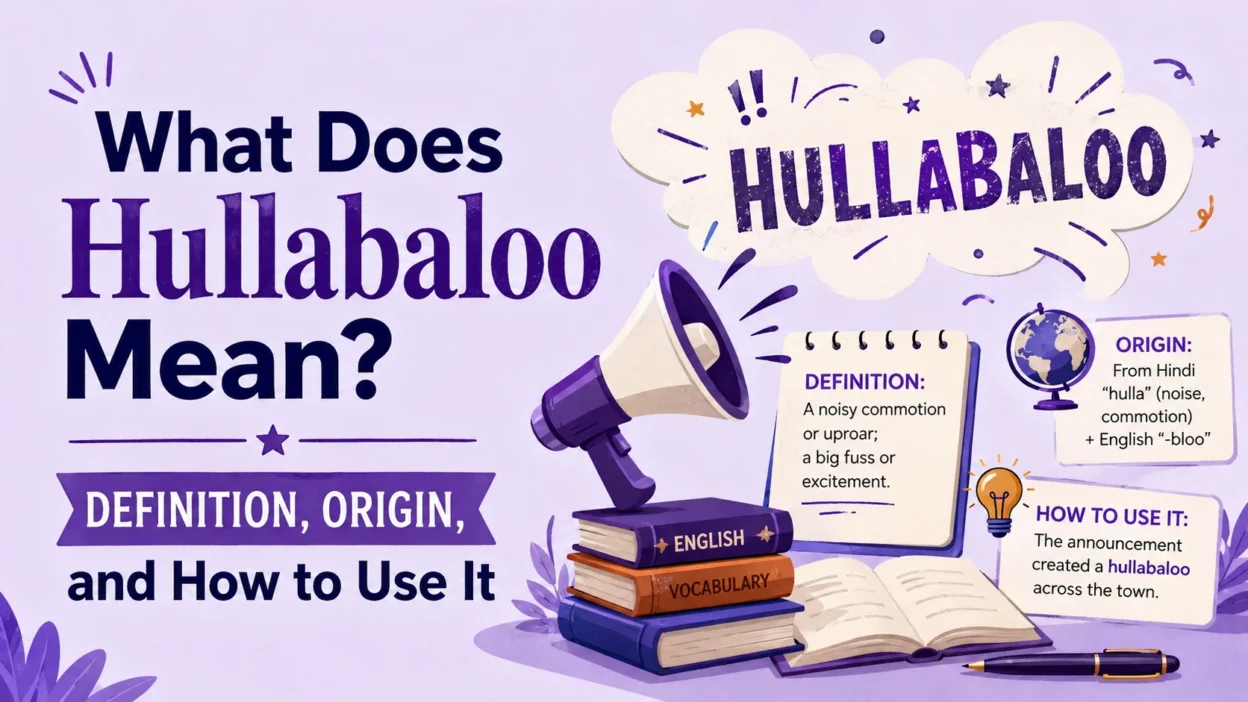
Hullabaloo means a loud commotion, a noisy fuss, or a public uproar. People use it when a situation gets louder, busier, or more chaotic than it needs to be. Think of a room where everyone starts talking at once, or a neighborhood where one small issue suddenly turns into a big scene. That kind of mess is a hullabaloo.
At its core, the word carries the idea of noise plus disorder. It does not just mean sound. It also suggests tension, excitement, or a lot of attention drawn to something that may or may not deserve it.
A simple way to remember it:
- Noise
- Confusion
- Public fuss
- A lot of unnecessary attention
You will often see it used when people want to sound a little playful, amused, or mildly annoyed.
Simple definition
Hullabaloo is a noun that refers to a noisy disturbance or excited uproar.
Part of speech
It is most often used as a noun.
Examples:
- There was a huge hullabaloo after the announcement.
- I don’t know why everyone made such a hullabaloo about it.
- The party ended in a cheerful hullabaloo.
Pronunciation
It is commonly pronounced:
HUL-uh-buh-LOO
A lot of people notice that it sounds almost like the thing it describes. That is part of why it sticks in your head. The word has rhythm. It bounces a little.
Quick meaning in one line
Hullabaloo = a noisy fuss or uproar.
Quick Answer: When People Say “Hullabaloo,” What Do They Usually Mean?
In everyday English, people usually use hullabaloo to describe:
- a public argument
- a lot of loud excitement
- a noisy disagreement
- an exaggerated reaction
- a scene that draws more attention than it should
It can describe something negative, but not always. Sometimes it is used with a light, teasing tone.
For example:
- “There was a hullabaloo at the meeting.”
- “Why all the hullabaloo over a small delay?”
- “The kids caused a hullabaloo in the hall.”
That last example shows something important: the word does not always point to anger. It can simply describe a lively, noisy disturbance.
Origin and Etymology of Hullabaloo
The origin of hullabaloo is a little fuzzy, and that is part of what makes the word interesting. Linguists generally treat it as a colloquial English word that appeared in the 18th century. Its exact roots are uncertain, though it may have developed as an expressive sound word rather than from one neat source.
That matters because some words grow from clear Latin or French roots. Hullabaloo does not behave like that. It feels more like a word that grew out of sound and usage, the way a nickname can stick because it just fits.
What makes the origin uncertain?
Words like this often develop through:
- local slang
- playful sound patterns
- rhyming or reduplication
- shifting spellings over time
Hullabaloo has that kind of energy. It sounds noisy, and that sound may have helped the word survive.
Historical usage
The word appears in older English writing as a term for uproar, clamor, or confusion. Over time, it settled into the same general meaning it carries today.
It has stayed useful because it fills a specific gap. English has lots of words for noise, but hullabaloo adds a little flavor.
Why the word lasted
A word often survives when it does three things well:
- It is easy to say.
- It paints a clear picture.
- It carries an emotional tone.
Hullabaloo does all three.
It is memorable. It is vivid. And it works whether you are talking about a family argument, a media storm, or a classroom disturbance.
A Simple Look at the Word’s Shape and Feel
One reason the word sticks is that it sounds like what it means. English has a few words like that. They do not prove meaning by sound alone, but they often feel natural because the rhythm matches the idea.
Here’s a quick breakdown of why hullabaloo works so well:
| Feature | Why It Helps |
| Repeated vowel sounds | Makes it catchy and memorable |
| Three-syllable rhythm | Gives it a lively, bouncing feel |
| Playful sound | Matches noisy, chaotic situations |
| Slightly old-fashioned tone | Makes it useful in writing and speech |
That sound pattern gives the word personality. It feels less flat than “noise” or “disturbance.” That is why writers and speakers still reach for it.
Definition of Hullabaloo in Modern English
Today, hullabaloo still means a noisy fuss, uproar, or commotion. In modern use, it often suggests that people are reacting too strongly or making too much noise over something.
You might hear it in conversations like these:
- “There was a hullabaloo when the fire alarm went off.”
- “The new policy caused a hullabaloo online.”
- “He didn’t want a hullabaloo about the surprise party.”
The word can describe:
- sound — lots of noise
- behavior — a messy, excited scene
- public reaction — a big stir, especially in media or community settings
Is it positive or negative?
Usually, it leans negative or mildly critical. It often implies disorder, overreaction, or needless fuss.
But that is not the whole story. Sometimes it is neutral. Sometimes it is even affectionate.
For example:
- A parent might say, “The kids made a hullabaloo,” with a smile.
- A journalist might say, “The proposal caused a hullabaloo,” to show public reaction.
- A neighbor might say, “What’s all the hullabaloo?” to express mild irritation.
So the word is flexible. Context does the heavy lifting.
Variations in Spelling and Usage
The standard spelling is hullabaloo.
You may sometimes see it used in slightly different ways in older writing or stylized branding, but the common modern spelling stays the same.
Standard form
- hullabaloo
Common usage patterns
- make a hullabaloo
- cause a hullabaloo
- all the hullabaloo
- a hullabaloo over something
Examples in sentences
- The announcement caused a hullabaloo in the office.
- There was a hullabaloo over the cancelled game.
- I don’t understand all the hullabaloo about it.
A small usage note
People usually use hullabaloo in casual or creative writing, not in technical writing. It adds color. It is a good word when you want your sentence to feel more expressive without sounding formal or stiff.
How to Use Hullabaloo in Daily Conversations
If you want to use hullabaloo naturally, think of situations where people are:
- loud
- agitated
- dramatic
- overly excited
- making a scene
- drawing public attention
The word works especially well when the reaction seems bigger than the event itself.
Everyday conversation examples
- “What’s all the hullabaloo about?”
- “They made a hullabaloo over the schedule change.”
- “There was a hullabaloo in the hallway before class started.”
These examples sound natural because the word fits a real, everyday mess.
Casual conversation
In casual speech, hullabaloo can sound light and conversational.
Examples:
- “The neighbors caused quite a hullabaloo last night.”
- “The whole thing turned into a hullabaloo for no reason.”
- “There was some hullabaloo at the front desk.”
It feels friendly and human. It also keeps the sentence from sounding too dry.
Formal settings
You can use hullabaloo in formal writing, but carefully. It works best when you want to sound readable rather than clinical.
Good uses:
- opinion pieces
- feature articles
- literary writing
- commentary
- journalistic writing with a lively tone
Less ideal uses:
- legal writing
- scientific reports
- highly technical documents
A business report usually sounds better with words like uproar, disturbance, or public reaction.
Tone matters
The same word can feel different depending on context.
| Context | Tone of “Hullabaloo” |
| Family conversation | Light, casual |
| News article | Descriptive, lively |
| Opinion writing | Slightly critical |
| Formal report | Usually too informal |
| Humor writing | Strong fit |
That flexibility makes the word useful. It gives you a way to describe noise and commotion without sounding dull.
What Kinds of Situations Fit the Word Best?
Hullabaloo works best when there is a sense of public fuss, scattered noise, or excited disruption. It is not just about volume. It is about the feeling of a scene.
Good fits
- a crowd reacting loudly
- a small issue getting blown up
- a social media storm
- a family argument that turns noisy
- a classroom disruption
- a neighborhood complaint spreading fast
Poor fits
- a quiet disagreement
- a private, calm discussion
- a serious formal dispute with no noise
- a technical malfunction with no public reaction
That distinction helps you use the word well. Hullabaloo needs movement. It needs energy. It needs some kind of scene.
Mini Case Study: How “Hullabaloo” Changes the Feel of a Sentence
Here is a simple comparison.
Plain version
- There was a big argument about the event.
With “hullabaloo”
- There was a whole hullabaloo about the event.
The second version feels more vivid and more human. It suggests not only conflict but also noise, fuss, and a slightly exaggerated reaction.
Another example:
Plain version
- People reacted strongly to the decision.
With “hullabaloo”
- The decision caused quite a hullabaloo.
That version sounds more conversational. It also creates a stronger mental picture.
That is the real advantage of the word. It gives your writing texture.
A Few Facts About the Word’s Style and Tone
Here are some useful facts to keep in mind:
- Hullabaloo is a real English word, not slang invented yesterday.
- It has a playful sound, which helps it stand out.
- It is usually used as a noun.
- It often suggests public noise or fuss.
- It can sound humorous, slightly old-fashioned, or mildly annoyed.
- It is a strong fit for everyday speech and lively writing.
You can think of it as a word that adds color without being too fancy.
Why People Still Use Hullabaloo
Some words survive because they are efficient. Others survive because they are expressive. Hullabaloo survives for both reasons.
It is efficient because it packs several ideas into one word.
It is expressive because it sounds like a noisy mess.
That combination makes it useful in modern English. You do not need a long explanation when the word does the job quickly.
And honestly, it just sounds fun.
There is a reason writers like words that feel almost musical. They make sentences easier to remember. They also keep the reader awake.
How to Use Hullabaloo Correctly in a Sentence
If you want to use the word naturally, keep these patterns in mind:
Common sentence patterns
- There was a hullabaloo about…
- They made a hullabaloo over…
- The announcement caused a hullabaloo.
- What’s all the hullabaloo?
- He didn’t want a hullabaloo at the event.
Helpful wording choices
Use hullabaloo when you want to suggest:
- excess noise
- public excitement
- unnecessary fuss
- lively disorder
- a noisy reaction
Avoid overdoing it
Because the word has a distinct style, using it too often can make your writing feel forced. One well-placed hullabaloo usually does more work than three repeated ones.
Best Ways to Think About “Hullabaloo”
If you only remember one thing, remember this:
Hullabaloo is what happens when noise, fuss, and public reaction crash into each other.
That is the heart of the word.
It can describe a mess in a room, a stir in the media, or a dramatic overreaction to a small issue. The exact scene changes. The core idea stays the same.
Simple memory guide
- Commotion = generic movement and noise
- Fuss = upset over something small
- Uproar = louder, stronger public noise
- Hullabaloo = noisy fuss with personality
That last one is the key. The word is useful because it carries meaning and mood at the same time.
Key Takeaway
Hullabaloo means a noisy fuss, commotion, or uproar. It is a lively, expressive word that works well in casual conversation, journalistic writing, and creative prose. Its exact origin is uncertain, but its meaning is stable and easy to understand. Use it when you want to describe a noisy scene, a public stir, or a reaction that feels bigger than it should.
In plain English: if something turns into a noisy mess, that is a hullabaloo.
Conclusion
Hullabaloo is a simple but expressive word that captures moments of commotion, noise, and uproar in everyday life. It helps describe situations where people gather, emotions rise, and everything becomes lively, loud, and full of activity. Using this word makes your vocabulary more colorful and natural when talking about real-world scenes.
FAQs
Q1. What does hullabaloo mean?
It means a loud situation with noise, commotion, or confusion caused by many people reacting at once.
Q2. Where is hullabaloo used?
It is used in everyday conversation, writing, books, movies, and news to describe noisy situations.
Q3. Is hullabaloo a formal word?
No, it is more informal and playful, often used in casual vocabulary.
Q4. What are similar words to hullabaloo?
Words like uproar, fuss, and commotion have similar meanings.
Q5. Why do people use the word hullabaloo?
People use it because it clearly describes lively, noisy situations in a colourful and expressive way.