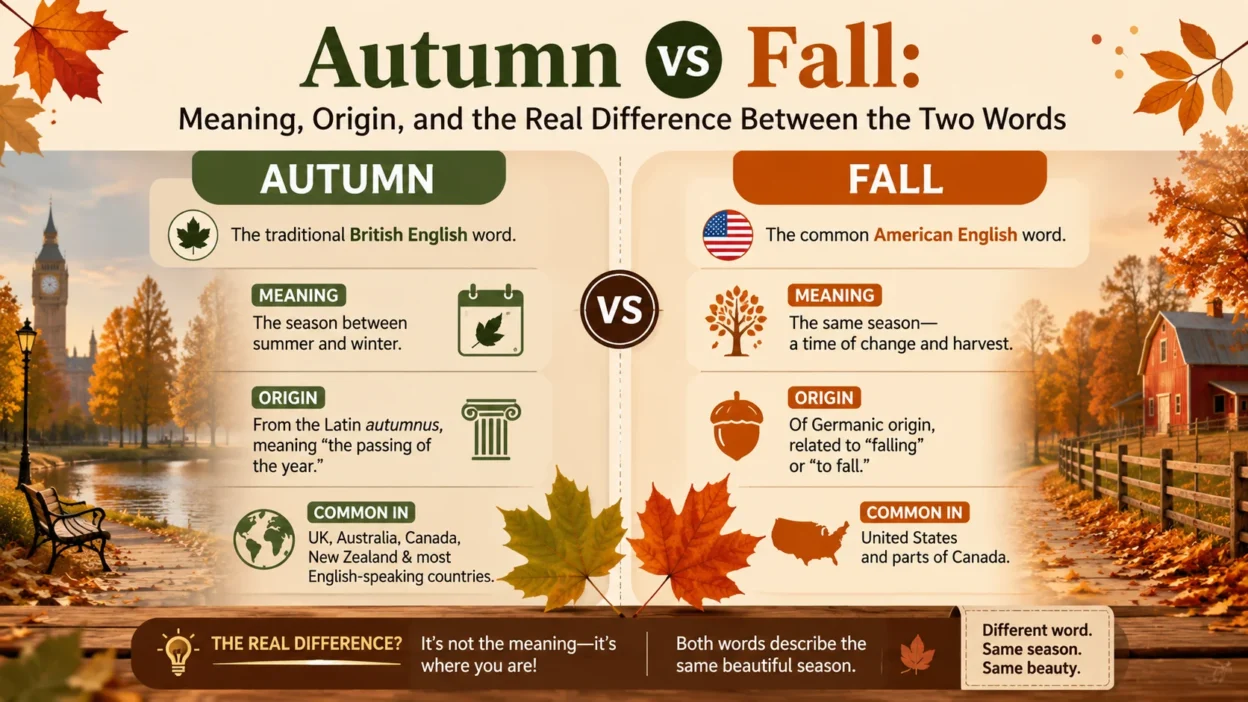
Autumn vs. Fall describes how two accepted names for the same season reflect shared history, language, and regional traditions across English-speaking communities. Although British English more commonly uses autumn and American English often prefers fall, both words correctly identify the season between summer and winter. The arrival of crisp air, colorful foliage, changing leaves, harvest celebrations, pumpkin spice treats, hot cider, and cooler weather creates a cozy atmosphere that people associate with seasonal traditions. These familiar signs also influence everyday conversations, seasonal expressions, and the vocabulary used to describe one of the year’s most recognizable transitions.
The origins of these terms demonstrate how language evolves over time. “Autumn” entered English through the French word “automne,” which originated from the Latin “autumnus,” while “fall” developed from older English expressions such as “fall of the leaf” and “fall of the year.” Historical evidence from the 1300s through the 18th century shows both words becoming well established as English continued to develop. Today, speakers in the United States, Canada, Australia, and the United Kingdom recognize both terms, with regional preferences, local traditions, and usage patterns shaping which word is more commonly chosen in different parts of the English-speaking world.
Examining the two words side by side reveals that they have coexisted for centuries rather than competing with one another. Writers, editors, linguists, and readers continue to compare their meanings, cultural identity, geographical differences, and naming conventions while exploring their influence on modern English. Although some critics once described fall as an American barbarism, historical records show it is an old English term with deep linguistic roots rather than an exclusively American invention. Understanding the evidence behind these names removes unnecessary confusion, encourages informed word choice, and demonstrates how history, culture, and language together shaped the seasonal terms people continue to use today.
Where the Word “Autumn” Comes From
The word “autumn” carries an older, more formal linguistic lineage. It traces back to the Latin word “autumnus,” which referred to the harvest season in the Roman calendar.
From there, the word moved into Old French as autompne, and eventually entered Middle English during the post-Norman Conquest period.
What matters here is not just the route but the context in which it arrived.
When French heavily influenced English after 1066, many refined or academic terms entered the language. “Autumn” became associated with educated writing, literature, and formal documentation rather than everyday speech.
Key points about “autumn”
- Rooted in Latin (autumnus)
- Passed through Old French influence
- Became more common in literary and formal English
- Associated with structure, education, and written tradition
Over time, “autumn” gained a slightly elevated tone. Not necessarily fancy, but more polished. Even today, it often appears in academic writing, poetry, and international English usage.
Where the Word “Fall” Comes From
Now let’s flip the coin.
The word “fall” comes from Old English expressions like “feallan” and later phrases such as “fall of the leaf.” That phrase described exactly what people observed: leaves dropping from trees as seasons changed.
Eventually, English speakers shortened it. “Fall of the leaf” became just fall.
Unlike “autumn,” this word grew directly from everyday speech. No Latin roots. No French refinement. Just plain observation.
Key points about “fall”
- Originates from Old English
- Derived from the phrase “fall of the leaf”
- Became a spoken, practical term
- Strongly tied to natural observation
- Shortened over time for simplicity
This makes “fall” feel more direct and conversational. It sounds like something you’d say without thinking, not something you’d write in a formal essay.
The Historical Split: How One Season Got Two Names
For a long time, English speakers didn’t treat “autumn” and “fall” as strict rivals. In fact, both terms were used in England at different times.
But language doesn’t stay still. It shifts with culture, politics, and education.
By the late Middle English and Early Modern English periods, something interesting happened:
- “Autumn” started appearing more in writing influenced by French and Latin traditions.
- “Fall” remained common in spoken English.
In England, “autumn” gradually became the dominant formal term, while “fall” slowly faded from common British usage.
But across the Atlantic, things took a different turn.
Why America Kept “Fall”
When English settlers arrived in North America, they brought their language with them as it existed at the time. That version of English still used many older expressions that Britain would later replace or refine.
“Fall” was one of those expressions.
In early American English, “fall” stayed natural because
- It was already widely used in spoken English
- It was simple and descriptive
- There was less pressure to align with evolving British formal standards
Then came the influence of language reformers like Noah Webster, who played a major role in shaping American spelling and vocabulary independence in the 18th and 19th centuries.
Webster didn’t invent “fall,” but he reinforced the idea that American English could evolve independently from British norms. That mindset helped preserve many older English forms—including “fall.”
Why “fall” stuck in American English
- It was already part of everyday speech
- American English favored simpler, shorter terms
- Language reform encouraged independence from British usage
- Cultural identity gradually reinforced linguistic separation
So instead of disappearing, “fall” became a defining feature of American English.
A Clear Timeline of Autumn vs. Fall
To make the evolution easier to see, here’s a simplified timeline:
| Period | Event | Language Shift |
| Roman Era | Latin “autumnus” An early-used | Root of “autumn” established |
| Old English period | “Fall of the leaf” used | Early form of “fall” appears |
| 11th–15th century | Norman influence grows | “Autumn” enters English |
| 1500s–1600s | Both terms used in England | Gradual stylistic split begins |
| 1600s–1700s | British English shifts | “Autumn” becomes dominant in the UK. |
| 1700s–1800s | American English stabilizes | “Fall” remains common in the US. |
| Modern era | Global English diversifies | Both terms coexist |
This timeline shows something important: the split wasn’t sudden. It unfolded slowly over centuries.
Why Britain Shifted Toward “Autumn”
In Britain, language trends leaned heavily toward Latin and French influence during the Renaissance and beyond. Educated writers preferred terms that sounded classical or scholarly.
“Autumn” fit that preference perfectly.
Meanwhile, “fall” started to feel less formal in British writing. Over time, it faded from standard usage.
By the 18th century, “autumn” had become the dominant British term in both literature and education.
Why “autumn” won in Britain
- Strong influence of Latin-based academic language
- Preference for formal vocabulary in writing
- Cultural association with literary style
- Gradual disappearance of older English expressions
The Role of Language Identity in the Split
Here’s where things get interesting. The difference between autumn vs. fall is not just linguistic. It’s also cultural.
Language often reflects identity, even when people don’t notice it.
In Britain, “autumn” aligns with a more classical and literary tone. In the United States, “fall” feels grounded, simple, and conversational.
Neither is better. They just reflect different linguistic instincts.
A quick contrast in tone
- Autumn → refined, poetic, traditional
- Fall → direct, casual, practical
Think of it like two outfits for the same season:
- One is a tailored coat for a formal evening
- The other is a warm sweater for a walk outside
Same weather. Different expressions.
A Key Insight Most Explanations Miss
Many explanations stop at “British vs. American English,” but that’s only the surface.
The deeper truth is this:
The split between “autumn” and “fall” reflects how English balances two forces: historical inheritance and everyday speech.
“Autumn” represents borrowed sophistication from Latin and French roots.
“Fall” represents native English simplicity that never disappeared.
Both survived because language doesn’t replace old forms instantly. It layers them.
Why This History Still Matters Today
You might think this is just trivia, but it actually affects modern communication more than you’d expect.
Writers, marketers, and educators choose between these words carefully because
- Audience expectations differ by region
- Tone changes depending on word choice
- SEO and search behavior often reflect local usage
- Literary tone still favors “autumn.”
- Everyday speech leans toward “fall.”
So even today, this old split quietly shapes how people read and respond to language.
Modern Usage of Autumn vs. Fall: Where Each Word Lives Today
The story doesn’t end in history books. It continues in how people actually speak, write, and search for information today. The divide between “autumn” vs. “fall” still shapes tone, audience perception, and even branding choices.
Let’s look at how both words behave in the modern world and why the split still matters.
Where “Autumn” Is Commonly Used Today
You’ll hear “autumn” most often in regions influenced by British English. It also shows up in formal writing almost everywhere in the world, even in countries that typically use American spelling.
Countries and regions where “autumn” dominates
- United Kingdom
- Ireland
- Australia
- New Zealand
- South Africa
- Much of Europe in English-language education
But here’s the twist: even in places that prefer “fall” conversationally, “autumn” still appears in formal contexts.
Where you’ll see “autumn” most often
- Academic writing and research papers
- Literature and poetry
- Government publications
- Travel guides and brochures
- Luxury branding and seasonal campaigns
For example, a travel company might say:
- “Experience the beauty of European autumn landscapes.”
Not “fall landscapes.” That subtle shift changes tone instantly.
Where “Fall” Dominates Today
Now let’s talk about “fall.”
This word thrives in American English, especially in everyday conversation. It feels natural, quick, and easy to say.
Countries where “fall” is dominant
- United States (primary usage)
- Canada (mixed, but “fall” is very common)
In Canada, you’ll often hear both terms, but “fall” appears more frequently in speech, while “autumn” shows up in writing depending on context.
Where you’ll see “fall” most often
- Casual conversation
- Social media posts
- Marketing aimed at American audiences
- Retail promotions (“Fall Sale,” “Fall Collection”)
- Lifestyle content
For example:
- “I love fall weather in October.”
That sentence feels natural in American English, but slightly informal in British English.
Why Tone Changes Everything in Autumn vs. Fall
Here’s where things get interesting. The difference isn’t just regional. It’s emotional.
Words carry tone, and tone affects perception.
“Autumn” feels like:
- Calm and reflective
- Slightly poetic
- Sophisticated
- Literary
“Fall” feels like:
- Casual and friendly
- Direct and simple
- Everyday speech
- Grounded in experience
Think of it like photography styles:
- “Autumn” is a warm, edited magazine cover
- “Fall” is a candid phone snapshot during a walk
Same season. Different lenses.
Autumn vs. Fall in Literature and Writing
Writers don’t choose words randomly. They pick based on mood, rhythm, and audience.
Why writers often prefer “autumn”
Authors and poets lean toward “autumn” because it carries more texture.
You’ll find it in works that aim for emotional depth or imagery, such as the following:
- Poetry collections
- Classic novels
- Reflective essays
- Literary journalism
A line like:
“The autumn light settled softly over the fields.”
feels more atmospheric than
“The fall light settled softly over the fields.”
It’s subtle, but the sound matters.
Why “fall” still appears in writing
Writers use “fall” when they want realism or regional voice.
It appears in:
- Dialogue in American novels
- Contemporary fiction
- Journalism
- Lifestyle writing
Example:
“By fall, the town had already gone quiet.”
It feels grounded and conversational.
Seasonal Language Beyond Autumn vs. Fall
The seasonal vocabulary tied to this debate goes deeper than just one word. Several expressions shift depending on which term you use.
Common “autumn” expressions
- autumn leaves
- autumn breeze
- autumn colors
- autumn harvest
Common “fall” expressions
- fall leaves
- fall colors
- fall breeze
- fall harvest
Notice something important: the meaning doesn’t change. Only the framing does.
Autumnal Equinox: Why “Autumn” Wins in Science
Here’s a detail that often confuses people.
We say “autumnal equinox,” not “fall equinox.”
Why?
Because scientific and astronomical terminology tends to rely on Latin-based naming systems. “Autumnal” comes directly from Latin roots, which makes it the standard in formal scientific language.
What the autumnal equinox actually is
- Occurs around September 22–23 in the Northern Hemisphere
- Day and night are nearly equal in length
- Marks the official start of astronomical autumn
Even in the United States, where people say “fall,” scientific references stick with “autumn.”
That’s a perfect example of how both words coexist without conflict.
Harvest Season and Cultural Meaning
Long before modern language debates, this season carried real agricultural meaning.
Across history, the transition between summer and winter meant one thing: harvest time.
Why harvest matters in both terms
- Crops are collected before winter
- Communities prepare food storage
- Rural economies historically depended on this period
Both “autumn” and “fall” connect to this reality, but through different linguistic paths.
- “Autumn” aligns with structured agricultural calendars
- “Fall” reflects what people literally saw happening in nature
Leaves fall. Crops are gathered. Life changes pace.
Fall Foliage vs. Autumn Colors: A Branding Case Study
One of the clearest modern differences shows up in tourism marketing.
United States tourism example
In the U.S., travel campaigns often use:
- “Fall foliage tours”
- “Best places to see fall colors”
Why?
Because American audiences naturally search for “fall.”
UK and international tourism example
In British or international marketing, you’ll see:
- “Autumn colors in the countryside”
- “Autumn landscapes of Europe”
Same experience. Different keyword strategy.
What this tells us
Language choice isn’t just grammar. It’s behavior-driven.
People search using the words they naturally speak. Marketers follow that pattern closely.
Autumn vs. Fall in Pop Culture
Movies, music, and TV also reflect this split.
“Autumn” in media
- Often used in film titles and poetry-inspired works
- Evokes nostalgia or emotional depth
- Common in European cinema descriptions
“Fall” in media
- Used in American TV episode titles
- Appears in dialogue-heavy storytelling
- Feels modern and conversational
Example usage in storytelling:
- “It all changed that fall.”
- “That autumn changed everything.”
The emotional difference is subtle but powerful.
Why Both Words Still Survive (Instead of One Winning)
Language usually doesn’t eliminate synonyms unless it absolutely has to. Instead, it assigns them roles.
Here’s what happened with Autumn vs. Fall:
| Factor | Autumn | Fall |
| Origin | Latin/French influence | Old English origin |
| Tone | Formal, literary | Casual, conversational |
| Region | UK and global formal usage | US everyday usage |
| Survival reason | Academic and poetic value | Simplicity and habit |
Both words survived because they serve different communication needs.
If one disappeared, English would actually lose nuance.
A Simple Way to Remember the Difference
If you ever hesitate, use this quick rule:
- Use “autumn” when you want elegance, formality, or global neutrality
- Use “fall” when you want simplicity, clarity, or American tone
Or think of it this way:
Autumn is how you describe the season.
Fall is how you talk about it.
Conclusion
Understanding “autumn” vs. “fall” is about more than choosing between two words. It reveals how history, language, culture, and regional preferences influence the way people communicate across the English-speaking world. While British English generally favors autumn and American English commonly uses fall, both terms are correct, widely accepted, and refer to the same beautiful season between summer and winter. By learning their origins, meanings, and usage patterns, you can confidently select the term that best suits your audience and writing style while appreciating the rich linguistic history behind both names.
FAQs
Q1. What is the main difference between autumn and fall?
The primary difference is regional usage rather than meaning. “Autumn” is more common in British English, while “fall” is preferred in American English. Both words describe the same season.
Q2. Which word is older, Autumn or Fall?
Both terms have historical roots in the English language. “Autumn” originated from the Latin word “autumnus” through the French word “automne,” while “fall” evolved from older English phrases such as “fall of the leaf.”
Q3. Is it correct to use “autumn” and “fall” interchangeably?
Yes. “Autumn” and “fall” are interchangeable in most situations because they refer to the same season. The preferred choice usually depends on your audience and regional language conventions.
Q4. Why do Americans say “fall” instead of “autumn”?” fall.”
The word Fall became popular in American English after early English settlers brought the term to North America. Over time, it remained the preferred word in the United States, while Autumn became more common in Britain.
Q5. Which term should I use in my writing?
Choose the word that matches your target audience. If you are writing for readers who use British English, Autumn is generally the better choice. For an American English audience, fall is usually more natural. Both are grammatically correct and widely understood.