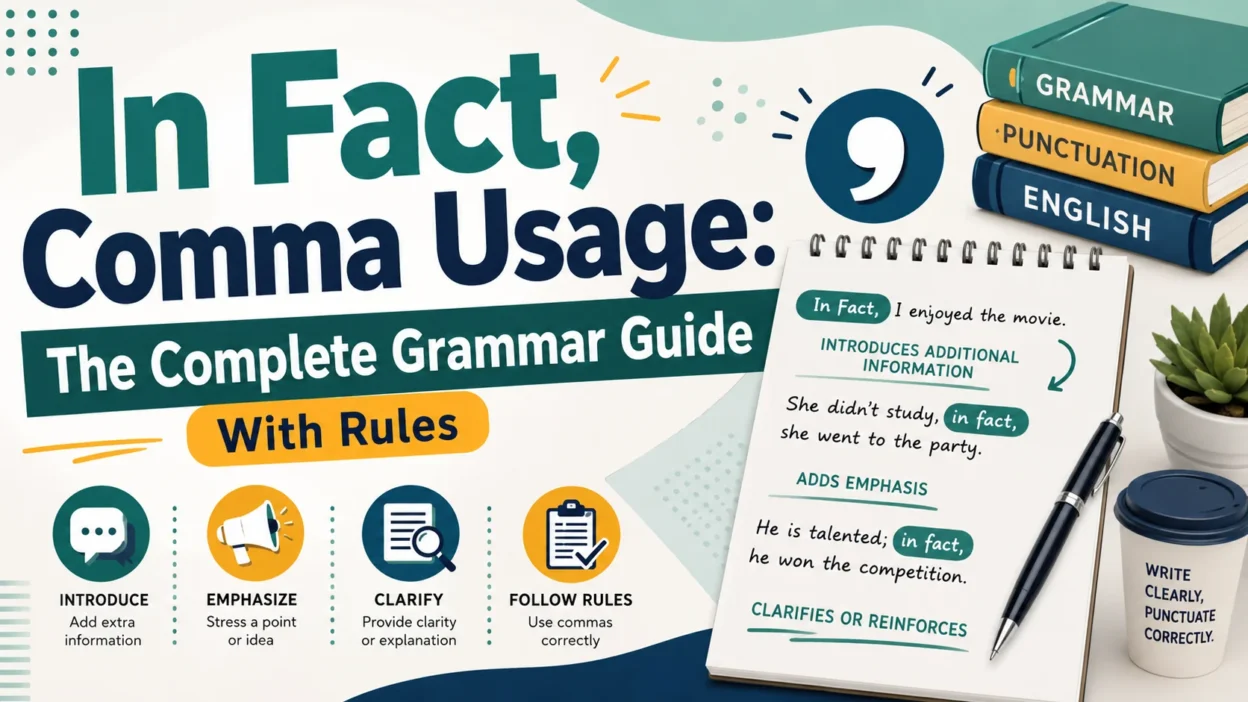
In fact, comma rules are among the most challenging aspects of English grammar, and from my experience with writing and editing, they are one of the most common issues learners face. Many people struggle with commas, punctuation, and proper comma rules when trying to make their sentences clearer and more readable. A strong understanding of grammar and English grammar punctuation helps improve sentence structure, writing flow, and overall clarity in written communication.
When working with the use of commas in list items, such as apples, oranges, and bananas, we separate items in a series using correct punctuation rules. The same applies when using coordinating conjunctions like and, but, and so in compound sentences. For example, I often place a comma before a conjunction when joining two independent clauses to improve clarity and sentence flow.
Another important area is handling nonessential information, including parenthetical information and parenthetical elements. For instance, My brother, a doctor, lives in Boston. The phrase a doctor provides extra information and is correctly set off with commas. The same principle applies to direct addresses, such as Lisa, could you help me?, and to introductory or interrupting elements that make communication clearer. Following these comma rules makes writing more natural, improves readability, strengthens sentence structure, and enhances overall writing flow.
What Does “In Fact” Mean?
Before learning comma rules, it’s important to understand what “in fact” actually means. Many punctuation mistakes happen because writers focus only on the commas instead of the phrase’s purpose.
Simply put, “in fact” introduces information that strengthens, confirms, corrects, or emphasizes what came before it.
Instead of adding a completely new idea, it usually reinforces an existing one.
Consider this example:
She isn’t just a talented writer. In fact, she has published five bestselling novels.
The second sentence doesn’t change the first idea. It makes it stronger by providing convincing evidence.
Definition and Function
The phrase “in fact” acts as a transitional expression or parenthetical expression in many sentences. It helps readers move from one thought to another while emphasizing that the following information is true or more surprising than expected.
Unlike coordinating conjunctions such as and, but, or so, “in fact” does not connect two independent clauses by itself. Instead, it introduces clarification or additional evidence.
You can think of it as saying:
- Actually
- Indeed
- As a matter of fact
- To tell the truth
- The reality is
Although these expressions have similar meanings, each creates a slightly different tone.
When Writers Use “In Fact”
Professional writers commonly use “in fact” for several purposes.
To strengthen a statement
Instead of making a simple claim, the writer provides stronger proof.
Example:
The software is reliable. In fact, it has operated without interruption for three years.
To correct an assumption
Sometimes readers expect one outcome, but the writer reveals something different.
Example:
Many people assume penguins live only in icy climates. In fact, several species thrive in warmer regions.
To introduce supporting evidence
Academic writing often uses “in fact” before statistics or research findings.
Example:
The treatment proved highly effective. In fact, researchers observed improvement in over 90 percent of participants.
To emphasize surprising information
Writers often use the phrase to create impact.
Example:
The hike looked easy. In fact, it became the hardest trail we completed all year.
Examples Across Different Types of Writing
The phrase appears naturally in many forms of communication.
| Writing Type | Example |
| Academic | In fact, previous research supports this conclusion. |
| Business | In fact, quarterly sales exceeded projections. |
| Journalism | In fact, officials confirmed the report yesterday. |
| Conversation | In fact, I’ve already finished it. |
| In fact, the meeting has been moved to Friday. |
Notice how the phrase serves the same purpose in every example: it strengthens or clarifies the statement.
Is “In Fact” a Conjunction, Transitional Phrase, or Parenthetical Expression?
Understanding the grammar behind in fact comma usage makes punctuation much easier.
Many people mistakenly treat “in fact” like a conjunction. It isn’t.
The Grammar Category Explained
“In fact” is generally considered a transitional phrase. Depending on the sentence, it may also function as a parenthetical expression.
A transitional phrase guides readers from one idea to another.
For example:
The project appeared unsuccessful. In fact, it earned record-breaking profits.
Here, “in fact” transitions smoothly between two related ideas.
A parenthetical expression adds extra information that isn’t grammatically essential.
Example:
The proposal, in fact, solved every concern.
The sentence still makes sense without the phrase.
The proposal solved every concern.
Since removing “in fact” doesn’t change the sentence’s core meaning, commas set it apart.
Why Grammar Determines Comma Placement
This principle explains nearly every punctuation rule.
Ask yourself one simple question:
Is “in fact” essential to the sentence’s grammatical structure?
If the answer is no, commas usually surround it.
If the answer is yes, commas often disappear.
Many grammar decisions become much easier once you stop memorizing rules and instead identify the phrase’s function.
Quick Comparison With Similar Expressions
Although these expressions seem interchangeable, each creates a different tone.
| Expression | Primary Purpose | Tone |
| In fact | Strengthens or confirms | Neutral |
| Actually | Corrects or clarifies | Conversational |
| Indeed | Confirms strongly | Formal |
| As a matter of fact | Adds emphasis | Conversational |
| In reality | Contrasts appearance with truth | Neutral |
Consider these examples:
The assignment wasn’t difficult. In fact, it was enjoyable.
The assignment wasn’t difficult. Actually, it was enjoyable.
The meaning remains similar, but the second version sounds more conversational.
The Core Rule Behind In Fact Comma Usage
Fortunately, almost every punctuation decision involving “in fact” follows one guiding principle.
The One Question That Solves Most Cases
Ask yourself:
Can I remove “in fact” without changing the sentence’s essential meaning?
If yes, commas usually belong.
If no, commas may not be necessary.
Professional editors rely on this editing technique because it’s simple and highly reliable.
When You Can Remove the Phrase
Consider this sentence.
Sarah, in fact, finished first.
Remove the phrase.
Sarah finished first.
The meaning stays intact.
Therefore, commas correctly separate the parenthetical phrase.
Another example:
The restaurant, in fact, closes at nine.
Without the phrase:
The restaurant closes at nine.
Again, the sentence remains complete.
When Removing It Changes the Meaning
Occasionally, “in fact” forms part of the sentence’s essential meaning.
Although this usage is less common, commas may disappear because the phrase directly contributes to the sentence’s structure.
For example:
She based her argument in fact rather than speculation.
Removing the phrase creates confusion because “in fact” forms part of the prepositional idea rather than acting as an interrupter.
These cases are relatively rare in everyday writing.
A Simple Decision Framework
You can use this quick editing process whenever you’re unsure.
Step 1
Locate “in fact.”
Step 2
Read the sentence without it.
Step 3
Ask whether the sentence still works naturally.
Step 4
If it does, use commas where appropriate.
Step 5
If removing it damages the sentence’s structure, reconsider the punctuation.
This five-second test prevents most comma mistakes.
In Fact Comma Usage at the Beginning of a Sentence
One of the easiest punctuation rules involves introductory placement.
When “in fact” begins a sentence and introduces the main clause, a comma almost always follows it.
The Standard Rule
Use a comma immediately after “in fact” when it appears at the beginning of a sentence.
Examples:
In fact, the results exceeded everyone’s expectations.
In fact, the solution had been available from the beginning.
In fact, most native speakers use this construction naturally.
The comma signals a brief pause before the main idea begins.
Why the Introductory Comma Matters
English frequently places commas after introductory words and phrases.
Readers naturally pause after introductory elements because they prepare the reader for the sentence’s main point.
Without the comma, the sentence feels rushed.
Compare these versions.
Correct:
In fact, nobody noticed the mistake.
Less natural:
In fact nobody noticed the mistake.
Although readers still understand the meaning, the missing comma interrupts the expected rhythm.
Correct Examples
These examples follow standard punctuation conventions.
In fact, the evidence strongly supports the conclusion.
In fact, she completed the marathon despite the heavy rain.
In fact, customer satisfaction reached its highest level this year.
In fact, the repairs cost less than expected.
Notice that every sentence introduces additional proof or clarification.
Incorrect Examples
These sentences contain common punctuation errors.
Incorrect:
In fact the meeting ended early.
Correct:
In fact, the meeting ended early.
Incorrect:
In fact the company hired fifty new employees.
Correct:
In fact, the company hired fifty new employees.
The missing comma creates a subtle reading interruption.
Rare Exceptions
English punctuation isn’t entirely rigid.
Very short introductory expressions sometimes appear without commas in advertising, headlines, social media posts, or creative writing.
Examples:
In fact everyone agreed.
In fact nobody complained.
These omissions reflect stylistic choices rather than standard grammar.
For formal writing, academic papers, business communication, journalism, and professional emails, including the comma remains the safest and clearest option.
In Fact Comma Usage in the Middle of a Sentence
The middle of a sentence is where most punctuation mistakes occur.
Some writers automatically place commas around “in fact.” Others never do. Neither approach works consistently because the correct punctuation depends on the phrase’s grammatical role.
When “In Fact” Needs Two Commas
When “in fact” interrupts the sentence as additional information, place a comma before and after it.
Think of the phrase as a guest visiting the sentence rather than someone who lives there permanently.
For example:
The committee, in fact, approved every recommendation.
The sentence still works perfectly without the interruption.
The committee approved every recommendation.
The commas simply mark the brief interruption.
Additional examples include:
The report, in fact, answered every question.
Our neighbors, in fact, had already moved.
The software, in fact, required no installation.
This punctuation creates a smooth reading experience and clearly separates the parenthetical expression from the main clause.
When No Commas Are Needed
Although less common, “in fact” does not always function as a parenthetical expression.
Sometimes it becomes part of the sentence’s essential meaning rather than an interruption.
For example:
Their decision rested in fact rather than opinion.
Here, “in fact” belongs directly to the grammatical structure.
Adding commas would interrupt the intended meaning.
Another example:
The distinction exists in fact not merely in theory.
These constructions appear more often in formal or philosophical writing than in everyday English.
Because most uses of “in fact” are parenthetical, writers should avoid assuming that commas never matter—or that they always do. The sentence itself provides the answer.
Restrictive vs. Nonrestrictive Use of “In Fact”
One of the easiest ways to master in fact comma usage is to understand the difference between restrictive and nonrestrictive elements.
A restrictive element provides information that is necessary to the sentence’s meaning. Removing it changes or weakens the message.
A nonrestrictive element adds extra emphasis or clarification. You can remove it without changing the sentence’s core meaning.
Most uses of “in fact” are nonrestrictive.
Compare these examples.
Nonrestrictive
The proposal, in fact, saved the company thousands of dollars.
Without the phrase:
The proposal saved the company thousands of dollars.
The sentence still communicates the same basic idea.
Restrictive
Their claim exists in fact rather than theory.
Removing “in fact” changes the intended meaning because the writer is contrasting fact with theory.
Knowing this distinction helps you avoid relying on guesswork.
Side-by-Side Examples
The following comparisons make the difference easier to spot.
| Sentence | Correct? | Why |
| The movie, in fact, won three awards. | ✅ | Parenthetical phrase that adds emphasis. |
| In fact, the movie won three awards. | ✅ | Introductory transitional phrase. |
| The movie won three awards, in fact. | ✅ | Phrase emphasizes the previous statement. |
| The argument rests in fact rather than assumption. | ✅ | Essential part of the sentence. |
| The argument rests, in fact, rather than assumption. | ❌ | Commas interrupt the grammatical structure. |
Looking at complete sentences instead of isolated rules makes punctuation much easier to understand.
A Quick Editing Test
Whenever you edit your work, try this simple exercise.
Read the sentence aloud once with “in fact.”
Then read it again without the phrase.
If the sentence still sounds complete, commas usually belong.
If removing the phrase makes the sentence awkward or changes its meaning, commas may not be appropriate.
Professional editors use this technique every day because it works consistently across many punctuation situations.
In Fact Comma Usage at the End of a Sentence
Most discussions about in fact comma usage focus on the beginning or middle of a sentence. However, writers also place the phrase at the end.
Although this position is less common, it follows a clear punctuation pattern.
The Standard Rule
When “in fact” appears at the end of a sentence as an emphasizing expression, place a comma before it.
Examples:
The project finished ahead of schedule, in fact.
Nobody expected the outcome, in fact.
She had already solved the problem, in fact.
The comma signals that the phrase comments on the entire statement rather than functioning as part of the clause.
Examples That Sound Natural
Consider these examples.
He knew the answer all along, in fact.
They had never visited the museum, in fact.
The repairs cost less than expected, in fact.
Notice that the phrase reinforces what came before it.
How End Placement Changes Emphasis
The placement of “in fact” influences rhythm and emphasis.
Compare these sentences.
Beginning:
In fact, the restaurant has expanded twice this year.
Middle:
The restaurant, in fact, has expanded twice this year.
End:
The restaurant has expanded twice this year, in fact.
Each sentence conveys nearly the same information.
The difference lies in where readers naturally place emphasis.
Beginning placement prepares readers for stronger evidence.
Middle placement creates a brief interruption that highlights the phrase.
Ending placement allows the statement to stand first before adding confirmation.
Does Comma Placement Change the Meaning?
One of the biggest misconceptions about punctuation is that commas only affect pauses.
In reality, punctuation often changes emphasis, rhythm, and even interpretation.
With “in fact,” the wording may stay the same while the reading experience changes considerably.
Same Words, Different Emphasis
Consider these examples.
In fact, she completed the project early.
The emphasis immediately signals that surprising information is coming.
Now compare it with:
She, in fact, completed the project early.
Here, the interruption shifts attention directly onto the subject.
Finally:
She completed the project early, in fact.
This version lets the statement arrive first before adding confirmation.
Although the factual meaning stays consistent, the emphasis changes.
Examples With and Without Commas
Look at these comparisons.
With commas
The proposal, in fact, solved every issue.
Without commas
The proposal in fact solved every issue.
Both versions are understandable.
However, the version with commas follows standard punctuation because “in fact” interrupts the sentence.
Another example:
Correct:
In fact, several experts agreed.
Less polished:
In fact several experts agreed.
The second sentence isn’t difficult to understand. It simply ignores the expected punctuation.
Which Version Sounds More Natural?
Native English speakers generally expect commas whenever “in fact” functions as an introductory or parenthetical expression.
That’s because written English often mirrors natural speech.
When people speak, they usually pause briefly before or around the phrase.
Proper punctuation reflects that rhythm.
In Fact Comma Usage in Different Types of Writing
One interesting feature of “in fact” is its flexibility.
You’ll find it almost everywhere—from scientific journals to casual text messages.
The punctuation rules stay remarkably consistent, but the tone changes depending on the context.
Academic Writing
Researchers frequently use “in fact” to reinforce evidence or introduce supporting findings.
Example:
In fact, multiple independent studies reached the same conclusion.
Academic writing values clarity over dramatic effect.
Because of that, writers should avoid overusing the phrase. One or two carefully placed instances often have greater impact than repeated emphasis.
Business Writing
Professional communication benefits from concise language.
“In fact” works well when highlighting measurable results.
Examples include:
In fact, customer retention increased by 18 percent.
The team, in fact, completed the project ahead of schedule.
Using the phrase sparingly keeps reports and presentations persuasive without sounding exaggerated.
Professional Emails
Business emails often include “in fact” when correcting misunderstandings politely.
For example:
In fact, your order shipped yesterday.
Or:
We have already processed the refund, in fact.
The phrase helps soften corrections while maintaining a professional tone.
Journalism
Reporters use “in fact” carefully because journalism prioritizes objectivity.
Example:
In fact, officials confirmed the information during Monday’s briefing.
Responsible journalism avoids unnecessary emphasis, so the phrase usually appears only when it adds meaningful clarification.
Creative Writing
Novelists use “in fact” to shape dialogue and narration.
Example:
“I wasn’t nervous,” she insisted. “I was excited, in fact.“
Dialogue allows greater flexibility because punctuation often reflects speech patterns.
Everyday Conversation
Spoken English uses “in fact” frequently.
Examples include:
In fact, I’ll come with you.
I already knew that, in fact.
Although everyday speech sometimes ignores commas, standard written English generally includes them.
“In Fact” vs. Similar Transitional Expressions
Many writers treat several transitional expressions as interchangeable.
Although they share similar meanings, subtle differences affect tone, emphasis, and style.
Understanding those differences improves both grammar and word choice.
In Fact vs. Actually
Both phrases clarify or strengthen an idea.
However, actually often corrects someone’s assumption.
Example:
Actually, that’s tomorrow.
“In fact” usually introduces stronger supporting evidence.
Example:
In fact, that’s exactly what the report concluded.
In Fact vs. Indeed
Indeed sounds slightly more formal.
Compare these examples.
The solution worked. Indeed, it exceeded expectations.
The solution worked. In fact, it exceeded expectations.
Both are correct.
The first feels more literary, while the second sounds more natural in modern writing.
In Fact vs. As a Matter of Fact
This expression has nearly the same meaning but creates a more conversational tone.
Example:
As a matter of fact, I’ve already finished.
Compared with:
In fact, I’ve already finished.
The second version is more concise and fits a wider range of writing styles.
In Fact vs. In Reality
These expressions are similar but not identical.
In reality emphasizes contrast between appearance and truth.
Example:
The task seemed impossible. In reality, it took only an hour.
“In fact” strengthens or confirms an idea instead.
Which One Should You Choose?
The table below summarizes the differences.
| Expression | Best Use | Tone |
| In fact | Reinforcing evidence | Neutral |
| Actually | Correcting assumptions | Conversational |
| Indeed | Strong confirmation | Formal |
| As a matter of fact | Casual emphasis | Conversational |
| In reality | Contrasting appearance with truth | Neutral |
Choosing the right transition improves readability just as much as correct punctuation.
Common Mistakes That Hurt Your Writing
Even experienced writers occasionally misuse “in fact.”
Fortunately, most mistakes follow recognizable patterns.
Omitting Required Commas
This is the most common error.
Incorrect:
In fact the report was accurate.
Correct:
In fact, the report was accurate.
Adding Unnecessary Commas
Some writers assume commas belong around every instance.
Incorrect:
The argument rested, in fact, rather than theory.
Correct:
The argument rested in fact rather than theory.
Always examine the sentence’s grammatical structure before adding punctuation.
Treating “In Fact” Like a Coordinating Conjunction
Remember that “in fact” does not replace and, but, or so.
Incorrect:
She finished early in fact she helped everyone else.
Correct:
She finished early. In fact, she helped everyone else.
Or:
She finished early, and in fact, she helped everyone else.
Using “In Fact” Too Frequently
Repeated emphasis quickly loses its power.
Instead of writing:
In fact, the product sold well. In fact, customers loved it. In fact, stores reordered it.
Write:
The product sold well. Customers loved it. As demand increased, stores quickly reordered it.
Variation creates stronger writing.
Placing It in Awkward Positions
Sometimes writers insert “in fact” where it interrupts natural flow.
Awkward:
The new software was installed yesterday in fact by every department.
Better:
In fact, every department installed the new software yesterday.
Or:
Every department, in fact, installed the new software yesterday.
Natural placement improves readability without changing the meaning.
Real Sentence Corrections
Editing real sentences is one of the fastest ways to understand in fact comma usage.
The following examples demonstrate common mistakes and their corrected versions.
Example One: Missing Introductory Comma
Before
In fact many students completed the assignment early.
After
In fact, many students completed the assignment early.
Why it works
The phrase introduces the sentence, so a comma follows it.
Example Two: Missing Parenthetical Commas
Before
The manager in fact approved every request.
After
The manager, in fact, approved every request.
Why it works
The phrase interrupts the sentence rather than forming part of its grammatical structure.
Example Three: Removing Unnecessary Commas
Before
Their conclusion rested, in fact, rather than speculation.
After
Their conclusion rested in fact rather than speculation.
Why it works
Here, “in fact” forms part of the phrase “in fact rather than speculation.” It is essential to the sentence, so commas would interrupt the grammatical structure instead of improving clarity.
Example Four: Improving Word Choice
Sometimes punctuation is correct, but the sentence still feels awkward.
Before
In fact, the restaurant was good. In fact, everyone enjoyed it.
After
The restaurant exceeded expectations. In fact, everyone at the table said they would return.
Why it works
The revised version removes repetition and lets “in fact” emphasize the strongest point instead of repeating the same transition.
Example Five: Revising Formal Writing
Formal writing benefits from concise transitions.
Before
The results were positive. In fact, they were very positive. In fact, every participant improved.
After
The results were overwhelmingly positive. In fact, every participant showed measurable improvement.
Why it works
A single, well-placed transition creates more impact than repeating the same phrase several times.
A Mini Case Study: How One Small Comma Improves Clarity
Imagine two employees writing updates to their manager.
Version One
In fact the client approved every design revision yesterday.
The message is understandable, but the missing comma creates an awkward reading rhythm.
Version Two
In fact, the client approved every design revision yesterday.
The comma creates a natural pause. Readers immediately recognize that the phrase introduces supporting information.
Now consider another example.
Version One
The client in fact approved every design revision yesterday.
Although acceptable in some contexts, many readers hesitate because the sentence lacks punctuation around a parenthetical expression.
Version Two
The client, in fact, approved every design revision yesterday.
The commas clearly identify the phrase as additional information.
What We Learn
The difference may seem small, yet punctuation affects how smoothly readers process information.
Good punctuation doesn’t call attention to itself. Instead, it quietly helps readers understand the writer’s meaning without stopping to interpret the sentence.
Style Guide Recommendations for In Fact Comma Usage
Grammar experts generally agree on how “in fact” should be punctuated when it functions as an introductory or parenthetical expression.
Although different style guides emphasize different writing conventions, their advice is remarkably consistent.
Chicago Manual of Style (CMOS)
The Chicago Manual of Style recommends using commas with introductory and parenthetical transitional expressions whenever they improve readability.
Examples such as the following follow Chicago style.
In fact, the proposal reduced overall costs.
The proposal, in fact, reduced overall costs.
Chicago also encourages writers to avoid unnecessary punctuation when the phrase forms part of the sentence’s essential structure.
AP Style
AP Style follows the same general principle.
Journalists favor punctuation that promotes clarity without adding unnecessary commas.
That means introductory “in fact” almost always takes a comma.
Parenthetical uses normally require commas on both sides.
Merriam-Webster Usage Guidance
Usage experts consistently describe “in fact” as a phrase that introduces clarification, emphasis, or confirmation.
Because readers naturally expect a pause around these functions, commas often improve readability.
Where the Style Guides Agree
Regardless of which guide you follow, these principles remain consistent.
- Use a comma after “in fact” at the beginning of a sentence.
- Use two commas when “in fact” interrupts a sentence as a parenthetical expression.
- Avoid commas when the phrase forms part of the sentence’s grammatical structure.
- Prioritize clarity over mechanical punctuation.
This consistency explains why professional editors rarely disagree about in fact comma usage.
How to Decide in Five Seconds
Even experienced writers occasionally hesitate over punctuation.
Fortunately, you don’t need to memorize dozens of grammar rules.
A simple editing routine solves nearly every case.
The Read-Aloud Test
Read the sentence naturally.
Do you pause briefly around “in fact”?
If so, commas usually belong there.
Example:
The conference, in fact, attracted participants from twenty countries.
Most people naturally pause before and after the phrase.
The Removal Test
Delete “in fact.”
Does the sentence still make complete sense?
If yes, commas usually indicate that the phrase is parenthetical.
Example:
Original:
The report, in fact, answered every question.
Without the phrase:
The report answered every question.
The sentence remains complete.
The Meaning Test
Ask yourself another question.
Does removing “in fact” change the sentence’s essential meaning?
If the answer is yes, commas may not be appropriate.
Example:
The distinction exists in fact rather than theory.
Removing the phrase changes the intended contrast.
The Flow Test
Finally, read the sentence one more time.
Does the punctuation help readers move smoothly through the sentence?
Good punctuation should feel almost invisible.
Quick Reference Table for In Fact Comma Usage
| Situation | Correct Usage | Example |
| Beginning of a sentence | Comma after “in fact” | In fact, the meeting ended early. |
| Middle (parenthetical) | Comma before and after | The meeting, in fact, ended early. |
| Middle (essential phrase) | No commas | Their conclusion rested in fact rather than theory. |
| End of a sentence | Comma before the phrase | The meeting ended early, in fact. |
| Formal writing | Follow standard punctuation | In fact, the evidence supports the claim. |
| Casual writing | Standard punctuation still recommended | In fact, I already knew that. |
| Common mistake | Omitting introductory comma | ❌ In fact the report was correct. |
| Correct revision | Add the comma | ✅ In fact, the report was correct. |
Practice Quiz: Test Your Understanding
Try answering these questions before checking the solutions.
Question One
Which sentence is correctly punctuated?
A. In fact the package arrived yesterday.
B. In fact, the package arrived yesterday.
C. In, fact the package arrived yesterday.
Correct Answer: B
Question Two
Choose the correct sentence.
A. The director in fact approved the budget.
B. The director, in fact, approved the budget.
Correct Answer: B
The phrase interrupts the sentence and should be enclosed in commas.
Question Three
Which sentence correctly uses “in fact” as an essential phrase?
A. Their conclusion rested on faith, in fact, rather than evidence.
B. Their conclusion rested in fact rather than evidence.
Correct Answer: B
Question Four
Which sentence follows standard punctuation?
A. She finished first, in fact.
B. She finished first in fact.
Correct Answer: A
Answer Summary
| Question | Correct Answer |
| One | B |
| Two | B |
| Three | B |
| Four | A |
If you answered all four correctly, you’ve already mastered the most common situations involving in fact comma usage.
Frequently Asked Questions
Do You Always Put a Comma After “In Fact”?
No. You almost always use a comma after “in fact” when it begins a sentence as an introductory phrase.
Example:
In fact, the results were better than expected.
However, if “in fact” forms part of the sentence’s grammatical structure, a comma may not be appropriate.
Can “In Fact” Be Used Without Commas?
Yes.
Although most everyday uses require commas, certain formal constructions do not.
Example:
The distinction exists in fact rather than theory.
In this sentence, the phrase is essential and should not be separated by commas.
Can “In Fact” Start a Sentence?
Absolutely.
Starting a sentence with “in fact” is common in academic writing, journalism, business communication, and everyday English.
Just remember the introductory comma.
Example:
In fact, many experts recommend this approach.
Is “in fact” a transition word?
Not exactly.
It is more accurately described as a transitional phrase because it consists of two words working together to connect ideas and strengthen information.
Is “Actually” the Same as “In Fact”?
Not quite.
Both expressions clarify information, but they create different tones.
Actually often corrects assumptions.
“In fact” usually introduces stronger supporting evidence or emphasizes a statement.
Key Takeaways About In-Fact Comma Usage
Mastering, in fact, comma usage doesn’t require memorizing dozens of punctuation rules. Most situations follow one simple principle: determine how the phrase functions in the sentence.
If “in fact” acts as an introductory or parenthetical expression, commas usually belong. If it forms part of the sentence’s essential grammatical structure, commas usually stay out.
Keep these guidelines in mind whenever you edit your writing:
- Use a comma after “in fact” when it begins a sentence.
- Use two commas when “in fact” interrupts a sentence as extra information.
- Use a comma before “in fact” when it appears at the end of a sentence as an emphasizing expression.
- Avoid commas when the phrase is essential to the sentence’s meaning.
- Read the sentence aloud to check whether the punctuation sounds natural.
- Remove the phrase temporarily to see whether the sentence still works.
- Avoid repeating “in fact” too often because overuse weakens its impact.
- Choose “actually,” “indeed,” or other transitions when they better fit the tone.
Like many punctuation rules, this one becomes easier with practice. The more examples you read and edit, the faster you’ll recognize correct comma placement without stopping to think about it.
Soon, using “in fact” correctly will become second nature, making your writing smoother, clearer, and more professional every time.
Conclusion
Mastering, in fact, comma rules helps you write with greater clarity, confidence, and flow. When you understand how commas work with introductory phrases like in fact, as well as lists, conjunctions, and non-essential information, your sentences become easier to read and more professional. Small punctuation choices may seem minor, but they strongly affect meaning, tone, and readability in everyday writing, academic work, and professional communication.
FAQs
Q1. What are, in fact, comma rules?
They are guidelines that explain when to use commas before, after, or around the phrase “in fact” to make sentences clear and natural.
Q2. Do we always need commas with “in fact”?
No, commas are only used when “in fact” is an interrupting or transitional phrase, not when it directly continues the sentence.
Q3. Where should “in fact” appear in a sentence?
It can appear at the beginning, middle, or end, depending on emphasis, but comma placement changes with its position.
Q4. What happens if I don’t use commas correctly with “in fact”?
Incorrect usage can make sentences sound awkward, confusing, or less professional.
Q5. How can I improve my comma usage with “in fact”?
Practice with examples, read professional writing, and apply simple rules for transitions, emphasis, and sentence flow.