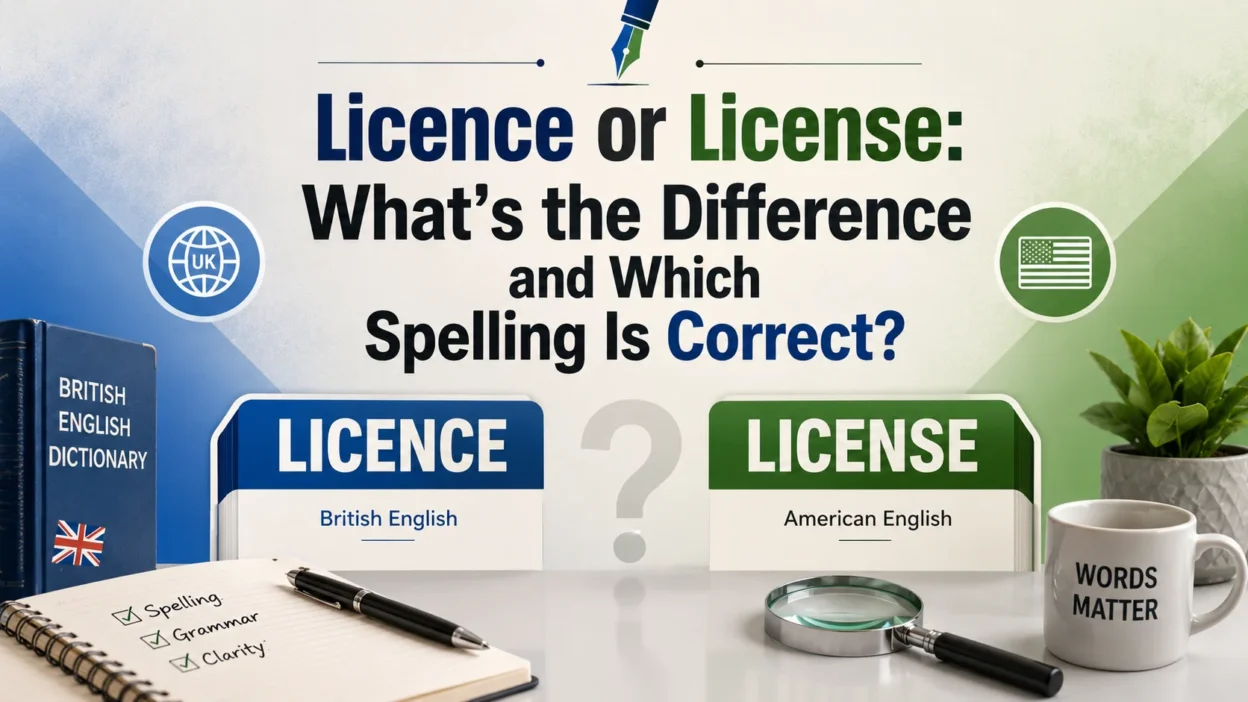
When I first started helping clients in the United States, I noticed how often people mixed up “licence” or “license.” Although the words sound the same, look nearly identical, and have similar spellings, they are not always interchangeable. The right choice depends on British English, American English, the country you are writing for, and the part of speech. Reading English lessons online, checking examples, and practicing regularly helped me avoid errors and remember the correct spelling with confidence.
The key discussion is about grammar and grammatical roles. In British English, “licence” is usually a noun, while “license” is the verb. In American English, “license” works as both a noun and a verb. Whether you are dealing with a driver’s permit, driver’s license, a legal document, or permission from a government or authority to operate a business, knowing the correct form makes your writing more accurate. I have also seen James Bond fans debate Licence to Kill, proving that even famous examples can start conversations about the correct usage.
Working with musicians, TV commercials, music rights, business content, academic work, and software documentation taught me that professional writing depends on understanding, continuous learning, and attention to detail. A good guide with practical examples, practical application, and real situations makes the rule easier to apply. Whether you are a student, professional, business owner, or one of many experienced writers, expanding your vocabulary and understanding this pair of words turns what once felt like a trip-you-up moment into a walk in the park.
Licence or License at a Glance
Here’s the quickest way to remember the difference.
| English Variant | Noun | Verb |
| American English | License | License |
| British English | Licence | License |
The table looks simple, yet it answers the question that confuses thousands of writers every day.
In American English, license serves as both the noun and the verb.
Examples:
- I renewed my driver’s license yesterday.
- The state will license the new business next month.
In British English, the spelling changes depending on how the word functions.
Examples:
- She received her driving licence yesterday.
- The government will license the new operator.
This distinction may seem minor, yet it reflects one of the most consistent spelling patterns in British English.
The Short Answer
If your audience is in the United States, always use license.
If your audience is in the United Kingdom, use:
- Licence for a noun
- License for a verb
Following this rule keeps your writing aligned with regional spelling conventions.
Which Spelling Is Correct in American English?
American English simplifies the issue.
The spelling license covers both meanings.
Whether you’re talking about a physical document, legal permission, or the act of granting permission, the spelling never changes.
For example:
- My medical license expires next year.
- The board will license qualified applicants.
Because American English avoids separate noun and verb spellings, many Americans never encounter licence unless they read British publications.
Which Spelling Is Correct in British English?
British English keeps two spellings.
When referring to the document or permission itself, use licence.
When describing the action of granting permission, use license.
Examples include:
- He lost his driver’s license.
- The authority will license additional taxis.
Many British nouns ending in -ce become verbs ending in -se, creating a recognizable spelling pattern.
Why Both Spellings Exist
The difference isn’t random.
It developed gradually as English evolved over centuries. American English later simplified many spellings, while British English preserved several historical distinctions.
As a result, today’s English contains two valid systems instead of one universal standard.
Neither system is wrong. They simply reflect different spelling traditions.
The Main Difference Between Licence and License
At first glance, “licence” and “license” appear interchangeable. In practice, they follow clear rules based on geography and grammar.
Knowing these rules helps you avoid common writing mistakes.
License as a Noun in American English
In the United States, “license” refers to an official document, certification, permit, or legal authorization.
Common examples include:
- Driver’s license
- Marriage license
- Business license
- Fishing license
- Hunting license
- Medical license
- Software license
- Professional license
Each example uses the exact same spelling.
Example sentences:
- Her driver’s license expires in September.
- The company obtained a new business license.
- Every pharmacist must hold a valid professional license.
Notice that every noun uses license rather than licence.
License as a Verb in American English
The verb license means to officially authorize, certify, or grant legal permission.
Government agencies, regulatory boards, publishers, and businesses regularly use this verb.
Examples include:
- The state will license new doctors.
- The city licenses food vendors every year.
- The publisher licensed the translation rights.
- The company licensed its software to several universities.
In American English, readers never have to decide between two spellings.
Everything remains license.
Licence as a Noun in British English
British English separates the noun from the verb.
The noun always appears as licence.
Examples include:
- Driving licence
- TV licence
- Firearms licence
- Business licence
- Export licence
Each one represents a document, permit, or legal authorization.
Example sentences:
- She renewed her driving licence online.
- The business received its operating licence.
- A fishing licence is required in many locations.
This spelling immediately tells British readers they’re looking at a noun.
License as a Verb in British English
The verb keeps the spelling license.
It describes giving legal authority or permission.
Examples include:
- The council licensed additional taxis.
- The government licensed new broadcasters.
- The university licensed the educational software.
- The regulator licensed the financial institution.
This noun-verb distinction remains standard throughout British publishing, education, and legal writing.
Why American and British English Use Different Spellings
Many people assume American English changed only pronunciation. In reality, spelling also evolved.
The difference between “licence” and “license” reflects centuries of language development rather than a modern invention.
Understanding that history makes the spelling rules much easier to remember.
Historical Development of the Two Forms
The word traces its roots to the Latin “licentia,” meaning freedom, permission, or liberty.
From Latin, it entered Old French as “licence” before becoming part of Middle English.
During the Middle Ages, English spelling lacked consistency.
Writers often spelled the same word several different ways, even within a single document.
Examples included:
- licence
- lisence
- lycence
- license
Because dictionaries didn’t yet standardize English, variation was normal.
Over time, printers and scholars gradually settled on preferred spellings.
By the eighteenth century, British English increasingly distinguished nouns ending in -ce from verbs ending in -se.
This created familiar pairs such as the following:
| Noun | Verb |
| Advice | Advise |
| Device | Devise |
| Practice | Practise (British) |
| Prophecy | Prophesy |
| Licence | License |
This pattern helped readers recognize whether a word functioned as a noun or a verb before reaching the end of the sentence.
How Spelling Standardization Created the Difference
English dictionaries played a major role in establishing spelling conventions.
As printing became widespread, publishers wanted consistency.
Lexicographers documented preferred spellings, and schools began teaching standardized forms.
British English generally favored preserving grammatical distinctions.
Instead of using one spelling for multiple purposes, it maintained separate forms whenever practical.
This approach explains why British English still distinguishes between the following:
- licence and license
- practice and practise
- advice and advise
Although these differences require extra memorization, they also provide grammatical clues while reading.
A British reader can often identify whether a word functions as a noun or verb simply by looking at its ending.
Why American English Simplified the Word
American English moved in a different direction.
During the late eighteenth and early nineteenth centuries, language reformers encouraged simpler and more consistent spelling.
One of the strongest advocates was Noah Webster, whose dictionaries influenced modern American English.
Webster believed spelling should reflect practicality rather than tradition.
As a result, many American spellings became shorter or more uniform.
Well-known examples include:
| British English | American English |
| Colour | Color |
| Honour | Honor |
| Centre | Center |
| Theatre | Theater |
| Travelling | Traveling |
| Defence | Defense |
The same philosophy affected the license.
Rather than maintaining separate noun and verb spellings, American English adopted license for both meanings.
This eliminated one spelling rule without changing pronunciation or meaning.
Today, nearly every American dictionary, government agency, educational institution, and publisher follows this convention.
For American writers, the rule couldn’t be much simpler.
“Use “license” whether you’re referring to permission itself or the act of granting permission.”
That straightforward approach explains why many Americans rarely encounter the spelling licence unless they read British books, newspapers, legal documents, or websites.
In contrast, British English continues to preserve the historical distinction between the noun and verb forms. Both systems are correct within their respective varieties of English. The key is consistency. Once you choose American or British English, keep that choice throughout your document to maintain a polished and professional style.
How Major English Dictionaries Define Licence and License
If you’ve ever compared dictionaries, you’ve probably noticed they don’t all present licence and license in exactly the same way. That’s because dictionaries reflect the spelling conventions of the variety of English they represent.
Fortunately, the major dictionaries agree on one important point. American English uses “license” for both the noun and the verb, while British English uses “licence” as the noun and “license” as the verb.
Let’s look at how the leading dictionaries explain these words.
Merriam-Webster
As the primary dictionary for American English, Merriam-Webster lists license as both a noun and a verb.
The noun generally refers to official permission or a document granting that permission.
Examples include:
- A driver’s license
- A business license
- A software license
- A professional license
The verb means to grant legal authority or permission.
For example:
- The state licenses physicians.
- The company licensed its technology overseas.
- The agency licenses commercial pilots.
If you’re writing for readers in the United States, Merriam-Webster confirms that license is always the correct spelling.
Oxford English Dictionary
The Oxford English Dictionary (OED) reflects British English conventions while also documenting global English usage.
Oxford distinguishes the two forms clearly.
- Licence is the noun.
- License is the verb.
This distinction appears throughout British education, publishing, government documents, and legal writing.
Oxford also notes that American English generally uses license in every context.
Cambridge Dictionary
The Cambridge Dictionary follows the same approach.
Its entries explain that
- British English separates “licence” and “license.”
- American English uses license for both grammatical functions.
Cambridge includes examples from everyday language, making it easier for learners to recognize the difference in context rather than simply memorizing a rule.
Collins Dictionary
The Collins Dictionary also supports the same spelling conventions.
Its entries recognize both American and British English while clearly identifying regional preferences.
This consistency across major dictionaries should give writers confidence.
No respected dictionary recommends mixing the spellings within the same variety of English.
What the Dictionaries Have in Common
Although each dictionary has its own editorial style, they all agree on the fundamental rules.
| Dictionary | American English | British English |
| Merriam-Webster | License (noun & verb) | Notes: British distinction |
| Oxford English Dictionary | License (noun & verb) | Licence (noun), License (verb) |
| Cambridge Dictionary | License (noun & verb) | Licence (noun), License (verb) |
| Collins Dictionary | License (noun & verb) | Licence (noun), License (verb) |
The agreement among these respected references shows that the spelling rules aren’t a matter of opinion. They’re established conventions followed throughout the English-speaking world.
How Style Guides Recommend Using the Word
While dictionaries explain definitions, style guides explain how professional writers should use words consistently.
Journalists, editors, publishers, universities, businesses, and government organizations rely on style guides to maintain accuracy.
When it comes to license, the recommendations are remarkably consistent.
AP Style
The Associated Press (AP) Stylebook serves newspapers, magazines, broadcasters, and digital news organizations throughout the United States.
AP follows American English.
That means writers should always use the following:
- License as the noun
- License as the verb
Examples include:
- The restaurant received its liquor license.
- The state licensed the contractor.
News organizations avoid “licence” because it doesn’t match American spelling conventions.
Chicago Manual of Style
The Chicago Manual of Style, widely used in book publishing and academic writing, also follows standard American spelling.
Whether you’re writing fiction, nonfiction, research papers, or professional books, Chicago recommends using license throughout American English.
Consistency matters more than anything else.
If your document follows American spelling, every occurrence should remain licensed.
Oxford Style Guide
The Oxford Style Guide follows British English.
It preserves the traditional distinction.
Use:
- Licence when referring to permission or an official document.
- License when describing the act of granting permission.
This rule applies throughout British publishing and academic writing.
Why Style Guides Matter
Many people assume spelling differences don’t matter because readers understand both forms.
In casual conversation, that’s often true.
Professional writing tells a different story.
Editors immediately notice inconsistent spelling.
Imagine reading a document containing:
- Driver’s licence
- Software license
- Business licence
- Professional license
The reader may understand every sentence, yet the document looks inconsistent.
Good editing isn’t only about grammar.
It’s about maintaining one standard from beginning to end.
A useful rule is simple:
- If you’re writing for Americans, stay with American spelling.
- If you’re writing for British readers, stay with British spelling.
Consistency builds credibility.
Licence vs. License Around the English-Speaking World
English is spoken in dozens of countries, yet spelling conventions aren’t identical everywhere.
Understanding regional preferences helps you communicate naturally with your intended audience.
United States
The United States uses licenses exclusively.
This applies to:
- Federal government documents
- State agencies
- Schools
- Universities
- Newspapers
- Courts
- Business communication
You’ll regularly encounter phrases such as the following:
- Driver’s license
- Business license
- Marriage license
- Medical license
- Software license
Americans generally consider licence a British spelling.
United Kingdom
The United Kingdom follows the traditional distinction.
Examples include:
- Driving licence
- TV licence
- Firearms licence
When used as a verb:
- The council licensed the operator.
- The agency licensed the broadcaster.
British schools teach this distinction from an early age.
Canada
Canada occupies an interesting position.
Canadian English combines elements of both British and American English.
Government publications often favor British spelling.
However, business writing and everyday communication sometimes reflect American influence.
You’ll encounter both spellings depending on:
- Province
- Organization
- Publisher
- Style guide
Many Canadian government agencies continue using licence as the noun.
Private businesses may choose either spelling based on their preferred editorial standard.
The important point is internal consistency.
Australia and New Zealand
Australia and New Zealand generally follow British English.
You’ll commonly see:
- Driver licence
- Fishing licence
- Firearms licence
The verb remains licensed.
Government publications consistently follow this convention.
Ireland and Other Commonwealth Countries
Ireland, South Africa, Singapore, and many Commonwealth nations largely follow British spelling traditions.
Although minor regional differences exist, licence usually appears as the noun.
Professional publications, educational institutions, and government agencies typically preserve the British distinction.
Regional Comparison
| Country | Noun | Verb |
| United States | License | License |
| United Kingdom | Licence | License |
| Canada | Usually Licence* | License |
| Australia | Licence | License |
| New Zealand | Licence | License |
| Ireland | Licence | License |
*Canadian usage varies depending on the publisher and style guide.
Common Examples of License in American English
Nothing reinforces spelling rules better than real examples.
Americans encounter “license” almost every day without thinking about the spelling.
Driver’s License
Perhaps the most familiar example.
A driver’s license proves that someone has legal permission to operate a motor vehicle.
Example:
She renewed her driver’s license before it expired.
Business License
Many businesses cannot legally operate without obtaining a business license from local or state authorities.
Examples include:
- Restaurants
- Retail stores
- Construction companies
- Medical practices
Example:
The city approved the company’s business license.
Marriage License
Couples applying to marry in the United States usually obtain a marriage license before the ceremony.
Example:
They received their marriage license on Monday.
Fishing License
Most states require anglers to purchase a fishing license before fishing in public waters.
Example:
Every visitor needs a valid fishing license.
Hunting License
Wildlife agencies issue hunting licenses to regulate hunting seasons and conservation efforts.
Example:
He bought his hunting license online.
Professional License
Doctors, nurses, lawyers, engineers, architects, accountants, and many other professionals require government-issued licenses.
Examples include:
- Medical license
- Nursing license
- Law license
- Real estate license
Professional licensing protects public safety by ensuring qualified practitioners meet established standards.
Software License
Technology companies rely heavily on software licensing.
Rather than selling ownership of software, developers often sell the right to use it under specific conditions.
Examples include:
- Single-user license
- Enterprise license
- Educational license
- Commercial license
Software licenses define:
- Who may use the software
- How many devices can install it
- Whether commercial use is permitted
- Redistribution rights
Common Examples of Licence in British English
British English uses “licence” whenever referring to permission or the official document itself.
Although the spelling changes, the meaning remains the same.
Driving Licence
The equivalent of the American driver’s license.
Example:
She passed her driving test and received her driving licence.
TV Licence
The United Kingdom requires households watching or recording certain television broadcasts to hold a TV licence.
Example:
Every eligible household must purchase a TV licence.
Firearms Licence
Firearm ownership requires licensing under British law.
Example:
He applied for a firearms licence.
Business Licence
Local authorities issue business licenses for regulated industries.
Example:
The restaurant renewed its business licence.
Software Licence
British technology companies commonly use software licence in contracts and documentation.
The spelling changes.
The legal meaning doesn’t.
License as a Verb: Real-World Examples
Regardless of whether you’re writing American or British English, the verb is always license.
The verb means to officially authorize, permit, certify, or grant legal rights.
Because licensing affects so many industries, you’ll see this verb across legal, commercial, educational, and technological contexts.
Legal Context
Governments license activities to protect public health, safety, and consumer interests.
Examples include:
- Licensing physicians
- Licensing attorneys
- Licensing pharmacists
- Licensing contractors
- Licensing childcare providers
Sentence examples:
- The state licenses all practicing dentists.
- The agency licensed three new hospitals this year.
Business and Professional Use
Businesses often require licenses before beginning operations.
Examples include:
- Food service
- Financial services
- Insurance companies
- Transportation firms
- Healthcare providers
Example:
Local authorities licensed the new manufacturing facility after inspections were completed.
Publishing and Copyright
Authors, artists, photographers, musicians, and publishers frequently license intellectual property rather than sell ownership.
For example:
- A photographer licenses an image.
- An author licenses translation rights.
- A publisher licenses foreign editions.
- A musician licenses songs for advertising campaigns.
Licensing agreements specify:
- Duration
- Territory
- Payment terms
- Usage rights
- Ownership
This allows creators to earn income while retaining control over their original work.
Software and Technology
Technology companies depend on licensing more than almost any other industry.
When you install software, you’re rarely purchasing the software itself.
Instead, you’re accepting a software license agreement that grants permission to use it under specific terms.
Common licensing models include:
| License Type | Purpose |
| Personal License | Individual use |
| Commercial License | Business use |
| Educational License | Schools and universities |
| Enterprise License | Large organizations |
| Open-Source License | Allows modification and redistribution under stated conditions |
Whether you’re discussing law, technology, publishing, medicine, or business, the verb remains the same.
You license something.
The document granting that permission, however, follows the spelling rules of the English variety you’re using. In American English, it’s a license. In British English, it’s a licence.
Side-by-Side Comparison Table
If you only remember one section from this guide, make it this one. The table below summarizes the essential differences between licence and license.
| Usage | American English | British English |
| Noun | License | Licence |
| Verb | License | License |
| Driver document | Driver’s license | Driving licence |
| Business permit | Business license | Business licence |
| Software agreement | Software license | Software licence |
| Fishing permit | Fishing license | Fishing licence |
| Official style | One spelling for both forms | Two spellings based on grammar |
A quick glance at this table can save you from making one of the most common spelling mistakes in English.
Common Mistakes People Make with Licence and License
Even experienced writers occasionally mix these spellings. Most errors happen because people switch between American and British English without realizing it.
Fortunately, the mistakes are easy to avoid once you know what to watch for.
Using “Licence” in American Writing
This is the mistake American writers make most often.
Because British books, websites, and news articles appear frequently in online searches, many people copy the British spelling without noticing.
Incorrect:
- I renewed my driver’s licence yesterday.
Correct:
- I renewed my driver’s license yesterday.
If you’re writing for an American audience, licence should almost never appear.
Mixing British and American Spellings
Another common mistake is combining both spelling systems in the same document.
For example:
- Driver’s license
- TV licence
- Software license
- Business licence
Although each phrase may be correct in its own variety of English, mixing them creates inconsistency.
Choose one style before you begin writing.
Confusing the Noun and Verb in British English
British English requires writers to remember the grammatical function.
Incorrect:
- The council issued a business license.
Correct:
- The council issued a business licence.
However:
Correct:
- The council will license several new businesses.
A useful question is
“Am I talking about permission, or am I talking about giving permission?”
If it’s the document or permission itself, British English uses licence.
If it’s the action, use a license.
Assuming Canada Always Follows One Standard
Many writers believe Canada follows either American or British English exclusively.
The reality is more nuanced.
Canadian English borrows from both traditions.
Government agencies often prefer British spelling, while businesses may choose American spelling.
The safest approach is to follow the style guide required by your organization and remain consistent throughout your writing.
Easy Tricks to Remember the Correct Spelling
Grammar rules become much easier when you attach them to memorable patterns.
Here are a few simple techniques that actually work.
The “C for Thing, S for Action” Rule (British English)
Think about the last letter before the ending.
- C in licence reminds you of a certificate or card—a physical thing.
- S in license reminds you of an action, since verbs describe actions.
This isn’t a historical rule, but it works surprisingly well as a memory aid.
The American English Shortcut
American English makes life easy.
There’s only one spelling to remember:
License
Whether it’s a noun or a verb, nothing changes.
Many students remember this as:
One country. One spelling.
It’s simple and accurate.
Memory Tips That Actually Work
Try these practical reminders:
- America uses one spelling.
- Britain uses two spellings.
- Licence = permission (noun).
- License = to permit (verb).
- When in doubt, check your audience before you check your keyboard.
These small habits quickly become second nature.
Licence vs. License in Everyday Sentences
Seeing words in context helps reinforce the rules far better than memorizing definitions.
American English Examples
Every example below follows standard American spelling.
- My driver’s license expires next month.
- She applied for a business license.
- The agency will license new inspectors.
- Every pharmacist must renew their professional license.
- The software license allows installation on three devices.
- The publisher licensed the book for international distribution.
Notice that license never changes.
British English Examples
British English distinguishes the noun from the verb.
- She forgot her driving licence at home.
- The restaurant renewed its operating licence.
- Every television owner needs a valid TV licence.
- The government will license additional radio stations.
- The university licensed the educational software.
- The authority licensed several new taxi operators.
Here, the spelling changes only when the word functions as a noun.
Incorrect vs. Correct Usage
The examples below highlight mistakes that many writers make.
| Incorrect | Correct |
| Driver’s licence (US) | Driver’s license |
| Business licence (US) | Business license |
| Driving license (UK noun) | Driving licence |
| TV license (UK noun) | TV license |
| The city issued a license. (UK noun) | The city issued a license. |
| The city will licence new drivers. | The city will license new drivers. |
Reading correct examples regularly is one of the fastest ways to build confidence.
Conclusion
Choosing between “licence” and “license” becomes much easier once you understand how each word is used. The main difference depends on whether you are writing in British English or American English, and in British English, it also depends on whether the word is a noun or a verb. Using the correct spelling improves your writing, makes your message more professional, and helps you communicate clearly. With regular practice and attention to grammar, context, and usage, this common spelling challenge soon becomes second nature.
FAQs
Q1. What is the difference between “licence” and “license”?
In British English, “licence” is a noun, and “license” is a verb. In American English, “license” is used as both the noun and the verb.
Q2. Which spelling should I use in American English?
If you are writing for an American audience, “license” is the correct spelling whether you are referring to a permit or the act of giving permission.
Q3. Why do people confuse “licence” or “license”?
People often confuse these words because they sound the same and look almost identical. The difference is based on regional English and grammar rules rather than pronunciation.
Q4. Is a driver’s license and a driver’s license the same thing?
Yes. They refer to the same document. The spelling “driver’s licence” is used in British English, while “driver’s license” is used in American English.
Q5. How can I remember when to use “licence” or “license”?
A simple way to remember is that in British English, “licence” is the noun and “license“ is the verb. In American English, use “license” for both. Reading and writing regularly will help you remember the correct form naturally.