In the same day or on the same day, understanding English grammar and correct usage of prepositions depends on context, meaning, sentence structure, and writing clarity.
I have noticed through guided teaching experience that many students and learners struggle with phrases and prepositions because they look similar but change meaning in different contexts. During drafting, editing, and revision, even a single sentence shift can affect clarity. In academic writing, business communication, and casual speech, choosing the right phrase improves fluency, grammar accuracy, and communication skills while avoiding mistakes.
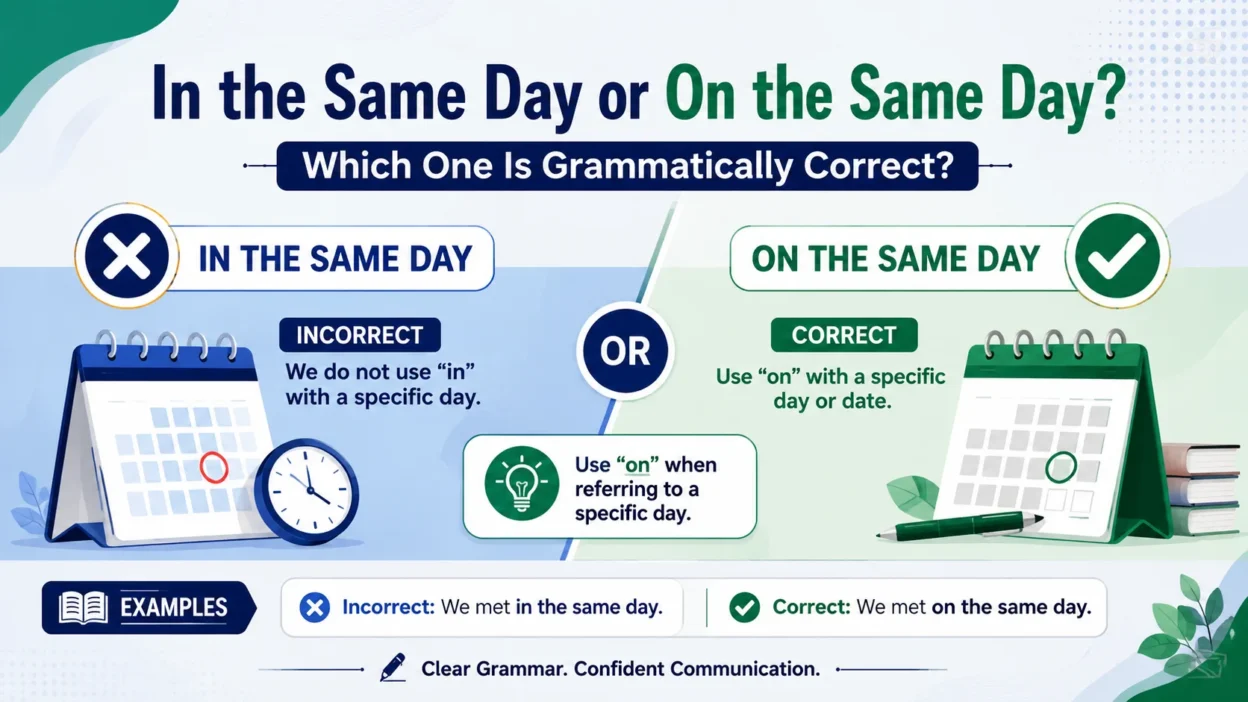
“On the same day,” widely used in standard English, refers to a specific date, identical day, and 24-hour period, often used in examples like a doctor appointment or movie example. It describes events happening together, multiple events, and occurrences within a timeframe. In contrast, “in the same day” focuses on one calendar day and completing multiple tasks within a time span, which can sometimes sound unnatural or incorrect in real usage.
Through practice, shared examples, and guided learning, learners build stronger language confidence, fluency, and grammar accuracy. Over time, small grammar choices and subtle differences create a semantic shift in understanding, helping users develop correct usage naturally in both written and spoken English.
Quick Answer: Should You Say “In the Same Day” or “On the Same Day”?
The short answer is this:
- Use “on the same day” when you’re referring to a specific calendar day.
- Use “in the same day” when you’re emphasizing that something happened within one 24-hour period or during the course of a single day.
In modern English, “on the same day” is much more common. You’ll hear it in conversations, news articles, legal documents, business emails, and academic writing because it clearly identifies a particular day.
For example:
- They were born on the same day. ✅
- The meeting and the conference happened on the same day. ✅
These sentences point to one shared calendar date.
By contrast, “in the same day” focuses on everything occurring within one day’s span rather than identifying a date.
For example:
- She completed three major projects in the same day. ✅
- It’s amazing that they visited four cities in the same day. ✅
Here, the emphasis isn’t on which day it was. Instead, it highlights how much happened during one day.
Quick Comparison
| Phrase | Primary Meaning | Most Common Use |
| On the same day | Refers to a specific calendar day | Everyday English, formal writing, conversation |
| In the same day | Refers to events occurring within one day | Duration or accomplishment within a day |
A helpful way to remember the rule is this:
If you’re answering “Which day?” use “on.” If you’re answering “Within how much time?” use “in.”
That simple distinction solves most grammar questions involving these two expressions.
Why English Uses Different Prepositions for Time
Many learners memorize prepositions instead of understanding them. That works for a while, but eventually similar phrases begin to blur together. Once you understand why English chooses certain prepositions, the rules become much easier to remember.
English organizes time into different levels. Some prepositions describe broad periods. Others identify specific dates or exact moments. Each one signals a different relationship between an event and time.
The three most important time prepositions are in, on, and at.
How “In” Expresses Time Periods
The preposition “in” usually refers to a period of time rather than one exact point.
Think of “in” as placing an event inside a larger container of time.
You use “in” with:
- Months
- Years
- Seasons
- Centuries
- Parts of the day
- Lengths of time
Examples include:
- In July
- In 2026
- In winter
- In the morning
- In two hours
- In five minutes
Notice that each example describes a period rather than a precise day.
The same idea explains why “in the same day” sometimes works. You’re talking about events that occur within the boundaries of one day, almost as though that day were a container holding multiple activities.
For example:
She traveled to three countries in the same day.
The sentence emphasizes the impressive amount accomplished during one day rather than identifying which calendar day it was.
Another example:
The technician repaired two servers in the same day.
Again, the focus is the time span.
How “On” Refers to Specific Days and Dates
Unlike “in,” the preposition “on” points directly to a specific day.
Whenever you’re discussing weekdays, holidays observed on fixed dates, or particular calendar dates, “on” is almost always the correct choice.
Examples include:
- On Monday
- On Friday afternoon
- On July 4
- On December 25
- On my birthday
- On election day
This explains why “on the same day” is so common.
For example:
The contracts were signed on the same day.
The sentence identifies one shared calendar date.
Another example:
Both companies announced their mergers on the same day.
Readers immediately understand that both announcements happened on one specific date.
This precision makes “on the same day” the preferred choice in journalism, legal writing, business communication, and academic papers.
How “At” Describes Exact Times Instead of Days
The preposition “at” works differently from both “in” and “on.”
Instead of referring to periods or dates, “at” identifies exact points in time.
You commonly use “at” with the following:
- Clock times
- Midnight
- Noon
- Sunrise
- Sunset
- Specific moments
Examples include:
- At 8:00 a.m.
- At midnight
- At lunchtime
- At sunrise
- At the beginning
- At the end
Notice that none of these examples refer to an entire day.
Because of this rule, expressions like “at the same day” sound unnatural. English speakers don’t treat an entire day as a single point in time.
Instead, they naturally say:
- On the same day
- During the same day
- In the same day
depending on the intended meaning.
A Simple Rule You Can Remember
Many grammar books introduce dozens of exceptions. Fortunately, this particular topic follows a clear pattern that works in most situations.
Use this quick reference whenever you’re unsure.
| Time Expression | Correct Preposition | Example |
| Year | In | In 2026 |
| Month | In | In April |
| Season | In | In summer |
| Century | In | In the 21st century |
| Morning | In | In the morning |
| Day | On | On Monday |
| Date | On | On June 10 |
| Holiday (day) | On | On Christmas Day |
| Exact time | At | At 9:30 a.m. |
| Midnight | At | At midnight |
If you visualize time as a map, the pattern becomes even clearer.
Large Time Periods
│
▼
IN
Year → Month → Season
Specific Calendar Days
│
▼
ON
Monday → Birthday → Same Day
Exact Moments
│
▼
AT
8:00 AM → Noon → Midnight
This simple progression—from broad periods to exact moments—explains thousands of English time expressions.
Once you recognize the pattern, choosing the correct preposition becomes much easier.
“In the Same Day” vs. “On the Same Day”: What’s the Real Difference?
Although these expressions look nearly identical, they emphasize different ideas.
The distinction isn’t about grammar alone. It’s about what you want readers to notice.
Choose “on the same day” when the important detail is the shared calendar date.
Choose “in the same day” when the important detail is that several events happened within one day’s time.
Consider these examples:
- The twins were born on the same day.
The sentence highlights the calendar date.
Now compare it with:
- The rescue team climbed the mountain and returned safely in the same day.
This sentence emphasizes completing everything within a single day’s duration.
Here’s another comparison.
| Sentence | Focus |
| The documents were signed on the same day. | Same calendar date |
| The lawyer reviewed fifty contracts in the same day. | Work completed within one day |
| The interviews happened on the same day. | Shared date |
| The editor finished three chapters in the same day. | Time span |
Understanding this subtle distinction will make your writing sound more natural and much closer to that of native English speakers.
Everyday Examples of “In the Same Day” vs. “On the Same Day”
Learning grammar rules is helpful. Seeing those rules in action is even better. Real-life examples show how native speakers naturally use each phrase and why context matters more than memorizing definitions.
As you read these examples, notice what each sentence emphasizes. Is it pointing to a specific calendar day or highlighting everything that happened within a single day? That small distinction makes all the difference.
Business and Workplace Examples
In professional communication, “on the same day” appears far more often because companies usually refer to schedules, meetings, deadlines, or announcements tied to a particular date.
Examples:
- The client approved the proposal on the same day.
- Both departments released their reports on the same day.
- The company announced the merger and published its earnings on the same day.
- Two interviews were scheduled on the same day, so the hiring team stayed busy.
Now compare those with examples using “in the same day.”
- The sales team closed five major deals in the same day.
- Our support staff answered more than 600 customer requests in the same day.
- She completed onboarding, training, and certification in the same day.
- The technician installed eight servers in the same day.
The first group tells you when something happened.
The second group highlights how much happened during one day.
School and Academic Examples
Students and teachers frequently talk about exams, assignments, presentations, and research. Choosing the correct preposition keeps those conversations clear.
Examples using “on the same day”:
- Our math and science exams were on the same day.
- The university released all admission decisions on the same day.
- The professor graded every paper on the same day.
- Both seminars took place on the same day.
Examples using “in the same day”:
- She finished three research papers in the same day.
- The students completed two laboratory experiments in the same day.
- He read an entire textbook in the same day.
- The class prepared every presentation in the same day.
Notice the pattern again.
Academic schedules usually use on.
Academic accomplishments often use in.
Medical and Healthcare Examples
Hospitals and clinics rely on precise language because timing affects treatment.
Examples:
- The patient had surgery and was discharged on the same day.
- Both medical tests were performed on the same day.
- The doctor reviewed the results on the same day they arrived.
- The prescription was issued on the same day as the diagnosis.
Now look at examples where the emphasis shifts.
- The laboratory processed every sample in the same day.
- The emergency department treated more than 200 patients in the same day.
- The pharmacist filled dozens of prescriptions in the same day.
Medical professionals choose words carefully because misunderstanding dates can create confusion. That’s one reason “on the same day” dominates medical writing.
Travel and Event Examples
Travel often combines schedules with activities, making it an excellent way to understand the difference.
Examples with “on the same day”:
- Our flight landed, and the conference began on the same day.
- The wedding and the reception took place on the same day.
- Both concerts happened on the same day.
- The train strike and the festival occurred on the same day.
Examples with “in the same day”:
- They visited three countries in the same day.
- We drove across two states in the same day.
- The athletes competed in multiple events in the same day.
- She photographed five landmarks in the same day.
Again, one phrase identifies the date while the other emphasizes the achievement.
Casual Conversation Examples
Everyday conversations follow the same pattern.
Natural examples include:
- We met on the same day we started college.
- My brother bought his house on the same day I accepted my new job.
- They celebrated both birthdays on the same day.
- Our packages arrived on the same day.
Examples emphasizing duration include:
- I cleaned the garage, painted the fence, and planted flowers in the same day.
- She watched an entire TV series in the same day.
- They moved into their new home and unpacked everything in the same day.
These examples sound perfectly natural because the meaning matches the preposition.
Why Native English Speakers Usually Prefer “On the Same Day”
If you search newspapers, books, business reports, or government publications, you’ll quickly notice one trend.
“On the same day” appears much more frequently than “in the same day.”
That’s because people usually talk about dates, not durations.
Imagine reading these headlines:
- Company announces expansion on the same day as quarterly earnings.
- Scientists publish two groundbreaking studies on the same day.
- Court issues ruling on the same day the appeal was filed.
Each headline focuses on a shared calendar date.
Now compare them with this sentence:
- The research team completed two years of fieldwork in the same day.
Although grammatically correct, the focus changes completely. Readers immediately think about how much work happened within one day instead of asking which day it occurred.
Why “On the Same Day” Feels More Natural
There are several reasons native speakers instinctively choose “on the same day.”
It identifies a specific point in the calendar.
Dates help organize information. Readers immediately know when events happened relative to one another.
It avoids ambiguity.
If someone says:
The meetings happened on the same day.
Nobody wonders whether the meetings lasted all day. The meaning is clear.
It matches common English patterns.
English already uses “on” with days.
Examples include:
- On Monday
- On Tuesday
- On my birthday
- On New Year’s Day
- On the weekend (common in American English)
Because “the same day” also refers to a day, native speakers naturally choose on.
A Simple Frequency Comparison
| Expression | Everyday Conversation | Professional Writing | Academic Writing |
| On the same day | Very common | Very common | Very common |
| In the same day | Less common | Occasional | Occasional |
This doesn’t mean “in the same day” is wrong.
It simply serves a different purpose.
Is “At the Same Day” Ever Correct?
One of the most common mistakes English learners make is saying “at the same day.”
The phrase sounds logical if you translate directly from another language. However, native English speakers almost never use it.
Why It’s Incorrect
The preposition “at” refers to specific moments, not entire days.
For example:
- At noon
- At midnight
- At 7:00 p.m.
- At sunrise
- At bedtime
A day isn’t a single moment.
It’s a complete period lasting 24 hours.
That’s why English pairs days with on, not with at.
Incorrect vs. Correct
| Incorrect | Correct |
| At the same day | On the same day |
| At Monday | On Monday |
| At my birthday | On my birthday |
| At July 4 | On July 4 |
Better Alternatives
Instead of saying
We arrived at the same day.
Say:
- We arrived on the same day.
- We arrived during the same day.
- We arrived later that day.
Each alternative sounds natural to native speakers.
Common Mistakes and How to Fix Them
Even advanced English learners occasionally mix up time prepositions. Fortunately, most mistakes follow predictable patterns.
Mistake One: Using “In” for Specific Days
❌ The meeting is in Monday.
✅ The meeting is on Monday.
Remember, weekdays always take on.
Mistake Two: Using “At” With Days
❌ She graduated at the same day.
✅ She graduated on the same day.
Think of at as a pinpoint on a timeline.
Days are too large for at.
Mistake Three: Confusing Duration With Dates
Consider these two sentences.
They signed both contracts on the same day.
This means both signatures happened on one calendar date.
Now compare it with:
They negotiated three contracts in the same day.
This emphasizes completing everything within one day.
Neither sentence is wrong.
They’re simply communicating different ideas.
Mistake Four: Translating Directly From Another Language
Many languages organize time differently.
As a result, learners often write expressions like the following:
- In Monday
- At Sunday
- At the same day
Instead of translating word for word, learn English prepositions as complete patterns.
For example:
- On Monday
- On the same day
- In the morning
- At noon
Patterns are easier to remember than isolated rules.
Quick Correction Table
| Incorrect Expression | Correct Expression | Explanation |
| In Monday | On Monday | Days use on |
| At Friday | On Friday | Days use on |
| At the same day | On the same day | Days require on |
| This morning | This morning / In the morning | Fixed English expression |
| On the morning | On the morning of July 4 | Only used when a specific date follows |
Learning these common corrections will eliminate many everyday grammar mistakes and make your English sound much more natural.
Similar Time Expressions That Follow the Same Grammar Rules
Once you understand the difference between “in the same day” and “on the same day,” you’ll notice the same grammar pattern in many other English expressions. These phrases often appear in business writing, legal documents, academic papers, and everyday conversations.
Learning them together helps you build a stronger understanding of English prepositions instead of memorizing isolated rules.
“On the Same Date” vs. “On the Same Day”
At first glance, these expressions look interchangeable. In many situations, they are. However, each one highlights a slightly different idea.
“On the same day” focuses on the day itself, while “on the same date” emphasizes the calendar date.
For example:
- Their weddings took place on the same day.
- Both contracts were signed on the same date.
The first sentence sounds more natural in everyday conversation because people usually think in terms of days rather than numerical dates.
The second sentence is more common in legal, financial, and administrative documents where precision matters.
Consider this comparison:
| Expression | Typical Use | Example |
| On the same day | Everyday speech, news, conversations | The awards ceremony and banquet were held on the same day. |
| On the same date | Contracts, legal writing, official records | Both agreements were executed on the same date. |
In most casual situations, “on the same day” sounds smoother and more natural.
“In One Day” vs. “On One Day”
These expressions differ more than many learners realize.
“In one day” refers to how long something took.
Examples:
- She learned the basics in one day.
- The crew completed the repairs in one day.
- They packed the entire house in one day.
The emphasis is on duration.
By contrast, “on one day” identifies a particular day without focusing on how much time passed.
Examples:
- On one day, everything changed.
- The museum offers free admission on one day each month.
- Sales doubled on one day during the holiday season.
A helpful trick is to ask yourself a question.
If you’re answering “How long?” choose “in.”
If you’re answering “Which day?”, choose on.
“During the Same Day” vs. “In the Same Day”
These two expressions are closely related, but they are not always interchangeable.
“During the same day” simply indicates that something happened at some point within that day.
For example:
- The weather changed several times during the same day.
- We received three deliveries during the same day.
- Several power outages occurred during the same day.
The phrase doesn’t emphasize speed or achievement. It simply describes events happening within that day’s timeline.
“In the same day,” however, often highlights completion or accomplishment.
Examples:
- She finished writing, editing, and publishing the article in the same day.
- The team solved every customer complaint in the same day.
Compare the meanings:
| Phrase | Primary Focus |
| During the same day | Events occurred at different times within a day |
| In the same day | Tasks or actions were completed within one day |
Although both are correct, “during the same day” often sounds more descriptive, while “in the same day” emphasizes efficiency.
“By the End of the Day” vs. “At the End of the Day”
These expressions look similar but serve different purposes.
By the End of the Day
This phrase sets a deadline.
Examples:
- Please submit your report by the end of the day.
- The payment must arrive by the end of the day.
- We’ll send the revised proposal by the end of the day.
Think of “by” as meaning “no later than.”
At the End of the Day
This expression has two common meanings.
The first refers literally to the final part of a day.
Example:
- At the end of the day, the staff cleaned the office.
The second is an idiom meaning when everything is considered.
Examples:
- At the end of the day, customer satisfaction matters most.
- At the end of the day, experience is the best teacher.
Context tells readers which meaning is intended.
“Within the Same Day” vs. “On the Same Day”
Another phrase you’ll encounter is “within the same day.”
This expression stresses that something happens before the day ends.
Examples:
- Most refunds are processed within the same day.
- The issue was resolved within the same day.
- Customers usually receive a response within the same day.
Although similar to “in the same day,” the word within adds a sense of completing something before a deadline expires.
Compare the differences.
| Expression | Meaning |
| On the same day | Refers to one calendar day |
| In the same day | Completed during one day’s duration |
| Within the same day | Finished before the day ended |
| During the same day | Happened sometime during that day |
Understanding these subtle differences helps your writing sound more precise and natural.
Common Collocations With “Same Day”
A collocation is a group of words that native speakers naturally use together. Learning collocations improves your fluency because you begin writing and speaking the way native speakers do.
Many industries use the phrase “same day” in predictable combinations.
Here are some of the most common examples.
| Collocation | Meaning |
| Same-day delivery | Products arrive on the day they are ordered. |
| Same-day shipping | The seller ships the order before the business day ends. |
| Same-day service | A service is completed on the day it is requested. |
| Same-day appointment | An appointment is available on the current day. |
| Same-day processing | A request or application is handled before the day ends. |
| Same-day results | Test results become available on the day of testing. |
| Same-day discharge | A patient leaves the hospital on the day of treatment. |
| Same-day repair | Repairs are completed before the end of the day. |
These collocations appear frequently in healthcare, retail, logistics, banking, and customer service.
Examples include:
- The clinic offers same-day appointments for urgent cases.
- Many online stores now provide same-day delivery in major cities.
- The repair center guarantees same-day service for most devices.
- Customers appreciate same-day shipping during the holiday season.
Notice that “same-day” becomes a compound adjective when it comes before a noun.
Examples:
- Same-day delivery
- Same-day service
- Same-day processing
However, when the phrase follows the noun, the hyphen usually disappears.
Examples:
- Delivery is available the same day.
- The repair was completed on the same day.
This small punctuation rule makes your writing look more polished.
Grammar Tips to Choose the Right Preposition Every Time
Even experienced writers occasionally pause before choosing a preposition. Instead of memorizing dozens of rules, follow a simple decision-making process.
Ask Yourself: “Am I Talking About a Date or a Duration?”
This single question solves most problems.
If you’re talking about a calendar day, use on.
Examples:
- The meeting is on Thursday.
- They graduated on the same day.
- The announcements were made on the same day.
If you’re talking about how much happened within one day, use in.
Examples:
- She completed every assignment in the same day.
- They renovated two rooms in the same day.
Look for fixed expressions.
English contains many phrases that never change.
Examples include:
- On Monday
- On my birthday
- In the morning
- At night
- At noon
- By the end of the day
Treat these as complete expressions instead of translating each word individually.
Read the Sentence Naturally
One of the best proofreading techniques is to read your sentence aloud.
Ask yourself:
- Does this sound like everyday English?
- Would a native speaker say it this way?
- Is the sentence referring to a specific date or a time span?
Often, the correct answer becomes obvious once you hear the sentence.
Avoid Word-for-Word Translation
Many grammar mistakes happen because learners translate directly from their first language.
Instead of translating, learn English prepositions through repeated exposure.
Reading books, newspapers, and professional articles helps you recognize natural patterns without consciously memorizing every rule.
Quick Decision Guide
Use this reference whenever you’re unsure.
| If You Mean… | Use… | Example |
| A specific day | On | On the same day |
| A period within one day | In | In the same day |
| Something happening before the day ends | Within | Within the same day |
| Events occurring during that day | During | During the same day |
| An exact time | At | At 8:00 a.m. |
| A deadline | By | By the end of the day |
Once you understand these patterns, choosing the correct expression becomes much more intuitive. Instead of relying on guesswork, you’ll know exactly which preposition fits your meaning and why.
Conclusion
Understanding the difference between “on the same day” and “in the same day” is essential for clear and correct English communication. While both phrases seem similar, their usage depends on context, time structure, and meaning. Using the correct expression improves grammar accuracy, fluency, and writing clarity, especially in academic writing, business communication, and everyday speech. With consistent practice and exposure to real examples, learners can naturally develop confidence and avoid common mistakes in sentence construction and preposition usage.
FAQs
Q1. What is the correct phrase: “in the same day” or “on the same day”?
The correct and most commonly accepted phrase is “on the same day.”
Q2. When do we use “on the same day”?
It is used when referring to a specific date or multiple events happening on the same calendar day.
Q3. Is “in the same day” grammatically correct?
It is generally considered incorrect or unnatural in standard English usage.
Q4. Why do learners get confused between these phrases?
Because both refer to time, but they differ in context, structure, and preposition usage.
Q5. How can I improve my usage of these phrases?
Practice with real examples, focus on contextual meaning, and observe how native speakers use them in writing and speech.