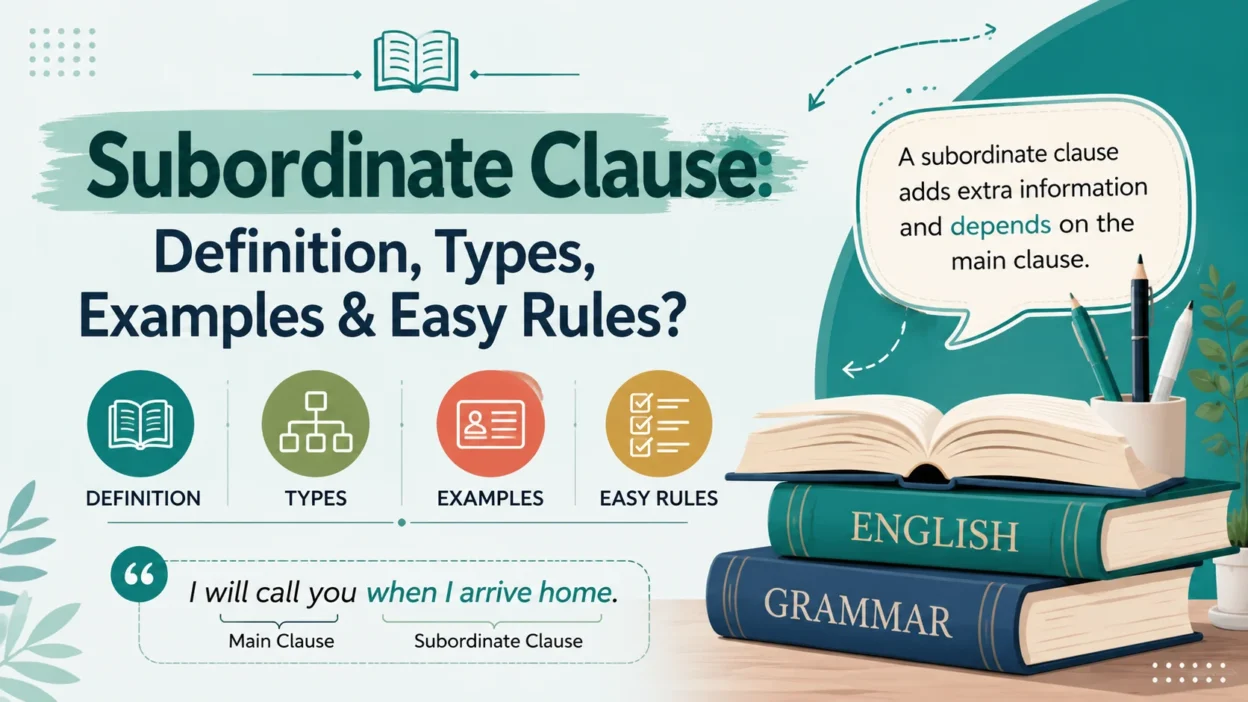
A Subordinate Clause contains a subject and verb, but it can’t form a complete sentence alone. It depends on a main clause to express a complete thought. For example, although it was raining, we went for a walk. This dependent clause adds extra information, such as a reason, condition, time, or contrast, and strengthens sentence structure and writing.
A subordinate clause can make sentences longer, clearer, and more precise. It adds detail and depth to language, narrative, and storytelling. Common subordinating words include because, if, and although. For example, “I ate pizza because I was hungry” connects an action with its reason and turns simple communication into more compelling storytelling.
To identify a subordinate clause, separate each clause and check whether it can stand alone. An independent clause can usually stand alone, while a dependent clause cannot. A relative clause can describe a noun, while sentence fragments occur when dependent clauses appear alone. Proper commas improve clarity and help each part of the sentence communicate its meaning clearly.
What Is a Subordinate Clause?
A subordinate clause, also called a dependent clause, is a clause that depends on another clause to complete its meaning.
A clause normally contains a subject and a verb. However, a subordinate clause begins with a word or structure that makes it dependent on another idea.
Consider this example:
Because Sarah missed the bus, she arrived late.
The sentence contains two clauses:
| Clause | Type | Can it stand alone? |
| Because Sarah missed the bus | Subordinate clause | No |
| She arrived late | Main clause | Yes |
The word because makes the first clause dependent. Without the main clause, “Because Sarah missed the bus” leaves the reader waiting for more information.
Subordinate Clause Definition in Simple Terms
You can think of a subordinate clause as an incomplete idea that needs a supporting sentence.
For example:
- When the movie ended — incomplete
- When the movie ended, we went home. — complete
- Because I was tired — incomplete
- Because I was tired, I went to bed. — complete
The subordinate clause gives the reader additional information, while the main clause delivers the central idea.
Subordinate Clause vs. Independent Clause
The easiest way to understand a subordinate clause is to compare it with an independent clause.
An independent clause can stand alone as a complete sentence:
The dog barked.
A subordinate clause cannot normally stand alone:
Because the dog barked.
Put them together:
Because the dog barked, the baby woke up.
Here, “the baby woke up” provides the complete main idea.
Can a Subordinate Clause Stand Alone?
Generally, no.
A subordinate clause may contain everything that looks like a sentence, including a subject and verb. Yet a subordinating word makes it dependent.
Compare:
The weather changed.
This is complete.
Although the weather changed.
This isn’t complete because although signals contrast without finishing the thought.
The reader naturally asks, “What happened although the weather changed?”
That’s the defining feature of a subordinate clause.
How Subordinate Clauses Work in Sentences
Subordinate clauses don’t simply make sentences longer. They explain the relationship between ideas.
They can tell you:
- When something happened
- Why something happened
- Where something happened
- How something happened
- Under what condition something happened
- Despite what circumstance something happened
- Which person or thing you’re talking about
For example:
We stayed inside because the storm became stronger.
The subordinate clause explains why we stayed inside.
The Main Clause and Subordinate Clause
Most sentences containing subordinate clauses have two basic parts:
Main clause + subordinate clause
or
Subordinate clause + main clause
Examples:
I called Maria after I finished work.
After I finished work, I called Maria.
Both sentences communicate essentially the same relationship. The difference lies mainly in word order and punctuation.
What Does a Subordinate Clause Add?
A subordinate clause can add a layer of meaning that a basic sentence lacks.
Compare:
Jake left.
with:
Jake left because he felt sick.
The first sentence tells you what happened. The second tells you why it happened.
That’s why subordinate clauses matter in practical writing. They let you connect ideas without turning every thought into a separate sentence.
Types of Subordinate Clauses
There are three major types worth knowing:
- Adverbial subordinate clauses
- Adjective or relative clauses
- Noun subordinate clauses
Each type performs a different grammatical job.
Adverbial Subordinate Clauses
An adverbial subordinate clause functions like an adverb. It explains circumstances surrounding the action in the main clause.
It can express:
- Time
- Reason
- Condition
- Contrast
- Purpose
- Place
- Result
Examples:
When the store opened, customers rushed inside.
We canceled the picnic because it started raining.
If you study regularly, you’ll improve your grades.
She kept working although she was exhausted.
Common subordinating conjunctions include because, although, if, when, while, after, before, unless, since, until, whereas, and though.
Adjective Subordinate Clauses
An adjective subordinate clause, commonly called a relative clause, modifies a noun or pronoun.
For example:
The woman who lives next door is a doctor.
The clause “who lives next door” describes the woman.
Common relative pronouns include:
- Who
- Whom
- Whose
- Which
- That
Relative adverbs include:
- When
- Where
- Why
Another example:
I visited the restaurant that you recommended.
The relative clause identifies which restaurant the speaker means.
Noun Subordinate Clauses
A noun subordinate clause functions as a noun within a larger sentence.
For example:
What she said surprised everyone.
The clause “what she said” functions as the subject.
Another example:
I know that he works here.
Here, “that he works here” functions as the object of know.
Noun clauses can perform several grammatical roles, including:
- Subject
- Direct object
- Subject complement
- Object of a preposition
Common introductory words include that, what, whatever, who, whoever, whether, if, why, how, and where.
Subordinating Conjunctions and Other Words That Introduce Subordinate Clauses
Certain words signal that a clause is subordinate.
Common Subordinating Conjunctions
Here are some of the most useful ones:
| Subordinating conjunction | Common meaning | Example |
| Because | Reason | We stayed home because it rained. |
| Although | Contrast | Although she was tired, she kept working. |
| If | Condition | If you hurry, you’ll catch the bus. |
| Unless | Negative condition | Unless you call, I won’t know. |
| When | Time | Call me when you arrive. |
| Before | Earlier time | Finish this before you leave. |
| After | Later time | We ate after the guests arrived. |
| While | Simultaneous time | She listened while I explained. |
| Since | Time or reason | I’ve known him since we met. |
| Until | Time limit | Wait until I return. |
| Whereas | Contrast | Tom prefers tea whereas Sam prefers coffee. |
Relative Pronouns and Relative Adverbs
Relative words connect a subordinate clause to a noun or another part of the sentence.
The teacher who helped me was patient.
This is the house where I grew up.
I remember the day when we met.
The relative word creates a connection between the clause and the noun or idea it describes.
Subordinators vs. Coordinating Conjunctions
Don’t confuse subordinating conjunctions with coordinating conjunctions.
The coordinating conjunctions are:
for, and, nor, but, or, yet, so
They connect elements of equal grammatical importance.
For example:
I wanted to go, but I was tired.
Both “I wanted to go” and “I was tired” can stand independently.
A subordinating conjunction creates a dependent relationship:
I stayed home because I was tired.
“I was tired” can stand alone, but “because I was tired” cannot.
Subordinate Clause Examples
Examples make subordinate clauses much easier to recognize.
Examples at the Beginning of a Sentence
When the subordinate clause comes first, a comma commonly separates it from the main clause.
Although the test was difficult, Maya remained calm.
After the guests arrived, we served dinner.
If you need help, call me.
The introductory clause prepares the reader for the main idea.
Examples at the End of a Sentence
When the subordinate clause follows the main clause, a comma often isn’t necessary.
Maya remained calm although the test was difficult.
We served dinner after the guests arrived.
Call me if you need help.
The exact punctuation can depend on the clause’s role and whether the information is restrictive or nonrestrictive.
Examples of Different Types
| Sentence | Subordinate clause | Type |
| We left because it was late. | because it was late | Adverbial |
| The man who called you is outside. | who called you | Relative |
| I know what you mean. | what you mean | Noun |
| When the sun rose, we started hiking. | When the sun rose | Adverbial |
| The book that you bought is expensive. | that you bought | Relative |
Subordinate Clauses in Everyday English
You use subordinate clauses constantly in normal conversation.
I’ll call you when I get home.
We can’t leave until Dad arrives.
I ordered the jacket that you showed me.
I don’t know what she wants.
These structures appear in texts, emails, conversations, school assignments, business writing, and professional communication.
Commas and Punctuation With Subordinate Clauses
Punctuation becomes much easier once you identify the clause’s position and function.
When to Use a Comma After an Introductory Subordinate Clause
An introductory subordinate clause is commonly followed by a comma.
When the meeting ended, everyone left.
Because the road was blocked, we took another route.
Although he disagreed, he respected the decision.
This comma helps readers see where the introductory dependent idea ends.
When a Subordinate Clause Doesn’t Need a Comma
When a closely connected subordinate clause follows the main clause, you often don’t need a comma.
Everyone left when the meeting ended.
We took another route because the road was blocked.
He respected the decision although he disagreed.
Don’t insert a comma simply because a sentence contains a subordinate clause.
Restrictive vs. Nonrestrictive Relative Clauses
This distinction is especially important with relative clauses.
A restrictive clause provides information needed to identify the noun.
The students who studied passed the exam.
The clause identifies which students passed.
A nonrestrictive clause adds extra information that isn’t essential to identifying the noun.
My brother, who lives in Texas, is visiting next week.
The commas signal that “who lives in Texas” is additional information.
| Type | Purpose | Commas? |
| Restrictive | Identifies the noun | Usually no |
| Nonrestrictive | Adds extra information | Yes |
Avoiding Sentence Fragments
A subordinate clause by itself creates a sentence fragment.
Incorrect:
Because I was hungry.
Correct:
Because I was hungry, I made a sandwich.
Or:
I made a sandwich because I was hungry.
A simple test helps: Can the clause stand alone as a complete thought?
If not, connect it to a main clause.
Subordinate Clause vs. Phrase
A clause and a phrase aren’t the same thing.
A clause contains a subject and a verb. A phrase doesn’t contain a complete subject-verb combination.
Compare:
After the meeting — phrase
After the meeting ended — subordinate clause
The second example contains:
- Subject: the meeting
- Verb: ended
- Subordinating word: after
That combination makes it a subordinate clause.
Common Mistakes With Subordinate Clauses
Even experienced writers can mishandle dependent clauses.
Using a Subordinate Clause as a Complete Sentence
Incorrect:
Although I studied all night.
Correct:
Although I studied all night, I couldn’t finish the exam.
Choosing the Wrong Conjunction
Different conjunctions express different relationships.
Because I was tired, I went home.
This expresses cause.
Although I was tired, I kept working.
This expresses contrast.
If I get tired, I’ll go home.
This expresses condition.
Replacing one with another can completely change the sentence’s meaning.
Misusing Commas
Incorrect:
I stayed home, because I was sick.
Better:
I stayed home because I was sick.
However:
Because I was sick, I stayed home.
The comma works naturally after the introductory subordinate clause.
Creating Overly Long Sentences
Subordinate clauses are useful, but too many can bury the main point.
For example:
Although the weather was cold, which was unusual for that time of year, we decided to visit the park because our friends, who had traveled several hours to see us, wanted to explore the city.
The grammar isn’t necessarily wrong, but the sentence carries too much information at once.
Breaking it up often improves readability:
Although the weather was unusually cold, we visited the park. Our friends had traveled several hours to see us, and they wanted to explore the city.
Good writing isn’t about packing every detail into one sentence. It’s about making relationships between ideas easy to follow.
Subordinate Clause vs. Dependent Clause
Subordinate clause and dependent clause generally refer to the same grammatical concept.
Both describe a clause that can’t function independently as a complete sentence in the given structure.
You may see one term more often depending on the grammar resource you’re using.
For practical writing, the distinction isn’t important. What matters is recognizing that the clause depends on another clause to complete the thought.
A Quick Subordinate Clause Case Study
Consider this sentence:
Because the restaurant was crowded, we waited outside until a table became available.
There are three important parts.
| Part | Function |
| Because the restaurant was crowded | Subordinate clause showing reason |
| We waited outside | Main clause |
| Until a table became available | Subordinate clause showing time |
Notice how each dependent clause adds a specific relationship. The first explains why we waited. The second tells us how long we waited.
Without the subordinate clauses, the sentence becomes:
We waited outside.
That’s grammatically complete, but far less informative.
Conclusion
Understanding a subordinate clause makes sentence writing clearer and more flexible. These dependent structures add detail, reason, time, condition, and contrast while connecting ideas smoothly. Once you can identify the main clause, dependent clause, and common subordinating words, you’ll find it easier to build precise sentences and avoid fragments or punctuation mistakes.
FAQs
Q1. What Is a Subordinate Clause?
A subordinate clause is a group of words with a subject and verb that depends on a main clause to form a complete thought.
Q2. What Is Another Name for a Subordinate Clause?
A subordinate clause is also called a dependent clause because it can’t normally stand alone as a complete sentence.
Q3. Can a Subordinate Clause Stand Alone?
No. A subordinate clause generally needs a main clause to complete its meaning.
Q4. What Words Introduce Subordinate Clauses?
Common words include because, although, if, when, while, unless, before, after, and until.
Q5. What Is an Example of a Subordinate Clause?
In “We stayed home because it was raining,” the words “because it was raining” form the subordinate clause.
Q6. What Is the Difference Between a Main Clause and a Subordinate Clause?
A main clause expresses a complete thought and can usually stand alone. A subordinate clause depends on it for complete meaning.
Q7. Do Subordinate Clauses Always Need Commas?
No. An introductory subordinate clause commonly takes a comma, while a dependent clause at the end often doesn’t.
Q8. What Are the Main Types of Subordinate Clauses?
The main types are adverbial clauses, relative clauses, and noun clauses. Each performs a different grammatical function.
Q9. What Is a Relative Subordinate Clause?
A relative clause describes or identifies a noun or pronoun. It often begins with who, whom, whose, which, or that.
Q10. How Can You Identify a Subordinate Clause?
Look for a subject and verb, then check for a subordinating word or relative word. If the clause can’t express a complete thought alone, it’s likely a subordinate clause.