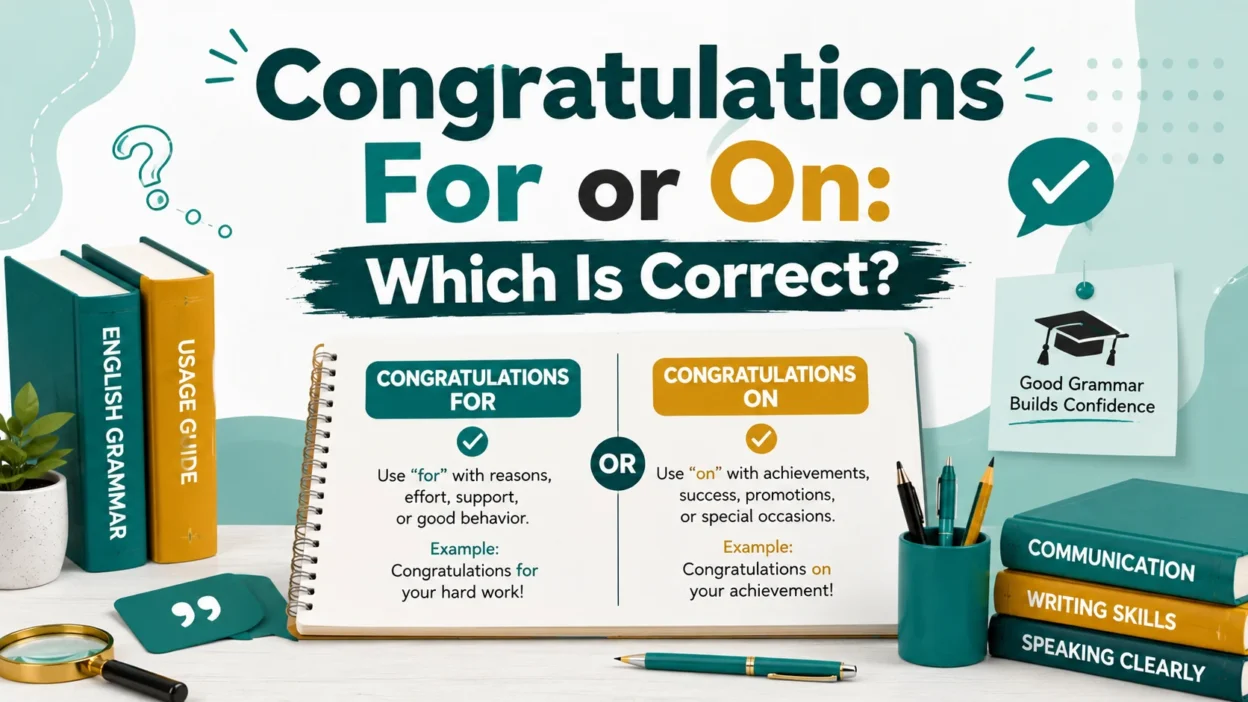
Congratulations For or Congratulations On can confuse English learners, but congratulations on is the correct choice for a specific achievement, promotion, exam, success, or new job. The preposition on connects congratulating with a particular success.
When sending a message or congratulatory note, use congratulations on in formal communication and professional writing. It makes your expression sound natural, clear, and correct, improving communication skill and reader comprehension.
By comparison, congratulations for may sound awkward or unclear when referring to an achievement. Use congratulations on when praising someone for their success, promotion, passing exams, or new job.
Congratulations On vs. Congratulations For: The Quick Answer
For most standard English writing, choose “congratulations on.”
| Expression | Typical use | Example |
| Congratulations on | Achievement, event, milestone, or success | Congratulations on your promotion. |
| Congratulations on + -ing | Celebrating an action or accomplishment | Congratulations on winning the award. |
| Congratulate someone on | Standard verb construction | I congratulated Maya on her graduation. |
| Congratulate someone for | Can emphasize the reason, effort, or action | I congratulate you for working so hard. |
| Congratulations for | Possible in some contexts, but less idiomatic as the default phrase | Usually use “Congratulations on…” |
The safest rule is simple:
When you want to congratulate someone directly on an achievement, event, or milestone, use “congratulations on.”
Major English-learning references and usage discussions consistently identify on as the usual preposition with congratulate when naming the achievement or event. Some usage sources also recognize for in contexts where the reason or action receives particular emphasis.
The Grammar Behind “Congratulations”
The word congratulations is a noun. It refers to an expression of praise or good wishes offered to someone because something noteworthy has happened.
The related verb is congratulate.
Compare these two structures:
- Congratulations on your success.
- I congratulate you on your success.
Both sentences point to the same achievement. The grammatical structure changes because one uses the noun congratulations while the other uses the verb congratulate.
The most common pattern is:
congratulations + on + achievement/event
For example:
- Congratulations on your graduation.
- Congratulations on your promotion.
- Congratulations on your engagement.
- Congratulations on winning the competition.
- Congratulations on completing the project.
This pattern is deeply established in standard English. That’s why “Congratulations on your promotion” sounds immediately natural while “Congratulations for your promotion” can sound awkward to many English speakers.
Why “On” Works So Naturally
The preposition on connects the congratulations to the event or accomplishment being celebrated.
Think of it as pointing directly at the occasion:
Congratulations → on → your achievement
The phrase doesn’t mean that the person is receiving congratulations on top of something. Here, on simply forms part of an established grammatical pattern.
English contains many expressions where prepositions don’t translate neatly from one language to another. That’s why trying to choose between on and for purely through literal logic can lead you down the wrong path.
Instead, learn the natural pattern.
Why “Congratulations On” Is Typically Correct
“Congratulations on” is the best default choice because English speakers commonly use it for achievements, milestones, victories, and important events.
Consider these examples:
- Congratulations on your new job.
- Congratulations on your promotion.
- Congratulations on your wedding.
- Congratulations on passing the exam.
- Congratulations on winning the championship.
- Congratulations on reaching your goal.
- Congratulations on completing your degree.
Notice something important: the word after on can be a noun or an -ing form.
Congratulations On + Noun
Use a noun when you are naming the achievement or event.
Congratulations on your promotion.
Congratulations on your graduation.
Congratulations on your award.
Congratulations on your new position.
Congratulations On + -ing Verb
You can also follow on with a gerund or -ing form.
Congratulations on passing your exams.
Congratulations on winning the competition.
Congratulations on completing the marathon.
Congratulations on starting your new business.
This structure is especially useful when the achievement involves an action.
When “Congratulations For” Can Work
Here’s where the issue gets more nuanced.
“Congratulations for” isn’t simply a forbidden grammatical combination. It appears in real English, particularly when the sentence emphasizes the action, effort, or reason behind the praise. However, it isn’t the best default replacement for “congratulations on.”
For example:
Congratulations for working so hard to reach your goal.
This focuses attention on the person’s effort.
Still, many speakers would naturally rewrite the sentence as:
Congratulations on working so hard to reach your goal.
Or they might choose a different construction:
I congratulate you for working so hard to reach your goal.
The last version makes the distinction especially useful because congratulate someone for can occur when for introduces the reason for praising that person. Usage discussions distinguish this from the more standard congratulate someone on construction.
So don’t memorize an overly rigid rule such as “for is always wrong.” English doesn’t work that neatly.
Instead, remember which form sounds most natural in ordinary congratulatory messages.
“Congratulations On” vs. “Congratulations For”: The Real Difference
The clearest way to understand the distinction is to look at what you’re emphasizing.
On generally points to the achievement, event, or circumstance being celebrated.
For can point toward the reason, action, or effort that explains why someone deserves praise.
For example:
Congratulations on your promotion.
The focus is the promotion.
I congratulate you for handling such a difficult project so well.
The focus is the way the person handled the project.
That difference isn’t an absolute grammatical law. Native usage can overlap. Still, it gives you a useful framework for choosing the most natural construction.
What Can You Say “Congratulations On”?
The phrase works with a remarkably wide range of situations.
Career Achievements
Use congratulations on for professional milestones such as:
- A promotion
- A new job
- A new position
- A successful project
- A professional award
- A business launch
- A major career milestone
- A retirement
Common Mistakes With “Congratulations On” and “Congratulations For”
Mistake: “Congratulations For Your Promotion”
This is understandable, but “Congratulations on your promotion” is the more natural standard choice.
Better:
Congratulations on your promotion!
Mistake: Confusing “Congratulate” With “Congratulations”
The noun and verb can create different sentence patterns.
Compare:
Congratulations on your achievement.
and:
I congratulate you on your achievement.
You can also encounter congratulate someone for when the sentence emphasizes the reason for praise:
I congratulate you for your dedication.
Because both structures exist, learners sometimes transfer for into the noun phrase and produce:
Congratulations for your dedication.
That wording may be understood, but “Congratulations on your achievement” remains the safer general-purpose construction.
Mistake: Assuming “For” Is Always Wrong
This goes too far in the other direction.
Real English does use for with congratulate and can use it in certain congratulatory constructions. Usage sources specifically note that congratulate can occur with both on and for, with a difference in emphasis.
The useful lesson isn’t “never use for.”
It’s “don’t use for automatically when the standard phrase calls for on.”
How to Use “Congratulations On” in Professional English
Professional messages usually benefit from being short, specific, and sincere.
Instead of writing:
Congratulations on your promotion. This is a very wonderful and extremely impressive achievement that clearly demonstrates all of the hard work you have put into your professional career.
A cleaner version works better:
Congratulations on your promotion! Your hard work and leadership have clearly paid off. Wishing you continued success in your new role.
The second version sounds warmer without becoming wordy.
Professional Email Example
Congratulations on your promotion!
Your dedication and leadership have made a real difference to the team. Wishing you every success in your new role.
This works for a colleague, manager, client, or professional contact. You can adjust the tone depending on your relationship.
Social and Casual Examples
Casual messages don’t need elaborate wording.
Try:
- Congratulations on the new job! 🎉
- Congrats on your graduation!
- Congratulations on winning! You earned it!
- Congrats on the promotion! Well deserved.
- Congratulations on reaching such an important milestone!
A short message can carry plenty of warmth. In fact, adding too much formality to a text message can make it feel strangely stiff.
What About “Congratulations To”?
There’s another construction worth knowing.
To can identify the person or group receiving the congratulations.
For example:
Congratulations to Sarah on her promotion!
Here, to Sarah tells the reader who receives the congratulations. On her promotion explains what the congratulations are about.
You can also say:
Congratulations to the entire team on completing the project.
This creates a useful three-part structure:
Congratulations + to + person + on + achievement
For example:
Congratulations to James on his graduation!
That construction is perfectly natural in announcements, speeches, cards, and social posts.
Quick Reference Table: On, For, or To?
| Phrase | Main function | Example |
| Congratulations on | Identifies the event or achievement | Congratulations on your promotion. |
| Congratulations to | Identifies the recipient | Congratulations to Sarah on her promotion. |
| Congratulate someone on | Standard verb pattern for an achievement/event | I congratulated Sarah on her promotion. |
| Congratulate someone for | Can emphasize the reason, effort, or action | I congratulated Sarah for handling the situation so well. |
| Congratulations for | Possible in some usage, but not the safest default | Prefer “Congratulations on…” in most standard messages. |
Case Study: A Career Achievement
Imagine that Jordan has just been promoted from sales manager to regional director.
Which message sounds more natural?
Option A:
Congratulations for your promotion!
Option B:
Congratulations on your promotion!
Option B is the clear choice for a conventional congratulatory message.
The promotion is the event being celebrated. Therefore, on fits the established pattern.
A polished professional version could say:
Congratulations on your promotion to regional director! Your leadership and consistent results have earned this opportunity. Best wishes in your new role.
The message works because it combines the standard phrase with a specific acknowledgment.
Case Study: Recognizing Hard Work
Now imagine that a coworker spends several months solving a difficult problem.
You might write:
Congratulations on completing such a challenging project.
Here, the completed project is the achievement.
If you want to focus more strongly on the person’s effort, you could say:
I congratulate you for staying focused throughout the process.
The second sentence uses the verb congratulate and highlights the person’s behavior.
This is the kind of distinction that makes the on vs. for question easier to understand. The choice isn’t merely about memorizing a preposition. It’s also about understanding the grammatical structure and what the sentence emphasizes.
Do Native Speakers Always Follow One Rule?
Not necessarily.
Prepositions are among the trickiest parts of English because usage develops through convention rather than perfect logic. A phrase can be understandable without being the most idiomatic choice.
That’s why “Congratulations for your promotion” may appear in English-language writing even though “Congratulations on your promotion” is the more established choice.
Usage references and English-learning discussions generally treat on as the usual construction for congratulating someone on an achievement or event.
The practical takeaway is more useful than arguing over isolated examples:
If you’re writing a congratulatory message and you’re unsure, choose “congratulations on.”
That choice will sound natural in professional emails, academic messages, social posts, greeting cards, and everyday conversation.
A Simple Rule to Remember
When the sentence celebrates what happened or what someone achieved, use on.
Congratulations on + achievement/event
Examples:
- Congratulations on your promotion.
- Congratulations on your graduation.
- Congratulations on your engagement.
- Congratulations on winning the award.
- Congratulations on completing the course.
When the sentence uses the verb congratulate, for can sometimes introduce the reason for praise.
I congratulate + person + for + action/effort
Example:
- I congratulate you for handling the situation so professionally.
However, on remains highly versatile with the verb too:
- I congratulate you on handling the situation so professionally.
When you aren’t sure, the second construction is usually the safer choice.
Conclusion
Choosing between congratulations for and congratulations on is simple once you understand the context. Use congratulations on when referring to a specific achievement, promotion, success, exam, or new job. Although congratulations for may appear in some contexts, congratulations on is the natural and preferred choice in standard English.
FAQs
Q1. Is “Congratulations on” grammatically correct?
Yes. Congratulations on is the standard and natural expression used to praise someone for a specific achievement or success.
Q2. Is it “Congratulations for” or “Congratulations on”?
Congratulations on is usually correct when you name the achievement. For example, “Congratulations on your new job.”
Q3. Can I say “Congratulations for your new job”?
It may be understood, but “Congratulations on your new job” is the more natural and grammatically preferred expression.
Q4. Do you say “Congratulations on passing your exam”?
Yes. “Congratulations on passing your exam” is correct because the phrase directly refers to the achievement.
Q5. When should I use “Congratulations on”?
Use congratulations on when praising someone for a promotion, success, achievement, exam result, graduation, new job, or another specific accomplishment.