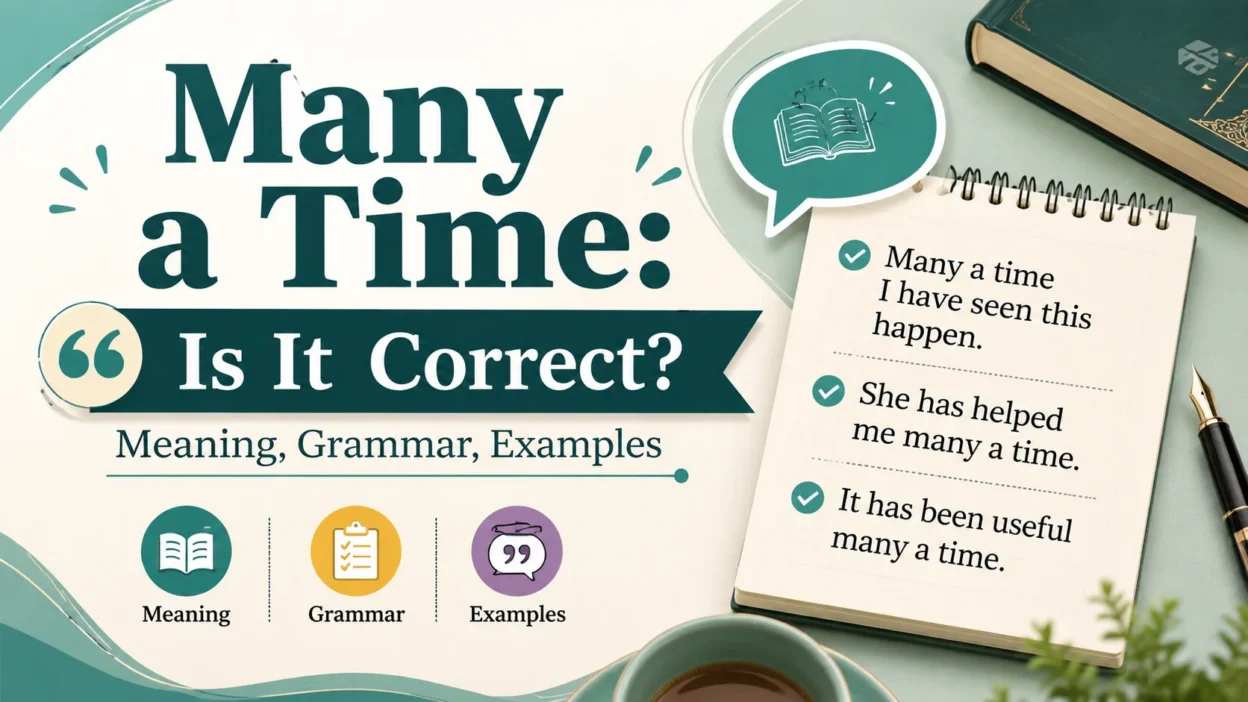
“Many A Time”? can look unusual because many normally appear with a plural form, while time is singular. However, this English expression is completely correct and means often, frequently, or many times. It can describe something that has happened on several occasions, such as visiting a place repeatedly. Although the phrase may sound old-fashioned or poetic, it still works in modern written English and spoken English.
The main grammar pattern is many a + singular noun, so many a time follows an established rule. In everyday conversation, many times often sounds more natural, while many a time can create a more formal, literary, or traditional tone. From my experience with English writing, the phrase works especially well when a writer wants to emphasize repeated actions or events without making the sentence sound forced. Just avoid many a times, because it incorrectly combines two different grammatical patterns.
When choosing between these expressions, consider your context, audience, and purpose. English learners, students, and professional writers can use many a time confidently when it fits the style of the sentence. In a reflective article or carefully written passage, it can add a useful stylistic touch, while many times may be the easier choice for casual communication. The key is to understand its structure, sense, and usage so your writing remains clear, precise, natural, and effective.
What Does “Many a Time” Mean?
Many a time means many times, frequently, or on many occasions.
It describes something that has happened repeatedly. The phrase doesn’t normally tell you the exact number of occasions. Instead, it emphasizes that an event has occurred again and again.
For example:
I’ve heard that story many a time.
This means:
I’ve heard that story many times.
The meaning stays essentially the same. The main difference lies in style and tone.
Many times sounds ordinary and direct. Many a time has a slightly more traditional or literary flavor.
Examples of “Many a Time”
- Many a time, she has helped me solve a difficult problem.
- I’ve visited that town many a time.
- Many a time, we discussed what might happen next.
- He had warned them many a time.
- I’ve wondered many a time whether that decision was right.
- Many a time, the simplest answer turned out to be the best one.
Notice that the expression works naturally with different tenses. It can describe repeated experiences in the past, continuing experiences, or repeated actions within a particular period.
Is “Many a Time” Grammatically Correct?
Yes. Many a time is grammatically correct.
The unusual-looking part is the structure many a + singular noun. English uses this construction to express a large number of individual instances while keeping the noun singular.
So:
- many a time → correct
- many times → correct
- many a times → not standard
- many time → incorrect
The important point is that many a works as a unit. You shouldn’t treat it as though many and a were separate words that can freely combine with a plural noun.
A linguistic analysis of the many a + noun construction describes it as a distinct grammatical pattern rather than simply an unusual version of ordinary many + plural noun. The construction has a large-number meaning while focusing on individual instances.
The Basic Pattern
| Pattern | Example | Correct? |
| many + plural noun | many times | ✅ |
| many a + singular noun | many a time | ✅ |
| many a + plural noun | many a times | ❌ |
| many + singular count noun | many time | ❌ |
That’s the rule worth remembering.
Why Is “Many a Times” Incorrect?
The problem with many a times becomes easier to see when you separate the two patterns.
Pattern One: Many + Plural Noun
The ordinary structure is:
many + plural noun
Examples:
- many times
- many days
- many people
- many years
- many mistakes
So we can write:
I’ve made that mistake many times.
Pattern Two: Many a + Singular Noun
The special structure is:
many a + singular noun
Examples:
- many a time
- many a day
- many a year
- many a person
- many a mistake
For example:
Many a person has faced the same problem.
The noun person remains singular. The verb has also remains singular because the grammatical subject is built around the singular noun phrase. The construction has a plural sense overall, but its grammatical form remains singular.
That’s why many a times doesn’t fit the standard pattern.
The Common Mix-Up
People sometimes combine:
many times
with:
many a time
and accidentally produce:
many a times
It’s an understandable mistake because both expressions have almost the same basic meaning. However, standard grammar keeps their structures separate.
Remember:
Many times = many + plural noun
Many a time = many a + singular noun
“Many a Time” vs. “Many Times”
Both many a time and many times are correct. They aren’t enemies in a grammar boxing match. They simply have different stylistic effects.
Many Times
Many times is the more straightforward choice.
It’s common in everyday American English and works comfortably in:
- Conversations
- Emails
- School writing
- Workplace communication
- Everyday explanations
- Informal storytelling
Example:
I’ve told you many times that the meeting starts at nine.
Nothing sounds unusual about this sentence.
Many a Time
Many a time is also correct, but it can sound more formal, literary, reflective, or old-fashioned.
Example:
Many a time, he sat by the window and thought about the road ahead.
That sentence has a different rhythm. The phrase adds a slightly traditional storytelling quality.
Side-by-Side Comparison
| Many a time | Many times |
| More literary or formal | More conversational |
| Can sound traditional | Sounds modern and direct |
| Means many times | Means many times |
| Useful in reflective writing | Useful in almost any everyday context |
| Emphasizes repeated individual occasions | Simply states repeated frequency |
The difference isn’t mainly about meaning. It’s mostly about register and style.
When Should You Use “Many a Time”?
Many a time works best when its slightly formal or literary tone fits the sentence.
You might see it in storytelling, reflective writing, essays, speeches, or traditional expressions.
Formal or Literary Writing
Consider this sentence:
Many a time, the old building had stood empty during the winter months.
The phrase gives the sentence a more polished, narrative feel.
You could replace it with:
The old building had stood empty many times during the winter months.
Both are grammatical. The second feels more direct.
Reflective Writing
The phrase also works well when someone looks back on repeated experiences:
Many a time, I wondered whether patience would eventually pay off.
Here, many a time helps create a reflective tone.
Storytelling
Writers sometimes use the expression to make repeated events feel like part of a larger story:
Many a time, the traveler stopped at the same inn before continuing his journey.
The phrase fits naturally into narrative prose.
When Should You Use “Many Times”?
If you’re writing ordinary American English, many times is usually the safest and most natural option.
Use it when you simply want to say that something happened repeatedly.
For example:
- I’ve seen that movie many times.
- She called many times.
- We’ve discussed this many times.
- He tried many times before he succeeded.
- That question has come up many times.
There’s no need to make the sentence sound more formal when a simple phrase communicates the idea perfectly.
A Simple Style Rule
Everyday writing: choose many times.
Literary or deliberately traditional writing: many a time may fit better.
That doesn’t mean many a time is wrong in casual writing. It simply has a different flavor.
The Grammar Behind “Many a”
The phrase many a becomes much easier once you understand the larger pattern.
English allows constructions such as:
- many a person
- many a student
- many a year
- many a day
- many a mistake
- many an opportunity
- many a time
The noun after many a stays singular.
For example:
Many a student has struggled with this concept.
Not:
Many a students have struggled with this concept.
The first sentence follows the many a + singular noun construction.
Why Does the Singular Form Matter?
The singular form reflects the way the construction treats the items individually.
Compare:
Many students have struggled with this concept.
with:
Many a student has struggled with this concept.
The first construction treats students as a plural group.
The second construction presents the students more individually: one student after another, among many students.
That individual or distributive effect is one reason the grammar stays singular.
“Many a Time” and Subject-Verb Agreement
This becomes especially important when many a introduces the subject of a sentence.
Consider:
Many a traveler has passed through this town.
The noun traveler is singular, so the verb is has.
Not:
Many a traveler have passed through this town.
Likewise:
Many a mistake has been made in the past.
The subject is grammatically singular even though the sentence refers to numerous mistakes.
This is one of the easiest places to make a mistake if you focus only on the meaning instead of the grammatical structure.
Compare These Forms
| Sentence | Verb | Why? |
| Many travelers have visited the town. | have | Plural noun |
| Many a traveler has visited the town. | has | Singular noun |
| Many mistakes have occurred. | have | Plural noun |
| Many a mistake has occurred. | has | Singular noun |
The same principle applies beyond many a time.
Many a Time vs. Many a Times: Examples
Seeing the correction in context makes the rule easier to remember.
| Incorrect | Correct |
| I’ve heard it many a times. | I’ve heard it many a time. |
| She visited us many a times. | She visited us many a time. |
| He warned me many a times. | He warned me many a time. |
| We discussed it many a times. | We discussed it many a time. |
| I’ve read the book many a times. | I’ve read the book many a time. |
You can also use many times in every example:
- I’ve heard it many times.
- She visited us many times.
- He warned me many times.
- We discussed it many times.
- I’ve read the book many times.
So when you catch yourself writing many a times, you have two clean alternatives: many a time or many times.
Common Mistakes With “Many a Time”
Writers often make common mistakes with “many a time” by confusing it with “many times” and writing the incorrect form “many a times.” Understanding the difference between these two grammatical patterns helps you choose the correct expression with confidence.
Mistake: “Many a Times”
This is the most common problem.
Incorrect:
I’ve watched that show many a times.
Correct:
I’ve watched that show many a time.
Also correct:
I’ve watched that show many times.
Mistake: “Many Time”
Another common error is leaving the noun singular without using a.
Incorrect:
I’ve told him many time.
Correct:
I’ve told him many times.
Or:
I’ve told him many a time.
The ordinary construction needs the plural times. The special construction needs many a time.
Mistake: “Many a People”
The same rule applies to other nouns.
Incorrect:
Many people have experienced this problem.
Correct:
Many people has experienced this problem.
Or simply:
Many people have experienced this problem.
Again, the choice is between two structures.
many + plural noun
versus
many a + singular noun
Mistake: Changing the Verb to Plural
Consider:
Many a student has struggled with grammar.
Because student is singular, has is correct.
A writer might be tempted to use have because the sentence refers to many students. However, the grammatical construction still takes the singular form.
“Many a Time” in Modern US English
Many a time is valid in modern English, but it isn’t usually the first choice for casual American conversation.
If someone says:
I’ve seen that movie many times.
the wording sounds completely natural.
If someone says:
I’ve seen that movie many a time.
the sentence is still correct. It simply sounds more formal or literary.
That distinction matters because grammar and style aren’t the same thing.
A phrase can be grammatically correct without being the most natural choice for every situation.
Real-Life Case Study: Choosing the Right Expression
Imagine a student writing this sentence:
I have read this chapter many a times.
The student knows that the chapter has been read repeatedly. The intended meaning is clear, but the construction mixes two patterns.
There are two clean corrections.
Option One: Everyday Style
I have read this chapter many times.
This is the most natural choice for ordinary conversation and straightforward academic writing.
Option Two: More Literary Style
I have read this chapter many a time.
This is grammatical but has a more traditional tone.
The Lesson
The problem isn’t the idea of repetition. The problem is the combination a + times.
A requires a singular count noun:
a time
Meanwhile, ordinary many takes a plural count noun:
many times
Once you see those two patterns separately, the confusion almost disappears.
Examples of “Many a Time” in Different Contexts
Everyday Experience
I’ve walked through that park many a time.
Grammatical, although many times sounds more conversational.
Reflection
Many a time, she wondered whether she had chosen the right path.
The slightly literary tone suits reflective writing.
Storytelling
Many a time, the travelers stopped beneath the old oak tree.
The expression gives the sentence a traditional narrative feel.
Formal Discussion
The issue has been examined many a time without a clear resolution.
The wording creates a formal tone.
Personal Memory
I remember visiting that little bookstore many a time.
The phrase emphasizes repeated memories.
“Many a Time” vs. Similar Expressions
Several phrases can express repeated occurrence, but their tone isn’t identical.
| Expression | Basic meaning | Style |
| many a time | Many times | Literary or formal |
| many times | On many occasions | Neutral |
| often | Frequently | Concise and natural |
| repeatedly | Again and again | Direct and emphatic |
| on many occasions | On numerous occasions | Formal |
| time and again | Repeatedly | Idiomatic and expressive |
For example:
I’ve told you many times.
could become:
I’ve told you often.
or:
I’ve told you repeatedly.
or:
I’ve told you many a time.
The basic idea remains similar, but each version creates a slightly different impression.
A Useful Rule for Remembering “Many a Time”
Here’s the easiest formula:
Many + plural noun
many times
Many a + singular noun
many a time
That’s the entire rule in a nutshell.
You can extend it to other examples:
- many students
- many a student
- many years
- many a year
- many mistakes
- many a mistake
- many opportunities
- many an opportunity
The same grammatical idea keeps appearing.
Quick Practice: Choose the Correct Form
Test yourself before checking the answers.
Choose the Best Option
A. I’ve heard that explanation many a time / many a times.
B. She has visited the museum many times / many a times.
C. Many a student has / Many a students have struggled with this lesson.
D. He warned us many a time / many time.
E. We have discussed the problem many times / many a times.
Answers
A. Many a time
The construction is many a + singular nouns.
B. Many times
The ordinary pattern is many + plural nouns.
C. Many a student has
Student is singular and therefore takes has.
D. Many a time
The noun time remains singular after many a.
E. Many times
The plural noun times works with ordinary many.
Quick Reference Table
| Question | Answer |
| Is many a time correct? | Yes. |
| Does it mean many times? | Yes. |
| Is many times correct? | Yes. |
| Is many a times standard? | No. |
| Is many time correct? | No. |
| What follows many a? | A singular count noun |
| What follows ordinary many? | Usually a plural count noun |
| Which sounds more natural in everyday US English? | Many times |
| Can many a time sound formal? | Yes. |
| Should the verb after a subject with many a be singular? | Yes. |
Conclusion
“Many A Time”? is a correct and well-established English expression that means often, frequently, or many times. Although it may sound slightly old-fashioned or poetic, it still has a place in modern writing and speech. The important grammar rule is many a + singular nouns, which explains why we say many a time, not many a times.
If you want a simple, everyday style, many times will usually sound more natural. However, many a time can add a formal, literary, or traditional tone to your writing. Once you understand the pattern and consider your context, you can use the expression confidently and appropriately.
FAQs
Q1. Is “many a time” grammatically correct?
Yes, many a time is grammatically correct and means often, frequently, or many times.
Q2. What does “many a time” mean?
Many a time means that something has happened repeatedly or on many occasions.
Q3. Is “many a times” correct?
No. Many a times is generally considered incorrect because many a takes a singular noun. Use time instead.
Q4. Is “many a time” formal or informal?
Many a time often sounds more formal, literary, or traditional than many times, which is more common in everyday conversation.
Q5. What is the difference between “many a time” and “many times”?
Both expressions generally have the same meaning, but many times sounds more natural in everyday English, while many a time can give writing a more formal or literary tone.