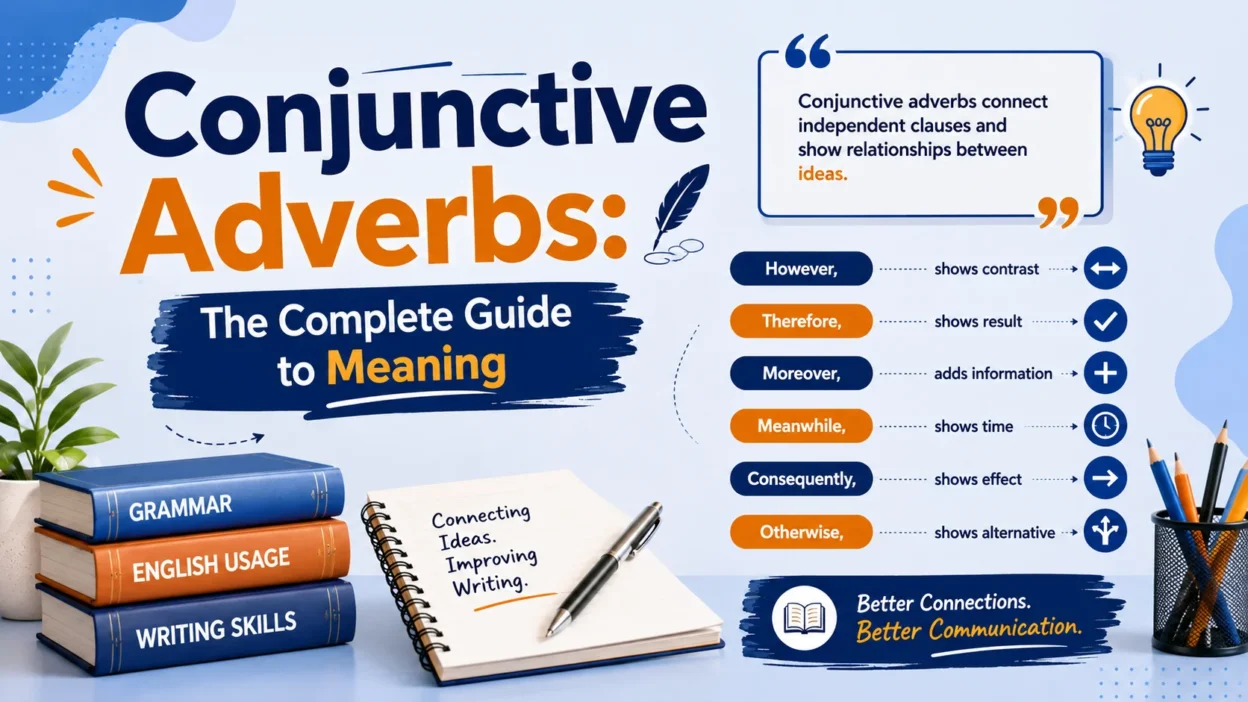
Conjunctive adverbs help writers create clearer connections between ideas by improving sentence flow, grammar, and communication in everyday writing. In the English language, conjunctive adverbs are useful words that allow writers to create smoother communication by showing clear connections between different ideas. For English for beginners, learning these connectors makes writing easier because they explain how one thought connects with another. These transitional words guide readers through sentences, paragraphs, and complete pieces of content by showing relationships such as contrast, cause and effect, addition, comparison, sequence, and emphasis
Strong sentence structure depends on proper usage of language tools that improve writing skills and create logical flow between independent clauses. These discourse markers help explain relationships between ideas without making writing feel disconnected. In professional writing, academic writing, research paper writing, business email communication, and general written communication, these terms improve readability, cohesion, and coherence. Understanding grammar rules, punctuation rules, and correct usage helps writers avoid punctuation mistakes.
Using conjunctive adverbs also helps writers organize information and explain complex thoughts more effectively. These linking words create sentence connection, idea connection, and thought connection while supporting effective writing and informative writing. When you want to improve grammar, create a professional message, or develop stronger language skills, these connectors provide a simple method for making sentences smoother, more precise, and easier to understand.
What Are Conjunctive Adverbs?
A conjunctive adverb is a word or phrase that connects two independent ideas while showing the relationship between them. Unlike coordinating conjunctions such as “and,” “but,” or “so,” conjunctive adverbs don’t simply join clauses. Instead, they explain how one idea relates to another.
For example:
- I studied for three hours; therefore, I felt prepared for the exam.
- The restaurant was crowded; however, the service remained fast.
- She completed the project early; meanwhile, the rest of the team continued working.
In each sentence, the conjunctive adverb creates a logical bridge between two complete thoughts.
Think of a conjunctive adverb as a traffic signal for your reader. It doesn’t merely connect sentences. It tells the reader which direction the next idea is taking.
Simple Definition
A conjunctive adverb is an adverb that connects independent clauses while expressing a relationship such as the following:
- Contrast
- Addition
- Cause and effect
- Comparison
- Time
- Sequence
- Clarification
- Emphasis
- Summary
Although they often appear between two clauses, they can also begin or interrupt a sentence depending on the intended meaning.
Why Conjunctive Adverbs Matter
Without transitions, writing often feels abrupt or disconnected.
Compare these examples.
Without a conjunctive adverb:
The weather changed suddenly. We canceled the picnic.
With a conjunctive adverb:
The weather changed suddenly; therefore, we canceled the picnic.
The second version immediately explains the relationship between the two events. Readers don’t have to guess why the picnic ended.
Using conjunctive adverbs helps you:
- Create smoother transitions
- Improve sentence variety
- Strengthen logical arguments
- Write more naturally
- Make complex ideas easier to understand
Professional writers, editors, teachers, journalists, and business professionals rely on these words every day because they guide readers through complicated information with ease.
What Does a Conjunctive Adverb Do?
Every conjunctive adverb serves a specific purpose. Instead of randomly linking sentences, each one communicates a particular relationship between ideas.
Shows Contrast
Contrast indicates that the second statement differs from or opposes the first.
Examples include:
- however
- nevertheless
- nonetheless
- instead
- conversely
- still
Example:
The software looked impressive; however, it lacked several important features.
The word “however” signals that the second statement contrasts with the first.
Shows Cause and Effect
These conjunctive adverbs explain results or consequences.
Common examples include:
- therefore
- consequently
- thus
- accordingly
- hence
Example:
Traffic was unusually heavy; therefore, everyone arrived late.
Here, the delay directly resulted from heavy traffic.
Shows Addition
Sometimes you want to add another supporting point.
Use words such as:
- furthermore
- moreover
- additionally
- besides
- also
Example:
The proposal reduced expenses; furthermore, it improved customer satisfaction.
The second clause strengthens the first rather than changing its direction.
Shows Time or Sequence
Some conjunctive adverbs organize events chronologically.
Examples include:
- meanwhile
- then
- subsequently
- finally
- eventually
Example:
The engineers tested the prototype; meanwhile, the marketing team prepared the launch campaign.
Readers immediately understand that both actions occurred during the same general period.
Shows Comparison
Comparison highlights similarity between ideas.
Common choices include:
- likewise
- similarly
Example:
Sarah enjoys mountain hiking; likewise, her brother spends most weekends outdoors.
Shows Clarification
Clarifying conjunctive adverbs make an explanation more specific.
Examples include:
- namely
- specifically
- in other words
Example:
Only one employee qualified for promotion; namely, the department supervisor.
Shows Emphasis
Sometimes you want readers to notice an important point.
Useful conjunctive adverbs include:
- indeed
- certainly
- undoubtedly
Example:
The company’s customer support exceeded expectations; indeed, response times improved by nearly 40%.
Shows Summary
Summary transitions help conclude an idea.
Examples include:
- overall
- in conclusion
- to sum up
Example:
Sales increased throughout the year. Customer retention also improved. Overall, the business experienced remarkable growth.
Why Conjunctive Adverbs Improve Writing
Good writing isn’t only about correct grammar. It’s also about helping readers follow your thinking.
Imagine reading a mystery novel where every chapter jumps to a different location without warning. Even if every sentence is correct, the story becomes confusing.
The same thing happens in everyday writing.
Conjunctive adverbs create signposts that guide readers through your ideas.
They Improve Logical Flow
Each sentence naturally leads to the next.
For example:
Customer demand increased significantly; consequently, production expanded during the following quarter.
Instead of forcing readers to infer the connection, the relationship becomes obvious.
They reduce confusion.
Many misunderstandings happen because ideas appear disconnected.
Compare these examples.
Less clear:
The meeting lasted three hours. Everyone approved the proposal.
Clearer:
The meeting lasted three hours; eventually, everyone approved the proposal.
Now the timeline makes perfect sense.
They Add Variety
Repeating words like “and,” “but,” and “so” can make writing predictable.
Instead of writing:
The laptop was expensive, but it performed well.
You could write:
The laptop was expensive; however, it performed exceptionally well.
The sentence feels more polished without becoming difficult to read.
They create professional writing.
Academic papers, business reports, legal documents, and research articles frequently use conjunctive adverbs because they establish precise relationships between ideas.
Consider this comparison.
| Basic Writing | Improved Writing |
| The project was delayed, so the budget increased. | The project was delayed; consequently, the budget increased. |
| Sales increased, and profits rose. | Sales increased; therefore, profits rose. |
| She practiced daily, so she improved quickly. | She practiced daily; accordingly, her performance improved rapidly. |
The second versions communicate the same message with greater precision.
Conjunctive Adverb vs. Conjunction
This is where many English learners become confused.
Although conjunctive adverbs and conjunctions both connect ideas, they follow different grammar rules and serve different purposes.
Conjunctive Adverb vs. Coordinating Conjunction
A coordinating conjunction joins two equal grammatical elements.
Common coordinating conjunctions include:
- and
- but
- or
- nor
- for
- so
- yet
Example:
James cooked dinner, and Emily prepared dessert.
The conjunction “and” simply joins two related ideas.
Now compare that with a conjunctive adverb.
James cooked dinner; meanwhile, Emily prepared dessert.
The conjunctive adverb doesn’t merely connect the clauses. It tells readers that both actions happened at roughly the same time.
Key Differences
| Conjunctive Adverb | Coordinating Conjunction |
| Connects ideas logically | Simply joins equal elements |
| Usually follows a semicolon between independent clauses | Usually follows a comma when joining independent clauses |
| Explains the relationship | Mainly joins clauses |
| Can move to different positions in a sentence | Usually stays between clauses |
Example Comparison
Coordinating conjunction:
We left early, but the traffic remained heavy.
Conjunctive adverb:
We left early; however, the traffic remained heavy.
Both sentences are correct. The second simply places more emphasis on the contrast.
Conjunctive Adverb vs. Subordinating Conjunction
Subordinating conjunctions create dependent clauses rather than joining two equal ideas.
Common subordinating conjunctions include:
- because
- although
- while
- since
- unless
- after
- before
- whereas
- if
Example:
Although it rained, we finished the game.
The first clause cannot stand alone.
Now compare it with a conjunctive adverb.
It rained heavily; nevertheless, we finished the game.
Both clauses remain complete sentences. The conjunctive adverb simply explains the relationship between them.
Quick Comparison Table
| Feature | Conjunctive Adverb | Coordinating Conjunction | Subordinating Conjunction |
| Connects complete sentences | Yes | Yes | No |
| Creates a dependent clause | No | No | Yes |
| Shows a specific relationship | Yes | Limited | Yes |
| Often requires a semicolon | Yes | No | No |
| Can move within a sentence | Often | Rarely | Usually fixed |
Writing Tip: If both sides of the sentence can stand alone as complete thoughts, you’re probably working with a conjunctive adverb or a coordinating conjunction. If one side depends on the other for meaning, you’re most likely using a subordinating conjunction.
Mastering this distinction makes punctuation much easier and helps you write with greater confidence. In the next section, you’ll discover the complete list of common conjunctive adverbs, learn the grammar rules that govern them, and see exactly how to punctuate them correctly in every situation.
Complete List of Common Conjunctive Adverbs
English contains dozens of conjunctive adverbs, but some appear far more often than others. Learning them by category makes it easier to choose the right one when you write.
The table below groups the most common conjunctive adverbs according to the relationship they express.
| Purpose | Common Conjunctive Adverbs |
| Addition | furthermore, moreover, additionally, besides, also |
| Contrast | however, nevertheless, nonetheless, conversely, instead, still, rather |
| Cause and Effect | therefore, consequently, thus, accordingly, hence |
| Time | meanwhile, then, subsequently, eventually, previously |
| Sequence | next, finally, afterward, thereafter |
| Comparison | likewise, similarly |
| Clarification | namely, specifically, in other words |
| Example | for example, for instance |
| Emphasis | indeed, certainly, undoubtedly |
| Summary | overall, in conclusion, to sum up |
Although many transition words exist, not every transition is a conjunctive adverb. Some are transitional phrases, while others function as prepositions or conjunctions. Knowing the difference prevents grammar and punctuation errors.
Conjunctive Adverbs for Addition
Use these when introducing another supporting point.
- Furthermore
- Moreover
- Additionally
- Besides
- Also
Examples
- The report was accurate; moreover, it included practical recommendations.
- The software is affordable; furthermore, it is easy to use.
- The course covers grammar; additionally, it includes writing exercises.
These words strengthen your argument by building upon the previous idea.
Conjunctive Adverbs for Contrast
Use these when presenting an opposing or unexpected idea.
- However
- Nevertheless
- Nonetheless
- Instead
- Conversely
- Rather
- Still
Examples
- The weather forecast predicted sunshine; however, it rained all afternoon.
- The experiment failed; nevertheless, researchers learned valuable lessons.
- Most customers preferred online ordering; conversely, older buyers visited the store.
Contrast words are among the most frequently used conjunctive adverbs in academic and business writing.
Conjunctive Adverbs for Cause and Effect
These explain why something happened or what resulted from a previous event.
- Therefore
- Consequently
- Thus
- Accordingly
- Hence
Examples
- Demand increased sharply; therefore, production doubled.
- The files were corrupted; consequently, the team restored the backup.
- The budget was approved; accordingly, construction began immediately.
These words are especially common in reports, essays, and research papers.
Conjunctive Adverbs for Time
These organize events in chronological order.
- Meanwhile
- Then
- Subsequently
- Eventually
- Previously
Examples
- The engineers fixed the issue; meanwhile, customer support handled incoming calls.
- The interview ended; subsequently, the hiring manager contacted references.
- The company struggled initially; eventually, profits improved.
Conjunctive Adverbs for Sequence
Sequence words guide readers through multiple steps.
- First
- Next
- Then
- Finally
- Thereafter
Examples
- Gather your materials. Next, organize them by category.
- The committee reviewed the proposal. Finally, members voted unanimously.
Conjunctive Adverbs for Comparison
Comparison words highlight similarities.
- Likewise
- Similarly
Examples
- Emily enjoys classical music; likewise, her sister prefers orchestras.
- The first solution reduced costs; similarly, the second increased efficiency.
Conjunctive Adverbs for Clarification
Use these to explain or narrow a previous statement.
- Namely
- Specifically
- In other words
Examples
- One city exceeded expectations, namely, Chicago.
- The report identifies one major concern, specifically, declining customer retention.
- The contract expires next month. In other words, renewal discussions should begin now.
Conjunctive Adverbs for Giving Examples
Examples make writing more persuasive and easier to understand.
- For example,
- For instance,
Examples
- Many foods contain antioxidants. For example, blueberries are especially rich in them.
- Several countries encourage renewable energy. For instance, Denmark has invested heavily in wind power.
Conjunctive Adverbs for Emphasis
These reinforce important ideas.
- Indeed
- Certainly
- Undoubtedly
Examples
- Customer satisfaction reached record levels. Indeed, complaints dropped by nearly half.
- The evidence is compelling. Certainly, further research will strengthen the findings.
Conjunctive Adverbs for Summary
These conclude discussions or arguments.
- Overall
- In conclusion
- To sum up
Examples
- Sales increased across every region. Overall, the company exceeded expectations.
- The evidence supports the hypothesis. In conclusion, the results remain statistically significant.
Conjunctive Adverb Grammar Rules
Understanding the grammar behind conjunctive adverbs matters just as much as knowing their meanings. Many punctuation mistakes happen because writers confuse them with coordinating conjunctions.
Fortunately, the rules are straightforward once you understand the sentence structure.
Rule One: Join Two Independent Clauses Correctly
When a conjunctive adverb connects two complete sentences, use a colon:
Independent Clause + Semicolon + Conjunctive Adverb + Comma + Independent Clause
Formula
Independent clause; conjunctive adverb, independent clause.
Correct Examples
- The meeting ended early; therefore, everyone returned to work.
- The package arrived late; however, it remained undamaged.
- The forecast changed suddenly; consequently, the event moved indoors.
This is the punctuation pattern you’ll see most often in formal writing.
Rule Two: Start a Sentence with a Conjunctive Adverb
A conjunctive adverb can begin a sentence if it introduces the relationship to the previous sentence.
Examples
- However, the results surprised everyone.
- Meanwhile, the design team created new prototypes.
- Therefore, careful planning became essential.
Notice that a comma usually follows the introductory conjunctive adverb.
This structure appears frequently in blog posts, news articles, and essays because it creates smooth transitions between paragraphs.
Rule Three: Place It in the Middle of a Sentence
Sometimes a conjunctive adverb interrupts a sentence for emphasis.
Examples
- The proposal, however, requires additional approval.
- This solution, therefore, deserves careful consideration.
- Our newest product, indeed, exceeded expectations.
Commas generally surround the conjunctive adverb when it interrupts the sentence.
Rule Four: Place It at the End of a Sentence
Although less common, some conjunctive adverbs can appear at the end of a sentence.
Examples
- The team completed every task successfully, indeed.
- The project will continue thereafter.
This placement sounds more formal and appears less often in everyday writing.
Rule Five: Choose the Right Relationship
Every conjunctive adverb expresses a specific meaning.
Do not replace one with another unless the relationship stays the same.
For example:
The roads were icy; moreover, schools closed.
The roads were icy; therefore, schools closed.
The first sentence suggests addition instead of cause and effect.
Choosing the wrong conjunctive adverb changes the meaning of the sentence.
Punctuation Rules for Conjunctive Adverbs
Punctuation causes more confusion than the words themselves.
The good news is that only a few rules cover nearly every situation.
Use a Semicolon Between Independent Clauses
When both clauses could stand alone as complete sentences, separate them with a semicolon.
Correct
She missed the train; therefore, she arrived late.
Incorrect
She missed the train, therefore, she arrived late.
The incorrect example creates a comma splice, one of the most common punctuation mistakes in English.
Add a Comma After the Conjunctive Adverb
The comma separates the conjunctive adverb from the second independent clause.
Correct
- The conference ended early; however, many attendees stayed.
- The report was incomplete; therefore, revisions became necessary.
No Semicolon Is Needed at the Beginning of a Sentence
If the conjunctive adverb starts a new sentence, no semicolon appears before it.
Correct
Sales declined during January. However, February showed significant improvement.
Each sentence stands independently.
Use Parenthetical Commas When Necessary
When the conjunctive adverb interrupts the sentence instead of connecting clauses, commas usually surround it.
Examples
- The proposal, however, still needs approval.
- This solution, indeed, deserves consideration.
Common Punctuation Patterns
| Sentence Pattern | Correct Example |
| Clause; however, clause | The test was difficult; however, everyone passed. |
| Clause; therefore, clause | The weather improved; therefore, the event continued. |
| However, sentence | However, the committee disagreed. |
| Therefore, sentence | Therefore, additional research became necessary. |
| Clause, however, phrase | The results, however, remained consistent. |
Where Can You Place a Conjunctive Adverb?
One advantage of conjunctive adverbs is flexibility.
Unlike coordinating conjunctions, they can appear in different positions depending on emphasis and style.
At the Beginning of a Sentence
Beginning placement creates a smooth transition from one idea to the next.
Examples
- However, customer satisfaction continued to improve.
- Consequently, production increased.
- Meanwhile, engineers investigated the issue.
This placement is common in professional writing because it immediately tells readers how the next sentence relates to the previous one.
In the Middle of a Sentence
Middle placement draws attention to the relationship without interrupting the flow.
Examples
- The manager, however, rejected the proposal.
- The software, indeed, simplified the workflow.
- The report, therefore, required revision.
This structure works well when you want to emphasize the conjunctive adverb itself.
At the End of a Sentence
End placement is less common but still grammatically acceptable in certain contexts.
Examples
- The policy remained unchanged thereafter.
- Everyone recognized the improvement eventually.
Use this position sparingly because beginning or middle placement usually sounds more natural.
Which Position Sounds Most Natural?
The best placement depends on your writing purpose.
| Position | Best Use |
| Beginning | Smooth transitions between sentences and paragraphs |
| Middle | Gentle emphasis within a sentence |
| End | Formal or stylistic emphasis in limited situations |
Most professional writers favor beginning placement because readers instantly recognize the connection between ideas.
Conjunctive Adverb Examples
The easiest way to master conjunctive adverbs is by seeing them in real contexts. The following examples demonstrate how they naturally improve sentence flow in everyday communication.
Everyday Conversation
- I forgot my umbrella; therefore, I got soaked.
- The movie looked interesting; however, the tickets sold out.
- We arrived early; meanwhile, the organizers prepared the venue.
- The café was full; instead, we visited a nearby bakery.
- She practices piano every day; consequently, her performances keep improving.
Academic Writing
- Previous studies produced mixed findings; however, recent research supports the theory.
- The sample size increased; therefore, the results became more reliable.
- Several variables influenced the outcome; specifically, temperature and humidity had the greatest impact.
- The experiment ended successfully; accordingly, researchers proceeded to the next phase.
- The hypothesis lacked sufficient evidence; nevertheless, it provided a useful framework for future studies.
Business Communication
- Customer demand rose significantly; therefore, the company expanded production.
- Shipping delays affected deliveries; however, customer satisfaction remained high.
- Marketing costs decreased; meanwhile, online sales continued growing.
- Employee engagement improved; consequently, productivity reached a record level.
- The proposal offered measurable benefits; moreover, implementation costs stayed within budget.
These examples show that conjunctive adverbs do more than connect sentences. They explain relationships clearly, improve readability, and make your writing sound polished and professional. In the next section, you’ll learn how to use the most common conjunctive adverbs individually, avoid frequent mistakes, and choose the right transition for every situation.
Conclusion
Conjunctive adverbs are small but powerful writing tools that can transform ordinary sentences into clear, organized, and engaging communication. They help connect ideas, explain relationships, and guide readers through sentences with better flow. By understanding how words like “however,” “therefore,” “moreover,” and “meanwhile” work, you can improve your grammar, strengthen your writing style, and communicate your thoughts more effectively.
Using conjunctive adverbs correctly requires attention to meaning and punctuation. Remember that these words do more than connect sentences; they show the exact relationship between ideas. Whether you are writing an essay, business email, research paper, or everyday message, choosing the right conjunctive adverb can make your writing smoother, clearer, and more professional.
FAQs
Q1. What is a conjunctive adverb?
A conjunctive adverb is a word or phrase that connects two independent ideas while showing the relationship between them. It can express contrast, cause and effect, addition, sequence, or emphasis. Common examples include, however, therefore, furthermore, and meanwhile.
Q2. What are some common examples of conjunctive adverbs?
Some frequently used conjunctive adverbs include however, therefore, moreover, furthermore, consequently, nevertheless, meanwhile, similarly, instead, and thus. Each one has a specific purpose depending on the relationship between ideas.
Q3. Do conjunctive adverbs need commas?
Yes, conjunctive adverbs usually require a comma when they appear after a semicolon between two independent clauses. For example: “The weather was bad; however, we continued the trip.” When a conjunctive adverb begins a sentence, it is usually followed by a comma.
Q4. What is the difference between a conjunctive adverb and a conjunction?
A conjunction directly connects words, phrases, or clauses, while a conjunctive adverb explains the relationship between complete ideas. For example, “but” is a coordinating conjunction, while “however” is a conjunctive adverb. They may have similar meanings, but their grammar rules are different.
Q5. Can you start a sentence with a conjunctive adverb?
Yes, you can start a sentence with a conjunctive adverb. This is a common technique in both formal writing and everyday communication. For example: “The project was challenging. However, the team completed it successfully.” Starting with a conjunctive adverb creates smooth transitions between sentences.