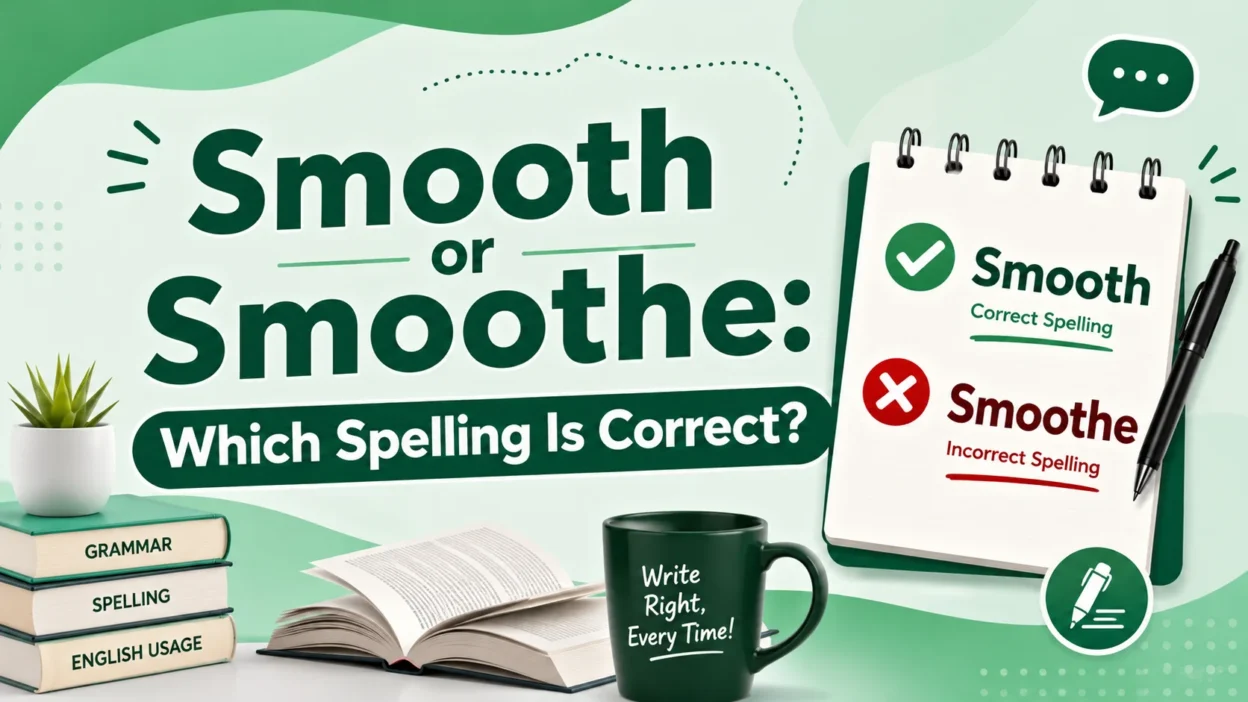
When choosing ‘Smooth’ or ‘Smoothe’, writers often face spelling confusion because both forms look and sound alike. In modern American English, smooth is the standard spelling and correct form. It works as an adjective for surfaces without bumps or roughness, and as a verb meaning to make something even or easier.
The English language has many similar terms and multiple accepted spellings, so writers may assume that smoothe works like sooth or soothe. However, smoothe has limited accepted usage and is mainly an outdated variant spelling found in older books or historical sources. In modern writing, smooth is the commonly accepted word.
A simple pronunciation guide can help, but the spelling is easier to remember. Use smooth in an email, article, or report to avoid common mistakes. If your mind hits a wall, remember this writing tip: smooth as butter. The clear answer is smooth.
Smooth or Smoothe: The Quick Answer
The correct spelling for modern English is smooth.
Smoothe has appeared as a historical variant, especially as a verb. You might encounter it in older literature or historical documents. In contemporary American English, though, smooth is the normal and accepted form.
| Word | Modern Usage | Main Role | Recommendation |
| Smooth | Common | Adjective, verb, noun | Use this spelling |
| Smoothe | Very rare/historical | Mainly historical verb form | Usually avoid it |
For example:
- The table has a smooth surface.
- Please smooth the paper before folding it.
- We had a smooth transition.
- She tried to smooth things over.
In all these modern examples, smooth is the right choice.
What Does “Smooth” Mean?
The word smooth has several meanings, which makes it one of those useful English words that appears in many situations.
At its most basic level, smooth describes something that doesn’t have a rough, uneven, or bumpy surface. However, English speakers also use it for things that happen easily, naturally, or without problems.
Smooth as an Adjective
As an adjective, smooth can describe a physical surface.
For example:
The glass feels smooth.
You can also use it for materials, textures, and objects:
- smooth wood
- smooth stone
- smooth fabric
- smooth skin
- smooth paper
- smooth metal
The meaning can also become figurative.
Consider these examples:
- a smooth transition
- a smooth process
- a smooth conversation
- a smooth performance
- a smooth journey
Here, smooth means something happened without unnecessary trouble or interruption.
Smooth as a Verb
Smooth can also function as a verb.
When you smooth something, you make it flatter, more even, or less rough.
For example:
She used a cloth to smooth the wrinkles from the shirt.
You can also use the verb in a figurative way:
The manager tried to smooth the disagreement between the two employees.
This meaning appears in several familiar expressions.
Smooth out means to remove problems or irregularities:
We need to smooth out a few problems before launching the project.
Smooth over means to reduce tension or make a disagreement less serious:
He apologized to smooth over the conflict.
Smooth as a Noun
Although smooth is most commonly an adjective or verb, it can also appear as a noun in specific contexts.
For example, technical, informal, or specialized language may use smooth to describe something characterized by a smooth quality or movement.
For everyday English, however, the adjective and verb uses are much more important.
Smooth as an Adverb
One important point can prevent another common mistake.
The usual adverb form is smoothly.
For example:
The machine operates smoothly.
Everything went smoothly during the event.
So, when you need an adverb, don’t automatically use smooth. Use smoothly when the sentence calls for it.
What Does “Smoothe” Mean?
Is “Smoothe” a Word?
Smoothe is a real historical spelling, but that doesn’t mean it’s the preferred spelling today.
Older English writing sometimes used smoothe as a variant of smooth. You may still find the form when reading historical material, old books, or archived writing.
Modern writers generally don’t need it.
If you’re writing an email, blog post, school assignment, business report, or website article, smooth is the better choice.
Where You Might See “Smoothe”
The spelling smoothe may appear in:
- Older books
- Historical documents
- Old newspapers
- Archived publications
- Historical dictionaries
- Reproductions of older texts
- Literary works from earlier periods
Finding smoothe in one of these sources doesn’t mean the spelling is appropriate for modern writing.
Language changes over time. A spelling can survive in historical records while becoming uncommon in everyday communication.
Should You Use “Smoothe” Today?
In most cases, no.
If you’re creating new content, use smooth.
For example:
Modern:
The carpenter will smooth the edges.
Unusual today:
The carpenter will smoothe the edges.
The second version may have historical precedent, but the first is what modern readers expect.
Smooth vs. Smoothe: Side-by-Side Comparison
The difference becomes much clearer when you put the two spellings next to each other.
| Feature | Smooth | Smoothe |
| Standard modern spelling | Yes | No |
| Common in American English | Yes | No |
| Describes a surface | Yes | No |
| Works as a modern verb | Yes | Rare/historical |
| Used in professional writing | Yes | Generally no |
| Appears in older texts | Yes | Yes |
| Recommended for modern writing | Yes | No |
The Key Takeaway
If you’re writing in modern American English, choose smooth.
That’s the practical rule worth remembering.
Why Do People Confuse Smooth and Smoothe?
The confusion isn’t completely random. English spelling has plenty of irregular patterns, so it’s easy to assume that an extra letter belongs where it doesn’t.
Similar Spellings
Some English words naturally end with e, including:
- soothe
- bathe
- breathe
- clothe
- move
Because smooth looks somewhat similar to soothe, writers may assume that smoothe is the verb form.
It isn’t the standard modern spelling.
Similar Pronunciations
Smooth has a long “oo” sound followed by the voiced th sound.
The spelling smoothe doesn’t give modern readers a meaningful pronunciation difference. That makes the extra e unnecessary from a practical standpoint.
Influence of Other Word Pairs
English has many pairs in which spelling changes when a word takes a different grammatical role.
That can encourage people to think:
smooth → smoothe
But English doesn’t follow one universal spelling formula.
The verb is already smooth.
Autocorrect and Online Writing
Seeing an unusual spelling online can also create confusion.
If someone repeatedly writes smoothe, another reader may assume it’s an accepted alternative. However, repetition doesn’t automatically make a spelling standard.
When a spelling looks questionable, it’s better to check its modern usage rather than copy it.
The History Behind Smooth and Smoothe
The word smooth has a long history in English. Its older forms developed over centuries before modern English spelling became more standardized.
Historical English included forms that looked different from today’s spelling. Variant spellings were common because spelling wasn’t always consistent from one writer or region to another.
Smoothe belongs to this history of spelling variation.
That historical background explains why the word can still appear in older sources. It doesn’t mean modern writers should switch from smooth to smoothe.
Historical Development
Older forms of the word were connected with meanings involving softness, evenness, and freedom from roughness.
Over time, smooth became the established spelling in modern English.
As dictionaries, publishing practices, education, and standardized spelling became more influential, commonly accepted spellings became more stable.
That’s why modern readers overwhelmingly expect smooth.
Is Smoothe Obsolete?
Calling smoothe completely meaningless would be too simplistic.
It has historical usage. However, it’s not the normal modern spelling.
You can think of it as a spelling that belongs more naturally to historical material than contemporary communication.
You May Still Find Smoothe In:
- Historical literature
- Older manuscripts
- Archived publications
- Historical quotations
- Discussions about English spelling
- Reproductions of older writing
If you’re quoting an old source, you may want to preserve the original spelling. If you’re writing something new, use smooth.
That distinction matters.
Grammar Roles Explained
Understanding the grammatical forms of smooth makes the spelling easier to remember.
Smooth as an Adjective
Use smooth to describe a person, object, surface, process, or experience.
Examples:
The road is smooth.
She has a smooth voice.
We enjoyed a smooth journey.
Smooth as a Verb
Use smooth when you mean “make even” or “make easier.”
Examples:
Smooth the paper before applying the sticker.
They worked together to smooth the transition.
Smooth as a Noun
The noun form appears in certain specialized or informal contexts. It’s less common than the adjective and verb.
Smoothe as a Verb
Historically, smoothe has appeared as a verb. In modern American English, however, smooth is the standard verb.
So:
Please smooth the surface.
is the normal modern construction.
Smooth, Smoothly, Smoothness, and Smoothing
Knowing related forms can help you avoid spelling mistakes.
| Word | Meaning | Example |
| Smooth | Even or make even | The surface is smooth. |
| Smoothly | Without difficulty | Everything went smoothly. |
| Smoothness | Quality of being smooth | I noticed the smoothness of the finish. |
| Smoothing | Making something smooth | Smoothing the wood took time. |
| Smoothed | Past form of smooth | She smoothed the fabric. |
| Smoother | Comparative form | This fabric feels smoother. |
| Smoothest | Superlative form | This is the smoothest surface. |
Notice the pattern.
None of these standard modern forms requires smoothe.
Examples of Smooth in Everyday English
The word appears in far more contexts than physical surfaces.
Physical Objects
The stone has a smooth surface.
The silk feels smooth against the skin.
Sand the edges until they’re smooth.
Business Communication
We want a smooth transition between departments.
Good planning makes the process smoother.
The team handled the change smoothly.
Social Interactions
She tried to smooth over the disagreement.
His smooth manner helped everyone relax.
Technology
The application provides a smooth user experience.
The animation runs smoothly on the new device.
The update should make navigation smoother.
Examples of Smoothe in Context
If you encounter smoothe in historical material, its intended meaning is usually clear from context.
For example, an older text might use it when discussing:
- Craftsmanship
- Surface preparation
- Manufacturing
- Woodworking
- Restoration
- Polishing
- Physical texture
A historical sentence might use the spelling as a verb where modern English would simply use smooth.
The important lesson is not to confuse historical evidence with modern spelling advice.
Quick Writer’s Checklist
Before you publish your sentence, check these points:
- Use smooth for modern writing.
- Use smooth as the standard modern verb.
- Use smoothly when you need the adverb.
- Use smoothness for the noun describing the quality.
- Recognize smoothe as a historical or unusual variant.
- Don’t assume an old spelling belongs in modern English.
- Preserve smoothe when accurately quoting historical material.
Conclusion
The choice between smooth or smoothe is simple in modern English. Smooth is the standard and widely accepted spelling for describing surfaces, processes, and actions. Smoothe may appear in older or historical writing, but it’s rarely appropriate in contemporary American English. When you’re writing an email, article, assignment, or professional document, choose smooth to keep your spelling clear and correct.
FAQs
Q1. Is “Smooth” or “Smoothe” correct?
Smooth is the correct standard spelling in modern American English. Smoothe is an uncommon historical variant.
Q2. Is “Smoothe” a real word?
Yes, smoothe has historical usage. However, it’s not normally used in modern English.
Q3. Why do people spell Smooth as Smoothe?
The confusion often comes from similar words such as smoothe. Writers may assume that smooth needs an extra e, but it doesn’t.
Q4. Can Smooth be used as a verb?
Yes. Smooth works as a verb meaning to make something even, less rough, or easier to handle.
Q5. How can I remember the spelling of Smooth?
Remember this simple rule: smooth doesn’t need an extra e. For modern writing, always choose smooth.