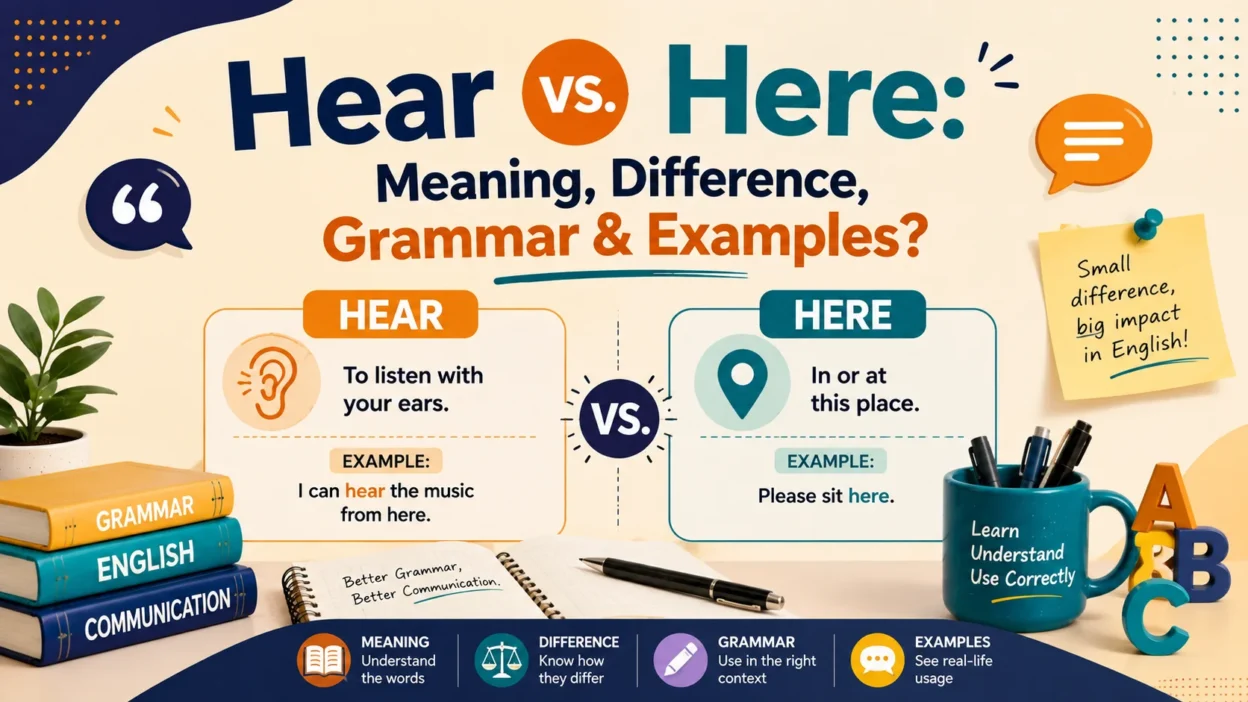
The ‘Hear’ vs ‘Here’ confusion happens because these homophones have the same sound but different meanings and uses. Hear relates to listening, while here refers to a place or location.
Hear is a verb connected to your ears and auditory perception. You can hear birds singing or someone talking. Here is an adverb that shows a place, such as “Please sit here” or “Come here.”
A simple memory trick is ear → hear. Use hear for sound and here for location. Understanding their grammar rules, context, and different uses helps prevent common mistakes and improves your writing and communication.
Hear vs. Here: Quick Answer
The simplest way to remember hear vs. here is this:
Hear = sound. Here = place.
Hear is a verb that means to perceive sound, listen to something being said, or receive information.
Here is mainly an adverb that refers to a particular place, usually the place where the speaker or listener is.
| Word | Meaning | Main grammatical role | Example |
| Hear | Perceive sound or receive information | Verb | I can hear the birds. |
| Here | In or at this place | Adverb | Your keys are here. |
Consider the difference in these two sentences:
- Can you hear me?
- Can you come here?
The first sentence asks about sound. The second identifies a location.
Hear vs. Here: The Main Difference
Although hear and here are pronounced alike in standard US English, they aren’t interchangeable.
The word hear describes an experience involving sound. You might hear music, a voice, a noise, a warning, or a piece of news.
The word here identifies a place. It can refer to the speaker’s current location or another location understood from the context.
Hear
Hear is a verb.
I hear a strange noise.
The sentence describes what the subject perceives through the ears.
Here
Here is generally an adverb.
Your phone is here.
The word tells us where the phone is located.
A quick substitution test can help. If the sentence relates to sound, you probably need hear. If it answers the question “Where?”, you probably need here.
What Does “Hear” Mean?
Hear means to perceive sound through the ears. It doesn’t necessarily mean that you deliberately paid attention to the sound.
For example:
I heard a loud bang during the night.
The speaker perceived the sound. That doesn’t tell us whether the speaker intentionally listened for it.
This distinction becomes important when comparing hear and listen.
Hear as a Verb
Hear is an irregular verb. Its principal forms are:
| Verb form | Example |
| hear | I hear music. |
| hears | She hears a noise. |
| heard | We heard the announcement. |
| hearing | He is hearing strange sounds. |
Notice something important: the past tense isn’t heared. The correct form is heard.
For example:
- I heard your message yesterday.
- She heard a knock at the door.
- They heard the news this morning.
Common Uses of Hear
The verb hear has several meanings beyond simply detecting sound.
Perceiving a sound
Did you hear that noise?
Understanding spoken words
I couldn’t hear what you said.
Receiving news or information
I heard that the store is closing.
Here, hear means receiving information rather than physically detecting a particular sound.
Hearing from someone
I haven’t heard from John lately.
The phrase hear from usually means receiving communication from someone.
What Does “Here” Mean?
Here refers to a place. Most often, it means the place where the speaker is located or the place currently being discussed.
For example:
Please wait here.
The speaker is identifying a particular location.
Another example:
I live here.
The exact location depends on the context. It could mean a house, neighborhood, city, or even country.
Here as a Place Word
The most common use of here is to identify location.
Examples include:
- Come here.
- Sit here.
- Your bag is here.
- I’ve worked here for five years.
- We stopped here for lunch.
In each example, here answers the question “Where?”
Here for Emphasis or Attention
Here can also introduce something or draw attention to it.
Consider:
Here is your coffee.
The speaker isn’t simply describing a location. The word here helps present or point out the coffee.
You may also hear:
Here comes the bus!
This sentence draws attention to something that is arriving.
Another common structure is:
Here we go.
Depending on context, this can mean that an activity is beginning or that something is finally happening.
Common Expressions With Here
English uses here in many everyday expressions.
| Expression | Meaning | Example |
| here and there | In various places | We saw small shops here and there. |
| here and now | At the present time | We need to decide here and now. |
| from here on | Starting at this point | From here on, we’ll be more careful. |
| here we go | Something is starting | Here we go! The game is beginning. |
| come here | Move toward this location | Come here for a moment. |
These expressions reinforce the basic idea behind here: location, position, or a point in the current situation.
Why Do “Hear” and “Here” Sound the Same?
Hear and here are homophones.
Homophones are words that have the same pronunciation but different meanings and often different spellings.
Other common examples include:
- see / sea
- right / write
- to / too / two
- there / their / they’re
- flower / flour
With hear and here, the spelling carries an important clue.
The word hear contains the letters ear, which makes it easy to connect the word with hearing.
The word here contains her plus the letter e. It doesn’t directly signal location, so context becomes especially important.
A Simple Sound Comparison
In standard US English, both words are commonly pronounced /hɪr/.
That means you can’t always identify the correct spelling from pronunciation alone.
For example, if someone says:
“Come hear.”
You need the surrounding context to know whether the intended sentence is “Come here” or something involving hear.
That’s why homophones can be tricky in writing even when they’re effortless in conversation.
Hear vs. Here in Sentences
Seeing the words in context is one of the fastest ways to understand their difference.
Examples With “Hear”
- I can hear the rain outside.
- Did you hear what she said?
- We heard a strange noise upstairs.
- She hears music every morning.
- I haven’t heard from him yet.
- Did you hear the latest news?
- They heard the announcement clearly.
Each example involves sound, spoken information, or communication.
Examples With “Here”
- Please wait here.
- Your shoes are here.
- Come here for a minute.
- I’ve been working here since June.
- Put the box here.
- We can meet here tomorrow.
- There’s nothing here.
Each example points to a place or location.
Hear and Here in the Same Sentence
Sometimes both words appear naturally in one sentence.
Come here so you can hear the announcement.
This sentence makes the difference obvious.
Here tells someone where to come. Hear describes what they should be able to perceive.
Another example:
I couldn’t hear you from here.
The first word refers to sound. The second refers to location.
These sentences are excellent examples because the two words can appear next to each other without causing any grammatical problem.
Hear vs. Here: Common Mistakes
Most errors happen because the words sound identical.
Using “Here” When You Mean “Hear”
Incorrect:
I can’t here you.
Correct:
I can’t hear you.
The sentence describes the ability to perceive someone’s voice, so hear is required.
Another example:
Incorrect:
Did you here that?
Correct:
Did you hear that?
Again, the sentence concerns sound.
Using “Hear” When You Mean “Here”
Incorrect:
Come hear and sit down.
Correct:
Come here and sit down.
The sentence tells someone to move to a location, so here is correct.
Another example:
Incorrect:
Your package is hear.
Correct:
Your package is here.
The sentence answers the question “Where is the package?” Therefore, here is the right word.
Hear vs. Here: A Quick Correction Table
| Incorrect | Correct | Why? |
| I can here you. | I can hear you. | Sound |
| Come hear. | Come here. | Location |
| Did you here that? | Did you hear that? | Sound |
| Your keys are hear. | Your keys are here. | Location |
| I can’t here anything. | I can’t hear anything. | Sound |
Easy Ways to Remember Hear vs. Here
A simple memory trick can eliminate most mistakes.
Remember “Ear” in Hear
Look at the spelling:
H + EAR = HEAR
The word hear contains ear, the body part associated with hearing.
So when you’re talking about sound, think:
EAR → HEAR
For example:
I can hear the music.
Remember Here as a Place
Think of here as pointing to a location.
Imagine someone pointing at the floor and saying:
“Stand here.”
If you could answer the sentence with “Where?”, here is probably the right word.
The Five-Second Test
When you’re unsure, ask yourself:
Does the sentence involve sound?
- Yes → hear
- No, it involves location → here
For example:
Can you ___ me?
The answer is hear because the sentence concerns sound.
Come ___.
The answer is here because the sentence concerns location.
“Hear, Hear!” vs. “Here, Here!”
One of the most interesting uses of hear appears in the expression “Hear, hear!”
“Hear, hear!” is used to express strong agreement or approval.
For example:
“Everyone deserves a fair chance.”
“Hear, hear!”
The expression essentially signals enthusiastic agreement with what someone has just said.
Why Isn’t It “Here, Here”?
“Here, here!” is a common spelling mistake when people intend the expression of agreement.
The correct idiom is:
Hear, hear!
The word hear comes from the idea of calling attention to someone’s words and encouraging others to listen to them.
This is different from ordinary uses of here.
Compare:
- Hear, hear! = I strongly agree.
- Here, here. = Generally not the standard spelling of the agreement expression.
Knowing this distinction can help when writing dialogue, articles, speeches, or professional content.
Hear vs. Here: A Practical Case Study
Imagine a student writing this message:
“I can’t here the teacher from hear.”
Both homophones have been reversed.
The corrected sentence is:
“I can’t hear the teacher from here.”
Why?
Hear describes the student’s ability to perceive the teacher’s voice. Here identifies the student’s current location.
The sentence becomes easy to analyze when each word is connected to its function:
- hear → sound
- here → location
This simple approach works even when the sentence becomes more complicated.
For example:
“From here, I can hear the music clearly.”
The phrase from here identifies a location. The verb hear describes sound perception.
Hear vs. Here: Quick Facts
- Hear is primarily a verb.
- Here is primarily an adverb.
- Hear relates to sound and auditory perception.
- Here relates to location or position.
- Hear and here are homophones.
- They are commonly pronounced the same in standard US English.
- Heard is the past tense of hear.
- Here appears in many expressions, including here and there and here we go.
- “Hear, hear!” is the standard spelling of the expression showing strong agreement.
- The letters ear in hear provide a useful memory clue.
Hear vs. Here Quiz
Choose the correct word in each sentence.
- Can you ___ the music from outside?
- A. here
- B. hear
- Please wait ___ until I return.
- A. hear
- B. here
- Did you ___ that loud noise?
- A. hear
- B. here
- Your jacket is right ___.
- A. here
- B. hear
- I couldn’t ___ what the speaker said.
- A. here
- B. hear
- Come ___ and look at this.
- A. hear
- B. here
- We haven’t ___ from Sarah recently.
- A. here
- B. heard
- I can ___ the birds from ___.
- A. here / hear
- B. hear / here
- Which expression shows strong agreement?
- A. Here, here!
- B. Hear, hear!
- Which word refers to a location?
- A. hear
- B. here
Quiz Answers and Explanations
- B. hear — The sentence concerns perceiving music.
- B. here — The word identifies a location.
- A. hear — A noise is something you perceive through hearing.
- A. here — The sentence tells where the jacket is.
- B. hear — The speaker couldn’t perceive the words clearly.
- B. here — The speaker asks someone to move to a location.
- B. heard — Heard is the past participle of hear in “hear from.”
- B. hear / here — You hear the birds from a particular place, here.
- B. Hear, hear! — This is the standard expression of agreement.
- B. here — Here refers to a place.
Here’s a concise conclusion and 7 FAQs in simple US English, with numbered questions and key terms bolded.
Conclusion
Understanding hear vs. here is simple when you connect each word with its main purpose. Hear relates to sound and listening, while here refers to a place or location. Since both words are homophones, their pronunciation can cause confusion. Remember ear → hear for sound and here → location when writing.
FAQs
Q1. What is the difference between hear and here?
Hear is a verb related to sound, while here is an adverb that refers to a place or location.
Q2. Are hear and here homophones?
Yes. Hear and here are homophones because they sound the same but have different spellings and meanings.
Q3. Is hear a verb?
Yes. Hear is a verb meaning to perceive sound or receive information.
Q4. What part of speech is here?
Here is mainly an adverb used to indicate a place or location.
Q5. How can I remember hear vs. here?
Remember ear → hear. If the sentence involves sound or your ears, use hear. For a location, use here.
Q6. What does “Hear, hear!” mean?
“Hear, hear!” is an expression used to show strong agreement or approval with something someone has said.
Q7. What is an example of hear and here together?
A simple example is: “From here, I can hear the music.” Here shows the location, while hear refers to sound.