“Hasn’t” vs. “Haven’t” is easy to understand when you check the subject first. Hasn’t means has not and works with he, she, and it. Haven’t means have not and works with I, you, we, and they. This subject-verb agreement helps you avoid common mistakes in everyday English writing and speaking.
Both forms appear in everyday conversations, English speaking, professional communication, and school assignments. In the present perfect tense, use hasn’t with singular third-person subjects and haven’t with plural or first- and second-person subjects. For example, “She hasn’t arrived” and “They haven’t arrived.”
When choosing the correct form, check the subject before the verb. This simple habit improves correct usage, effective communication, writing skills, and speaking skills. It also helps English learners use these commonly confused contractions with confidence..
Hasn’t vs. Haven’t: What’s the Difference?
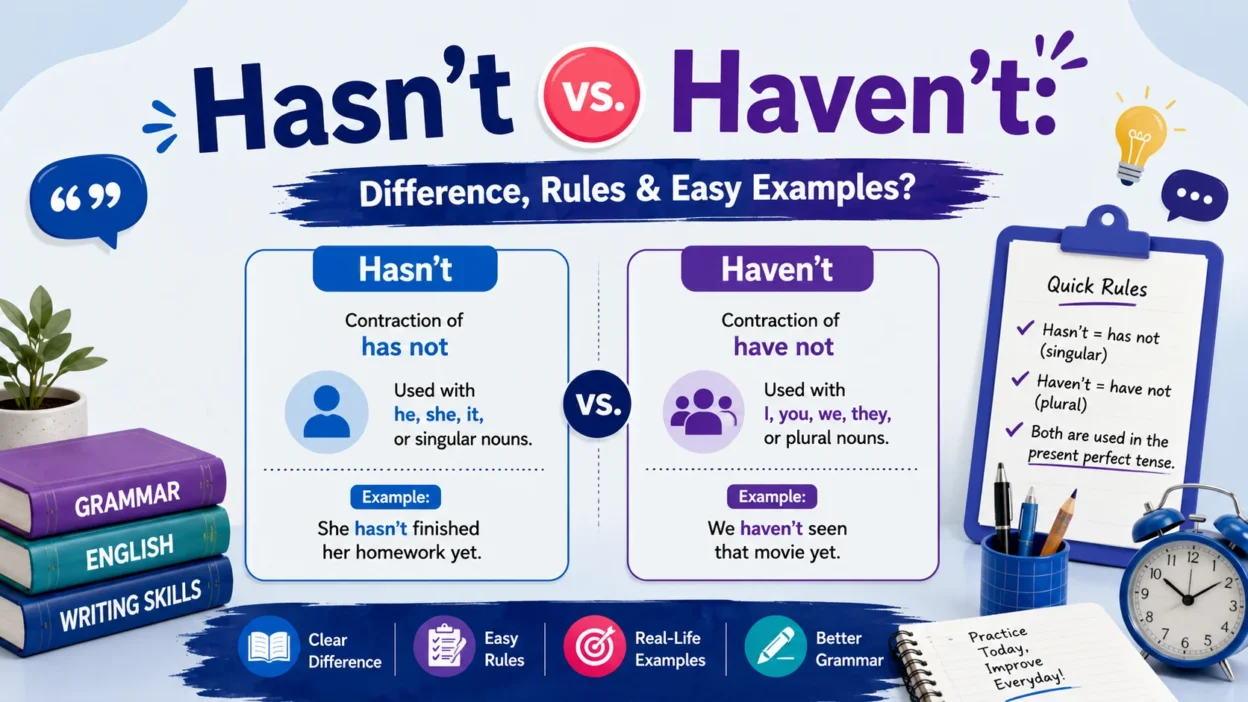
Hasn’t is the contraction of has not, while haven’t is the contraction of have not.
Both forms can express a negative idea. However, the correct choice depends on the subject of the sentence.
| Form | Full Form | Used With | Example |
| Hasn’t | Has not | He, she, it, singular nouns | She hasn’t arrived. |
| Haven’t | Have not | I, you, we, they, plural nouns | They haven’t arrived. |
Consider these two sentences:
- Michael hasn’t finished his work.
- Michael and David haven’t finished their work.
The first sentence has a singular subject, so it uses hasn’t. The second has a plural subject, so it uses haven’t.
Hasn’t Meaning
Hasn’t means has not. It usually appears when a third-person singular subject has not completed an action or when something has not happened.
Examples:
- She hasn’t called me.
- He hasn’t finished his homework.
- The dog hasn’t eaten yet.
- The computer hasn’t started.
- Maria hasn’t replied to the email.
Haven’t Meaning
Haven’t means have not. It commonly appears with I, you, we, they, and plural nouns.
Examples:
- I haven’t finished yet.
- You haven’t answered my question.
- We haven’t seen that movie.
- They haven’t arrived.
- The students haven’t submitted their assignments.
Hasn’t vs. Haven’t at a Glance
The fastest way to remember the difference is:
He, she, it → hasn’t
I, you, we, they → haven’t
This small rule handles most everyday situations.
The Basic Rule for Using Hasn’t and Haven’t
English subject-verb agreement determines whether you use hasn’t or haven’t.
Use Hasn’t With He, She, and It
Use hasn’t with third-person singular subjects.
Examples:
- He hasn’t arrived.
- She hasn’t eaten.
- It hasn’t stopped raining.
You also use hasn’t with singular nouns.
- The teacher hasn’t arrived.
- My brother hasn’t called.
- The car hasn’t started.
Use Haven’t With I, You, We, and They
Use haven’t with these subjects:
- I
- You
- We
- They
Examples:
- I haven’t finished.
- You haven’t told me.
- We haven’t decided.
- They haven’t arrived.
Plural nouns also take haven’t.
- The students haven’t finished.
- The dogs haven’t eaten.
- My parents haven’t arrived.
Quick Subject-Verb Agreement Table
| Subject | Correct Form | Example |
| I | Haven’t | I haven’t finished. |
| You | Haven’t | You haven’t called. |
| He | Hasn’t | He hasn’t arrived. |
| She | Hasn’t | She hasn’t replied. |
| It | Hasn’t | It hasn’t worked. |
| We | Haven’t | We haven’t decided. |
| They | Haven’t | They haven’t started. |
How Hasn’t and Haven’t Work in the Present Perfect
One of the most important uses of hasn’t and haven’t occurs in the present perfect tense.
The present perfect connects a past action or event with the present. The exact time may not matter, or the action may continue to have a result now.
The basic positive structure is:
Subject + has/have + past participle
For negative sentences, use:
Subject + hasn’t/haven’t + past participle
Examples:
- She has finished the report.
- She hasn’t finished the report.
- They have finished the report.
- They haven’t finished the report.
Notice something important: the main verb doesn’t change to the simple past after hasn’t or haven’t.
Correct:
- She hasn’t gone home.
- They haven’t eaten yet.
- He hasn’t seen the movie.
Incorrect:
- She hasn’t went home.
- They haven’t ate yet.
- He hasn’t saw the movie.
Present Perfect Signal Words
Certain words frequently appear with the present perfect.
- Already
- Yet
- Ever
- Never
- Just
- Recently
- Since
- For
- So far
Examples:
- She hasn’t called yet.
- We haven’t finished so far.
- He hasn’t visited New York before.
- They haven’t seen each other recently.
- I haven’t spoken to her since Monday.
When to Use “Hasn’t”
Use hasn’t when the subject is singular and third person.
Hasn’t With He, She, and It
These pronouns always take hasn’t in standard English.
- He hasn’t arrived.
- She hasn’t responded.
- It hasn’t stopped.
Don’t let the noun after the verb distract you from the subject.
For example:
She hasn’t finished her assignments.
The word assignments is plural, but it isn’t the subject. She is the subject. Therefore, hasn’t is correct.
Hasn’t With Singular Nouns and Names
A singular person, animal, object, or name generally takes hasn’t.
- James hasn’t arrived.
- The manager hasn’t approved the request.
- My sister hasn’t called.
- The printer hasn’t worked today.
- The cat hasn’t eaten.
When to Use “Haven’t”
Use haven’t with I, you, we, they, and plural nouns.
Haven’t With I and You
Examples:
- I haven’t finished my work.
- I haven’t eaten lunch.
- You haven’t answered my question.
- You haven’t told me the truth.
Haven’t With We and They
Examples:
- We haven’t made a decision.
- We haven’t received the package.
- They haven’t arrived.
- They haven’t completed the project.
Haven’t With Plural Nouns
Plural subjects take haven’t.
- The students haven’t arrived.
- The workers haven’t finished.
- My friends haven’t called.
- The dogs haven’t eaten.
Hasn’t vs. Haven’t Side-by-Side Comparison
| Feature | Hasn’t | Haven’t |
| Full form | Has not | Have not |
| I | No | Yes |
| You | No | Yes |
| He | Yes | No |
| She | Yes | No |
| It | Yes | No |
| We | No | Yes |
| They | No | Yes |
| Singular noun | Yes | No |
| Plural noun | No | Yes |
| Example | She hasn’t arrived. | They haven’t arrived. |
The distinction isn’t based on the action. It’s based mainly on the subject..
Hasn’t and Haven’t in Negative Statements
Both forms create negative statements, but subject agreement still controls the choice.
Hasn’t
- He hasn’t finished the work.
- She hasn’t visited Chicago.
- The company hasn’t announced the results.
- The computer hasn’t connected to the internet.
Haven’t
- I haven’t finished the work.
- We haven’t visited Chicago.
- They haven’t announced the results.
- You haven’t connected the device.
The formula remains straightforward:
Subject + hasn’t/haven’t + past participle
Common Mistakes With Hasn’t and Haven’t
Even advanced learners sometimes make these mistakes because English contains several similar helping verbs.
Mistake #1: Using Haven’t With a Singular Third-Person Subject
Incorrect:
❌ He haven’t finished.
Correct:
✅ He hasn’t finished.
The subject he requires hasn’t.
Mistake #2: Using Hasn’t With I
Incorrect:
❌ I hasn’t finished.
Correct:
✅ I haven’t finished.
Although I refers to one person, English uses have with I.
That’s an important exception to the simple singular/plural shortcut.
Mistake #3: Forgetting Subject Agreement
Incorrect:
❌ The students hasn’t arrived.
Correct:
✅ The students haven’t arrived.
Because students is plural, use haven’t.
Mistake #4: Using the Wrong Verb Form
After hasn’t or haven’t, use the past participle, not the simple past.
❌ She hasn’t went.
✅ She hasn’t gone.
❌ They haven’t ate.
✅ They haven’t eaten.
❌ He hasn’t saw it.
✅ He hasn’t seen it.
Hasn’t vs. Haven’t vs. Doesn’t vs. Don’t
These forms can look similar because they all create negative sentences. However, they don’t serve the same grammatical purpose.
| Form | Main Use | Example |
| Hasn’t | Present perfect | She hasn’t eaten. |
| Haven’t | Present perfect | They haven’t eaten. |
| Doesn’t | Simple present | She doesn’t eat meat. |
| Don’t | Simple present | They don’t eat meat. |
Compare these sentences:
She hasn’t eaten breakfast.
This means breakfast has not happened up to the relevant present time.
She doesn’t eat breakfast.
This describes a habit or general pattern.
That’s a meaningful difference.
Hasn’t vs. Haven’t vs. Hadn’t
Hadn’t is the contraction of had not. Unlike hasn’t and haven’t, it belongs to the past perfect.
| Form | Tense | Example |
| Hasn’t | Present perfect | He hasn’t arrived. |
| Haven’t | Present perfect | They haven’t arrived. |
| Hadn’t | Past perfect | He hadn’t arrived before noon. |
Consider the time relationship:
- He hasn’t arrived. → The situation relates to now.
- He hadn’t arrived when I left. → The situation happened before another past event.
The word hadn’t works with all subjects:
- I hadn’t
- You hadn’t
- He hadn’t
- She hadn’t
- We hadn’t
- They hadn’t
Tricky Subject Cases
Some subjects require extra attention because they don’t look like ordinary singular or plural nouns.
Collective Nouns
In American English, collective nouns such as team, committee, company, family, and government are often treated as singular when the group acts as one unit.
Examples:
- The team hasn’t decided.
- The committee hasn’t reached a decision.
- The company hasn’t released the results.
- The family hasn’t arrived yet.
However, the surrounding meaning can affect how a sentence is constructed. Focus on whether the noun represents one group acting as a unit or individual members.
Compound Subjects
Two people or things joined with and normally form a plural subject.
- Tom and Sarah haven’t arrived.
- The teacher and student haven’t spoken.
- My brother and sister haven’t called.
That’s because the sentence has more than one subject.
Indefinite Pronouns
Words such as everyone, someone, nobody, anybody, and each are generally grammatically singular.
Therefore:
- Everyone hasn’t agreed.
- Nobody hasn’t called.
However, these negative constructions can sound awkward or confusing because they may create a double-negative meaning. Clearer alternatives often work better:
- Not everyone has agreed.
- Nobody has called.
This is a good example of why grammar isn’t only about choosing the correct verb. Meaning and clarity matter too.
Quick Grammar Test: Hasn’t or Haven’t?
Choose hasn’t or haven’t.
- She ___ finished the report.
- They ___ arrived yet.
- I ___ seen that movie.
- He ___ called today.
- We ___ made a decision.
- The students ___ completed the assignment.
- It ___ stopped raining.
- You ___ answered the question.
- My sister ___ visited New York.
- The workers ___ finished the project.
Answer Key
- hasn’t
- haven’t
- haven’t
- hasn’t
- haven’t
- haven’t
- hasn’t
- haven’t
- hasn’t
- haven’t
The fastest way to solve each one is to identify the subject first.
Quick Cheat Sheet: Hasn’t vs. Haven’t
| Remember This | Correct Choice |
| I | Haven’t |
| You | Haven’t |
| He | Hasn’t |
| She | Hasn’t |
| It | Hasn’t |
| We | Haven’t |
| They | Haven’t |
| Singular noun | Hasn’t |
| Plural noun | Haven’t |
| Hasn’t + verb | Past participle |
| Haven’t + verb | Past participle |
The Core Formula
He/She/It + hasn’t + past participle
I/You/We/They + haven’t + past participle
Examples:
- She hasn’t finished.
- They haven’t finished.
That’s the heart of the entire rule.
Here’s a concise conclusion and 10 SEO-friendly FAQs with the questions in H3 format and key terms bolded.
Conclusion
Understanding hasn’t vs haven’t becomes simple when you focus on the subject. Use hasn’t with he, she, and it, while haven’t works with I, you, we, and they. With a little practice, you can use these English contractions correctly and speak and write with more confidence.
FAQs
Q1. What does hasn’t mean?
Hasn’t is the contraction of has not. We usually use it with he, she, or it.
Q2. What does haven’t mean?
Haven’t is the contraction of have not. It commonly works with I, you, we, or they.
Q3. What is the difference between hasn’t and haven’t?
The main difference is the subject. Hasn’t is used with singular third-person subjects, while haven’t is used with I, you, and plural subjects.
Q4. Can I say “I hasn’t”?
No. Use “I haven’t” because I takes have, not has.
Q5. Can I say “She haven’t”?
No. The correct form is “She hasn’t” because she is a singular third-person subject.
Q6. Is hasn’t a contraction?
Yes. Hasn’t is the shortened form of has not.
Q7. Is haven’t a contraction?
Yes. Haven’t is the shortened form of have not.
Q8. Are hasn’t and haven’t interchangeable?
No. They are not interchangeable because they agree with different subjects.
Q9. Which is correct: “He hasn’t” or “He haven’t”?
“He hasn’t” is correct because he takes has.
Q10. Which is correct: “They hasn’t” or “They haven’t”?
“They haven’t” is correct because they takes have.