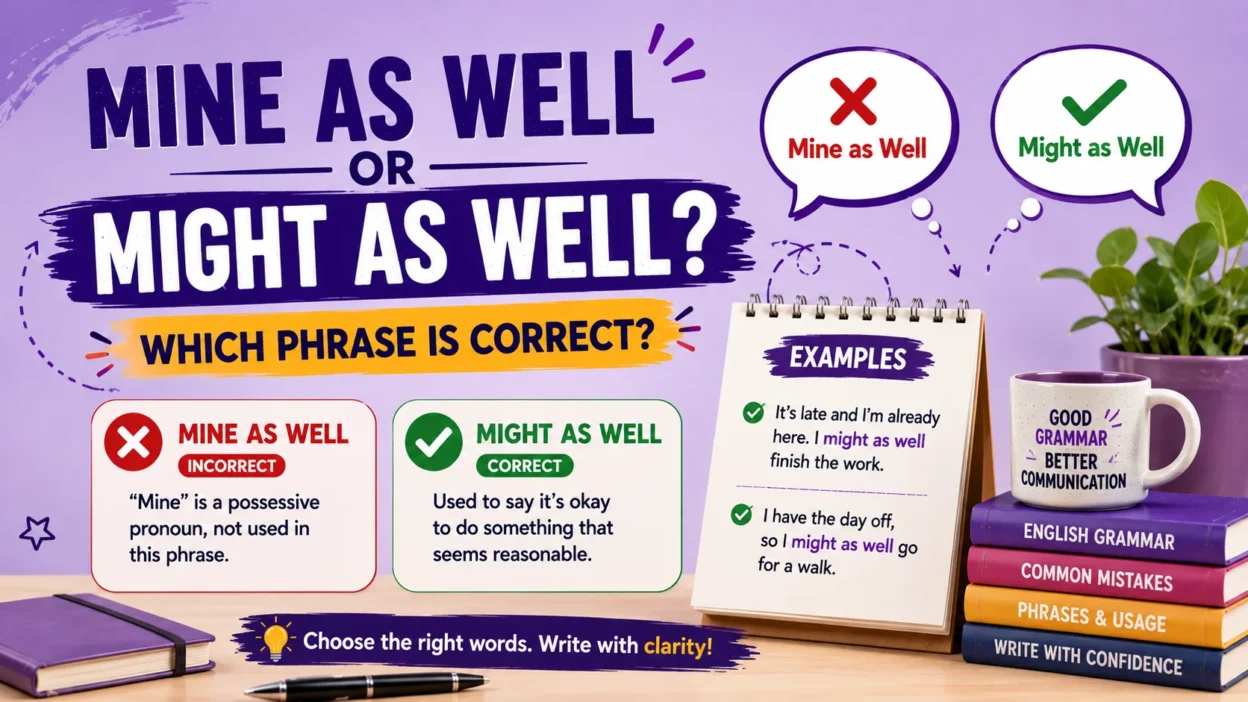
“Mine as Well” or “Might as Well” often confuses learners because the phrases sound similar in everyday conversation and writing. “Might as well” is correct, while “mine as well” is commonly incorrect. The correct phrase expresses a suggestion, acceptance, or a practical option.
These tricky twins can sound alike in fast English speech. Your ear may catch the wrong sound, especially during casual talk. This can lead to a spelling mistake or hearing mistake. Although they sound similar, their meanings and grammatical roles are different.
In everyday English, might as well means an action makes sense in a situation. For example, “We’re free, so we might as well see the movie.” It suggests a reasonable choice when there’s no strong reason to choose another option. Mine as well doesn’t have this meaning.
“Might as Well” vs. “Mine as Well” at a Glance
The simplest rule is this:
Use “might as well” when you’re talking about an action that seems reasonable, practical, or worth doing under the circumstances.
| Phrase | Correct? | Meaning |
| might as well | Yes | It makes sense to do something |
| mine as well | Usually no | Not the standard expression |
| may as well | Yes | Similar meaning to “might as well” |
| might aswell | No | “As well” must remain two words |
Consider these examples:
- We might as well leave now.
- You might as well call her.
- I mine as well go.
- I might aswell go.
The problem with “mine as well” isn’t just spelling. The word mine doesn’t perform the grammatical job that might be performed in this expression.
What Does “Might as Well” Mean?
“Might as well” is an idiomatic expression used when an action seems reasonable because of the circumstances.
It often carries the idea of:
- There isn’t much reason not to do it.
- This option makes practical sense.
- Since we’re already doing something, we can continue.
- The situation leaves us with little to lose.
- An action is probably the easiest or most sensible choice.
For example:
The restaurant is only five minutes away, so we might as well walk.
The speaker isn’t necessarily saying that walking is the only possible choice. They’re saying that, given the situation, walking seems like a sensible option.
“Might as Well” for a Practical Choice
One of the most common uses involves making a practical decision.
We’re already downtown, so we might as well visit the museum.
The speaker could choose not to visit the museum. However, being downtown makes the trip convenient.
Another example:
If you’re going to the store, you might as well pick up some bread.
The second action requires little additional effort. That’s the logic behind might as well.
“Might as Well” for an Unavoidable Situation
The expression can also appear when circumstances make an action seem almost inevitable.
The meeting doesn’t start for another hour, so we might as well grab coffee.
There’s time to spare. Instead of sitting around, getting coffee seems worthwhile.
Similarly:
The rain isn’t stopping, so we might as well head home.
The speaker accepts the circumstances and chooses the most practical response.
“Might as Well” for a Resigned Decision
Sometimes it might as well have a slightly resigned tone.
The flight is delayed for three hours, so we might as well get something to eat.
Nobody wanted the delay. Still, since they’re stuck at the airport, eating becomes a reasonable way to spend the time.
This is an important nuance. “Might as well” doesn’t always express enthusiasm. Depending on context and tone, it can suggest acceptance, indifference, resignation, or reluctant agreement.
Why Is “Mine as Well” Incorrect?
The confusion becomes much easier to understand when you examine the two words separately.
“Mine” Is a Possessive Pronoun
Mine is a possessive pronoun. It shows that something belongs to the speaker.
Examples include:
- That phone is mine.
- The blue notebook is mine.
- This seat is mine.
- The decision was mine.
Notice the pattern. Mine relates to ownership or possession.
It doesn’t function as the modal verb needed in the expression might as well.
So this sentence doesn’t work:
We mine as well go home.
The word mine has no grammatical connection to the action go.
“Might” Is a Modal Verb
Might, on the other hand, is a modal verb.
It can express possibility:
It might rain tonight.
But in might as well, the entire expression has a more specific idiomatic meaning.
We might as well start now.
This doesn’t simply mean that starting is possible. It suggests that starting now is a reasonable choice given the circumstances.
That’s why replacing might with mine destroys the intended meaning.
Might vs. Mine: Quick Comparison
| Word | Grammatical Role | Main Function | Example |
| might | Modal verb | Expresses possibility or contributes to suggestions | We might leave early. |
| mine | Possessive pronoun | Shows possession | The red jacket is mine. |
A useful memory trick is simple:
Might = possibility or choice.
Mine = possession.
If you’re discussing something that belongs to you, mine may be appropriate. If you’re suggesting an action because it makes sense, might as well is the phrase you need.
Why Do People Confuse “Mine as Well” With “Might as Well”?
The mistake usually comes from sound rather than grammar.
When native speakers talk quickly, individual sounds can become less distinct. In casual speech, it might as well not sound as carefully separated as it looks in writing.
Someone who has mostly heard the expression may mentally reconstruct the phrase as something like “mine as well.”
This is especially easy for language learners because the two phrases begin with similar sounds.
However, pronunciation doesn’t change the standard spelling.
It’s similar to hearing one word in a song and later discovering that the actual lyrics use a completely different word. What sounds familiar isn’t always what appears on the page.
How to Use “Might as Well” Correctly
The most useful structure is
Subject + might as well + base verb
Examples:
- I might as well stay.
- You might as well ask.
- We might as well leave.
- They might as well wait.
- She might as well try.
The verb after might as well stays in its base form.
“Might as Well” + Base Verb
Compare these examples:
- We might as well go.
- We might as well go.
- We might as well went.
- We might as well go.
The correct pattern is:
might as well go
Not:
might as well go
This follows the normal pattern for modal verbs. After might, English uses the base form of the verb.
“Might as Well” in Everyday Decisions
The expression appears naturally in everyday conversations.
“Are you staying here?”
“Yeah. I might as well wait for her.”
Or:
“We’re only ten minutes from the beach.”
“Then we might as well go.”
Or:
“The deadline isn’t until Friday.”
“We might as well finish it today.”
These examples show why the expression is so useful. It connects a current situation with a reasonable action.
“Might as Well” vs. Similar Expressions
Although might as well is common, several other expressions can look or sound similar.
Might as Well vs. May as Well
May as well and might as well can have nearly the same meaning.
For example:
We may as well leave now.
and:
We might as well leave now.
Both can mean that leaving now seems reasonable.
In modern American English, might as well is very common in everyday speech.
Might as Well vs. Should
These expressions aren’t always interchangeable.
Should they communicate advice, expectation, or obligation:
You should call your doctor.
Might as well usually suggests that an action makes sense given the circumstances:
You’re already calling the office, so you might as well ask about the appointment.
The first sentence gives advice. The second focuses on practical convenience.
Might as Well vs. Could
Could often present an available option:
We could take the train.
Might as well suggests that the option is worth choosing because of the circumstances:
The traffic is terrible, so we might as well take the train.
The distinction can be subtle. Context does most of the work.
“Might as Well” in American English
In American English, might as well is common in casual conversations and everyday writing.
You may hear it when people discuss:
- Travel plans
- Food and restaurants
- Work decisions
- Errands
- Waiting
- Invitations
- Weekend plans
- Unexpected problems
- Last-minute choices
For example:
“The store closes in twenty minutes.”
“We might as well go now.”
The phrase sounds natural because it quickly communicates the speaker’s reasoning without requiring a long explanation.
It can also soften a suggestion.
Compare:
Let’s go home.
with:
We might as well go home.
The second version can sound less forceful. It presents the action as a sensible response to the circumstances rather than a firm command.
Is “Might as Well” Appropriate in Formal Writing?
Yes. “Might as well” is grammatically correct and can appear in formal writing.
However, style matters.
In a casual email, this sentence sounds perfectly natural:
Since you’re already reviewing the report, you might as well check the figures.
In highly formal or technical writing, a more precise construction may sometimes work better:
Given that you are already reviewing the report, it would be practical to check the figures as well.
That doesn’t mean might as well is incorrect or unprofessional. It simply means that formal writing sometimes benefits from more explicit wording.
The key is to consider your audience and purpose.
“Might as Well” Examples vs. “Mine as Well” Examples
Seeing the difference in context makes the rule easier to remember.
Correct Examples
- We’re already at the mall, so we might as well eat here.
- You might as well tell him the truth.
- If you’re going outside, you might as well take the trash with you.
- The movie has already started, so we might as well stay.
- Since everyone is here, we might as well begin.
- I have another hour before work, so I might as well finish this book.
Each sentence describes an action that seems reasonable under the circumstances.
Incorrect Examples
- We mine as well eat here.
- You mine as well tell him.
- I mine as well finish it.
Correct versions:
- We might as well eat here.
- You might as well tell him.
- I might as well finish it.
The correction isn’t mine → might because the words are interchangeable. They’re not. The correction works because might as well is the established expression.
Common Mistakes With “Might as Well”
Several errors appear repeatedly when people use this phrase.
1. Writing “Mine as Well”
We mine as well go.
Correct:
We might as well go.
2. Writing “Might aswell”
The expression contains two separate words:
might as well
Not:
might aswell
3. Using the Wrong Verb Form
After might as well, use the base form.
I might as well stay.
Not:
I might as well staying.
4. Confusing the Meaning With Simple Possibility
Might as well can contain the idea of possibility because might is a modal verb. However, the complete expression usually communicates practical reasoning or acceptance of a choice.
It might rain.
This expresses possibility.
It might as well rain now.
This has a different meaning and tone. The speaker is reacting to circumstances rather than simply predicting rain.
How to Remember “Might as Well”
Here’s an easy memory trick:
Might = a possible action.
Mine = something belongs to me.
Imagine these two sentences:
That backpack is mine.
versus:
We might as well take the backpack.
The first sentence involves ownership. The second involves a practical decision.
Another shortcut works well:
If you’re choosing an action, think “might.”
For example:
We’re already here → we might as well stay.
You’re already cooking → you might as well make enough for everyone.
The store is closing soon → we might as well hurry.
Once you connect might as well with practical choices, the spelling becomes much easier to remember.
Quick Practice: “Mine as Well” or “Might as Well”?
Choose the correct phrase in each sentence.
- We ________ order dessert since everyone wants something sweet.
- That laptop is ________.
- You ________ finish the assignment tonight.
- I ________ go home if nobody else is coming.
- The blue jacket is ________.
Answers and Explanations
- might as well — The sentence describes a practical choice.
- mine — The sentence expresses possession.
- might as well — The phrase introduces a reasonable action.
- might as well — The speaker accepts a situation and chooses an action.
- mine — The jacket belongs to the speaker.
Notice how context makes the distinction clear. Mine works when something belongs to someone. Might as well works when someone considers an action reasonable under the circumstances.
A Real-World Case Study: Choosing What to Do Next
Imagine you’re waiting at an airport. Your flight gets delayed for two hours.
You could say:
“We have two hours to wait.”
That’s simply a fact.
You could also say:
“We might as well get something to eat.”
Now you’re connecting the situation with a practical decision.
The expression communicates more than possibility. It implies:
We’re already stuck here, so eating is a sensible way to use the time.
That’s the heart of might as well.
Conclusion
“Might as well” is the correct phrase when you want to suggest a reasonable or practical action. “Mine as well” is generally incorrect when used with this meaning. Remember that might works as part of the expression, while mine shows possession. Once you understand this difference, choosing the correct phrase becomes much easier.
FAQs
Q1. Is “Mine as Well” correct?
No. “Mine as well” is generally incorrect when you mean that something is a sensible choice. Use “might as well” instead.
Q2. What does “Might as Well” mean?
“Might as well” means that an action seems reasonable or practical given the situation.
Q3. Why do people say “Mine as Well”?
People often confuse the phrases because “mine” and “might” can sound similar in fast conversation.
Q4. Can I use “Might as Well” in casual English?
Yes. “Might as well” is very common in everyday American English and casual conversations.
Q5. Is “Might as Well” grammatically correct?
Yes. “Might as well” is a standard and grammatically correct English expression.
Q6. What comes after “Might as Well”?
A base-form verb usually follows it. For example, you can say “might as well go,” “might as well stay,” or “might as well try.”
Q7. What is an easy way to remember “Might as Well”?
Remember that might as well relates to a practical choice or suggestion. Mine, however, shows possession, as in “That book is mine.”