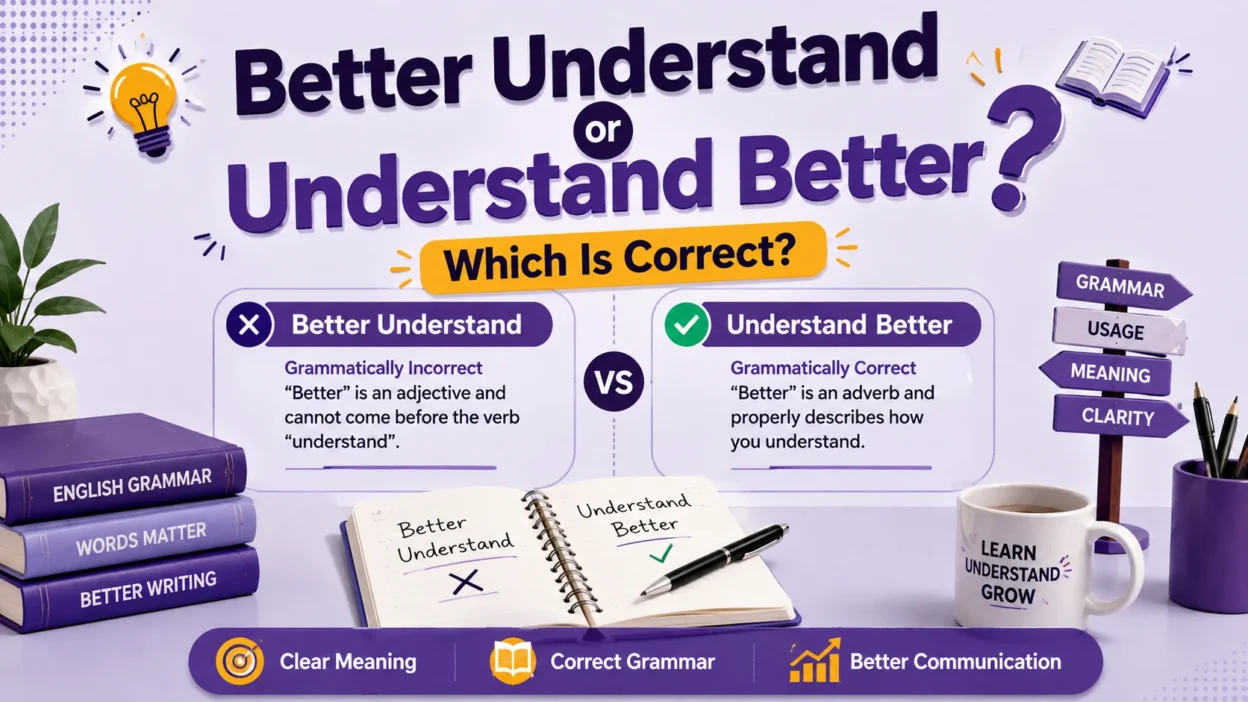
“Better understand” or “understand better” can seem confusing when English learners study word order, sentence structure, and natural English usage. Both phrases are correct, but their word placement, tone, and context can affect how a sentence sounds. In everyday English conversations, books, emails, and online articles, native speakers use both expressions naturally. The same words may appear differently because a small shift in placement can create a slight difference in style without changing the main meaning. When learning English, I find that checking the purpose, word choice, and sentence flow makes this grammar point much easier to understand.
Both phrases support fluent communication, clear meaning, and natural communication, but the choice depends on the sentence. Better Understand often fits naturally near the beginning of a sentence, while Understand Better can work well toward the end. Neither form is less grammatically correct; instead, sentence structure, right emphasis, contextual meaning, and linguistic context guide the choice. In formal writing, professional communication, professional writing, and written communication, one form may create a smoother expression. In casual conversations, casual speech, and spoken communication, both can sound natural.
A helpful grammar comparison is to see each phrase as a particular phrase that must fit its purpose and overall sentence. The grammar guide becomes easier when you compare, highlight common mistakes, and use practical tips instead of treating English as a jigsaw puzzle with one right piece. The grammatical roles, grammatical structure, semantic meaning, subtle differences, and stylistic differences explain why each expression can work. A deeper comprehension of language usage also helps explain beginning, end, clause, example, concept, information, convey, aim, form, and structure.
Better Understand vs. Understand Better: The Short Answer
If you’re looking for a quick answer, here it is.
Both phrases are correct, but they emphasize different parts of the sentence.
- Better understand often appears in formal writing, professional communication, academic articles, and instructional content.
- Understand better sounds more natural in everyday conversations and informal writing.
Consider these examples:
- We need to better understand customer behavior.
- I understand the process better after your explanation.
Both sentences express improved understanding. The difference lies mainly in style and emphasis rather than meaning.
Quick Comparison
| Feature | Better Understand | Understand Better |
| Grammatically correct | ✅ Yes | ✅ Yes |
| Common in formal writing | ✅ Very common | ✅ Acceptable |
| Common in conversation | ✅ Common | ✅ More common |
| Sounds conversational | Moderate | High |
| Emphasis | Improving understanding | Current level of understanding |
Simple rule: If you’re writing professionally, better understand often fits the tone. If you’re speaking naturally, understand better usually sounds smoother.
Why Both Phrases Are Correct
Many people assume only one phrase can be correct. English grammar doesn’t work that way.
English allows certain adverbs to appear in more than one position without changing the core meaning of the sentence. The word better is one of them.
That flexibility explains why native speakers comfortably use both expressions.
For example:
- Scientists hope to better understand climate patterns.
- Scientists understand climate patterns better than they did ten years ago.
Both sentences are perfectly natural.
The placement simply changes what receives a little extra emphasis.
Word Order in English
English follows patterns, but it also allows flexibility.
With many verbs, adverbs can appear before or after the main verb depending on what the speaker wants to emphasize.
Here are a few examples.
| Before the Verb | After the Verb |
| Better understand | Understand better |
| Fully appreciate | Appreciate fully |
| Clearly explain | Explain clearly |
| Better appreciate | Appreciate better |
Notice that neither version breaks any grammar rules.
Instead, the choice often depends on rhythm, emphasis, and style.
The Grammar Behind It
The word better serves as an adverb in these expressions. It modifies the action of understanding.
You can place the adverb before or after the verb because English grammar permits both positions in many situations.
Compare these examples.
- Researchers want to better understand how memory works.
- I understand the topic better after reading your article.
The first sentence emphasizes the goal of improving understanding.
The second emphasizes the improvement that has already happened.
That’s a subtle difference, but experienced writers use it intentionally.
Why Native Speakers Switch Between Them
Native speakers rarely think about grammar rules while talking.
Instead, they choose the wording that feels natural.
Formal situations often encourage phrases like
- better understand
- better appreciate
- better recognize
Casual conversations usually sound more relaxed.
For example:
- I understand it better now.
- She understands the problem better than I do.
- We understand each other better after talking.
Neither style is incorrect.
The context guides the choice.
Better Understand: Meaning and Usage
The phrase better understand focuses on the act of gaining deeper knowledge or insight.
You’ll see it frequently in reports, presentations, research papers, business communication, and educational materials.
It often introduces a goal.
For example:
Companies collect customer feedback to better understand buying habits.
The emphasis falls on improving future understanding.
What “Better Understand” Means
Simply put, better understand means:
to improve your knowledge, awareness, or comprehension of something.
You’re not describing what you already know.
You’re describing the process of learning more.
For example:
- Doctors continue to better understand rare diseases.
- Engineers study failures to better understand material strength.
- Teachers assess students to better understand learning needs.
Notice how each sentence describes an ongoing effort.
When to Use Better Understand
This phrase fits naturally in formal settings.
Academic Writing
Researchers often explain the purpose of a study.
Examples:
- This research helps scientists better understand human memory.
- The experiment aims to better understand language acquisition.
Business Communication
Companies frequently describe goals this way.
Examples:
- We surveyed customers to better understand their expectations.
- Our analytics help us better understand purchasing trends.
Professional Reports
Formal reports often discuss future improvements.
Examples:
- The committee reviewed the data to better understand safety concerns.
- Analysts examined the market to better understand consumer demand.
Educational Content
Teachers and textbooks regularly use this structure.
Examples:
- Read the chapter to better understand photosynthesis.
- Practice these exercises to better understand fractions.
Examples of Better Understand
Here are examples from different situations.
Workplace
- Managers meet regularly to better understand employee concerns.
- The team analyzed customer complaints to better understand recurring issues.
Healthcare
- Researchers continue to better understand Alzheimer’s disease.
- Doctors study genetics to better understand inherited conditions.
Technology
- Developers review user feedback to better understand software problems.
- Engineers monitor system performance to better understand network failures.
Education
- Students perform experiments to better understand scientific concepts.
- Reading primary sources helps learners better understand history.
Why It Sounds More Formal
One reason professional writers prefer better understand is that it places emphasis on the action itself.
The phrase sounds purposeful.
That’s why you’ll often find it in:
- research papers
- government reports
- business proposals
- university websites
- nonprofit organizations
- corporate presentations
It communicates intention rather than simply describing a result.
Understand Better: Meaning and Usage
The phrase understand better usually focuses on the outcome rather than the process.
Instead of emphasizing the goal, it highlights the improvement that has already happened.
For example:
I understand the instructions better after watching the video.
The speaker isn’t talking about learning as an objective.
They’re describing their current level of understanding.
What “Understand Better” Means
This phrase simply means:
to have clearer or improved understanding compared with before.
It’s common in everyday English because it sounds relaxed and conversational.
Examples include:
- I understand your point better now.
- She understands English better than last year.
- We understand the rules better after practicing.
Each sentence describes progress that has already taken place.
When to Use Understand Better
You’ll hear this phrase almost everywhere in spoken English.
Everyday Conversations
- I understand you better now.
- Do you understand the assignment better?
- Thanks. I understand everything much better.
Family Discussions
Parents naturally say:
- I understand how you feel better after hearing your story.
Children often reply:
- I understand the rules better now.
Classroom Conversations
Teachers frequently ask:
- Do you understand this concept better after today’s lesson?
Students respond:
- Yes, I understand it much better now.
Customer Support
Support representatives commonly write:
- I understand your concern better after reviewing your account.
- We understand the issue better thanks to the additional information.
These responses feel warm and conversational without sounding overly formal.
Examples of Understand Better
You use understand better when talking about improved knowledge or clearer comprehension after gaining new information or experience. It usually emphasizes the result of learning rather than the learning process itself. In everyday conversation, it often sounds more natural, friendly, and conversational than better understand.
Daily Life
- I understand cooking better after taking classes.
- She understands budgeting better than she did last year.
- We understand our neighbors better after spending time together.
Learning
- Reading examples helped me understand grammar better.
- Watching demonstrations helped students understand chemistry better.
Travel
- Living abroad helped him understand different cultures better.
- Visiting museums helped us understand local history better.
Personal Growth
- Experience helped me understand myself better.
- Honest conversations helped us understand each other better.
A Quick Tip to Remember
A simple way to choose between the two is to ask yourself one question:
- Are you talking about the goal of learning something? Use better understand.
- Are you talking about what someone knows now compared with before? Use understand better.
This small distinction will make your writing sound more natural and help you choose the phrase that best fits the situation.
Conclusion
Understanding Better Understand and Understand Better becomes easier when you focus on word placement, sentence structure, and context. Both forms are grammatically correct, and the best choice depends on how naturally the phrase fits the sentence. With regular practice, you can use both expressions with greater confidence in everyday and formal English.
FAQs
Q1. Which is correct, Better Understand or Understand Better?
Both Better Understand and Understand Better are correct. Your choice depends on the sentence structure, context, and emphasis.
Q2. What does Better Understand mean?
Better Understand means to gain a clearer or deeper understanding of something. It often appears near the beginning of a sentence.
Q3. What does Understand Better mean?
Understand Better means to understand something more clearly or fully. It often appears toward the end of a sentence.
Q4. Is Better Understand more formal?
Not necessarily. Better Understand can appear in both formal and casual English. The context determines which form sounds more natural.
Q5. Can I use both phrases in English?
Yes. Both phrases are natural and grammatically correct. Choose the one that creates better sentence flow and clearer meaning.