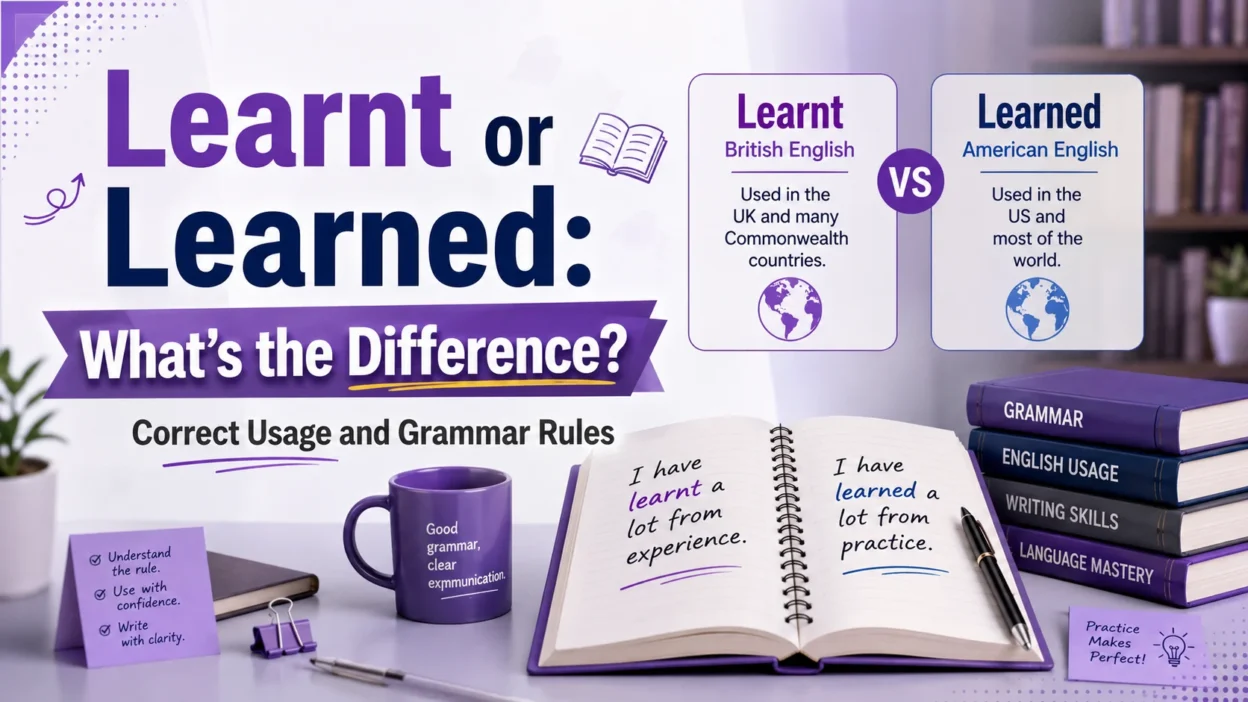
Many students, professionals, writers, English learners, and native English speakers wonder whether “learned” or “learnt” is the correct choice. Both verb forms of “learn” are correct in the past tense and share the same meaning. The main difference comes from regional English, not grammar. American English usually prefers “learned,” while British English commonly uses “learnt,” although both are accepted.
When you read books, newspapers, websites, an article, a blog post, an academic paper, or a business email, you’ll see both spellings. The right choice depends on context, English usage, language conventions, writing style, and your audience. Learning through research, real-world examples, grammar guides, and practical exercises makes it easier to choose the correct spelling with confidence.
Strong English grammar, better language learning, and a richer vocabulary help you write naturally. Although “learned” and “learnt” may sound similar and seem interchangeable, matching your spelling to your readers improves communication, writing skills, writing accuracy, and writing consistency. This simple habit helps you use correct usage while respecting different English writing traditions.
Quick Answer: Is It Learnt or Learned?
If you’re looking for the fastest answer, here it is:
- Learned is the preferred spelling in American English.
- Learnt is widely used in British English, Australian English, and New Zealand English.
- Both words mean exactly the same thing.
- Both serve as the past tense and past participle of the verb learn.
- Neither spelling is grammatically incorrect.
The Short Answer
Choose learnt if you’re writing for readers in the United States. Choose “learnt” if you’re following British English conventions or writing for audiences where that spelling is common.
If your audience includes readers from many countries, learned is usually the safest option because it enjoys broader international recognition.
Quick Comparison Table
| Feature | Learnt | Learned |
| Meaning | Past tense and past participle of learn | Past tense and past participle of learn |
| Grammar | Correct | Correct |
| American English | Rare | Preferred |
| British English | Common | Also accepted |
| Australian English | Common | Accepted |
| Canadian English | Both used | Slight preference for learned |
| Formal Writing | Accepted in British style | Accepted worldwide |
Everyday Examples at a Glance
| Sentence | Correct? |
| I learned French in college. | ✅ |
| I learnt French in college. | ✅ |
| She has learned to swim. | ✅ |
| She has learnt to swim. | ✅ |
| They learned from their mistakes. | ✅ |
| They learnt from their mistakes. | ✅ |
Quick Tip: Don’t mix the two spellings within the same document. Consistency matters more than choosing one over the other.
Learnt vs Learned: What’s the Difference?
The biggest surprise for many English learners is that there isn’t a difference in meaning.
Both words describe gaining knowledge, developing a skill, or understanding something through study, experience, or practice.
The Meaning Is Exactly the Same
Whether someone says:
“I learned Spanish.”
or
“I learnt Spanish.”
the message remains identical.
The only noticeable difference is the regional spelling preference.
The Only Difference Is Regional Preference
Think of “learnt” and “learned” the same way you think about these spelling pairs:
| American English | British English |
| Color | Colour |
| Favorite | Favourite |
| Center | Centre |
| Organize | Organise |
| Learned | Learnt |
Each version follows the spelling traditions of a particular variety of English rather than changing the meaning.
Why Both Spellings Are Grammatically Correct
English contains many verbs that developed more than one accepted past-tense form over time.
Some examples include:
| American Preference | British Preference |
| Burned | Burnt |
| Dreamed | Dreamt |
| Spelled | Spelt |
| Leaped | Leapt |
| Learned | Learnt |
These pairs reflect the history of English rather than modern grammar rules.
Grammar Fact: Dictionaries such as Merriam-Webster, Cambridge Dictionary, and Oxford English Dictionary recognize both “learnt” and “learned” as standard English.
What Do “Learnt” and “Learned” Mean?
Before choosing the correct spelling, it’s important to understand what the verb “learn” actually means.
The verb “learn” means
- To gain knowledge.
- To acquire a skill.
- To remember information.
- To discover something new.
- To become familiar with an idea or process.
Both “learnt” and “learned” express actions that happened in the past.
Learnt Definition
“Learnt” is the traditional past tense and past participle of “learn” in British English.
Examples:
- I learnt how to drive last year.
- She learnt several useful phrases before visiting Spain.
- We have learnt valuable lessons from the project.
Notice that every sentence refers to knowledge gained in the past.
Learned Definition
Learned performs exactly the same grammatical function.
Examples:
- I learned how to code.
- She learned the rules quickly.
- They have learned from experience.
Again, the meaning never changes.
Learnt and Learned as the Past Tense
The simple past tense describes completed actions.
Examples:
- I learned the answer yesterday.
- She learnt the song in one afternoon.
- They learned the procedure during training.
- We learnt about climate change in school.
Every sentence talks about something that already happened.
Learned as an Adjective (A Different Meaning)
Here’s where many learners become confused.
The word “learned” means “studied” or “acquired knowledge.” It also functions as an adjective.
Compare these sentences:
Verb
- She learned French at university.
Adjective
- She is a learned professor.
In the first sentence, learned means studied or acquired knowledge.
In the second sentence, “learned” means highly educated, scholarly, or knowledgeable.
This adjective usually has two syllables when spoken:
learned
Examples:
- A learned scholar.
- A learned judge.
- A learned historian.
- A learned philosopher.
Notice that “learnt” is never used as an adjective.
Grammar Rules for Learnt and Learned
Many people assume there must be separate grammar rules for these two spellings.
There aren’t.
Both forms follow identical grammatical patterns.
Past Simple Usage
Use either spelling to describe actions completed in the past.
Examples:
- I learned a valuable lesson.
- I learnt a valuable lesson.
- She learned to bake.
- She learnt to bake.
The sentence structure stays exactly the same.
Past Participle Usage
The past participle appears with helping verbs such as the following:
- has
- have
- had
Examples:
- I have learned patience.
- I have learnt patience.
- They had learned the truth.
- They had learnt the truth.
Again, the only difference is regional style.
Using the Forms with Helping Verbs
Common combinations include:
| Helping Verb | Example |
| Has | She has learned French. |
| Have | They have learnt teamwork. |
| Had | We had learned the process before the exam. |
| Has | He has learnt valuable skills. |
Every example remains grammatically correct.
Why Neither Form Changes the Meaning
Unlike verbs that completely change form or meaning, “learnt” and “learned” simply represent two accepted spellings.
Think of them as two roads leading to the same destination.
No matter which road you choose, readers understand exactly what you mean.
Why English Has Two Correct Spellings
English didn’t develop overnight.
It evolved over centuries, borrowing words, spellings, and grammar from many languages. As English spread across continents, different regions preserved different forms.
That’s why modern English sometimes accepts more than one correct spelling.
Regular and Irregular Verb Development
Many Old English verbs ended with -t in their past forms.
Over time, American English gradually favored the more regular -ed ending because it aligned with the majority of English verbs.
British English retained many traditional -t forms.
Examples include:
- Burnt
- Dreamt
- Leapt
- Spelt
- Learnt
Both systems survived.
Historical Changes in English
As dictionaries became standardized during the eighteenth and nineteenth centuries, spelling conventions began to differ.
American lexicographers promoted spellings that simplified English.
British publishers often retained historical forms.
Neither approach was wrong.
Each became part of its own regional writing tradition.
The Influence of British and American English
Today, millions of people learn English from television, movies, books, universities, websites, and social media.
That creates frequent exposure to both spellings.
For example:
- Watching an American documentary usually exposes you to learning.
- Reading a British newspaper may expose you to learning.
- International websites sometimes use either spelling depending on the author’s location.
This global mix explains why both versions continue to appear in modern English.
Did You Know? English is an official or widely used language in more than 70 countries, so regional spelling differences are a normal part of the language rather than exceptions.
Learnt vs Learned in American English and British English
Regional preference—not grammar—is the key difference between these spellings.
Understanding those preferences helps you write naturally for your audience.
Which Form Americans Prefer
In the United States, “learned” is overwhelmingly the standard spelling.
You’ll see it in:
- School textbooks
- Government publications
- Newspapers
- Business documents
- Academic journals
- Professional emails
- Corporate websites
Examples:
- I learned a new programming language.
- We learned valuable lessons during the project.
- She learned how to negotiate effectively.
American editors often change “learnt” to “learned” for consistency.
Which Form Britons Prefer
British English accepts both spellings, but “learnt” remains especially common in everyday writing and speech.
You’ll regularly encounter sentences like
- I learnt something useful today.
- We’ve learnt from our mistakes.
- She learnt to play the piano as a child.
However, many British publications also use learned, particularly in formal or academic contexts. That means British readers generally recognize both forms without confusion.
Which One Should You Use?
Instead of asking which spelling is “correct,” ask which spelling best matches your audience.
That’s the decision professional writers, editors, and publishers make every day.
For American English
Use “learned” if you’re writing for:
- American readers
- US universities
- American businesses
- US government agencies
- American publishers
- Most US-based websites
It aligns with American spelling conventions and meets reader expectations.
For British English
Use “learnt” if your audience primarily reads British English or follows UK style guides. It fits naturally with other British spellings and sounds familiar to readers in the United Kingdom and many Commonwealth countries.
For Academic Writing
Always follow the required style guide or institutional preference. If you’re submitting work to an American university, learned is usually the appropriate choice. For a British institution, “learnt” may be equally acceptable. Whatever you choose, use the same spelling throughout the entire document.
For Business Communication
Business writing should reflect the audience rather than personal preference.
For example:
- A proposal sent to a company in New York should use learned.
- A report prepared for a client in London may use learnt if it matches British English conventions.
Consistent language helps your writing appear polished and professional.
For Websites and SEO Content
If your website targets readers in the United States, optimize your content around learned because it matches the spelling most American users search for. If your audience is primarily in the United Kingdom, Australia, or New Zealand, learnt may better align with local search habits and reader expectations.
Why Consistency Matters More Than Preference
The most important rule isn’t choosing learnt over learned. It’s avoiding unnecessary switching between the two.
Imagine reading a blog post that begins with I learned a lot” and ends with “We have learnt many lessons.” While both forms are correct, the inconsistency can distract readers and make the writing feel less polished.
Learned or Learnt in Different Types of Writing
The choice between “learnt” and “learned” becomes more important when you consider the type of writing you’re producing. Although both spellings are correct, readers expect language that matches the style and region they are familiar with.
A student writing an essay, a marketer creating website content, and a journalist preparing a news article may all choose different spellings depending on their audience.
Let’s look at how each form works across different writing contexts.
Everyday Conversations
In everyday speech, people rarely notice whether someone says “learnt” or “learned.” Most listeners focus on the message rather than the spelling behind the spoken word.
American speakers naturally say the following:
- I learned something new today.
- We learned a lot from that experience.
- She learned how to cook from her grandmother.
British speakers often say the following:
- I learnt something new today.
- We learnt a lot during the trip.
- He learnt to drive when he was seventeen.
Both versions sound completely natural within their respective regions.
Example Conversation
Emma: Did you enjoy the photography class?
Daniel (US): Yes. I learned several editing techniques.
Daniel (UK): Yes. I learnt several editing techniques.
The conversation communicates exactly the same idea.
School Assignments
Schools usually teach students to follow one variety of English consistently.
For example:
| Country | Preferred Form |
| United States | Learned |
| United Kingdom | Learnt or Learned |
| Australia | Learnt commonly used |
| New Zealand | Learnt commonly used |
| Canada | Both accepted |
If your teacher follows American English, writing learnt throughout your paper may look inconsistent even though it isn’t grammatically wrong.
Likewise, British schools often accept either spelling as long as the entire assignment remains consistent.
Tip: Always check your school’s style guide before submitting formal work.
Professional Emails
Business communication values clarity and consistency.
Imagine sending these two emails.
Email A
We learned valuable lessons during the project.
Email B
We learnt valuable lessons during the project.
Neither email contains a grammatical mistake.
However, the first feels more natural to an American client, while the second sounds more familiar to many British readers.
Companies with international teams often create internal writing guides so employees use the same spelling throughout reports, proposals, and documentation.
Academic Papers
Academic writing demands consistency more than anything else.
Universities usually recommend following one recognized style manual.
Examples include:
- APA Style
- MLA Style
- Chicago Manual of Style
- Oxford Style
- Cambridge Style
American style guides overwhelmingly favor “learned,” while British institutions often permit both spellings.
Changing between “learnt” and “learned” within the same research paper creates unnecessary inconsistency.
Journalism and Publishing
Editors carefully maintain a publication’s style.
A newspaper based in New York typically edits every instance of “learnt” to “learned.”
A newspaper published in London may keep learning because it reflects local English.
Major publishers rarely switch spelling styles midway through a book or article.
This consistency strengthens readability and preserves the publication’s identity.
Creative Writing
Novels, short stories, and scripts give writers more flexibility.
The characters’ nationality often determines the spelling.
Consider this example.
American Character
“I learned everything from my father.”
British Character
“I learnt everything from my father.”
Using regional language makes dialogue feel authentic.
Learnt and Learned in Common Expressions
Many English expressions include “learned” or “learnt.” These phrases appear in books, business meetings, classrooms, newspapers, and everyday conversations.
Understanding these expressions helps you sound more natural.
Lessons Learned
One of the most common expressions is lessons learned.
It refers to knowledge gained from experience, especially after success or failure.
Examples:
- The company documented its lessons learned after the project.
- Every mistake became one of life’s greatest lessons learned.
- Good leaders share lessons learned with their teams.
British writers sometimes use lessons learned, particularly in government reports and project reviews.
Both versions are correct.
Learned Behavior
Learned behavior describes actions acquired through observation or experience rather than instinct.
Examples include:
- Speaking your native language.
- Driving a car.
- Playing the piano.
- Using computer software.
Example sentence:
Children develop many forms of learned behavior by watching adults.
Notice that learned here functions as an adjective.
Learned Skill
A learned skill is an ability developed through practice rather than something a person is born with.
Examples include:
- Writing
- Programming
- Public speaking
- Cooking
- Graphic design
Sentence example:
Time management is a learned skill that improves with experience.
Hard-Learned Lesson
A hard-learned lesson describes knowledge gained through difficult experiences.
Examples:
- Losing money taught him a hard-learned lesson.
- The team discovered a hard-learned truth about preparation.
- Every entrepreneur collects a few hard-learned lessons.
These expressions often appear in leadership books and motivational articles.
Well-Learned Experience
Although less common, writers sometimes use well-learned or well-learned experience to emphasize knowledge gained over many years.
For example:
- Her confidence came from well-learned experience.
- Years of practice produced well-learned habits.
Learnt vs Learned: Side-by-Side Example Sentences
Seeing both spellings together makes the difference much easier to understand.
Daily Life Examples
| Learned | Learnt |
| I learned how to swim last summer. | I learnt how to swim last summer. |
| She learned Spanish quickly. | She learnt Spanish quickly. |
| We learned a valuable lesson. | We learnt a valuable lesson. |
Workplace Examples
| Learned | Learnt |
| Our team learned from the feedback. | Our team learnt from the feedback. |
| I learned a new software platform. | I learnt a new software platform. |
| She learned better communication skills. | She learnt better communication skills. |
Education Examples
| Learned | Learnt |
| Students learned algebra this semester. | Students learnt algebra this semester. |
| He learned grammar through practice. | He learnt grammar through practice. |
| They learned new vocabulary every week. | They learnt new vocabulary every week. |
Travel Examples
| Learned | Learnt |
| I learned a few Italian phrases. | I learnt a few Italian phrases. |
| We learned local customs. | We learnt local customs. |
| She learned how to use public transportation. | She learnt how to use public transportation. |
Formal Writing Examples
American English:
The researchers learned valuable information during the experiment.
British English:
The researchers learnt valuable information during the experiment.
The meaning stays exactly the same.
Pronunciation of Learnt and Learned
Spelling isn’t the only difference people notice.
Pronunciation varies slightly depending on which form you’re using and whether learned acts as a verb or an adjective.
How to Pronounce Learned
When learned functions as the past tense or past participle of learn, it usually has one syllable.
Pronunciation
lurnd
Examples:
- I learned French.
- We learned quickly.
- She learned the answer.
The ending sounds similar to the word turned.
How to Pronounce Learnt
Learnt also has one syllable.
Pronunciation
lurnt
The ending sounds similar to burnt or turned, except with a clear t sound.
Examples:
- I learnt patience.
- They learnt teamwork.
- She learnt to cook.
Many British speakers pronounce the final t clearly.
Pronunciation When Learned Is an Adjective
This is where pronunciation changes.
When learned describes an educated or scholarly person, it usually has two syllables.
Pronunciation
learn-ed
Examples:
- A learned professor.
- A learned judge.
- A learned historian.
- A learned scholar.
Compare these sentences:
Verb
She learned French in college.
One syllable.
Adjective
She is a learned professor.
Two syllables.
This pronunciation difference helps listeners understand whether learned functions as a verb or an adjective.
Quick Pronunciation Comparison
| Word | Part of Speech | Typical Pronunciation |
| Learned | Verb | One syllable |
| Learnt | Verb | One syllable |
| Learned | Adjective | Two syllables |
Why Many English Learners Get Confused
It’s easy to see why learnt or learned causes confusion. Most grammar mistakes happen because people believe one spelling must be wrong. In reality, the confusion comes from the way English has evolved across different countries.
Today, people learn English from teachers, books, movies, podcasts, social media, and websites from all over the world. That means you might read learned in one article and learnt in the next. Both are correct, yet they reflect different regional standards.
The key isn’t choosing the “right” word. It’s choosing the spelling that matches your audience and using it consistently.
Exposure to Multiple English Varieties
Modern English no longer belongs to just one country.
A student in Brazil might study from an American textbook, watch British television, read Australian news websites, and communicate with Canadian coworkers. Naturally, they’ll encounter both learned and learnt.
For example:
- An American YouTube creator says, I learned a valuable lesson.
- A British news article says, The company learnt from previous mistakes.
- An Australian blogger writes, I’ve learnt a lot about gardening.
None of these examples is incorrect.
This constant exposure makes it easy to wonder whether one version has replaced the other. It hasn’t.
Dictionaries Show Both Forms
Another source of confusion is that reputable dictionaries list both spellings.
Major dictionaries identify learned and learnt as acceptable forms of the verb learn, while also noting their regional preferences.
A typical dictionary entry explains:
- Learned — Preferred in American English.
- Learnt — Common in British English and other Commonwealth varieties.
Many learners expect dictionaries to provide only one correct answer. Instead, they discover two accepted spellings, which can feel surprising at first.
Online Content Uses Both Spellings
The internet brings together writers from every English-speaking country.
Search for the phrase lessons learned, and you’ll find millions of results.
Search for lessons learnt, and you’ll also find thousands of articles, reports, and government publications.
This happens because websites naturally follow the spelling conventions of their target audience.
For example:
| Website Audience | Likely Spelling |
| United States | Learned |
| United Kingdom | Learnt |
| Australia | Learnt |
| International Company | Learned or house style |
As a reader, you’ll continue to see both forms across the web.
Spell Checkers May Suggest Different Versions
Spell-checking software doesn’t always agree.
Many writing tools automatically follow the language setting you’ve selected.
For example:
- English (United States) often suggests learned.
- English (United Kingdom) commonly accepts learnt.
- English (Australia) usually recognizes both.
If your document suddenly underlines one spelling, it doesn’t necessarily mean you’ve made a grammar mistake. It often means your software is checking against a different regional dictionary.
Tip: Before you start writing, set your language preference to match your intended audience. Doing so reduces unnecessary spelling alerts and keeps your document consistent.
Common Mistakes to Avoid
Although both spellings are correct, writers still make mistakes when using learnt and learned. Most errors involve consistency, audience, or misunderstanding the grammar.
Avoiding these common pitfalls will make your writing look polished and professional.
Thinking Learnt Is Incorrect
One of the biggest misconceptions is that learnt is old-fashioned or incorrect.
It isn’t.
Millions of people use learnt every day across the United Kingdom, Australia, New Zealand, South Africa, and many other English-speaking regions.
Example:
✅ We learnt several useful techniques during the workshop.
This sentence is completely correct in British English.
Thinking Learned Is Only American
Some learners assume learned belongs exclusively to American English.
That’s also incorrect.
Although learned dominates in the United States, British English accepts it as well.
Many British universities, publishers, and professional organizations regularly use learned, especially in formal writing.
Example:
✅ We have learned a great deal from the research.
This sentence is perfectly acceptable in British English.
Mixing Regional Styles in the Same Document
Consistency matters more than personal preference.
Imagine reading this paragraph:
I learned how to drive when I was seventeen. Later, I learnt advanced driving techniques.
Both spellings are correct, but switching between them without a reason can distract readers.
Instead, write either:
I learned how to drive when I was seventeen. Later, I learned advanced driving techniques.
or
I learnt how to drive when I was seventeen. Later, I learnt advanced driving techniques.
Choose one style and stick with it.
Confusing the Verb with the Adjective “Learned”
Another common mistake involves the adjective learned.
Compare these examples.
Verb
She learned Italian.
Adjective
She is a learned linguist.
The first sentence describes an action completed in the past.
The second describes a person’s education or scholarly knowledge.
Remember:
- Learned can be a verb and an adjective.
- Learnt functions only as a verb.
Using the Wrong Form for Your Audience
Audience awareness is an important writing skill.
Suppose you’re preparing content for:
- An American university
- A US business website
- A company based in California
Using learned aligns with local expectations.
If you’re writing for:
- A British magazine
- A UK university
- An Australian government agency
Using learnt may sound more natural.
Neither choice is grammatically superior. The best choice simply reflects your readers.
Quick Checklist to Avoid Mistakes
Before publishing your work, ask yourself:
- Did I choose one spelling and use it consistently?
- Does my spelling match my audience?
- Am I using “learned” correctly when it functions as an adjective?
- Is my document set to the correct English language preference?
- Have I proofread for accidental spelling switches?
Answering “yes” to these questions helps eliminate nearly every common error.
Learnt vs Learned Compared with Similar Double Forms
The pair learnt and learned isn’t unique.
English contains several verbs with two accepted past-tense forms. Some end in -ed, while others end in -t. In many cases, American English favors the -ed form, whereas British English often uses both.
Recognizing these patterns makes English spelling much easier to understand.
Dreamed vs Dreamt
Both words describe dreams that happened in the past.
Examples:
- I dreamed about traveling the world.
- I dreamt about traveling the world.
Both are correct.
Burned vs Burnt
Both forms describe something damaged by fire or heat.
Examples:
- The toast burned.
- The toast burnt.
However, burnt also appears frequently as an adjective.
Example:
- Burnt toast.
- Burnt sugar.
- Burnt orange.
Spoiled vs Spoilt
These forms both mean something became damaged, ruined, or overindulged.
Examples:
- The milk spoiled overnight.
- The milk spoilt overnight.
British English often uses spoilt, while American English strongly prefers spoiled.
Spelled vs Spelt
These two spellings describe writing letters in the correct order.
Examples:
- She spelled the word correctly.
- She spelt the word correctly.
Again, both forms remain standard English.
Leaped vs Leapt
Both describe jumping.
Examples:
- The athlete leaped over the hurdle.
- The athlete leapt over the hurdle.
American English generally favors leaped, while British English frequently uses leapt.
Comparison Table
| Base Verb | American Preference | British Preference |
| Learn | Learned | Learnt or Learned |
| Dream | Dreamed | Dreamt or Dreamed |
| Burn | Burned | Burnt or Burned |
| Spell | Spelled | Spelt or Spelled |
| Leap | Leaped | Leapt or Leaped |
| Spoil | Spoiled | Spoilt or Spoiled |
Pattern to Remember: American English usually regularizes verbs with -ed, while British English preserves many traditional -t forms alongside the -ed versions.
Learnt vs Learned Usage Statistics and Trends
Language changes over time, and usage patterns reveal how people actually write. Looking at trends helps explain why learned appears more frequently worldwide, even though learnt remains an established and respected spelling.
American English Trends
In the United States, learned overwhelmingly dominates books, newspapers, magazines, academic journals, and online content.
You’ll encounter it in:
- School textbooks
- University publications
- Government documents
- National newspapers
- Business reports
- Professional websites
Finding learnt in modern American writing is relatively uncommon.
British English Trends
British English tells a different story.
Although “learned” has become more common over the years, learnt remains widely used in:
- Newspapers
- Government publications
- Educational materials
- Books
- Everyday communication
Many British writers choose one form based on personal preference or an organization’s editorial style guide.
Publishing and Media Preferences
Large publishers and media organizations establish internal style guides to maintain consistency.
For example:
| Publication Type | Typical Preference |
| US Newspapers | Learned |
| US Universities | Learned |
| UK Newspapers | Learnt or Learned |
| UK Academic Publishers | Usually style-guide dependent |
| International Businesses | Often Learned |
Professional editors don’t decide which spelling is “better.” They simply apply the style required for their publication.
Search Popularity Over Time
Search behavior also reflects regional differences.
People in the United States search for “learned” far more often than “learnt.” In contrast, users in the United Kingdom, Australia, and New Zealand generate a much higher share of searches for learnt.
For international websites, this creates an interesting SEO consideration.
If your primary audience is American, targeting learned and related phrases will usually match user expectations and search habits. If you’re publishing for a British audience, incorporating learnt naturally into your content can improve relevance without changing the meaning.
A Real-World Case Study: One Company, Two Audiences
Imagine a global software company launching two versions of the same training guide.
US Edition
Our team learned valuable lessons during product testing.
UK Edition
Our team learnt valuable lessons during product testing.
The information, grammar, and meaning remain identical. Only the spelling changes to meet regional expectations.
This simple adjustment helps readers feel that the content was written specifically for them, which improves readability and builds trust.
“Good writing doesn’t just use correct grammar. It uses the language your audience expects.”
That principle explains why both “learnt” and “learned” continue to thrive in modern English. They aren’t competing spellings. They’re regional variations of the same correct word, each serving readers in different parts of the English-speaking world.
Learnt vs Learned Comparison Table
If you only remember one section from this guide, make it this one. The table below summarizes the most important differences and similarities between “learnt” and “learned.”
| Feature | Learnt | Learned |
| Meaning | Same as learned | Same as learnt |
| Part of Speech | Past tense and past participle | Past tense, past participle, and adjective |
| Grammatically Correct | Yes | Yes |
| Preferred in American English | Rare | Yes |
| Preferred in British English | Common | Also accepted |
| Preferred in Australian English | Common | Accepted |
| Preferred in Canadian English | Used | More common |
| Formal Writing | Accepted in British English | Accepted worldwide |
| Business Writing | Depends on audience | Preferred for international audiences |
| Academic Writing | Accepted in UK institutions | Accepted globally |
| SEO for US Audience | Less common | Better choice |
| SEO for UK Audience | Very common | Also common |
Key Takeaways
- Both spellings are correct.
- The meaning never changes.
- The difference is regional, not grammatical.
- Learned is the standard choice in American English.
- Learnt is common in British and many Commonwealth varieties of English.
- Stay consistent throughout your writing.
Simple Memory Tricks
Many learners remember grammar rules for a day or two, then forget them. A few practical memory tricks can help you choose the right spelling without stopping to think every time you write.
Remember the Country Rule
The easiest way to remember the difference is to connect each spelling with the audience.
Think of it like this:
- United States = Learned
- United Kingdom = Learnt (or Learned)
This simple association solves most situations.
Match the Style Guide
Professional writers rarely choose spellings based on habit. Instead, they follow a style guide.
Ask yourself:
- Who will read this?
- Which variety of English do they expect?
If you’re writing for an American company, use learned.
If you’re writing for a British publisher, learnt may be the better fit.
Stay Consistent Throughout Your Writing
Consistency creates credibility.
Imagine reading a book that switches between color and colour, favorite and favourite, or learned and learnt without any reason. The changes interrupt the reading experience.
Choose one variety of English before you begin writing and use it from the first sentence to the last.
Memory Tip: Your audience decides the spelling—not the grammar.
Practice Exercises
Now it’s time to test your understanding.
Try answering each question before checking the solutions.
Exercise 1: Choose Learnt or Learned
Fill in the blanks with the correct word.
- I ________ how to play chess last summer.
- She has ________ several valuable lessons from the experience.
- We ________ about ecosystems in science class.
- They have ________ to work together effectively.
- He ________ Spanish while living in Mexico.
Possible Answers
- American English: learned
- British English: learnt or learned
Both versions are acceptable when they match the chosen variety of English.
Exercise 2: Correct the Sentence
Read each sentence and decide whether it needs correction.
Sentence 1
I learned French at school, and later I learnt Italian.
Correction
If you’re writing in American English:
I learned French at school, and later I learned Italian.
If you’re writing in British English:
I learnt French at school, and later I learnt Italian.
Sentence 2
She is a learnt professor.
Correction
She is a learned professor.
Remember, “learned” is the adjective meaning “educated” or “scholarly.”
Sentence 3
We have learnt many valuable lessons.
This sentence is correct in British English.
American English would normally use the following:
We have learned many valuable lessons.
Exercise 3: Rewrite for American English
Convert these sentences into American English.
- I learnt to swim when I was ten.
- We’ve learnt a lot from our customers.
- She learnt how to manage her time.
Answers
- I learned to swim when I was ten.
- We’ve learned a lot from our customers.
- She learned how to manage her time.
Exercise 4: Rewrite for British English
Rewrite the following using a common British English style.
- I learned several important skills.
- They have learned from experience.
- She learned to play the violin.
Possible Answers
- I learnt several important skills.
- They have learnt from experience.
- She learnt to play the violin.
Remember that learned is also acceptable in British English.
Conclusion
Choosing between “learned” and “learnt” is much easier once you understand that both spellings are correct. The real difference lies in regional preference rather than grammar. “Learned” is the standard choice in American English, while learnt is more common in British English and many other Commonwealth countries. By matching your spelling to your audience and staying consistent throughout your writing, you can improve clarity, professionalism, and confidence. Whether you’re writing an email, an academic paper, a blog post, or simply practicing English, using the right form for your readers will make your writing more natural and effective.
FAQs
Q1. Is learned or learnt correct?
Both “learned” and “learnt” are correct. “Learned” is preferred in American English, while learnt is more common in British English and several other English-speaking countries.
Q2. Which spelling should I use in the United States?
If you’re writing for an American audience, learned is the recommended spelling because it follows standard American English conventions.
Q3. Is learnt old-fashioned?
No. Learnt is still widely used in the United Kingdom, Australia, New Zealand, and other Commonwealth countries. It remains a standard and accepted spelling.
Q4. Can I use “learned” and “learnt” in the same document?
It’s best to avoid mixing them. Choose one spelling based on your target audience and use it consistently throughout your document for a more professional style.
Q5. Does “learned” have another meaning?
Yes. Besides being the past tense of learn, “learned” (well-educated) can also be an adjective meaning well-educated or scholarly, as in the phrase “a learned professor.”