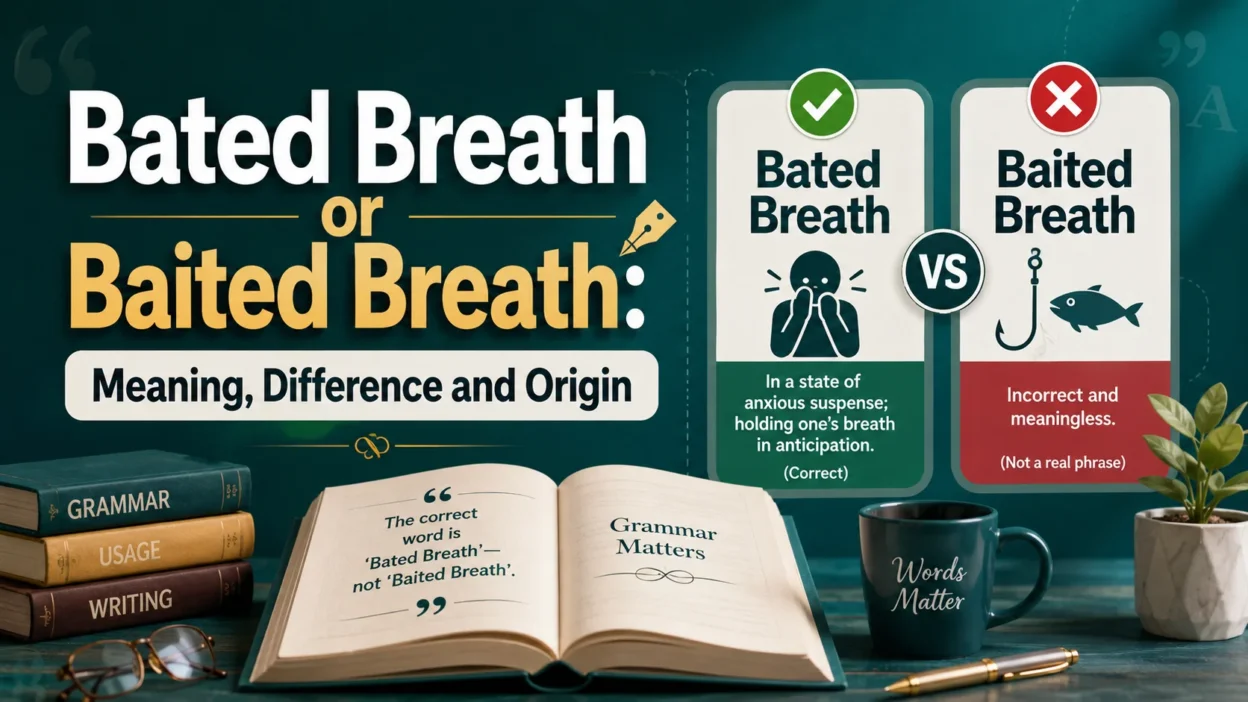
Bated Breath or Baited Breath often confuses writers because both words share the same pronunciation but not the same meaning. In modern English, Bated Breath is the correct phrase, while Baited Breath is the incorrect phrase for expressing anticipation, anxious anticipation, excitement, and suspense. This familiar English expression is an idiom that describes waiting for an important announcement, a competition result, the ending of a suspenseful movie, or another important result, helping you avoid an English mistake through the correct usage.
The origin of Bated Breath comes from older English, where abate meant to reduce or hold back. Over time, the word came to describe restrained breathing during moments of emotional suspense. This rich history, spanning hundreds of years, explains why the expression, phrase, and expression meaning remain important in the English language. Although many learners experience confusion because bated is an uncommon word and baited is a familiar word, learning the context, vocabulary, usage, and difference makes the phrase much easier to understand.
Knowing the expression meaning allows writers to use this classic phrase confidently in conversations, essays, emails, and professional writing. Whether you call it an anticipation phrase, excitement phrase, or suspense phrase, it always describes waited moments filled with focused attention. Paying attention to correct usage instead of a spelling mistake helps you avoid a common mistake, improve your writing, and communicate naturally whenever you compare bated breath vs baited breath or explain why they are a homophone with different meanings.
Bated Breath or Baited Breath: Quick Difference
Before exploring the history and details, here is the simple answer:
| Phrase | Correct Meaning | Usage | Example |
| Bated breath | Waiting with excitement, suspense, nervousness, or strong anticipation | Correct expression | “The audience waited with bated breath for the winner to be announced.” |
| Baited breath | Breath connected literally with bait (rare and unusual meaning) | Usually incorrect when describing anticipation | “The fans waited with baited breath.” ❌ |
The phrase you usually want is bated breath.
When someone says, “I waited with bated breath,” they mean they waited eagerly while feeling intense curiosity or suspense. The person may feel nervous, excited, or deeply interested in what happens next.
For example:
- A student waits for exam results.
- A job applicant waits for an interview decision.
- Fans wait for the final score of a championship game.
- Viewers wait for the final scene of a mystery movie.
In each situation, the person is not using bait. They are experiencing anticipation. Therefore, bated breath is the correct choice.
What Does Bated Breath Mean?
The expression “bated breath” means waiting in a state of suspense, excitement, or nervous anticipation. It describes a moment when someone becomes so focused on an upcoming event that they almost stop and hold their breath.
The phrase creates a picture of a person becoming quiet and still while waiting for something important.
Imagine a family sitting together while opening a letter containing life-changing news. Nobody speaks. Everyone watches closely. The room becomes silent. That feeling of intense waiting is what bated breath describes.
The expression does not mean someone literally stops breathing for a long period. Instead, it is a figurative phrase that describes an emotional reaction.
Simple Definition of Bated Breath
Bated breath means:
- Waiting eagerly for something to happen
- Feeling suspense or excitement
- Holding back your breath because of anticipation
- Watching or listening with great attention
The phrase often appears when the outcome matters.
For example:
“Millions of fans waited with bated breath to see who would win the championship.”
This sentence does not mean millions of people stopped breathing. It means they watched with intense excitement and curiosity.
Examples of Bated Breath in Everyday Sentences
The phrase bated breath works in many situations. Here are examples from everyday life:
Entertainment
“The audience watched the final scene with bated breath.”
A movie ending creates suspense, so viewers wait eagerly to discover what happens.
Sports
“The crowd waited with bated breath as the referee reviewed the final play.”
Sports fans often experience this feeling because a single decision can change the result of a game.
Career and Business
“Employees waited with bated breath for the company’s announcement about the merger.”
Important workplace decisions can create uncertainty and anticipation.
Personal Life
“She waited with bated breath for the phone call that would change her future.”
The phrase adds emotional weight because the moment feels important.
What Does Baited Breath Mean?
The phrase “baited breath” is usually a mistake when people want to describe excitement or anticipation.
The word baited comes from the noun bait, which means something used to attract or catch an animal, fish, or another target.
Examples of bait include:
- Worms used for fishing
- Food placed in a trap
- Something designed to attract attention
The word “baited” means something has been prepared with bait.
Examples:
- “The fisherman baited the hook before casting the line.”
- “The trap was baited with food to attract the animal.”
However, this meaning does not connect naturally with the idea of waiting excitedly.
A person cannot normally have “baited breath” when waiting for news or an event. The expression sounds correct only because baited and bated have the same pronunciation.
Is Baited Breath Ever Correct?
Although baited breath is almost always wrong when discussing anticipation, the phrase could theoretically make sense in a very unusual literal situation.
For example, if someone created a fictional scene where a person’s breath carried the smell of bait, the phrase could be interpreted literally. However, this usage is extremely uncommon and does not represent normal English.
In everyday writing and speech:
Use:
“The team waited with bated breath.”
Avoid:
“The team waited with baited breath.”
The second sentence contains a spelling mistake because the writer chose the wrong word.
Why Do People Confuse Bated Breath and Baited Breath?
The confusion exists for several reasons.
Both Words Sound Identical
The biggest reason is pronunciation.
Bated and baited are homophones. Homophones are words that sound the same but have different meanings and spellings.
Other examples of homophones include:
| Word 1 | Word 2 | Meaning |
| Their | There | Possession vs location |
| Flower | Flour | Plant part vs baking ingredient |
| To | Too | Direction vs also |
| Bated | Baited | Reduced/held back vs prepared with bait |
Because people hear the phrase but do not see it written, they often choose the wrong spelling.
“Bated” Is Rare Outside This Expression
Modern English speakers rarely use bate or bated in everyday conversation.
Most people know words like:
- debate
- abate
- bait
- baited
However, “bated” usually appears only in the phrase “with bated breath.”
Because the word feels unfamiliar, many people assume it must relate to a familiar word like “baited.”
Spellcheck Does Not Always Catch the Error
Grammar tools and spellcheck programs may not identify “baited breath” as incorrect because baited is a real English word.
For example:
“The audience waited with baited breath.”
A spellchecker sees two correctly spelled words. It does not always understand that the phrase itself is wrong.
This is why learning the meaning behind the expression is more useful than relying only on automated corrections.
The Origin and History of Bated Breath
The phrase “bated breath” has a much older history than many people realize.
The expression dates back to the late 16th century. It became especially famous through the works of the English playwright and poet William Shakespeare.
The phrase appears in Shakespeare’s play The Merchant of Venice, written around 1596–1598.
In the play, Shakespeare used the expression:
“With bated breath…”
The phrase described a person waiting with controlled breathing and intense attention.
This historical connection explains why the expression has survived for more than four centuries.
The Meaning of “Bated” in Historical English
To understand bated breath, you need to understand the older meaning of bate.
The word bate comes from abate, which means:
- To reduce
- To lessen
- To decrease
- To hold back
When someone’s breath is “bated,” their breathing is reduced or restrained.
Over time, the longer phrase “abated breath” became shortened to “bated breath.”
The change followed a common pattern in English where words become shorter through everyday use.
For example:
- “Against” became “’gainst” in older forms of English.
- “Even” became “e’en” in poetry.
- “Abated” became “bated” in this expression.
The original idea was simple:
A person becomes so interested, nervous, or excited that they naturally hold their breath while waiting.
That physical reaction became a metaphor for emotional anticipation.
Bated Breath Meaning in Modern English
Although bated is an old word, the phrase with bated breath remains common in modern English. You will find it in newspapers, novels, magazines, television commentary, speeches, and everyday conversations. Writers continue to use it because it instantly communicates suspense without needing a long explanation.
Today, the phrase describes a moment when someone eagerly waits for an outcome that matters. The anticipation might involve excitement, fear, hope, or curiosity. Regardless of the emotion, the key idea is that the person is completely focused on what happens next.
Here are a few modern examples:
- “Investors waited with bated breath for the company’s earnings report.”
- “Parents watched with bated breath as their child walked onto the graduation stage.”
- “Fans waited with bated breath for the final episode of the series.”
- “Scientists followed the spacecraft’s landing with bated breath.”
In each example, the people involved are emotionally invested in the outcome. That emotional investment makes the phrase appropriate.
Common Situations Where People Use “Bated Breath”
You will often hear or read this expression in situations involving:
- Election results
- Sports championships
- Award ceremonies
- Job interviews
- College admission decisions
- Medical test results
- Court verdicts
- Product launches
- Movie finales
- Space missions
- Financial announcements
- Breaking news
Each situation shares one thing in common: uncertainty. People know something important is about to happen, but they do not yet know the result.
Emotional Meaning Behind the Expression
One reason the phrase has lasted for centuries is that it captures a universal human experience.
Think about the moments when you have:
- Opened an acceptance email.
- Waited for your driving test result.
- Watched the final penalty kick in a soccer match.
- Refreshed your inbox after an important interview.
Your breathing may naturally slow for a second. You become unusually quiet. Even if you do not literally hold your breath, the sensation feels real. That is exactly the image bated breath creates.
Is “Bated Breath” Formal or Informal?
One advantage of this expression is its flexibility.
You can use bated breath in both formal and informal communication without sounding awkward.
| Context | Appropriate? | Example |
| Everyday conversation | ✅ Yes | “We waited with bated breath for the results.” |
| Journalism | ✅ Yes | “Markets reacted with bated breath ahead of the announcement.” |
| Literature | ✅ Yes | “The castle fell silent as everyone listened with bated breath.” |
| Academic writing | ⚠️ Sometimes | Better when discussing language, literature, or style |
| Business writing | ✅ Occasionally | “Stakeholders waited with bated breath for the quarterly report.” |
In casual speech, the phrase sounds natural when describing exciting moments.
In professional writing, it works best when the goal is to create vivid imagery rather than maintain a strictly technical tone.
Common Mistakes With Bated Breath
Even experienced writers sometimes misuse this expression. Understanding the most common mistakes will help you avoid them.
Mistake: Writing “Baited Breath”
This is by far the most common error.
Incorrect
The audience waited with baited breath.
Correct
The audience waited with bated breath.
The mistake happens because “baited” is much more familiar than “bated.”
Remember:
- Bated relates to restrained breathing.
- Baited relates to bait used for attracting something.
Mistake: Assuming “Bated” Means Excited
Another misunderstanding is believing that bated itself means excited.
It does not.
The excitement comes from the overall expression, not from the word bated alone.
Think of it this way:
- Bated describes reduced or restrained breathing.
- The entire phrase describes waiting in suspense.
Mistake: Using the Phrase for Ordinary Waiting
Not every waiting situation deserves this expression.
For example:
“I waited with bated breath for my coffee.”
Although this sentence is grammatically correct, it sounds exaggerated unless the coffee somehow determines your future.
A stronger example would be:
“I waited with bated breath for the scholarship decision.”
The second sentence communicates genuine suspense.
Mistake: Using It Too Often
Like many idioms, bated breath becomes less effective if it appears repeatedly.
Instead of writing:
- The crowd waited with bated breath.
- The coach waited with bated breath.
- The players waited with bated breath.
You can vary your language:
- The crowd fell silent.
- The coach watched anxiously.
- The players stood motionless.
- Everyone anticipated the announcement.
Variety makes your writing stronger.
Bated Breath vs Holding Your Breath
These expressions are closely related, but they are not identical.
| Expression | Meaning | Literal or Figurative |
| Bated breath | Waiting with suspense or anticipation | Mostly figurative |
| Holding your breath | Temporarily stopping your breathing or waiting anxiously | Literal and figurative |
Consider these examples:
Literal
She held her breath underwater for thirty seconds.
This sentence refers to actual breathing.
Figurative
We held our breath until the votes were counted.
This means people waited anxiously.
Now compare that with:
We waited with bated breath until the votes were counted.
Both expressions communicate suspense. However, bated breath sounds more literary and emphasizes anticipation rather than the physical act of holding one’s breath.
Bated Breath vs On the Edge of Your Seat
These expressions also share similarities.
| Expression | Main Focus |
| Bated breath | Quiet anticipation |
| On the edge of your seat | Intense excitement during an event |
For example:
The audience sat on the edge of their seats during the action scene.
This highlights excitement throughout the experience.
Now compare it with:
The audience waited with bated breath for the winner to be announced.
This focuses on the tense moment before the outcome.
Although both expressions involve suspense, they create different mental images.
Similar Expressions That Convey Anticipation
English offers many alternatives that communicate a similar feeling.
Some common expressions include:
- Waiting anxiously
- In eager anticipation
- Holding your breath
- On pins and needles
- On tenterhooks
- Waiting expectantly
- Watching closely
- In suspense
- On the edge of your seat
- Full of anticipation
Each expression has its own nuance.
For example:
On pins and needles often emphasizes nervousness.
On tenterhooks suggests anxiety while waiting.
Bated breath emphasizes restrained anticipation.
Choosing the right expression depends on the tone you want to create.
Case Study: Why “Baited Breath” Keeps Appearing Online
Search engines process millions of searches every day, and one interesting pattern appears consistently.
Many users search for:
- baited breath
- baited breath meaning
- baited breath origin
The reason is simple.
People usually hear the phrase before they ever see it written.
Because baited is a common word and bated is uncommon, they naturally assume the familiar spelling must be correct.
This phenomenon is called an eggcorn—a language mistake where one word or phrase is replaced by another that sounds similar but changes the meaning.
Other famous eggcorns include:
| Incorrect Form | Correct Form |
| Deep-seeded | Deep-seated |
| For all intensive purposes | For all intents and purposes |
| Wet your appetite | Whet your appetite |
| Free reign | Free rein |
| Baited breath | Bated breath |
These mistakes spread because they sound logical, even though they are historically incorrect.
By understanding the origin of bated breath, you can avoid making the same mistake.
Quick Comparison: Bated vs Baited
The easiest way to remember the difference is to compare the words directly.
| Word | Meaning | Example |
| Bated | Reduced, restrained, held back | “She listened with bated breath.” |
| Baited | Supplied with bait | “He baited the fishing hook.” |
Notice how the meanings belong to completely different topics.
One concerns anticipation.
The other concerns attracting something with bait.
Once you recognize that difference, choosing the correct spelling becomes much easier.
Conclusion
Choosing between Bated Breath and Baited Breath becomes simple once you understand their meanings and history. Bated Breath is the correct expression for describing anticipation, suspense, or eager waiting, while Baited Breath is usually a spelling mistake caused by the similar pronunciation of the two words. Remember that bated comes from abate, meaning to reduce or hold back, which explains why the phrase refers to restrained breathing during tense moments. Whether you are writing an essay, email, article, or simply speaking in everyday conversation, using Bated Breath correctly will make your English sound more accurate and natural.
FAQs
Q1. Is it Bated Breath or Baited Breath?
The correct phrase is Bated Breath. It means waiting with excitement, suspense, or anxious anticipation. Baited Breath is usually an incorrect spelling because baited relates to bait used for fishing or traps, not emotional anticipation.
Q2. What does with bated breath mean?
The phrase with bated breath means waiting quietly and eagerly for something important to happen. It often describes moments of suspense, curiosity, or excitement, such as waiting for exam results, a championship winner, or a major announcement.
Q3. Why do people write Baited Breath instead of Bated Breath?
Many people confuse the two because they are homophones, meaning they sound exactly the same. Since baited is a more familiar word in modern English, writers often choose it by mistake even though bated is the correct word in this expression.
Q4. Where did the phrase Bated Breath come from?
The phrase comes from the older English word abate, which means “to reduce” or “to hold back.” It became widely known through William Shakespeare’s The Merchant of Venice, where he used with bated breath to describe restrained breathing caused by intense anticipation.
Q5. Can I use Bated Breath in professional writing?
Yes. Bated Breath is appropriate in professional writing when describing suspense, anticipation, or an important upcoming event. It also works well in journalism, storytelling, speeches, and formal communication, provided it fits the tone and context.