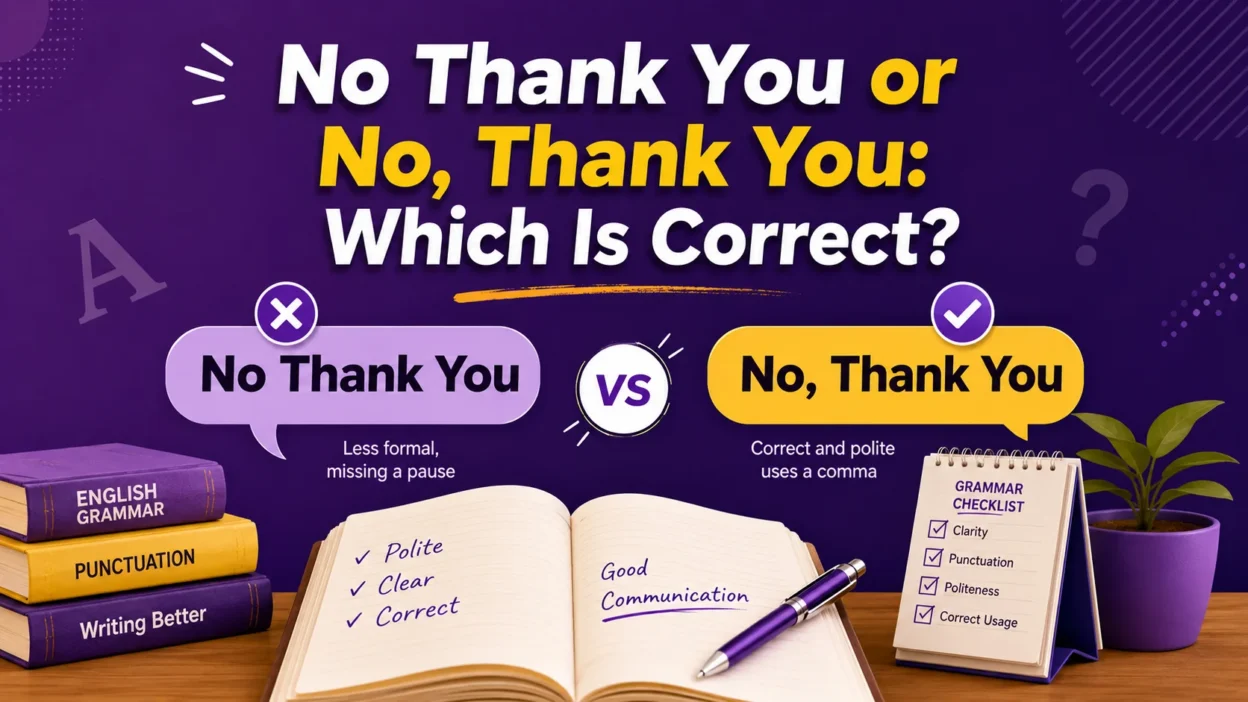
“No thank you” or “No, thank you” may look almost identical, yet one small comma can improve clarity, tone, and reader understanding in everyday communication. The phrase No, thank you is the grammatically correct form in most formal writing because the comma placement separates the refusal from the polite expression, making the meaning easier to understand. Standard grammar, grammar rules, writing rules, and language rules support this approach, especially in professional communication, written communication, and English writing. Good punctuation, proper sentence structure, and careful wording also strengthen readability, correctness, and overall professionalism.
In more relaxed situations, No thank you often appears without a comma. This version is common in informal writing, conversational English, and spoken English, where context, style, and conversational tone help readers understand the speaker’s intent. Although both expressions communicate a polite decline, the difference lies in usage, etiquette, and proper usage rather than meaning alone. From editing business documents and personal messages, it becomes clear that small changes in punctuation mark, syntax, semantics, expression, and wording choice can influence reader perception and improve the flow of a sentence.
Choosing the right version depends on your audience and purpose. Professional writing, proofreading, editing, and established writing conventions usually recommend No, thank you because it follows standard grammar rule guidance and promotes precision, coherence, and clarity. Meanwhile, No thank you remains an acceptable choice for casual conversations. Reviewing examples, practical examples, and grammar explanations in a trusted guide helps every writer make the correct choice with confidence while maintaining courtesy, politeness, communication skills, and a consistent writing style.
Quick Answer: Should You Write “No Thank You” or “No, Thank You”?
If you’re looking for the short answer, here it is.
“No, thank you” is the standard grammatically correct form in most sentences. The comma separates the word “No” from the polite phrase “thank you.” It signals a brief pause that naturally occurs in speech and helps readers understand your meaning immediately.
For example:
- No, thank you. I already ate.
- No, thank you. I’m not interested.
- No, thank you. That’s very kind of you.
Without the comma, the expression often appears more informal.
Examples include:
- No thank you.
- No thank you, we’re just looking.
- No thank you!
Although these versions appear frequently in everyday communication, especially online, most grammar experts and editors recommend using the comma whenever you’re politely declining something in complete writing.
Quick Comparison
| Expression | Grammar | Best Use |
| No, thank you. | Standard and grammatically correct | Formal writing, emails, school, business, books |
| No thank you. | Informal but widely accepted | Text messages, casual conversations, signs, dialogue |
| No thanks. | Informal | Friends, everyday speech, texting |
A simple way to remember the rule is this:
If you’re politely refusing someone, “No, thank you” is almost always the safest choice.
That one comma improves clarity and makes your writing look polished.
Why This Tiny Comma Creates So Much Confusion
It seems strange that a single comma could spark so much debate. After all, both versions sound almost identical when spoken. So why do writers disagree?
The answer lies in the difference between spoken English and written English.
When people speak, they rarely think about punctuation. They simply say:
“No thank you.”
Listeners naturally hear a slight pause because tone of voice carries the meaning. In writing, however, punctuation has to do that job.
Speech Doesn’t Show Commas
Imagine someone offers you another slice of pizza.
You reply:
“No, thank you.”
When spoken aloud, there’s a tiny pause after “No.” It feels natural, and nobody notices it.
Now write the same sentence without punctuation.
No thank you.
Readers can still understand it, but the pause disappears. That’s why editors often restore the comma. It reflects the rhythm of natural speech.
Everyday Writing Ignores Many Grammar Rules
Text messages, social media posts, and online chats have changed how people write.
Many people skip punctuation entirely.
Examples include:
- no thanks
- no thank you
- sounds good
- see you tomorrow
None of these expressions necessarily follow formal grammar rules, yet readers understand them because context fills in the gaps.
That’s one reason you’ll find “No thank you” all over the internet.
Different Publications Follow Different Style Guides
Another source of confusion is that publishers don’t always follow the same editorial standards.
Some prioritize conversational readability.
Others follow strict grammar conventions.
For example:
- Newspapers often edit dialogue differently than academic books.
- Marketing copy may remove punctuation to sound friendlier.
- Novelists sometimes omit commas to match realistic speech.
- Advertising headlines frequently ignore punctuation altogether.
Because readers encounter both versions every day, they naturally assume both must always be correct.
The truth is more nuanced.
Search Engines Display Both Forms
Search online for “No thank you” and you’ll find millions of results.
Search for “No, thank you” and you’ll find millions more.
This doesn’t prove both are equally correct. It simply reflects how people actually write online.
Search engines index:
- Formal articles
- Casual blog posts
- Social media
- Product pages
- Discussion forums
- Marketing campaigns
- Emails published online
Each source follows different writing conventions.
Why Native Speakers Still Disagree
Even native English speakers debate this punctuation because language constantly evolves.
Some learned strict grammar in school.
Others rely on how expressions look in everyday writing.
Neither group is intentionally wrong. They’re simply using different standards.
Professional editors usually favor grammatical consistency, while casual writers often prioritize speed and simplicity.
That explains why the discussion continues despite the grammar rule remaining relatively straightforward.
Understanding the Grammar Rule Behind “No, Thank You”
Once you understand the grammar, choosing between “No thank you” and “No, thank you” becomes much easier.
The comma isn’t random.
It serves a clear grammatical purpose.
What Is Direct Address?
Direct address happens when you speak directly to someone or to a person being referred to.
For example:
- Thank you, Sarah.
- Please sit down, everyone.
- Excuse me, officer.
- Good morning, class.
Commas separate the person being addressed from the rest of the sentence.
Although “thank you” isn’t someone’s name, it functions as a polite expression directed toward another person.
Consider this exchange.
Would you like some coffee?
No, thank you.
The speaker isn’t simply saying “no.”
They’re saying:
“No. Thank you.”
Those are two closely connected ideas.
The comma marks the pause between them.
Why “Thank You” Functions as a Polite Expression
The phrase “thank you” softens the refusal.
Compare these responses.
| Response | Tone |
| No. | Direct and potentially blunt |
| No, thank you. | Polite and respectful |
| No thanks. | Friendly and casual |
| Absolutely not. | Strong and emphatic |
Adding “thank you” changes the emotional tone.
Instead of rejecting the person, you’re politely declining the offer.
That’s why the expression remains one of the most common polite refusals in English.
The Role of the Comma
A comma does more than create a pause.
It separates ideas.
Think about these examples.
Without a comma
No thank you
With a comma
No, thank you.
The second version guides readers through the sentence exactly as you would speak it.
Professional writing values that clarity.
Why Context Matters More Than Memorizing Rules
Many people search for a simple rule like this:
“Always use a comma.”
Real English isn’t always that simple.
Context matters.
Ask yourself these questions.
- Is this a formal document?
- Is it a business email?
- Is it casual texting?
- Is it dialogue in a novel?
- Is it a headline?
- Is it a restaurant sign?
The answers influence whether writers keep or omit the comma.
For example:
A customer texts a friend.
No thank you lol 😂
Perfectly understandable.
A manager replies to a client.
No, thank you for your proposal.
The comma looks more professional.
Understanding context helps far more than memorizing isolated grammar rules.
Think of It Like a Conversation
Imagine someone offers you a free sample at a grocery store.
You smile.
You pause.
Then you answer.
“No… thank you.”
That tiny pause is exactly what the comma represents.
Instead of thinking about punctuation, think about natural speech.
If you naturally pause after “No,” the comma usually belongs there.
When “No, Thank You” Is the Correct Choice
Most grammar references recommend “No, thank you” whenever you’re politely declining an offer in complete written English.
This version works in nearly every professional, academic, and formal setting.
Declining an Offer Politely
This is the most common situation.
Someone offers something.
You politely refuse.
Examples include:
- No, thank you. I’ve already eaten.
- No, thank you. I’m driving today.
- No, thank you. I’m not interested.
- No, thank you. Maybe another time.
Notice how naturally each sentence reads.
The comma separates the refusal from the courteous expression.
Formal and Professional Writing
Professional communication benefits from proper punctuation.
Whether you’re writing to a customer, professor, colleague, or employer, the comma makes your response appear polished and intentional.
Examples:
No, thank you. I appreciate your invitation.
Business correspondence
No, thank you. We’ve decided to pursue another option.
Customer response
No, thank you. We won’t need additional services at this time.
Small details like punctuation often shape first impressions.
Professional writing values consistency because consistency builds credibility.
Business Emails and Customer Communication
Customer service representatives frequently decline requests while maintaining a respectful tone.
Examples include:
- No, thank you. We appreciate your feedback.
- No, thank you. Your subscription will remain unchanged.
- No, thank you. We already have a preferred supplier.
Even when delivering disappointing news, polite language helps preserve positive relationships.
That’s one reason businesses continue to emphasize courteous wording.
Everyday Conversation in Written Form
Even outside the workplace, “No, thank you” remains the safest choice.
Examples include:
At a restaurant
No, thank you. I’m full.
At a party
No, thank you. I don’t drink alcohol.
Shopping
No, thank you. I’m just browsing today.
Phone calls
No, thank you. I’m not interested in switching providers.
Each example sounds friendly without feeling overly formal.
Correct Sentence Examples
Here are several examples covering different situations.
| Situation | Correct Response |
| Someone offers dessert | No, thank you. I’m full. |
| A salesperson approaches | No, thank you. I’m just looking. |
| Declining an invitation | No, thank you. I already have plans. |
| Refusing assistance | No, thank you. I’ve got it. |
| Rejecting a business proposal | No, thank you. We’ll move in a different direction. |
Notice a consistent pattern.
The comma creates a natural pause, improves readability, and matches the rhythm of polite speech.
It’s a tiny punctuation mark, yet it carries an important job. In most situations, using “No, thank you” helps your writing sound clear, courteous, and grammatically polished.
When “No Thank You” Is Acceptable
Although “No, thank you” is the standard grammatical form, that doesn’t mean “No thank you” is always wrong. English changes depending on context, audience, and purpose. Informal writing often bends punctuation rules without confusing the reader.
The key is understanding when omitting the comma is a stylistic choice instead of a grammar mistake.
Informal Writing and Text Messages
Texting is one of the few places where punctuation becomes optional. People usually focus on speed rather than perfect grammar.
For example:
- No thank you 😊
- No thanks!
- No thank you, I’m good.
- No thank you lol.
These responses sound natural because readers rely on context and tone instead of punctuation.
Many messaging apps have also changed writing habits. People commonly skip periods, commas, and even capital letters.
For example:
- see you soon
- sounds good
- thanks again
- no thank you
These expressions are widely understood despite missing punctuation.
Dialogue, Signs, and Creative Writing
Writers sometimes remove commas to make dialogue feel more realistic.
Consider these examples.
With standard punctuation
“No, thank you,” Emma replied.
With a conversational style
“No thank you,” Emma replied.
Both versions communicate the same idea. The first follows standard grammar more closely, while the second mimics natural speech.
You’ll also notice omitted commas in:
- Advertising slogans
- Greeting cards
- Product packaging
- Restaurant menus
- Store signs
- Social media graphics
For example:
- No Thank You Needed
- No Thank You Sale
- No Thank You Required
These aren’t grammar lessons. They’re marketing choices designed to keep text short and visually appealing.
Branding, Headlines, and Creative Writing
Headlines often remove punctuation because they need to be brief and eye-catching.
Examples include:
- No Thank You: Why Saying No Builds Confidence
- No Thank You Gifts Required
- No Thank You Challenge
Editors frequently simplify punctuation in titles because readers expect headlines to follow slightly different conventions than complete sentences.
The same principle applies to branding.
A coffee shop might print:
No Thank You Necessary
instead of
No, Thank You Necessary
The first version looks cleaner on a sign even though the second follows traditional grammar more closely.
Examples Where the Comma Is Commonly Omitted
Here are situations where you’ll often see “No thank you” without a comma.
| Situation | Common Form |
| Text message | No thank you |
| Social media comment | No thank you |
| Blog title | No Thank You |
| Poster | No Thank You |
| Store sign | No Thank You |
| Novel dialogue | No thank you |
That doesn’t mean these examples establish a grammar rule. They simply reflect how English adapts to different types of writing.
Does the Comma Change the Meaning?
Many people wonder whether the comma actually changes the meaning or simply affects appearance.
The answer is somewhere in the middle.
In most situations, the core meaning stays the same. You’re politely declining something. However, punctuation influences tone, rhythm, clarity, and the reader’s perception.
Grammar vs. Readability
Grammar rules exist to help readers understand ideas quickly.
The comma in “No, thank you” tells readers to pause after the refusal before reading the polite expression.
Compare these examples.
No thank you.
No, thank you.
Most readers understand both.
The second version simply guides the eye more naturally.
Think of commas as road signs.
You can sometimes drive without them, but the journey becomes smoother when they’re present.
How Punctuation Changes Tone
Small punctuation marks often create surprisingly large differences in tone.
Compare these responses.
| Response | How It Sounds |
| No. | Direct |
| No thanks. | Friendly |
| No thank you. | Casual and polite |
| No, thank you. | Polite and polished |
| Absolutely not. | Strong refusal |
The comma doesn’t make the sentence more polite by itself.
Instead, it reflects the natural pause people use when speaking politely.
That subtle rhythm makes readers perceive the sentence as warmer and more thoughtful.
Polite Refusal vs. Abrupt Rejection
Imagine a server asks:
Would you like dessert?
Response one:
No.
Response two:
No, thank you.
Both answers refuse the offer.
Only one acknowledges the person’s effort.
That’s why customer service training often encourages polite refusals rather than blunt ones.
Adding “thank you” shows appreciation even when declining.
Reader Perception in Different Contexts
Readers judge writing differently depending on where they see it.
For example:
A professor grading an essay will probably expect:
No, thank you.
A friend reading your text message won’t think twice if you write:
No thank you.
Professional editors also pay close attention to punctuation because consistency signals careful writing.
The average reader may not consciously notice the comma, yet many will notice when polished writing feels smoother.
No, Thank You vs. No Thank You vs. No Thanks
English offers several polite ways to decline something.
Although they express similar ideas, they differ in tone, formality, and style.
Differences in Tone
Let’s compare the three expressions.
| Expression | Tone | Formality |
| No, thank you. | Warm and respectful | High |
| No thank you. | Friendly | Medium |
| No thanks. | Casual | Low |
Each works well in the right setting.
Which Sounds More Natural?
Natural speech depends on the situation.
Imagine these conversations.
Restaurant
Server:
Would you like more coffee?
Customer:
No, thank you.
This sounds polished and courteous.
Now imagine texting a sibling.
Want pizza?
No thanks.
That feels perfectly natural.
Neither response is wrong.
They’re simply suited to different audiences.
When to Use Each Expression
Use “No, thank you” when:
- Writing professional emails
- Speaking with customers
- Communicating with teachers
- Writing essays
- Responding formally
- Declining invitations politely
Use “No thank you” when:
- Texting friends
- Writing casual dialogue
- Posting online
- Creating conversational content
Use “No thanks” when:
- Chatting casually
- Sending quick replies
- Speaking with close friends
- Keeping responses short
Which Version Should You Learn First?
If English isn’t your first language, learn “No, thank you” first.
Why?
Because it’s accepted almost everywhere.
You can always become more casual later.
Learning the formal version first reduces mistakes and builds confidence.
American vs. British English Usage
Many grammar questions involve regional differences.
Fortunately, this one doesn’t create major divisions.
Both American English and British English generally prefer “No, thank you” in formal writing.
Is There Any Regional Difference?
The difference isn’t between American and British English.
Instead, it’s between formal and informal writing.
Both varieties commonly use:
No, thank you.
Both also sometimes omit the comma in:
- Text messages
- Advertisements
- Informal dialogue
- Headlines
The grammar principle stays the same.
What Major Dictionaries Recommend
Leading dictionaries define “thank you” as a polite expression used to show gratitude or decline an offer courteously.
Grammar references generally punctuate polite refusals like this:
No, thank you.
Although dictionaries focus on meaning rather than punctuation, published examples overwhelmingly favor the comma in complete sentences.
Style Guide Preferences
Professional editors usually follow established style guides.
Whether using AP Style, Chicago Manual of Style, or other editorial standards, writers generally punctuate the phrase as:
No, thank you.
These guides emphasize readability and grammatical consistency.
Businesses, publishers, newspapers, and educational institutions often follow similar conventions.
That’s another reason you’ll see the comma in professionally edited writing far more often than in everyday texting.
Common Grammar Mistakes
The confusion surrounding “No thank you” often leads to recurring mistakes.
Fortunately, they’re easy to avoid.
Omitting the Comma When It Improves Clarity
Many writers remove commas simply because they see others doing it online.
For example:
No thank you. I’d rather wait.
This isn’t difficult to understand.
However, the standard version reads more smoothly.
No, thank you. I’d rather wait.
Professional writing almost always benefits from that extra clarity.
Adding Unnecessary Commas
Some writers swing too far in the opposite direction.
Examples include:
- No, thank, you.
- No thank, you.
- No, thank, you, very much.
These commas interrupt the sentence unnecessarily.
Remember this simple pattern:
No, thank you.
One comma is usually enough.
Treating Every Informal Example as a Grammar Rule
Seeing something online doesn’t automatically make it grammatically correct.
Social media contains:
- Sentence fragments
- Missing punctuation
- Misspelled words
- Slang
- Creative formatting
Those examples reflect informal communication rather than standard written English.
Copying Social Media Instead of Standard English
Many learners accidentally imitate casual writing everywhere.
That creates problems in:
- Job applications
- Academic papers
- Business emails
- Professional reports
Always match your writing style to your audience.
Professional situations deserve professional punctuation.
Real-Life Examples in Different Situations
Grammar becomes much easier when you see it in action.
Here are common situations where polite refusals appear every day.
Declining Food or Drinks
Host:
Would you like another piece of cake?
Guest:
No, thank you. It was delicious.
The response feels warm and appreciative.
Turning Down an Invitation
Friend:
Want to come hiking this weekend?
Reply:
No, thank you. I already have plans.
Notice that the refusal stays polite even though the answer is negative.
Saying No in a Business Email
Suppose a vendor offers additional services.
A professional response might read:
No, thank you. We’ve decided to continue with our current provider. We appreciate your time and wish you success.
This wording maintains goodwill while clearly declining the offer.
Customer Service Responses
Customers often refuse promotions or add-on purchases.
Examples include:
- No, thank you. I’m just looking today.
- No, thank you. I don’t need an extended warranty.
- No, thank you. Everything is perfect.
Each response is brief, respectful, and easy to understand.
Classroom and Workplace Communication
Teachers and managers appreciate polite communication.
Examples:
- No, thank you. I understand the assignment.
- No, thank you. I’ve already completed the training.
- No, thank you. I’m comfortable with my current schedule.
These responses sound confident without appearing rude.
Text Messages and Social Media
Casual communication allows more flexibility.
You might see:
- No thank you 🙂
- No thanks!
- I’m good thanks.
- Maybe next time!
Even here, adding the comma isn’t wrong. It’s simply less common because speed usually matters more than perfect punctuation.
Side-by-Side Sentence Comparison
Sometimes the easiest way to understand a grammar rule is to compare examples side by side. The table below shows which version works best in different situations and explains why.
| Situation | Recommended Form | Why It Works |
| Business email | No, thank you. | Professional, polished, and grammatically correct |
| Job interview | No, thank you. | Shows courtesy and professionalism |
| Restaurant | No, thank you. | The standard polite response |
| Customer service | No, thank you. | Respectful while declining an offer |
| Academic writing | No, thank you. | Follows standard punctuation rules |
| Text message | No thank you or No, thank you | Both are commonly understood |
| Social media comment | No thank you | Casual writing often omits punctuation |
| Blog headline | No Thank You | Headlines frequently remove commas for design |
| Advertising slogan | No Thank You | Visual simplicity takes priority |
| Novel dialogue | Either | Depends on the author’s style and voice |
The pattern becomes clear after looking at these examples.
If you’re writing for school, work, business, or publication, “No, thank you” is the better choice.
If you’re texting a friend or writing an informal social media post, “No thank you” usually won’t look out of place.
Common Alternatives to “No, Thank You”
English offers many polite ways to refuse an offer. Choosing the right alternative depends on your relationship with the other person, the situation, and the tone you want to create.
No Thanks
This is probably the most common alternative.
Examples:
- No thanks.
- No thanks. I’m okay.
- No thanks. Maybe next time.
It sounds friendly and relaxed.
I’m Good, Thanks
Many Americans naturally use this expression.
Examples:
- I’m good, thanks.
- I’m good. Thanks anyway.
- I’m good for now, thanks.
Although some people criticize this phrase because good traditionally describes character rather than condition, it has become a perfectly natural expression in everyday American English.
Not Right Now, Thank You
Sometimes you don’t want to refuse forever.
You simply want to decline at the moment.
Examples:
- Not right now, thank you.
- Not today, thank you.
- Maybe later. Thank you.
These responses leave the door open for future opportunities.
I Appreciate the Offer, but No, Thank You
This version works well when declining something important.
Examples include:
- A business proposal
- A generous gift
- A volunteer opportunity
- A professional invitation
Example:
I appreciate the offer, but no, thank you. We’ve already made our decision.
The extra appreciation softens the refusal even more.
Maybe Another Time
This expression avoids sounding final.
Examples:
- Maybe another time.
- Maybe next week.
- Let’s try again another day.
It’s especially useful when declining invitations from friends or family.
Comparison of Common Alternatives
| Expression | Formality | Typical Use |
| No, thank you. | High | Business, school, professional settings |
| No thank you. | Medium | Informal writing |
| No thanks. | Low | Friends and casual conversation |
| I’m good, thanks. | Casual | Everyday American English |
| Not right now, thank you. | Medium | Temporary refusal |
| I appreciate the offer, but no, thank you. | High | Business and formal communication |
| Maybe another time. | Casual | Friendly invitations |
Using different expressions helps your writing sound more natural. Repeating the exact same phrase over and over can make conversations feel repetitive.
Decision Chart: Which Version Should You Choose?
When you’re unsure, use this simple guide.
Someone offered you something.
│
▼
Are you politely refusing it?
│
┌─────┴─────┐
│ │
Yes No
│
▼
Is this professional, academic,
or formal writing?
│
┌───┴────┐
│ │
Yes No
│ │
▼ ▼
Use Is it casual,
“No, texting, or
thank social media?
you.” │
┌───┴────┐
│ │
Yes No
│ │
▼ ▼
“No thank “No, thank
you” is you” is still
acceptable. the safest choice.
If you’re ever uncertain, choose “No, thank you.”
It’s accepted almost everywhere and rarely sounds out of place.
Expert Writing Tips for Natural English
Small punctuation choices make a noticeable difference in polished writing. These tips will help you sound more confident and natural.
Read the Sentence Aloud
Reading aloud is one of the simplest editing techniques.
Ask yourself:
Do I naturally pause after “No”?
If the answer is yes, the comma probably belongs there.
For example:
No, thank you.
That brief pause reflects how most people actually speak.
Consider Your Audience
Always think about who’s reading your writing.
A close friend probably won’t notice whether you include the comma.
A hiring manager, professor, editor, or client might.
Professional readers often expect standard grammar because it reflects careful attention to detail.
Match the Level of Formality
Good writers adjust their style based on context.
Formal writing usually requires:
- Complete sentences
- Correct punctuation
- Consistent capitalization
- Standard grammar
Casual writing allows:
- Short replies
- Sentence fragments
- Emojis
- Missing punctuation
Neither style is wrong.
The key is choosing the one that fits the situation.
Prioritize Clarity Over Habit
Many people develop writing habits without realizing it.
Some omit every comma.
Others add too many.
Instead of writing automatically, ask one question:
Will this punctuation help my reader?
If the answer is yes, keep it.
Clear writing always serves the reader first.
“Good punctuation is invisible. Readers notice it only when it’s missing.”
That’s why experienced editors pay attention to even the smallest details.
Conclusion
Choosing between No Thank You and No, Thank You comes down to understanding both grammar and context. In most formal situations, No, thank you is the preferred form because the comma separates the polite refusal from the expression of gratitude, making the sentence clearer and more natural to read. In casual conversations, text messages, headlines, or creative writing, No thank you is also widely accepted and rarely causes confusion. Instead of memorizing exceptions, focus on your audience, the tone you want to convey, and the purpose of your writing. When you’re unsure, No, thank you is the safest and most professional choice.
FAQs
Q1. Is No, thank you grammatically correct?
Yes. No, thank you is the standard grammatical form in American English. The comma creates a natural pause and separates the refusal from the polite expression, making the sentence clearer and more polished.
Q2. Is No thank you incorrect?
Not necessarily. No thank you is common in informal writing, text messages, social media posts, headlines, and casual conversations. However, most editors and grammar experts recommend No, thank you for formal and professional writing.
Q3. Does the comma change the meaning of No, thank you?
The core meaning remains the same because both expressions politely decline an offer. However, the comma improves readability, reflects natural speech, and creates a more refined and professional tone.
Q4. Which version should I use in business emails?
For business emails, academic writing, customer communication, and other professional documents, use No, thank you. It follows standard punctuation rules and presents a courteous, polished impression.
Q5. How can I remember when to use the comma?
A simple rule is to imagine saying the phrase aloud. If you naturally pause after No, write No, thank you. This approach works in almost every formal writing situation and helps you maintain clear, professional communication.