“Sun” and “son” are a common homophone word pair because both words have the same sound and similar pronunciation but different meanings. A single letter, vowel, or small change in spelling creates a big difference. Many English learners, students, and writers face confusion, so paying attention to context, context clues, word choice, grammar, and correct usage improves writing, writing accuracy, spelling accuracy, communication, and confidence.
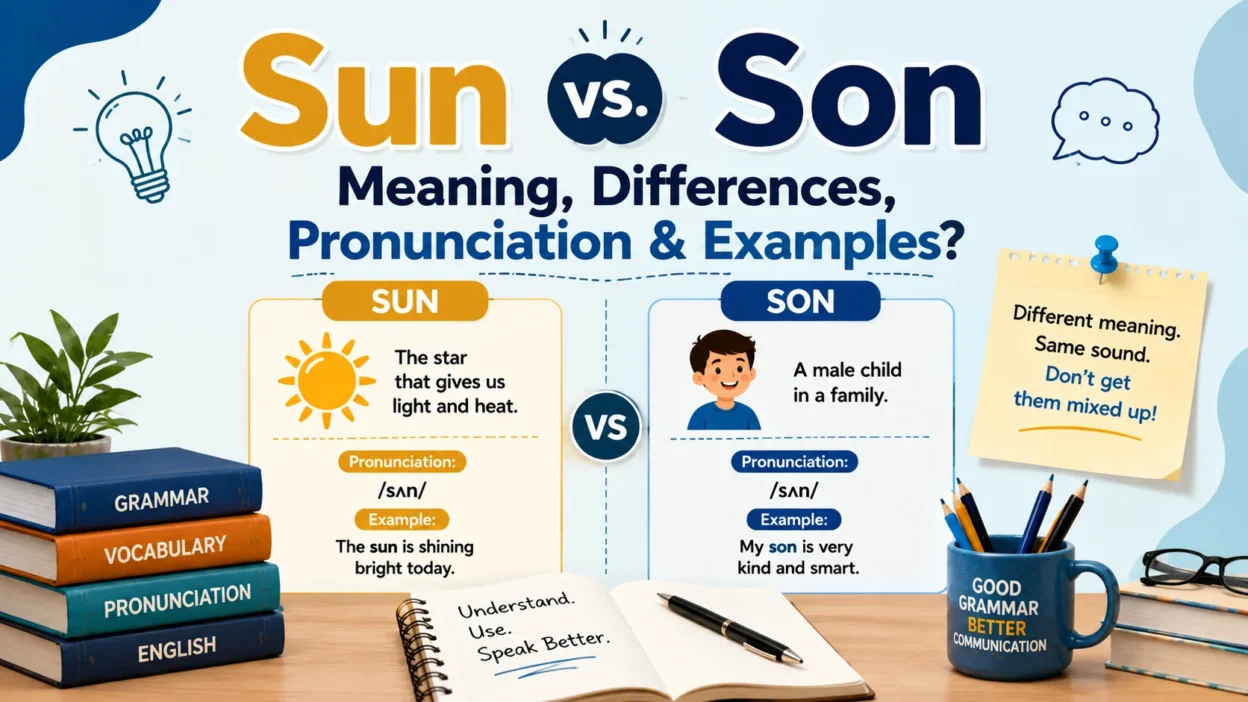
The Sun is the star at the center of the solar system that provides Earth with light and heat, while a Son is a male offspring or child. Compare My sun graduated from college with My son graduated from college to see how the meaning changes. Learning through definitions, examples, and comparing the pair side by side strengthens understanding, language learning, language skills, literacy, and comprehension.
A simple guide with practical tips makes remembering easier than memorizing rules. Using real life, everyday life, a fairy tale, father, prince, rising Sun, or loving Son helps reduce common mistakes, misunderstandings, and spelling confusion. With regular learning, practice, and proper usage, you’ll improve, build mastery, and use each term correctly.
Sun vs Son: Quick Answer
Here’s the simplest way to remember the difference:
| Word | Meaning | Example |
| Sun | The star at the center of our solar system or sunlight | The sun is shining brightly today. |
| Son | A male child or male descendant | Their son starts college this fall. |
Quick rule: If you’re talking about space, light, heat, weather, or daytime, use sun. If you’re talking about family or relationships, use son.
Although they sound identical, their meanings never overlap. Context tells you which word belongs in the sentence.
Sun Meaning and Definition
What Does “Sun” Mean?
The sun is the massive star at the center of our solar system. It provides the light and heat that make life on Earth possible. Without the sun, plants couldn’t grow, weather patterns would disappear, and Earth would become an icy planet.
In everyday English, sun can also refer to sunlight, warm weather, or bright conditions.
For example:
- We spent the afternoon enjoying the sun.
- The flowers need plenty of sun.
- Let’s sit in the sun for a while.
Notice that each sentence relates to light, warmth, or the star itself.
The Sun as Earth’s Star
Scientifically, the Sun (capitalized when referring to our star by name) is a medium-sized star located at the center of the solar system. It contains more than 99.8% of the solar system’s total mass, making it the dominant gravitational force that keeps the planets in orbit.
Here are a few fascinating facts:
- Age: About 4.6 billion years
- Diameter: Approximately 864,000 miles (1.39 million kilometers)
- Surface Temperature: Around 9,940°F (5,500°C)
- Core Temperature: Roughly 27 million°F (15 million°C)
- Distance from Earth: About 93 million miles (150 million kilometers)
These facts explain why the sun is central to astronomy, climate, and life on Earth.
Other Meanings of “Sun”
Besides its scientific meaning, sun appears in many everyday expressions.
It can describe:
- Bright sunshine
- Warm weather
- A cheerful atmosphere
- Success or happiness in figurative language
For instance:
“She finally found her place in the sun.”
Here, place in the sun doesn’t describe weather. Instead, it means achieving success or happiness.
Common Phrases with “Sun”
English includes many idioms featuring the word sun.
Everything under the sun
Meaning: Everything imaginable.
Example:
We talked about everything under the sun during the road trip.
A place in the sun
Meaning: A position of success or recognition.
Example:
After years of hard work, the company finally earned a place in the sun.
Make hay while the sun shines
Meaning: Take advantage of favorable conditions before they disappear.
Example:
Summer sales are booming, so let’s make hay while the sun shines.
These expressions show that sun often symbolizes opportunity, warmth, and optimism.
Examples of “Sun” in Sentences
- The sun rises in the east.
- We watched the sun set over the ocean.
- Too much sun can damage your skin.
- Solar panels convert energy from the sun into electricity.
- Children played outside until the sun disappeared behind the hills.
- The bright sun made the snow sparkle like diamonds.
Son Meaning and Definition
What Does “Son” Mean?
A son is a male child in relation to his parents. The word can also describe a male descendant or someone regarded as being closely connected to a particular group, culture, or place.
Examples include:
- Their son graduated from college.
- She has one daughter and one son.
- He’s the oldest son in the family.
Unlike sun, the word son always relates to people rather than nature or astronomy.
Literal and Family Meaning
Most commonly, son refers to a biological or adopted male child.
Examples:
- My son loves baseball.
- Their youngest son just turned ten.
- She introduced her son to the neighbors.
Family relationships make the meaning immediately clear.
Religious and Symbolic Uses of “Son”
The word Son is sometimes capitalized in religious writing, particularly in Christianity, where the Son refers to Jesus Christ as part of the Holy Trinity.
You may also hear symbolic uses such as:
- Son of the nation
- Son of liberty
- Native son
- Favorite son
These expressions don’t always describe family relationships literally. Instead, they emphasize loyalty, heritage, or honor.
Common Expressions with “Son”
English uses son in many familiar expressions.
Like father, like son
Meaning: A son behaves similarly to his father.
Example:
They’re both talented musicians. Like father, like son.
The prodigal son
Meaning: Someone who leaves home but later returns.
Example:
After years abroad, he returned as the prodigal son.
Native son
Meaning: A man born in a particular place.
Example:
The town honored its native son after his Olympic victory.
Examples of “Son” in Sentences
- Their son won a science competition.
- My son enjoys reading adventure novels.
- The proud parents celebrated their son’s graduation.
- She hugged her son before he boarded the plane.
- Every son deserves encouragement and support.
- His son inherited his love of music.
Sun vs Son: Side-by-Side Comparison
Sometimes the easiest way to understand two confusing words is to compare them directly.
| Feature | Sun | Son |
| Meaning | The star that provides Earth’s light and heat | A male child or descendant |
| Category | Astronomy, nature | Family relationships |
| Part of Speech | Noun | Noun |
| Pronunciation | /sʌn/ | /sʌn/ |
| Common Topics | Space, weather, daylight | Parents, children, genealogy |
| Example | The sun is shining. | Their son is studying. |
This table highlights the biggest difference: same pronunciation, different meaning.
Sun vs Son: The Key Differences
Although these words sound identical, they belong to entirely different contexts.
Meaning
The sun is a celestial object that gives Earth light and heat.
A son is a male child or male descendant.
One belongs to science. The other belongs to family relationships.
Usage
Use sun whenever you’re discussing:
- Daylight
- Sunshine
- Weather
- Space
- Astronomy
- Solar energy
Use son when discussing:
- Family
- Children
- Parents
- Genealogy
- Relationships
Keeping the topic in mind usually solves the confusion instantly.
Context
Context is your best clue.
Compare these sentences:
- The sun disappeared behind the mountains.
- Their son climbed the mountains.
Both sentences are grammatically correct, yet the surrounding words reveal which spelling fits naturally.
Grammar Role
Both sun and son function as countable nouns.
Examples:
- The sun is bright.
- A son called his parents.
Since they share the same grammatical role, spelling—not grammar—is what distinguishes them.
Real-World Examples
Consider these everyday situations.
A weather report says:
The sun will remain visible throughout the afternoon.
A family announcement says:
Their son was accepted into medical school.
Switching the words would make each sentence incorrect, even though the pronunciation stays exactly the same.
Why Sun and Son Sound Exactly the Same
One reason writers confuse these words is that sun and son are perfect homophones.
Homophones are words that share the same pronunciation but have different meanings and spellings.
Other examples include:
- Right / Write
- Sea / See
- Flour / Flower
- Knight / Night
English contains hundreds of homophone pairs because its spelling has developed over centuries from multiple languages.
They Are Perfect Homophones
Both words are pronounced:
/sʌn/
Whether you’re discussing astronomy or introducing your child, listeners hear the exact same sound.
That’s why spoken English rarely creates confusion. Written English does.
IPA Pronunciation
Using the International Phonetic Alphabet (IPA):
- Sun → /sʌn/
- Son → /sʌn/
Every sound matches perfectly:
- /s/ = initial “s” sound
- /ʌ/ = short vowel sound as in cup
- /n/ = ending “n” sound
There is no pronunciation difference to help distinguish the two.
Why Spelling Changes but Pronunciation Doesn’t
English spelling reflects history more than pronunciation.
Over centuries, words entered English from different languages and evolved separately. As pronunciation changed, many spellings remained the same while others did not. The result is a language filled with homophones like sun and son.
A useful reminder is:
“Your ears hear the same sound. Your eyes must choose the correct spelling.”
Why People Confuse Sun and Son
Confusing sun and son is surprisingly common, even among native English speakers. The mistake usually happens because people rely on sound instead of meaning.
Several factors contribute to the confusion:
- They sound identical. There’s no pronunciation clue to separate them.
- Fast typing. Writers often type what they hear in their minds.
- Autocorrect limitations. Since both are correctly spelled words, spell-checkers rarely flag the mistake.
- Context is ignored. Reading too quickly makes it easy to miss the intended meaning.
- English learners memorize pronunciation first. Many ESL students learn spoken vocabulary before mastering spelling.
Fortunately, the solution is simple: pause for a moment and ask yourself one question.
Am I talking about the sky or a family member?
If the answer is the sky, weather, daylight, or space, choose sun.
If the answer is a male child or family relationship, choose son.
That quick mental check prevents almost every mistake.
Sun vs Son in Context
Context is the easiest way to decide whether sun or son belongs in a sentence. Since both words sound exactly the same, the surrounding words carry all the meaning.
When you read the entire sentence instead of focusing on a single word, the correct spelling usually becomes obvious.
Compare These Sentence Pairs
| Correct Use of Sun | Correct Use of Son |
| The sun warmed the beach all afternoon. | Their son spent the afternoon at the beach. |
| The sun disappeared behind the clouds. | Her son disappeared into the crowd. |
| We enjoyed the sun during vacation. | We visited our son during vacation. |
| The sun powers solar panels. | Their son studies engineering. |
| The sun rose before six o’clock. | Their son woke up before six o’clock. |
Notice how the surrounding words immediately reveal which spelling makes sense.
How Context Changes the Meaning
Look at these examples.
❌ My sun starts high school next week.
✅ My son starts high school next week.
Now compare another one.
❌ The son was shining brightly.
✅ The sun was shining brightly.
Only one word changes, yet the meaning shifts completely.
Quick Clues to Choose the Correct Word
Ask yourself these questions:
- Are you talking about space, weather, heat, daylight, or sunshine? Choose sun.
- Are you talking about parents, children, family, or relatives? Choose son.
- Does the sentence mention school, birthdays, parents, or siblings? It’s almost certainly son.
- Does it mention clouds, sky, sunrise, sunset, or solar energy? It’s sun.
These simple clues make proofreading much easier.
Common Mistakes and How to Avoid Them
Even experienced writers occasionally confuse homophones. Fortunately, the mistakes with sun and son are easy to fix once you recognize the pattern.
Using “Sun” When Referring to Family
Incorrect:
My sun graduated from college.
Correct:
My son graduated from college.
The sentence discusses a family member, not the star in the sky.
Using “Son” When Talking About Nature
Incorrect:
The son is setting behind the mountains.
Correct:
The sun is setting behind the mountains.
Anything related to daylight or astronomy requires sun.
Writing by Sound Instead of Meaning
Many writers type words exactly as they hear them.
Because sun and son sound identical, relying only on pronunciation often creates mistakes.
Instead, pause and identify the topic before writing.
Proofreading Tips
Before submitting any piece of writing:
- Read slowly instead of skimming.
- Look specifically for homophones.
- Read the sentence aloud while thinking about its meaning.
- Ask someone else to proofread important documents.
- Use grammar tools, but don’t rely on them completely.
Remember:
Spell-check checks spelling—not meaning.
Everyday Examples of Sun vs Son
These homophones appear everywhere in daily life.
School Assignments
Incorrect:
The sun won the spelling bee.
Correct:
The son won the spelling bee.
Text Messages
Friend:
Your son is waiting outside.
Not:
Your sun is waiting outside.
Emails
Business writing should also avoid homophone mistakes.
Example:
Our son will attend the family reunion next month.
Social Media Captions
Examples using sun:
- Chasing the sun all summer.
- Nothing beats a beautiful sunset.
- The sun makes every vacation better.
Examples using son:
- Proud of my son’s first soccer game.
- Watching my son grow has been life’s greatest blessing.
Everyday Conversations
Although people pronounce both words the same way, listeners understand them through context.
For example:
“My son loves playing outside in the sun.”
This sentence uses both words correctly.
Idioms and Expressions Using Sun
The word sun appears in many English expressions.
Make Hay While the Sun Shines
Meaning: Take advantage of a good opportunity before it disappears.
Example:
Business is booming. Let’s make hay while the sun shines.
A Place in the Sun
Meaning: Success, happiness, or recognition.
Example:
She finally earned her place in the sun after years of hard work.
Everything Under the Sun
Meaning: Almost everything imaginable.
Example:
They discussed everything under the sun during dinner.
These idioms show that sun often symbolizes hope, success, warmth, and opportunity.
Expressions Using Son
The word son also appears in many well-known expressions.
Like Father, Like Son
Meaning: Sons often resemble their fathers in personality or behavior.
Example:
They both enjoy fixing old cars. Like father, like son.
The Prodigal Son
This biblical expression refers to someone who leaves home, learns valuable lessons, and eventually returns.
Today it often describes someone returning after a long absence.
Native Son
A man born in a particular city, region, or country.
Example:
The mayor honored the town’s native son after his Olympic victory.
Memory Tricks to Remember Sun vs Son
Small memory tricks often work better than memorizing grammar rules.
The Sky Reminder
If you can point upward, the word is sun.
Think:
Sky = Sun
The Family Reminder
If you’re talking about parents or children, choose son.
Think:
Family = Son
The Letter Association Method
Notice the letter O in son.
Imagine it standing for:
Offspring
That single connection helps many learners remember the correct spelling.
The One-Second Memory Test
Ask yourself:
Is this about the sky or a child?
If it’s the sky:
✅ Sun
If it’s a child:
✅ Son
It takes one second and prevents nearly every mistake.
Sun vs Son Practice Exercise
Test yourself before moving on.
Fill in the Blanks
Choose sun or son.
- The ______ rises every morning.
- Their ______ just graduated from college.
- The flowers need plenty of ______.
- My ______ loves playing baseball.
- We watched the ______ disappear behind the mountains.
Choose the Correct Word
- The (sun/son) produces heat.
- Her (sun/son) plays the piano.
- The (sun/son) shines all day.
- Their (sun/son) won first place.
Answer Key
- Sun
- Son
- Sun
- Son
- Sun
Multiple Choice Answers:
- Sun
- Son
- Sun
- Son
If you answered all of them correctly, you’ve already mastered the difference.
Frequently Confused Homophones Related to Sun vs Son
Many English learners confuse other homophones too.
| Word Pair | Difference |
| Sea / See | Ocean vs vision |
| One / Won | Number vs past tense of win |
| Flower / Flour | Plant vs baking ingredient |
| Knight / Night | Medieval warrior vs evening |
| Their / There / They’re | Possession vs location vs they are |
| Hear / Here | Listen vs location |
Learning these word pairs together helps strengthen your spelling skills.
Conclusion
Understanding “sun” vs. “son” becomes much easier when you focus on the meaning instead of the pronunciation. Although these two words sound exactly the same, they belong to completely different contexts. “Sun” refers to the star at the center of the solar system that gives Earth light and heat, while “son” refers to a male child. By paying attention to the context, practicing with examples, and checking the spelling, you can avoid common mistakes and use both words with confidence.
FAQs
Q1. What is the difference between Sun and Son?
Sun is the star at the center of the solar system, while Son means a male child or male offspring. They are homophones, so they sound the same but have different meanings.
Q2. Why do people confuse Sun and Son?
People often confuse them because they have the same pronunciation and sound alike. Many writers rely on sound instead of checking the context, spelling, and word choice.
Q3. How can I remember the difference between Sun and Son?
Think of the Sun as the object in the sky that provides light and heat. Think of a Son as a family member or male child. This simple memory trick helps you choose the correct word every time.
Q4. Are Sun and Son pronounced differently?
No. Sun and Son are pronounced exactly the same. They are perfect homophones in the English language, even though their spellings and meanings are different.
Q5. Can using the wrong word change the meaning of a sentence?
Yes. Using Sun instead of Son, or Son instead of Sun, completely changes the meaning of a sentence. Checking the context before writing helps improve accuracy and prevents misunderstandings.