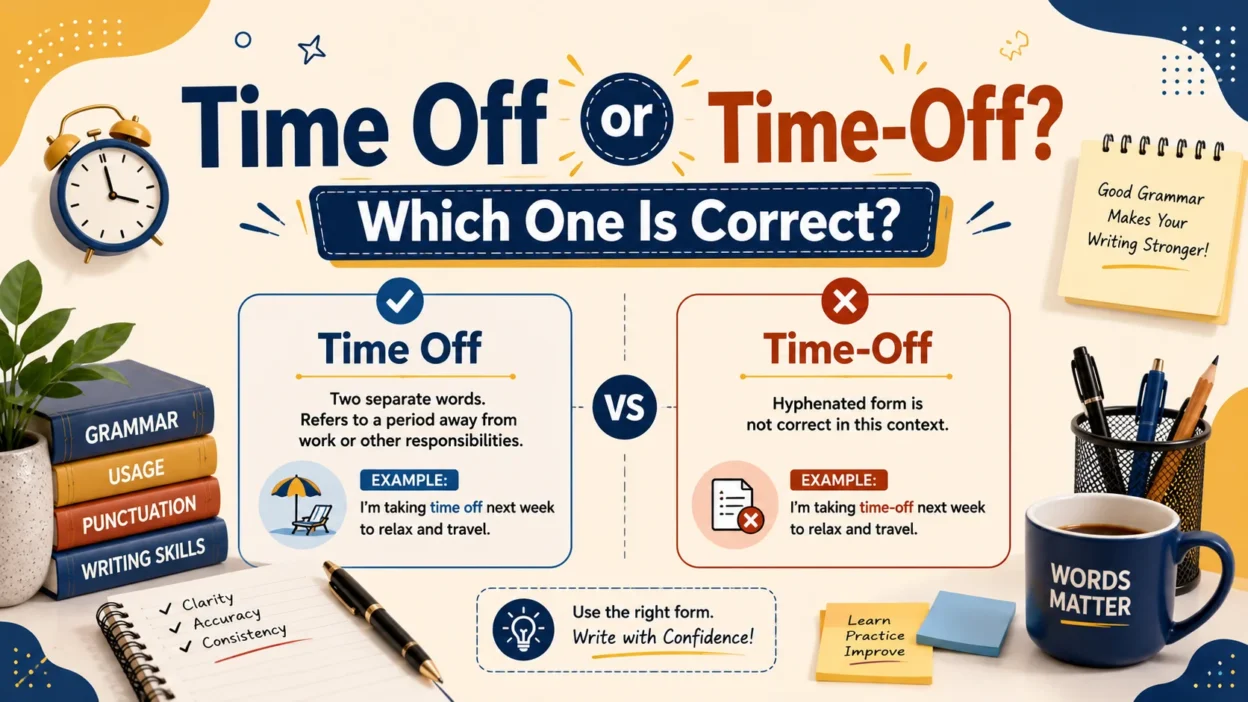
Time off or Time-off becomes easier once you understand one simple grammar rule and know how each form works in everyday writing. Many people pause while writing an email or professional email because they are unsure which form is correct. This confusion appears in the workplace, workplaces, school, and schools. In plain English, time off is a noun phrase, while time-off is a compound adjective used as a modifier before another noun. Learning this small difference improves communication, writing, writing skills, writing confidence, clarity, meaning, and correct usage.
Use time off when talking about a break, vacation, or period away from work and other work responsibilities. For example, someone may be taking time off or taking a break next week. Use time-off before another word, such as time-off request or time-off policy. You may submit a request through HR, complete an HR form, or update a company policy or document. Paying attention to punctuation, the hyphen, word choice, context, and the simple rule helps readers understand your message and avoid common mistakes.
Every reliable guide, example, examples, instance, and real-world examples shows that the rule is easy to follow. These related ideas explain the roles each form plays in the language and help you choose the right form with confidence. Whether you read language resources, prepare business documents, or improve your English grammar, remembering the grammar rule, grammar rules, noun, adjective, compound adjective, noun phrase, and usage will make your writing clearer, more professional, and easier to read.
Time Off or Time-Off: The Short Answer
The difference comes down to how the phrase functions in a sentence.
- Time off is a noun phrase that refers to leave from work, school, or another regular activity.
- Time-off is a compound adjective that describes a noun and usually appears before it.
Here’s a quick comparison.
| Form | Part of Speech | Correct Usage | Example |
| Time off | Noun phrase | Refers to leave or a break | I need time off next week. |
| Time-off | Compound adjective | Describes another noun | Please submit your time-off request. |
A simple rule to remember is this:
Use “time off” when you’re talking about taking leave. Use “time-off” when the phrase describes another noun.
Once you understand that rule, choosing the correct form becomes much easier.
What Does Time Off Mean?
Time off refers to a period when someone is away from work, school, or another regular responsibility. The time may be paid or unpaid depending on company policy or the reason for the leave.
People take time off for many reasons, including:
- Vacation
- Sick leave
- Personal appointments
- Family emergencies
- Maternity or paternity leave
- Mental health days
- Bereavement leave
- Religious holidays
In everyday English, this is the form you’ll see most often because it names the period of leave itself.
Examples of Time Off in Sentences
- I need time off for a family wedding.
- She requested time off next Friday.
- Our manager approved everyone’s time off.
- Employees earn additional time off after five years.
- Taking time off helped reduce stress and improve productivity.
- He used his remaining time off before the end of the year.
- We scheduled our vacation during our time off.
- The company encourages employees to take time off regularly.
Notice that time off does not describe another noun in these examples. Instead, it acts as the thing being discussed.
What Does Time-Off Mean?
Time-off functions as a compound adjective. It describes another noun and usually appears immediately before that noun.
The hyphen tells readers that the two words work together as a single modifier.
For example:
- time-off request
- time-off policy
- time-off approval
- time-off calendar
- time-off balance
- time-off tracking system
Without the hyphen, readers may briefly misunderstand the relationship between the words.
Examples of Time-Off in Sentences
- Please complete the time-off request before Friday.
- Our company updated its time-off policy.
- HR introduced a new time-off management system.
- Managers review every time-off application carefully.
- Employees can access their time-off balance online.
- The company uses time-off tracking software to manage leave.
In each sentence, time-off describes the noun that follows.
The Grammar Rule Behind Time Off and Time-Off
The difference follows a common English grammar pattern used with many compound words.
English often changes whether a compound is open, closed, or hyphenated depending on how it functions in a sentence.
Here’s how it works.
Open Compound Nouns
When the phrase acts as a noun, it usually remains open without a hyphen.
Examples include:
- time off
- full time
- high school
- real estate
- decision making
Example:
She requested time off next month.
Here, time off is the object of the sentence.
Hyphenated Compound Adjectives
When two or more words work together to describe another noun, English often connects them with a hyphen.
Examples include:
- time-off request
- full-time employee
- long-term investment
- high-school student
- decision-making process
Example:
Submit your time-off request today.
Here, time-off describes the word request.
This pattern appears throughout modern English and makes sentences easier to read.
When to Use Time Off
Use time off whenever you’re referring to leave itself rather than describing another noun.
Common situations include:
- Talking about vacation
- Discussing sick leave
- Referring to paid leave
- Mentioning personal leave
- Speaking about days away from work
- Writing casual conversations
- Sending professional emails
- Explaining company benefits
Examples
- I need time off next month.
- She finally took some time off after finishing the project.
- Everyone deserves time off to recharge.
- My supervisor approved my time off yesterday.
- Employees receive three weeks of time off every year.
- He saved his time off for the holidays.
- They discussed time off during orientation.
- Our department plans time off months in advance.
- Parents often request time off during school vacations.
- The company encourages workers to use all their time off.
A useful tip is to replace time off with leave. If the sentence still makes sense, the open form is probably correct.
Example:
- I requested leave yesterday.
- I requested time off yesterday.
Both sentences sound natural.
When to Use Time-Off
Use time-off whenever the phrase directly modifies another noun.
This usually happens in workplace documents, HR software, employee handbooks, and business communication.
You’ll commonly see expressions such as:
- time-off request
- time-off policy
- time-off form
- time-off approval
- time-off schedule
- time-off balance
- time-off tracker
- time-off software
- time-off management
- time-off calendar
Examples
- Submit your time-off request at least two weeks in advance.
- Every employee receives a copy of the time-off policy.
- HR reviewed the time-off application this morning.
- The time-off calendar helps managers avoid scheduling conflicts.
- Our time-off tracking system updates automatically.
- Employees can view their time-off balance online.
- The company launched a new time-off management platform.
- Supervisors receive every time-off notification immediately.
- Managers follow the time-off approval process consistently.
- The updated time-off procedure reduces paperwork.
If the phrase comes immediately before another noun and describes it, the hyphenated form is usually the correct choice.
Time Off in HR and Workplace English
In human resources, time off is one of the most common workplace terms. It refers to any approved period when an employee is away from work. Depending on company policy, the leave may be paid, partially paid, or unpaid.
Modern HR systems also use several related expressions, many of which include the hyphenated adjective form when modifying another noun.
Common types of time off include:
- Paid Time Off (PTO)
- Vacation leave
- Sick leave
- Personal leave
- Bereavement leave
- Maternity leave
- Paternity leave
- Jury duty leave
- Military leave
- Unpaid leave
Paid Time Off (PTO)
Paid Time Off (PTO) is a benefit that allows employees to take leave while continuing to receive their regular pay. Instead of separating vacation days and sick days, many employers combine them into a single PTO balance.
Examples include:
- Employees earn 20 days of paid time off each year.
- New hires begin earning paid time off after completing their probation period.
- Unused paid time off may roll over into the next year, depending on company policy.
Vacation Time
Vacation time is planned leave that employees use for holidays, travel, or personal relaxation.
Example:
- She saved her time off for a two-week trip to Hawaii.
Sick Leave
Sick leave allows employees to recover from illness or attend medical appointments.
Example:
- He used time off after his surgery.
Personal Leave
Personal leave covers situations that don’t fall under vacation or sick leave.
Examples include:
- Moving to a new home
- Caring for a family member
- Attending legal appointments
- Handling personal emergencies
HR Documents That Commonly Use “Time-Off”
Because these phrases describe another noun, the hyphenated form is preferred.
Examples include:
- time-off request
- time-off form
- time-off approval
- time-off balance
- time-off report
- time-off policy
- time-off tracker
- time-off management software
Understanding this distinction helps you write professionally in employee handbooks, HR manuals, and workplace communication.
Style Guide Recommendations
Most major style guides follow the same general principle.
| Style Guide | Recommendation |
| AP Style | Use time off as a noun. Hyphenate when it functions as a compound modifier before a noun if needed. |
| Chicago Manual of Style | Hyphenate compound modifiers before nouns when doing so improves clarity. |
| Merriam-Webster | Recognizes time off as the standard noun phrase. |
| Cambridge Dictionary | Lists time off as the common expression for leave from work. |
Although wording may vary slightly between publishers, they all support the same underlying grammar rule.
Real-Life Examples of Time Off
These examples show how native English speakers naturally use the noun phrase.
- I’m taking time off next week.
- She requested time off for her wedding.
- Our team planned time off around the holiday season.
- Everyone deserves time off to recharge.
- He used his remaining time off before changing jobs.
- The manager approved my time off immediately.
- Taking time off helped improve my work-life balance.
- We discussed time off during the annual review.
- Employees should schedule time off early.
- She returned to work after two weeks of time off.
- The company encourages regular time off to prevent burnout.
- Parents often need time off during school vacations.
- He canceled his time off because of an important project.
- I have enough time off saved for a long vacation.
- They enjoyed their time off together.
Real-Life Examples of Time-Off
The following examples use the hyphenated compound adjective.
- Complete the time-off request before Friday.
- HR updated the time-off policy this year.
- Managers review every time-off application.
- Employees can check their time-off balance online.
- The time-off calendar prevents scheduling conflicts.
- Submit the time-off form electronically.
- The time-off approval process takes two business days.
- Our time-off tracking software simplifies leave management.
- The time-off management system sends automatic reminders.
- Supervisors receive each time-off notification instantly.
- The revised time-off guidelines clarify company expectations.
- Every department follows the same time-off procedure.
- The HR team introduced a new time-off portal.
- Employees can update their time-off preferences online.
- Managers review the time-off schedule every Monday.
Common Mistakes to Avoid
Many writers mix these forms because they sound identical when spoken. Fortunately, the mistakes are easy to fix.
| Incorrect | Correct |
| I requested time-off yesterday. | I requested time off yesterday. |
| She needs time-off next week. | She needs time off next week. |
| My time off policy explains everything. | My time-off policy explains everything. |
| Complete your time off request today. | Complete your time-off request today. |
| HR updated the time off form. | HR updated the time-off form. |
A quick proofreading tip is to identify whether the phrase names the leave or describes another noun.
Time Off in Professional Emails
Using the correct form makes your emails sound polished and professional.
Requesting Time Off
- I’d like to request time off from July 14 through July 18.
- Could you please approve my time off for next month?
- I’m requesting time off to attend a family event.
Approving Time Off
- Your time off has been approved.
- We approved your request for time off.
- Enjoy your time off, and we’ll see you next week.
Referring to HR Documents
When discussing paperwork, use the hyphenated adjective.
Examples:
- Please submit your time-off request by Friday.
- Review the updated time-off policy before submitting your application.
- The time-off approval process now takes one business day.
Time Off and Paid Time Off (PTO)
Many people use these terms interchangeably, but they aren’t always identical.
| Time Off | Paid Time Off (PTO) |
| Can be paid or unpaid | Always paid |
| General expression | Specific HR benefit |
| Used in everyday conversation | Common in HR policies |
| Covers many types of leave | Usually combines vacation and sick leave |
For example:
- She requested time off after her surgery.
- She used her remaining Paid Time Off (PTO) before the end of the year.
Every PTO is time off, but not every period of time off is PTO.
Conclusion
Choosing between time off and time-off is easier once you understand their grammar. Use time off when referring to a period away from work, school, or other responsibilities. Use time-off when the phrase describes another noun, such as time-off request or time-off policy. Remembering this simple rule will improve your writing, make your message clearer, and help you communicate confidently in both professional and everyday situations.
FAQs
Q1. What is the difference between time off and time-off?
Time off is a noun phrase that refers to leave from work or school. Time-off is a compound adjective used before a noun, such as time-off request or time-off policy.
Q2. Is time off or time-off correct in an email?
Both are correct, depending on the sentence. Use time off when talking about taking leave, and use time-off when describing a noun, such as time-off request.
Q3. Should I write time-off request with a hyphen?
Yes. Because time-off describes the noun request, the hyphenated form is grammatically correct.
Q4. Is time off one word or two words?
Time off is written as two separate words when it refers to leave from work, school, or other responsibilities.
Q5. How can I remember when to use time off or time-off?
A simple trick is to remember that “time off” names the leave itself, while time-off describes another noun. If it comes before a noun like request or policy, use the hyphen.