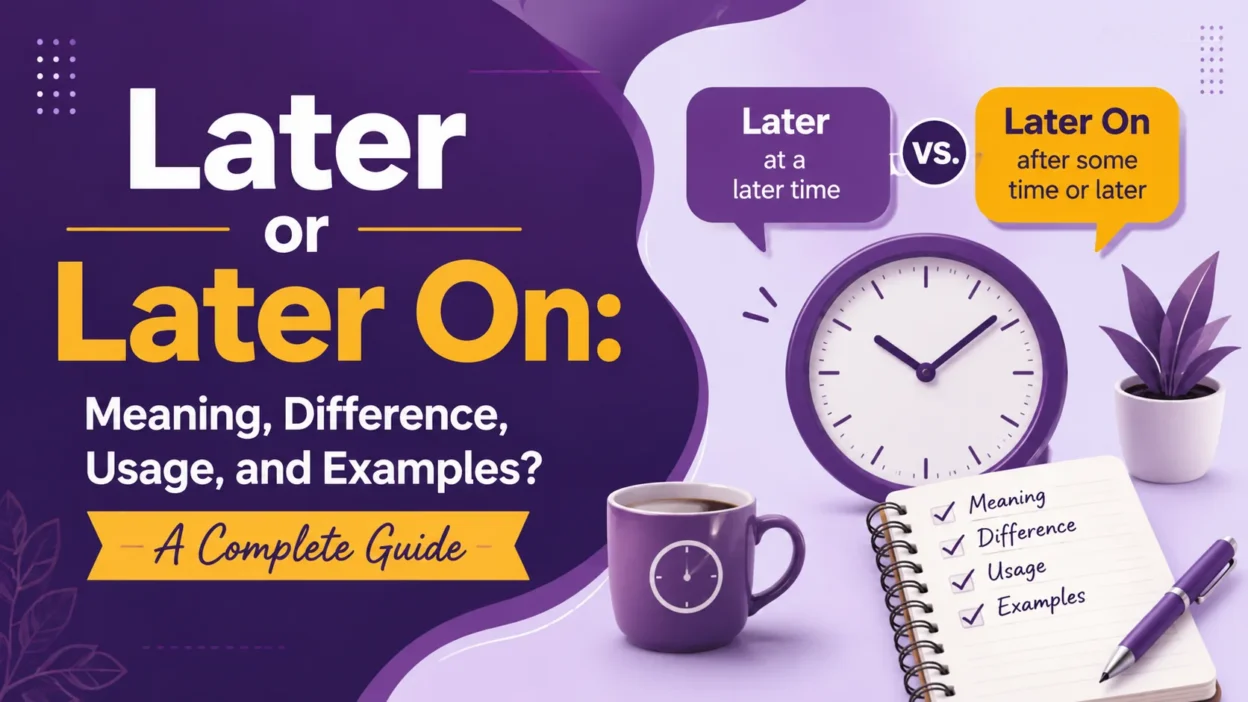
Later or Later On can confuse English learners because both expressions refer to a future time. Although their meaning is similar, the right choice often depends on the context, sentence, and situation. Understanding this small difference makes everyday English easier to use.
Later is the shorter and more direct choice for something happening after now, such as “I’ll call you later.” Later on can sound more conversational when an action happens after another event, such as “Later on, we can go for a walk after dinner.” Both forms are correct.
Learning this subtle difference helps you avoid confusion and common mistakes. When you understand how each expression works, your speaking and writing can sound more natural and confident. This simple distinction also helps you make clearer choices in everyday English.
Later or Later On: What Is the Difference?
The basic meaning of later and later on is almost identical. Both can refer to a time after the present moment or after another time already mentioned.
Compare:
I’ll call you later.
I’ll call you later on.
Both sentences mean that the speaker plans to make the call at a future time. The first version is shorter. The second can sound slightly more relaxed or can suggest a point farther along in the day or situation.
The difference is therefore usually stylistic rather than grammatical.
| Expression | Basic meaning | Common feel | Example |
| Later | At a subsequent time | Direct and concise | I’ll call you later. |
| Later on | At a subsequent time | Conversational or progressive | I’ll call you later on. |
| Later in the day | At a subsequent point during a specific period | More precise | I’ll call you later in the day. |
| Later in the process | At a subsequent stage | Specific and descriptive | We’ll review it later in the process. |
So, if you’re asking “Later or later on?”, neither is automatically wrong.
What Does “Later” Mean?
Later is an adverb that refers to a time after now or after another point in time.
For example:
- I’ll finish the report later.
- She arrived later than expected.
- We can discuss the problem later.
- He moved to Boston and later started a business.
- I’ll see you later.
The word can describe both future events and events that happened afterward.
Consider:
Emma finished college in 2020. Later, she moved to California.
Here, later means after she finished college.
It doesn’t tell us exactly when she moved. It simply establishes the order of events.
“Later” Can Refer to a Specific Period
You can also combine later with a time expression to make your meaning clearer.
Examples include:
- later today
- later tonight
- later this week
- later this month
- later in the year
- later in the afternoon
- later in the conversation
- later in the process
For example:
I’ll send you the document later today.
That’s more specific than:
I’ll send you the document later.
The second sentence leaves the timing open.
What Does “Later On” Mean?
Later on is a standard English expression that also means at a subsequent time.
For example:
I’ll explain everything later on.
We discovered the problem later on.
Later on, she became the company’s director.
We’ll deal with that issue later on.
The addition of on doesn’t turn the expression into a completely different grammatical structure. Instead, later on functions as a time expression.
According to Cambridge Dictionary, later on refers to a time in the future or to a time after something previously mentioned. Merriam-Webster gives a similar definition, describing it as a future or subsequent time.
That makes one point clear: later on is not an incorrect version of later.
Later or Later On in Everyday English
In ordinary American English, you’ll hear both forms.
However, later is especially common in short, direct statements.
See you later.
Talk to you later.
I’ll call you later.
We can figure it out later.
These expressions sound natural because they’re brief and familiar.
Now consider:
We can figure it out later on.
That’s also correct. It simply has a slightly different rhythm.
Later often feels quick and straightforward. Later on can feel more relaxed, extended, or conversational.
The difference is subtle. Native speakers generally don’t stop to analyze it every time they use one.
Later or Later On in Storytelling
Storytelling is one situation where later on can be especially useful.
Suppose you’re describing a person’s life:
James moved to New York after college. Later on, he started his own company.
The phrase helps move the story forward.
You could also write:
James moved to New York after college. Later, he started his own company.
That version is perfectly natural too.
The choice depends on the rhythm you want.
Later moves quickly.
Later on can make the timeline feel slightly more extended.
Here’s another example:
At first, Sarah didn’t understand the decision. Later on, she realized why her manager had made it.
The phrase works well because the story contains a progression:
Initial event → passage of time → realization
In this type of context, later on can feel particularly natural.
Later or Later On in Professional Writing
When writing emails, reports, business messages, or other professional content, later is often the cleaner choice.
For example:
I’ll review the proposal later.
That’s concise and professional.
You could write:
I’ll review the proposal later on.
This isn’t wrong. However, the extra word doesn’t necessarily add useful information.
If you know the specific time, an even better option may be:
I’ll review the proposal after the meeting.
That’s more precise.
Compare These Examples
Less specific:
We’ll discuss the budget later.
More specific:
We’ll discuss the budget during tomorrow’s meeting.
Progressive context:
Later on in the project, we’ll review the budget again.
The third example shows where later on becomes especially useful. It refers to a later stage of the project.
Does “On” Change the Meaning?
Sometimes the difference between later and later on is almost impossible to notice.
For example:
I’ll see you later.
I’ll see you later on.
The basic message remains the same.
However, context can give later on a slightly stronger sense of progression.
Compare:
She called me later.
with:
Later on, she called me again.
The second sentence can suggest that some time passed before the second call occurred.
Still, don’t treat this as an absolute rule. Later can also describe events far into the future.
For example:
Later in his career, he became a successful author.
The word later already handles the idea of progression perfectly well.
So, on isn’t required to express a later stage.
Later vs. Later On: When to Use Each One
A simple decision process can help.
Choose “Later” When:
- You want a short and direct expression.
- You’re referring to an unspecified future time.
- You’re making a simple promise or plan.
- You’re writing concise professional English.
- You’re using a common expression such as see you later.
- The word on doesn’t add anything useful.
Examples:
I’ll email you later.
Let’s talk later.
I’ll finish it later.
See you later.
Choose “Later On” When:
- You’re describing a sequence of events.
- You’re telling a story.
- You’re referring to a later stage in a process.
- You want a slightly more conversational rhythm.
- The context already suggests that time has progressed.
Examples:
Later on, we discovered what had happened.
She started as an assistant and later on became a manager.
Later on in the project, the team changed its strategy.
Later or Later On: Common Mistakes
Mistake 1: Thinking “Later On” Is Incorrect
This is one of the biggest misconceptions.
Later on is grammatically correct.
There’s no general grammar rule requiring you to remove on.
I’ll call you later on.
This sentence is completely acceptable.
Mistake 2: Thinking “Later On” Is Always Better
Adding extra words doesn’t automatically make writing better.
Consider:
I’ll call you later on.
versus:
I’ll call you later.
If both mean exactly the same thing in context, the shorter version may be more efficient.
Good writing isn’t about making every sentence longer. It’s about making every word useful.
Mistake 3: Using “Later On” Repeatedly
Repetition can make storytelling sound mechanical.
For example:
Later on, John went home. Later on, he ate dinner. Later on, he watched television.
The grammar is fine, but the writing lacks variety.
A better version would be:
Later, John went home. After dinner, he watched television. By midnight, he was ready for bed.
The second version gives the reader more precise timing.
Mistake 4: Confusing “Later” With “Lately”
These two words have completely different meanings.
Later means afterward or at a future time.
I’ll finish the work later.
Lately means recently.
I’ve been working late lately.
A useful memory trick is:
later = afterward
lately = recently
Later or Later On vs. “After”
Another common question involves later and after.
Although they’re related to time, they don’t always work in the same grammatical position.
For example:
I’ll call you later.
You can’t simply replace later with:
I’ll call you after.
That sentence feels incomplete because after often needs an object, clause, or additional information.
For example:
I’ll call you after work.
I’ll call you after the meeting.
I’ll call you after I get home.
So, when comparing later or later on, don’t assume that every time expression works in the same way.
Later or Later On: Real-Life Examples
Example 1: Casual Conversation
A: Are you busy tonight?
B: Not really. I’ll call you later.
This is probably the most natural choice for a short conversation.
Example 2: A Future Stage
We’re still testing the software. Later on, we’ll release the final version.
Here, later on works because the sentence describes progression from testing to release.
Example 3: A Story
At first, Michael didn’t like the new job. Later on, he realized it was exactly what he needed.
The phrase helps transition between two stages of the story.
Example 4: Professional Communication
I’ll review the document later and send you my comments.
This sounds concise and professional.
Example 5: Specific Timing
I’ll review the document after lunch.
This is even clearer because the reader knows roughly when the action will happen.
A Simple Timeline for Later or Later On
Think of time as a road:
NOW → Earlier event → Time passes → LATER → LATER ON → Much later
This isn’t a strict grammatical timeline. Instead, it’s a useful way to understand the feel of the expressions.
Later simply points to a subsequent time.
Later on can point toward a subsequent point while giving more attention to the progression of events.
For example:
We met in college. Later, we worked together.
Or:
We met in college. Later on in our careers, we worked together.
The second version gives the reader more information about the timeline.
Later or Later On: Quick Comparison
| Situation | Better choice | Example |
| Simple future plan | Later | I’ll call you later. |
| Casual farewell | Later | See you later. |
| Short professional sentence | Later | I’ll review it later. |
| Story progression | Later on | Later on, we discovered the truth. |
| Later stage of a process | Later on | Later on in the project, we’ll test it. |
| Specific timing | Neither by itself | We’ll discuss it after lunch. |
| Repeated narrative transitions | Vary wording | Later, afterward, that evening, eventually |
Conclusion
Later and later on are both correct expressions for talking about a future time or something that happens afterward. Later is usually shorter and more direct, while later on can sound more conversational or emphasize a later point. In most cases, context will help you choose the expression that sounds most natural.
FAQs
Q1. Is “later” or “later on” correct?
Both later and later on are correct. The choice depends on the sentence, context, and the meaning you want to express.
Q2. What is the main difference between “later” and “later on”?
Later is generally more direct and common. Later on can place more emphasis on a later stage, point, or event.
Q3. Can I use “later” instead of “later on”?
Yes. In many sentences, later can replace later on without changing the basic meaning.
Q4. Is “later on” more informal?
Later on can sound slightly more conversational, but it isn’t incorrect or overly informal. It’s common in everyday English.
Q5. Which is more common, “later” or “later on”?
Later is generally more common because it is shorter and works naturally in many different situations.
Q6. Can “later on” refer to a specific future event?
Yes. Later on can be useful when you’re referring to a later stage connected to another event or action.
Q7. How can I remember the difference?
Think of later as the simple, direct choice for “after now.” Use later on when you want to emphasize a later stage, moment, or event.