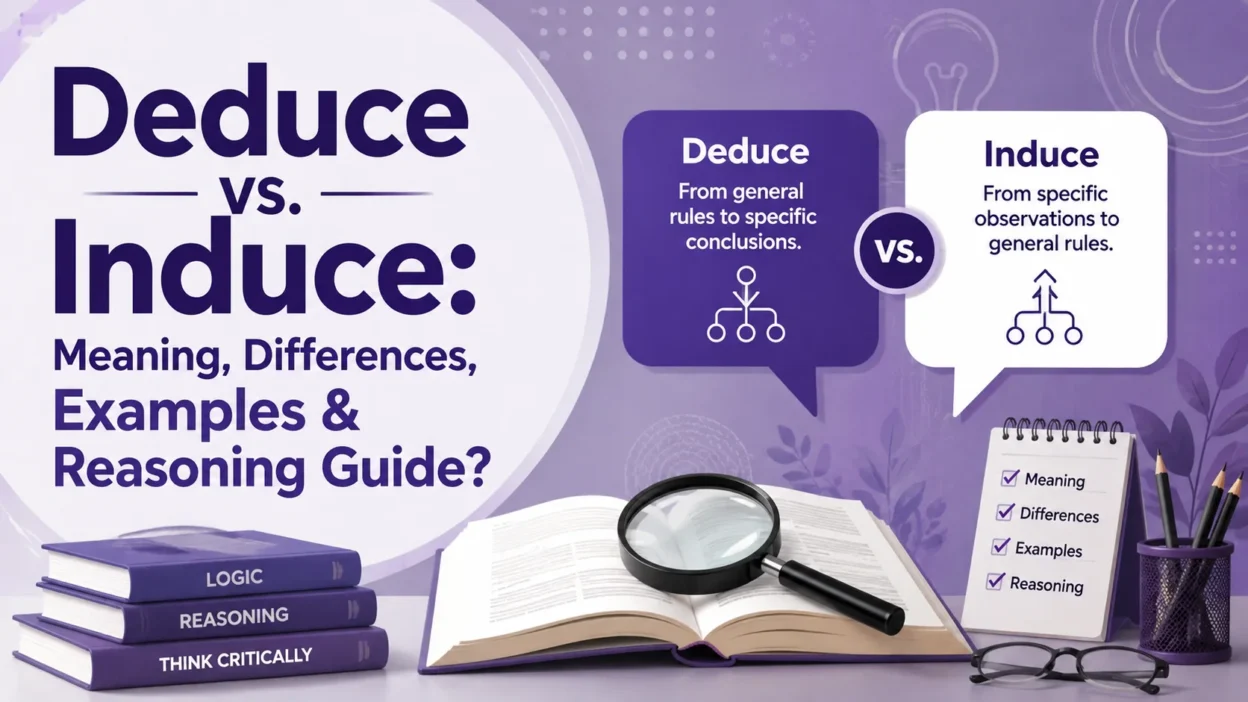
Deduce vs. Induce becomes easier when you understand the direction of reasoning. Deduction uses known facts, rules, and a general principle to reach specific conclusions, while induction starts with specific observations, evidence, and patterns to form broader generalizations. This difference appears in logical thinking, deductive reasoning, inductive reasoning, and academic reasoning.
Sherlock Holmes, the famous detective and fictional sleuth from Baker Street, provides a useful example. A detective examines a crime scene, studies clues, reviews observations, and evaluates evidence using logical inference, critical thinking, and analytical thinking. Similarly, students, writers, researchers, and professionals use these reasoning skills for problem solving, decision-making, research, and communication.
In daily life, academic writing, and professional communication, deduction moves from a general rule to a specific answer, while induction moves from individual evidence toward a broader idea. These reasoning methods improve clear thinking, structured thinking, analytical reasoning, and practical reasoning. Understanding this distinction also strengthens language learning, effective communication, and accurate language usage.
Deduce vs. Induce: The Quick Answer
The easiest way to understand deduce vs. induce is to look at the direction of reasoning.
| Word | Meaning | Direction | Type of conclusion |
| Deduce | Reach a conclusion from known facts or principles | General → Specific | Can be certain when premises are true and reasoning is valid |
| Induce | Form a general conclusion from observations | Specific → General | Usually probable |
| Infer | Reach a conclusion from evidence | Evidence → Conclusion | An interpretation or judgment |
| Conclude | Reach a final judgment | Various | A final decision or belief |
For example, suppose every employee must wear an ID badge. You know Sarah is an employee. You can deduce that Sarah must wear an ID badge.
Now imagine you observe hundreds of employees wearing ID badges. You might induce that employees generally wear ID badges.
The first example applies a general rule to a specific person. The second develops a general idea from specific observations.
A Simple Example of Deduce vs. Induce
Consider a store that closes at 9 p.m.
If the company policy says every branch closes at 9 p.m., you can deduce that a particular branch closes at 9 p.m.
If you visit several branches and notice that each one closes at 9 p.m., you might induce that the company’s branches generally close at 9 p.m.
Deduction narrows. Induction broadens.
What Does “Deduce” Mean?
Deduce means to reach a conclusion through reasoning from facts, evidence, or known principles.
For example:
From the muddy footprints, we can deduce that someone entered through the garden.
The footprints don’t directly state what happened. Instead, you use available evidence to work out a likely conclusion.
Common sentence patterns include:
- deduce that something is true
- deduce something from evidence
- deduce something based on information
Here are some natural examples:
- The detective deduced that the suspect had used the back entrance.
- We can deduce from the data that demand has increased.
- She deduced that the meeting had already started.
- The engineer deduced the problem from the unusual readings.
The word often suggests deliberate reasoning. You aren’t simply noticing something. You’re connecting information and arriving at an answer.
What Is Deductive Reasoning?
Deductive reasoning starts with a general rule, principle, or premise and applies it to a specific situation.
The basic structure is:
General rule → Specific fact → Specific conclusion
For example:
- All registered vehicles require valid license plates.
- This car is registered.
- Therefore, this car requires a valid license plate.
The conclusion follows from the premises.
In formal logic, a valid deductive argument is structured so that if its premises are true, its conclusion must also be true. The Stanford Encyclopedia of Philosophy explains this distinction between deductive validity and the probabilistic support associated with inductive reasoning.
Characteristics of Deductive Reasoning
Deductive reasoning usually:
- Starts with general information.
- Applies rules or principles to a specific case.
- Produces a focused conclusion.
- Can provide certainty when the premises are true and the argument is valid.
- Appears frequently in mathematics, formal logic, law, and structured problem-solving.
A useful formula is:
General principle + specific case = specific conclusion
For instance:
Every recalled product must be removed from store shelves.
Product A has been recalled.
Therefore, Product A must be removed.
The reasoning moves from the broad rule to the individual case.
What Does “Induce” Mean?
Induce has more than one meaning, which is why this word can be tricky.
In reasoning, induce means forming a general conclusion from particular observations. Merriam-Webster describes this logical sense as inferring from particular facts.
However, induce can also mean to cause, bring about, or persuade.
Compare these sentences:
The observations induced researchers to conduct another experiment.
Here, induced means prompted.
The medication induced sleep.
Here, it means caused sleep.
The discount induced customers to buy more products.
Here, it means encouraged or persuaded customers.
Context determines which meaning applies.
What Is Inductive Reasoning?
Inductive reasoning moves from specific observations toward a broader conclusion.
Its basic structure is:
Specific observations → Pattern → General conclusion
Imagine that a bus arrives late every day for five consecutive days. You might conclude:
This bus route tends to run late.
That’s an inductive conclusion.
The conclusion is reasonable because it comes from repeated observations. However, it isn’t guaranteed. The bus could arrive early tomorrow.
That’s the key difference between inductive and deductive reasoning. Induction supports a conclusion without necessarily proving it.
Characteristics of Inductive Reasoning
Inductive reasoning typically:
- Begins with specific examples or observations.
- Looks for recurring patterns.
- Produces broader conclusions.
- Deals with probability rather than certainty.
- Becomes stronger when evidence is plentiful and representative.
A simple formula is:
Specific observations + recurring pattern = probable general conclusion
For example:
Ten customers complained about slow checkout times.
Five more customers reported the same issue.
Therefore, checkout speed may be a broader problem.
The evidence supports the conclusion, but additional information could change it.
Deduce vs. Induce: Side-by-Side Comparison
| Feature | Deduce | Induce |
| Starting point | General rule or premises | Specific observations |
| Direction | General → Specific | Specific → General |
| Main purpose | Apply known information | Identify patterns |
| Conclusion | Can be necessary | Usually probable |
| Typical question | What follows from this rule? | What pattern do these examples suggest? |
| Common uses | Logic, mathematics, law | Science, research, prediction |
Think of deduction as zooming in.
Think of induction as zooming out.
Deduce vs. Induce in Real-Life Examples
Weather Example
A weather policy says an outdoor event is canceled when the forecast reaches a 90% chance of rain. Today’s forecast reaches 90%.
You can deduce that the event will be canceled.
Now imagine you’ve tracked local weather patterns for several months. Each time dark clouds form over a particular area, heavy rain follows.
You might induce that those clouds are a reliable sign of approaching rain.
School Example
A school rule says students who exceed a specific absence limit cannot take the final exam. Jordan has exceeded that limit.
You can deduce that Jordan isn’t eligible under that rule.
Now imagine you study several years of student data and notice that students who attend review sessions regularly tend to score higher.
You might induce that regular review attendance is associated with better grades.
Business Example
A company policy says orders placed after 5 p.m. ship the next business day. An order arrives at 6 p.m.
You can deduce that the order won’t ship that evening.
Now suppose a company studies thousands of purchases and finds that personalized recommendations are consistently associated with higher sales.
The company might induce that personalized recommendations can increase purchases.
Deduce vs. Infer vs. Conclude
These words overlap, but each emphasizes something different.
Deduce vs. Infer
Infer generally means reaching a conclusion from evidence or clues.
From her silence, I inferred that she was upset.
Deduce can emphasize a more deliberate reasoning process.
From her silence and facial expression, I deduced that she was upset.
Both can work in many situations. In everyday conversation, infer is often more natural when you simply interpret a clue.
Deduce vs. Conclude
Conclude is broader than deduce. It means reaching a final judgment or decision after considering information.
For example:
After reviewing the evidence, the committee concluded that the project needed more funding.
You could use deduce when the conclusion specifically follows from evidence or logical reasoning:
From the measurements, the engineer deduced that the structure had shifted.
Common Mistakes With Deduce and Induce
Mistake: Treating Them as Synonyms
They aren’t exact synonyms when describing reasoning.
Use deduce when moving from a general rule toward a specific conclusion.
Use induce when moving from specific observations toward a general conclusion.
Mistake: Confusing Deduce With Infer
The meanings overlap.
I inferred that he had already left.
I deduced that he had already left from the empty office and missing coat.
Both sentences are possible. The second puts more emphasis on the reasoning process.
Mistake: Assuming Induction Guarantees Truth
Inductive reasoning doesn’t guarantee a conclusion.
You may observe 1,000 white swans and conclude that all swans are white. A single black swan would disprove that universal claim.
The conclusion was supported by the evidence. It simply wasn’t certain.
Mistake: Forgetting the Other Meaning of Induce
Remember that induce can mean cause or persuade.
The medication induced sleep.
The advertisement induced customers to purchase the product.
Neither sentence describes inductive reasoning.
Deductive and Inductive Reasoning in Academic Writing
Academic arguments can use either reasoning structure.
Deductive Writing
A deductive approach often follows this pattern:
General claim → Evidence → Specific application → Conclusion
It works well when you already have a clear principle or theory that you want to apply.
Inductive Writing
An inductive approach often follows this pattern:
Evidence → Observations → Pattern → Broader conclusion
It works well when your evidence leads naturally toward a larger claim.
Neither method is automatically better. The right choice depends on your argument, evidence, research question, and field.
How Science Uses Deduction and Induction
Science relies on both forms of reasoning.
Induction helps researchers recognize patterns and develop broader explanations.
For example:
- Researchers observe repeated results.
- They identify a recurring pattern.
- They develop a possible explanation.
Deduction then helps turn that explanation into specific predictions.
A simplified scientific cycle looks like this:
Observations
↓
Patterns
↓
General hypothesis
↓
Deductive predictions
↓
Testing
↓
New observations
Neither approach works in isolation. Scientists often move back and forth between observations, general explanations, predictions, and new evidence.
Memory Trick for Deduce vs. Induce
Use this simple shortcut:
Deduce = General → Specific
Induce = Specific → General
You can also picture two arrows:
DEDUCTION
General
↓
Specific
INDUCTION
Specific
↓
General
If you’re applying a known rule to one situation, think deduce.
If you’re combining several observations into a broader idea, think induce.
Quick Reference: Deduce vs. Induce
| If you mean… | Use |
| Apply a general rule to a specific case | Deduce |
| Reach a specific conclusion through reasoning | Deduce |
| Build a generalization from observations | Induce |
| Identify a broad pattern | Induce |
| Interpret evidence or clues | Infer |
| Reach a final judgment | Conclude |
| Cause something to happen | Induce |
| Persuade someone to act | Induce |
Conclusion
Understanding deduce vs. induce becomes much easier when you remember the direction of reasoning. Deduce moves from a general rule or known facts toward a specific conclusion. Induce moves from specific observations toward a broader generalization. Both methods support logical thinking, critical reasoning, problem solving, and better decision-making. Once you understand this simple difference, you’ll find it much easier to choose the right word in everyday language, academic writing, and professional communication.
FAQs
Q1: What is the main difference between deduce and induce?
Deduce means reaching a specific conclusion from general facts, rules, or evidence. Induce means forming a broader conclusion from specific observations or examples.
Q2: Is deduce the same as infer?
Not exactly. Infer means reaching a conclusion from evidence or clues, while deduce often emphasizes reaching a conclusion through logical reasoning.
Q3: What is deductive reasoning?
Deductive reasoning moves from a general rule or principle to a specific conclusion. If the premises are true and the reasoning is valid, the conclusion necessarily follows.
Q4: What is inductive reasoning?
Inductive reasoning moves from specific observations toward a broader conclusion. Its conclusions are generally probable rather than guaranteed.
Q5: Can deduce and induce be used in everyday life?
Yes. You might deduce that someone is home after seeing their car outside. You might induce that a store is popular after seeing large crowds there repeatedly.
Q6: What is an easy way to remember deduce and induce?
Remember the direction: deduce = general to specific, while induce = specific to general.
Q7: Does induce have meanings besides reasoning?
Yes. Induce can also mean to cause, bring about, or persuade. For example, “The medicine induced sleep” means that the medicine caused sleep.