Have you ever received an email, text, or message that simply said, “Thanks for letting me know”? Maybe you’ve typed it yourself dozens of times without giving it much thought. It feels natural, polite, and professional. Still, many English learners and even native speakers wonder whether it’s actually the best phrase to use. Is it grammatically correct? Does it sound too cold? Could it come across as passive-aggressive?
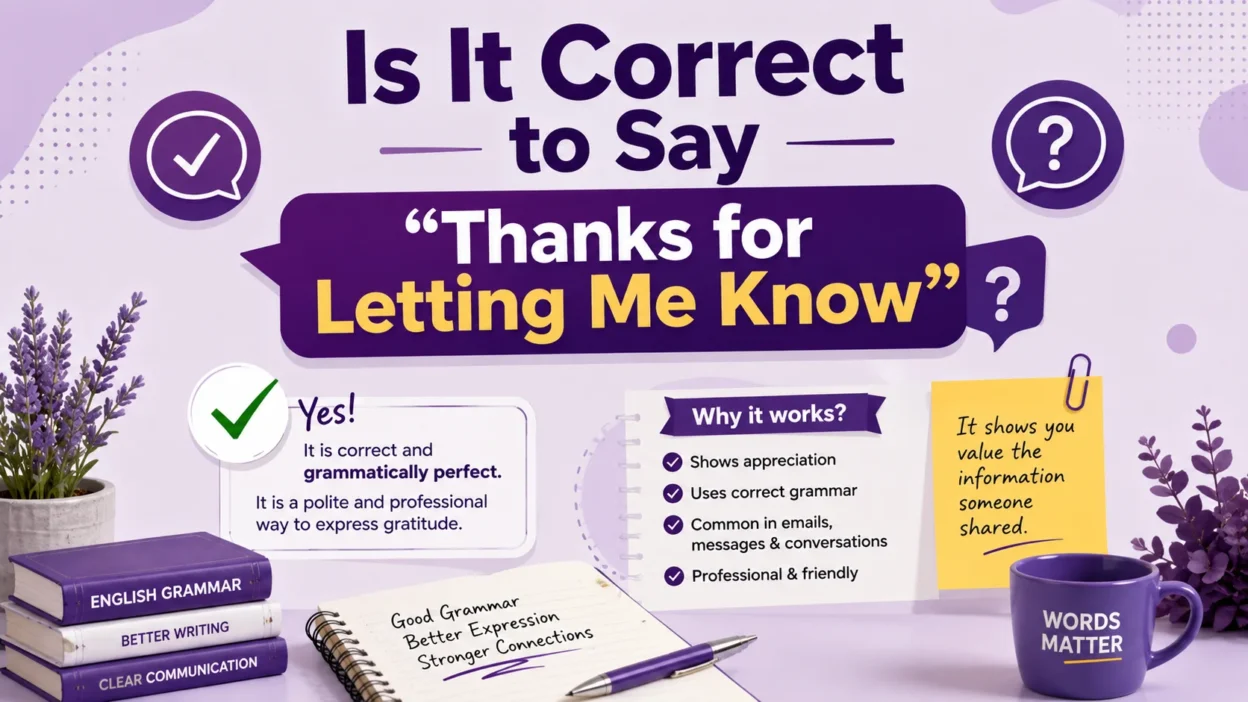
The short answer is yes. “Thanks for letting me know” is grammatically correct, widely accepted, and commonly used in both personal and professional communication. However, its tone depends on the situation, your relationship with the other person, and what you say next. A simple follow-up sentence can make the phrase sound warm and appreciative instead of brief or distant.
This guide explains the meaning, grammar, tone, and best alternatives to “Thanks for letting me know.” You’ll also learn when to use it, when to avoid it, and how to make it sound more natural in emails, text messages, workplace conversations, and everyday English.
Quick Answer: Is “Thanks for Letting Me Know” Correct?
Yes. “Thanks for letting me know” is a grammatically correct English expression. Native speakers use it every day to acknowledge that someone has shared information, provided an update, or informed them about something important.
The phrase works well because it does two things at once:
- Shows appreciation for the information.
- Acknowledges that you’ve received and understood it.
Whether someone tells you about a meeting change, reports a technical problem, or shares good or bad news, this phrase is often an appropriate response.
Here are a few common examples:
| Situation | Natural Response |
| A coworker reschedules a meeting | Thanks for letting me know. I’ll update my calendar. |
| A friend says they’ll arrive late | Thanks for letting me know. Drive safely! |
| A customer reports an issue | Thanks for letting us know. We’ll look into it right away. |
| A teacher changes an assignment deadline | Thanks for letting us know. That helps a lot. |
Although the phrase works in many situations, it’s not always the best choice. Context matters, and you’ll learn why later in this guide.
What Does “Thanks for Letting Me Know” Mean?
At its core, “Thanks for letting me know” means the following:
“I appreciate you taking the time to tell me this information.”
It doesn’t necessarily express excitement or agreement. Instead, it acknowledges that the other person made an effort to communicate with you.
Imagine someone tells you:
“The meeting has been moved to Friday.”
Replying with “Thanks for letting me know” tells them you received the update and appreciate being informed.
The Literal Meaning
Let’s break the phrase into smaller parts.
| Word or Phrase | Meaning |
| Thanks | An informal way to express gratitude |
| for | Introduces the reason for your gratitude |
| letting | The present participle of “let,” meaning “allowing” or “giving someone information” |
| me | The person receiving the information |
| know | To become aware of something |
Together, the sentence means the following:
“I appreciate that you informed me.”
Even though the wording is simple, the message feels complete and polite.
The Implied Meaning in Conversation
Language isn’t only about dictionary definitions. Every phrase carries implied meaning depending on the situation.
When someone says “Thanks for letting me know,” they usually imply one or more of the following:
- I’ve received your message.
- I understand what you told me.
- I appreciate the update.
- You did the right thing by informing me.
- I’ll take this information into account.
For example:
Employee: “The client canceled tomorrow’s meeting.”
Manager: “Thanks for letting me know.”
The manager isn’t just saying thank you. They’re also confirming they’ve received the information and will act on it if necessary.
Why This Phrase Sounds Polite
English speakers often soften conversations by adding appreciation.
Instead of saying
“I know.”
They might say:
“Thanks for letting me know.”
The second response feels friendlier because it recognizes the other person’s effort.
Notice the difference.
| Less Polite | More Polite |
| I know. | Thanks for letting me know. |
| Okay. | Thanks for the update. |
| Got it. | Thanks for letting me know. I’ll take care of it. |
A small expression of gratitude can completely change how your response feels.
Is “Thanks for Letting Me Know” Grammatically Correct?
Yes. The sentence follows standard English grammar and appears in countless business emails, customer service messages, academic settings, and everyday conversations.
Let’s examine why it works.
Grammar Breakdown of the Phrase
Here’s how each part functions.
| Part | Grammar Role |
| Thanks | Interjection expressing gratitude |
| for | Preposition |
| letting | Gerund (verb acting as a noun) |
| me | Object pronoun |
| know | Bare infinitive following let |
The verb “let” follows a unique grammatical pattern.
The structure is:
let + object + base verb
Examples include:
- Let me know.
- Let him finish.
- Let us help.
- Let them leave.
That’s why “letting me know” is correct.
You wouldn’t say:
- ❌ letting me knowing
- ❌ letting me know
- ❌ letting me knew
The base form “know” must follow “let.”
Why “Letting” Is the Correct Verb Form
Some learners ask why we say “letting” instead of “let.”
The answer is simple.
The preposition “for” is followed by a noun or a gerund.
Compare these examples:
- Thanks for helping.
- Thanks for calling.
- Thanks for coming.
- Thanks for waiting.
- Thanks for letting me know.
Using the -ing form after “for” is standard English grammar.
Common Grammar Mistakes to Avoid
Although the phrase is simple, learners often make small mistakes.
| Incorrect | Correct |
| Thanks for letting me know. | Thanks for letting me know. |
| Thanks for letting me know. | Thanks for letting me know. |
| Thanks for letting me know. | Thanks for letting me know. |
| Thanks for letting me know. | Thanks for letting me know. |
| Thanks for letting me know. | Thanks for letting me know. |
These errors usually happen because learners confuse verb patterns or omit necessary prepositions.
“Thanks” vs. “Thank You”
Both are correct, but they create slightly different impressions.
| Thanks | Thank you |
| Informal | Slightly more formal |
| Friendly | Professional |
| Common in texts | Common in emails |
| Conversational | Polite and complete |
Examples:
Text Message
Thanks for letting me know!
Business Email
Thank you for letting me know. I’ll review the information this afternoon.
Neither version is better. The right choice depends on your audience.
Is “Thanks for Letting Me Know” Formal or Informal?
One reason this phrase is so popular is its flexibility.
It comfortably fits into casual conversations, professional emails, customer service interactions, and workplace discussions.
Still, the level of formality changes depending on the version you choose.
Professional Workplace Communication
In offices, “Thanks for letting me know” strikes a nice balance between friendly and professional.
It acknowledges information without sounding overly formal.
Examples include:
- “Thanks for letting me know about the deadline.”
- “Thanks for letting me know the report has been submitted.”
- “Thanks for letting me know the client approved the proposal.”
These responses sound courteous while keeping communication efficient.
Semi-Formal Business Emails
Business emails often benefit from a little extra warmth.
Instead of ending with only:
Thanks for letting me know.
You might write:
Thank you for letting me know. I’ll review everything today and get back to you by tomorrow.
Or:
Thank you for letting me know. I appreciate the update.
Adding a follow-up sentence shows engagement and professionalism.
Casual Conversations
Among friends and family, the shorter version feels completely natural.
Examples:
Friend:
“I’m running about fifteen minutes late.”
You:
“Thanks for letting me know!”
Sibling:
“I already fed the dog.”
You:
“Thanks for letting me know.”
These responses acknowledge the information without making the conversation feel formal.
Text Messages and Online Chats
Digital communication favors brevity.
That’s one reason this phrase appears so often in messaging apps.
Examples:
- Thanks for letting me know 👍
- Thanks for the update!
- Thanks! I’ll check it out.
- Appreciate the heads-up.
In text messages, people often add an emoji or a short follow-up sentence to make the tone warmer.
Compare these replies.
| Message | Tone |
| Thanks for letting me know. | Neutral |
| Thanks for letting me know! | Friendly |
| Thanks for letting me know. 😊 | Warm |
| Thanks for letting me know. I’ll take care of it. | Professional |
| Thanks so much for letting me know! | Appreciative |
Small details like punctuation and word choice can dramatically change how your message feels.
When Should You Say “Thanks for Letting Me Know”?
This phrase works best when someone provides information that helps you, informs you, or prevents confusion.
In other words, they took the time to tell you something useful, and you want to acknowledge their effort.
Someone Shares New Information
People appreciate knowing their message was received.
Examples include:
- A coworker updates the project timeline.
- A teacher changes the class schedule.
- A neighbor tells you about a community event.
- A family member shares travel plans.
Instead of replying with a simple “Okay,” saying “Thanks for letting me know” adds warmth without making the conversation longer.
Someone Reports a Problem
Whether it’s a software bug, a broken appliance, or a missed delivery, acknowledging the report builds trust.
For example:
Customer: “The package arrived damaged.”
Support Agent: “Thanks for letting me know. We’ll arrange a replacement immediately.”
The phrase reassures the customer that their concern has been heard.
Someone Corrects Your Mistake
Nobody enjoys being corrected, but responding graciously leaves a positive impression.
Example:
Coworker: “The meeting starts at 2:00, not 3:00.”
You: “Thanks for letting me know. I’ll update my calendar.”
Rather than becoming defensive, you acknowledge the correction and move forward professionally.
Someone Updates Plans or Schedules
Plans change all the time.
Using this phrase shows flexibility and appreciation.
Examples include:
- Flight delays
- Appointment changes
- Meeting rescheduling
- Event cancellations
- Deadline extensions
A thoughtful response helps keep communication positive.
Someone Gives Helpful Feedback
Constructive feedback deserves acknowledgment, even if you don’t completely agree.
For example:
“Thanks for letting me know. I’ll review your suggestions and make the necessary changes.”
This response demonstrates maturity, professionalism, and openness to improvement.
When You Should Avoid Saying “Thanks for Letting Me Know”
Although “Thanks for letting me know” is polite and grammatically correct, it isn’t the perfect response for every situation. Sometimes the phrase feels too brief, too neutral, or even emotionally distant. The key is understanding the context before you hit send.
If someone shares deeply personal news, reports a serious problem, or expresses strong emotions, acknowledging the information isn’t enough. They often expect empathy, reassurance, or a clear plan of action.
Let’s look at situations where a different response works better.
Serious or Emotional Situations
Imagine a coworker sends this message:
“I won’t be at work today because my father was admitted to the hospital.”
Replying with only:
Thanks for letting me know.
is technically polite, but it lacks compassion.
A warmer response would be
- Thank you for letting me know. I’m sorry to hear that. I hope everything goes well.
- I appreciate the update. Please take all the time you need.
- I’m sorry your family is going through this. Let us know if we can help.
In emotional conversations, people remember how you made them feel—not just what you said.
Customer Complaints That Need Empathy
Customer service relies on trust.
When a customer reports a frustrating experience, your response should recognize both the information and the customer’s feelings.
Instead of writing:
Thanks for letting us know.
Consider:
- Thank you for bringing this to our attention. We’re sorry this happened, and we’re already working on a solution.
- We appreciate you letting us know about the issue. We’ll make this right.
- Thank you for your patience while we investigate the problem.
Adding empathy builds confidence and strengthens customer relationships.
Delivering Bad News
Suppose a client emails:
“Unfortunately, we decided to move forward with another vendor.”
A reply that says only:
Thanks for letting me know.
can sound abrupt.
A stronger response might be
Thank you for letting me know. I appreciate the opportunity to work with your team, and I hope we can collaborate in the future.
This leaves the conversation on a positive, professional note.
Sensitive Workplace Conversations
Managers often discuss topics like performance reviews, layoffs, salary adjustments, or personal concerns.
These conversations require emotional intelligence.
For example:
Employee:
“I’m feeling overwhelmed by my workload.”
A manager shouldn’t respond with the following:
Thanks for letting me know.
A better reply is
Thank you for telling me. Let’s discuss how we can reduce the workload and support you moving forward.
Notice how the response acknowledges the concern and offers action.
Can “Thanks for Letting Me Know” Sound Rude or Passive-Aggressive?
One of the most common questions people ask is whether “Thanks for letting me know” sounds passive-aggressive.
The answer is sometimes—but not because of the phrase itself.
Tone depends on three things:
- Context
- Relationship
- Follow-up
The words alone are neutral. Your delivery determines how they’re interpreted.
How Tone Changes Meaning
Written communication doesn’t include facial expressions or vocal cues.
Because readers can’t hear your voice, they often fill in the emotional gaps themselves.
Compare these examples.
Example 1
Thanks for letting me know!
This feels friendly.
Example 2
Thanks for letting me know.
Neutral.
Example 3
Thanks for letting me know.
After someone apologizes for making a costly mistake, the same sentence may feel cold because nothing follows it.
The missing context changes the emotional impact.
Situations Where It Sounds Genuine
The phrase usually sounds sincere when someone shares routine information.
Examples include:
- Meeting updates
- Schedule changes
- Delivery notifications
- Weather alerts
- Appointment reminders
- Travel updates
These conversations don’t require emotional support.
Situations Where It Can Feel Dismissive
The phrase may sound cold when someone expects empathy.
For example:
Friend:
“I lost my job today.”
Reply:
Thanks for letting me know.
Most people would find this response disappointing because it ignores the emotional weight of the situation.
A better reply would be:
I’m really sorry to hear that. Thank you for telling me. If you need anything, I’m here.
The difference is empathy.
How Punctuation and Follow-Up Change the Tone
Small writing choices create big differences.
| Response | Tone |
| Thanks for letting me know. | Neutral |
| Thanks for letting me know! | Friendly |
| Thanks so much for letting me know! | Warm and appreciative |
| Thanks for letting me know. I’ll take care of it. | Professional |
| Thank you for letting me know. I appreciate the update. | Polite and formal |
| Thank you for letting me know. I’m sorry you’re dealing with this. | Empathetic |
Adding one thoughtful sentence often transforms an average reply into an excellent one.
Tone Comparison Table
The table below shows how the same phrase works in different situations.
| Situation | “Thanks for letting me know.” | Better Choice |
| Team meeting update | ✅ Excellent | Thanks for letting me know. I’ll update my notes. |
| Appointment change | ✅ Excellent | Thanks for the update. I’ll be there. |
| Friend running late | ✅ Natural | Thanks for letting me know. Drive safely! |
| Customer complaint | ⚠️ Too brief | Thank you for bringing this to our attention. We’ll fix it. |
| Family emergency | ❌ Too cold | I’m so sorry to hear that. Thank you for telling me. |
| Employee stress | ⚠️ Needs empathy | Thank you for sharing this. Let’s work through it together. |
| Bad news from a client | ⚠️ Add professionalism | Thank you for letting me know. I appreciate your honesty. |
A simple rule works well:
Routine updates need acknowledgment. Emotional updates need acknowledgment plus empathy.
Better Alternatives to “Thanks for Letting Me Know”
Repeating the same phrase in every email or conversation can make your communication sound robotic.
Fortunately, English offers many natural alternatives.
Professional Alternatives
These work well in business emails and workplace communication.
- Thank you for the update.
- I appreciate you keeping me informed.
- Thank you for bringing this to my attention.
- Thank you for informing me.
- I appreciate the information.
- Thank you for the notification.
- Thanks for the update.
- I appreciate your message.
Example:
Thank you for bringing this to my attention. I’ll review it this afternoon.
Friendly Alternatives
Friends usually prefer warmer language.
Try these expressions:
- Good to know!
- Thanks for the heads-up!
- Appreciate the update!
- Got it. Thanks!
- Thanks for the info!
- Thanks for telling me!
- That’s helpful—thanks!
Example:
Thanks for the heads-up! I’ll leave a little later.
Warm and Appreciative Alternatives
These responses show genuine gratitude.
- Thanks so much for letting me know.
- I really appreciate you telling me.
- Thanks for keeping me updated.
- I appreciate you taking the time to tell me.
- Thank you for thinking of me.
These phrases strengthen personal and professional relationships.
Empathetic Alternatives
Sometimes people need support more than acknowledgment.
Better responses include:
- I’m sorry you’re going through this. Thank you for telling me.
- I appreciate you sharing that with me.
- Thank you for being honest.
- I’m glad you let me know.
- Thank you for trusting me with this information.
These responses feel much more human.
Action-Oriented Alternatives
Showing what you’ll do next builds confidence.
Examples include:
- Thanks for letting me know. I’ll handle it right away.
- I appreciate the update. I’ll investigate this immediately.
- Thanks for the information. I’ll follow up with the team.
- I’ll take care of it. Thanks for letting me know.
- I’ll make the necessary changes today.
People appreciate knowing that their message led to action.
Formal Email Alternatives
If you’re writing to executives, clients, or external partners, these expressions sound polished.
- Thank you for your email.
- Thank you for informing me.
- I appreciate your prompt update.
- Thank you for keeping me informed.
- Many thanks for your message.
- Your update is greatly appreciated.
Choose the level of formality that matches your relationship with the recipient.
“Thanks for Letting Me Know” vs. Similar Expressions
Many English phrases communicate appreciation, but each has a slightly different purpose.
Understanding these differences helps you sound more natural.
“Thanks for the update.”
Use this when someone shares progress on an ongoing task.
Example
Thanks for the update. Please keep me posted.
This phrase emphasizes ongoing communication rather than a single piece of information.
“I Appreciate the Update.”
This version sounds slightly more formal.
It’s common in business emails and client communication.
Example:
I appreciate the update. We’ll review everything before tomorrow’s meeting.
“Thanks for informing me.”
This phrase is grammatically correct but less conversational.
It appears more often in formal writing than in everyday speech.
“Thanks for the heads-up.”
A heads-up is an advance warning.
Example:
Thanks for the heads-up about the road closure.
This phrase is casual and friendly.
“Good to Know”
This expression acknowledges information without expressing much gratitude.
Example:
Good to know. I’ll keep that in mind.
It’s suitable for informal conversations but may sound too casual in business settings.
“I Appreciate You Telling Me.”
This alternative feels more personal because it focuses on the person rather than the information.
Example:
I appreciate you telling me. That couldn’t have been easy.
It’s an excellent choice when someone shares difficult news.
Comparison Table
| Expression | Formality | Best Used For |
| Thanks for letting me know | Neutral | General communication |
| Thank you for letting me know | Formal | Business emails |
| Thanks for the update | Neutral | Progress reports |
| Thanks for the heads-up | Casual | Advance warnings |
| Good to know | Informal | Casual conversations |
| I appreciate you telling me | Warm | Personal conversations |
| Thank you for bringing this to my attention | Professional | Problems or concerns |
| Thank you for informing me | Formal | Official communication |
Choosing the right phrase isn’t about memorizing rules. It’s about matching your response to the situation. When your tone fits the context, your communication feels natural, respectful, and authentic.
Real-Life Examples of “Thanks for Letting Me Know”
Understanding grammar is one thing. Knowing how native speakers actually use a phrase is another. Below are realistic examples that show how “Thanks for letting me know” fits naturally into everyday conversations.
Workplace Email Example
A colleague informs you that tomorrow’s meeting has been moved.
Hi Sarah,
The client requested that tomorrow’s meeting be moved to 3:00 PM instead of 10:00 AM.
Thanks,
Daniel
Reply
Hi Daniel,
Thanks for letting me know. I’ve updated my calendar and will be ready for the meeting at 3:00 PM.
Best,
Sarah
This response is professional, acknowledges the update, and confirms the next step.
Customer Service Response
Customer
My package arrived with a damaged box.
Support Agent
Thank you for letting us know. We’re sorry your order didn’t arrive in perfect condition. We’ll arrange a replacement immediately and send you a confirmation email shortly.
Notice that the reply combines acknowledgment, empathy, and action.
Teacher and Student Conversation
Student
I won’t be able to attend class tomorrow because of a doctor’s appointment.
Teacher
Thanks for letting me know. I hope everything goes well. I’ll email today’s notes after class.
The teacher acknowledges the message while showing concern.
Friends Making Plans
Friend
I’m stuck in traffic. I’ll probably be twenty minutes late.
You
Thanks for letting me know! No worries. I’ll grab us a table while I wait.
The response feels relaxed and supportive.
Family Conversation
Sibling
I already picked up groceries on my way home.
You
Thanks for letting me know. That saves me a trip to the store.
Adding a follow-up sentence makes the conversation feel warmer.
Text Message Examples
Here are a few natural text responses.
Message
The concert starts at 8 instead of 7.
Reply
Thanks for letting me know! I’ll leave a little later.
Message
I finished your book.
Reply
Awesome! Thanks for letting me know.
Message
The restaurant is closed today.
Reply
Thanks for the heads-up! Let’s pick another place.
Email Examples You Can Copy
If you write emails often, you’ll probably use this phrase regularly. These templates help you sound professional without being repetitive.
Responding to a Schedule Change
Hi Emily,
Thank you for letting me know about the revised meeting time. I’ve updated my calendar and will join the meeting at 2:00 PM.
Looking forward to speaking with everyone.
Best regards,
Replying to Project Updates
Hi Mark,
Thanks for the update. I appreciate you keeping me informed. I’ll review the latest changes this afternoon and share my feedback before the deadline.
Thanks again.
Responding to an Employee Notification
Thank you for letting me know you’ll be taking personal leave tomorrow. I appreciate the advance notice. Please let me know if you need any assistance before you’re away.
Replying to Client Feedback
Thank you for bringing this to our attention. We appreciate your feedback and are already reviewing the issue. We’ll provide another update as soon as possible.
These examples show that adding one or two extra sentences creates a more complete and professional response.
How to Make “Thanks for Letting Me Know” Sound More Natural
The phrase works well on its own, but small improvements make it sound warmer, more personal, and more engaging.
Add Appreciation
Instead of writing only:
Thanks for letting me know.
Try:
- Thanks so much for letting me know.
- I really appreciate you letting me know.
- Thank you for taking the time to let me know.
These versions emphasize gratitude.
Add Empathy
When someone shares difficult news, acknowledge their feelings.
Examples:
- I’m sorry to hear that. Thank you for letting me know.
- That must have been frustrating. I appreciate you telling me.
- I’m glad you reached out. Thanks for letting me know.
Empathy strengthens communication.
Add Your Next Step
People appreciate knowing what happens next.
Examples:
- Thanks for letting me know. I’ll investigate the issue today.
- Thank you for the update. I’ll make the necessary changes.
- Thanks for letting me know. I’ll keep everyone informed.
This reassures the other person that their message had an impact.
Combine Acknowledgment with Action
A simple formula works in almost every situation.
Acknowledgment + Appreciation + Action
For example:
Thanks for letting me know. I appreciate the update, and I’ll review everything before tomorrow’s meeting.
This approach sounds thoughtful, professional, and complete.
Common Mistakes Native and English Learners Make
Even native speakers occasionally misuse this expression. Avoiding these mistakes will make your communication more natural.
Using It Without Responding Further
Sometimes the phrase feels unfinished.
Instead of stopping here:
Thanks for letting me know.
Continue with:
Thanks for letting me know. I’ll handle it this afternoon.
Adding context improves clarity.
Sounding Robotic
Repeating the exact phrase in every email becomes noticeable.
Mix in alternatives such as the following:
- Thank you for the update.
- I appreciate you keeping me informed.
- Thanks for bringing this to my attention.
- Thanks for the heads-up.
Variety keeps your writing fresh.
Choosing the Wrong Level of Formality
A casual phrase may not suit an executive or an important client.
Compare these examples.
Too Casual
Thanks!
Better
Thank you for letting me know. I appreciate the update.
Always match your tone to your audience.
Overusing the Phrase
Like any expression, “Thanks for letting me know” loses impact when you use it repeatedly.
Consider this sequence in an email thread:
- Thanks for letting me know.
- Thanks for letting me know.
- Thanks for letting me know.
It quickly becomes repetitive.
Switch between different acknowledgments to keep your writing engaging.
Why Native English Speakers Use This Phrase So Often
If you pay attention to emails, online chats, and workplace conversations, you’ll notice this expression everywhere.
There are good reasons for its popularity.
It Acknowledges Information Quickly
People want to know their message has been received.
A short acknowledgment prevents confusion and confirms that communication was successful.
It Shows Courtesy
Adding a simple thank you creates a more positive interaction.
Compare these replies.
Reply A
Okay.
Reply B
Thanks for letting me know.
Most people perceive the second response as friendlier.
It Fits Almost Every Situation
Whether you’re talking with:
- coworkers,
- clients,
- teachers,
- friends,
- neighbors,
- family members,
The phrase usually works well.
That’s why it has become one of the most common acknowledgment expressions in modern English.
Conclusion
“Thanks for letting me know” is a correct, natural, and widely accepted English expression that works well in both personal and professional communication. It shows gratitude, acknowledges that you’ve received important information, and helps conversations move forward politely. Whether you’re replying to an email, a text message, or a workplace update, this phrase creates a positive impression while confirming your understanding.
The key to using this expression effectively is matching it to the situation. For routine updates, it works perfectly on its own. For emotional or sensitive conversations, adding empathy or explaining your next step makes your response feel warmer and more thoughtful. By understanding the meaning, grammar, tone, and best alternatives, you can use “Thanks for letting me know” with confidence in everyday English.
FAQs
Q1. Is “Thanks for letting me know” grammatically correct?
Yes. It is a grammatically correct English phrase that expresses appreciation while acknowledging that someone has shared information. Native speakers commonly use it in both spoken and written communication.
Q2. Can I use “Thanks for letting me know” in professional emails?
Yes. It is appropriate for business emails, workplace conversations, and client communication. For a more formal tone, you can use “Thank you for letting me know” and add a follow-up sentence.
Q3. Does “Thanks for letting me know” ever sound rude?
The phrase itself is not rude. However, it may sound cold in emotional situations if you don’t add empathy or a supportive response. Context and tone always matter.
Q4. What are some alternatives to “Thanks for letting me know”?
Good alternatives include “Thank you for the update,” “I appreciate you keeping me informed.” “Thanks for the heads-up.” “Thank you for bringing this to my attention,” and “I appreciate you telling me.”
Q5. When should I avoid saying “Thanks for letting me know”?
Avoid using it by itself when someone shares bad news, personal struggles, or sensitive information. In those situations, combine it with empathy, encouragement, or an offer to help so your response feels more caring and genuine.