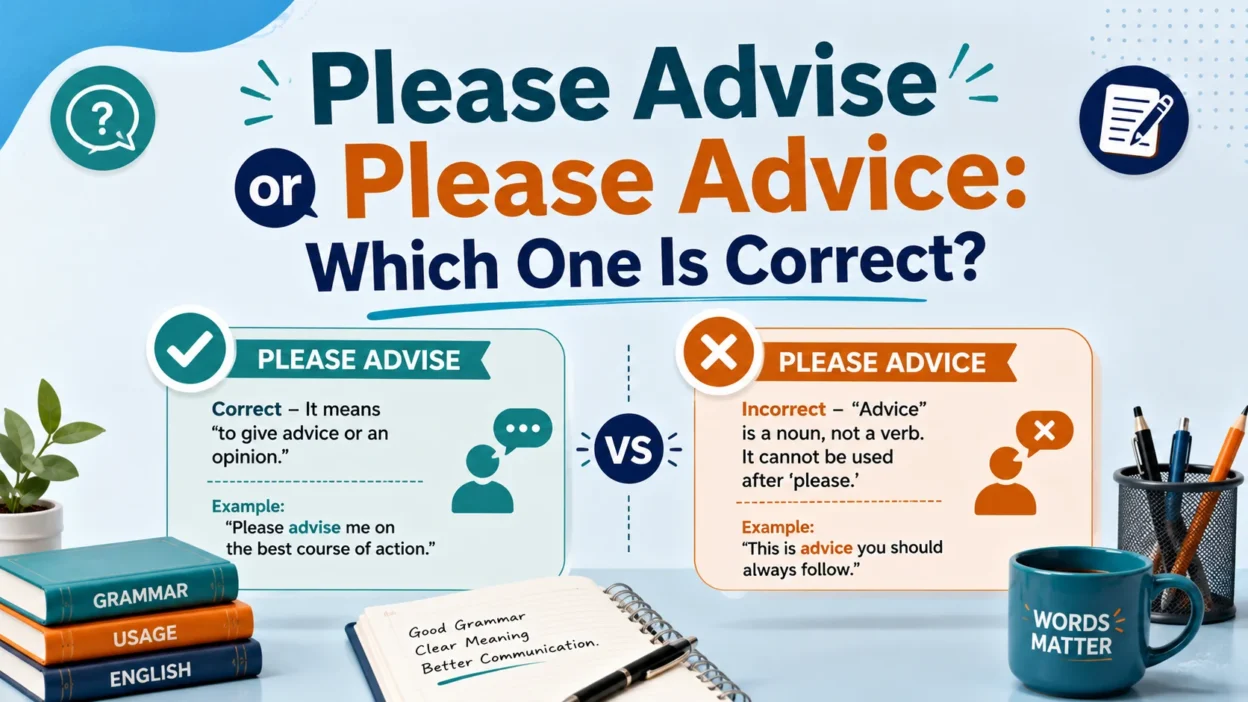
Please Advise or Please Advice becomes easier to understand when you know basic English grammar. While reviewing professional emails, business emails, formal letters, and customer service messages, many English learners, experienced speakers, professionals, and native speakers pause before sending an important email. Advise is a verb and an action word, while advice is a noun. This grammar rule, function, difference, and clear distinction help you choose the correct phrase, improve clarity, strengthen communication, and avoid common grammar mistakes, incorrect writing, and confusing writing in American English, British English, for UK audiences, and US audiences.
A simple tip is to pause before sending every email. Read the sentence again, check the phrases, terms, and words, and decide whether you need an action or a recommendation. This habit improves email writing, clear writing, polished writing, and professional writing. It also creates a polished email, clearer messages, stronger professional communication, business communication, workplace communication, better communication skills, professional tone, professionalism, reader clarity, and greater confidence.
The grammar question continues because the spellings look alike, but their meaning, usage, and pronunciation differences are not the same. Learning the right grammar, using suitable alternatives, and remembering each letter make the process easy, then easier. With regular practice, writers produce better workplace messages, formal business notes, modern work chats, and real-world communication without constantly rereading at the desk, even during late night work..
Quick Answer
The correct phrase is “Please advise.”
The phrase “Please advice” is grammatically incorrect because advice is a noun, not a verb. After the word please, English requires a verb when you’re making a polite request.
The Correct Phrase
Use please advise whenever you’re asking someone to provide guidance, instructions, clarification, or a decision.
Correct examples:
- Please advise whether the meeting is still scheduled.
- Please advise on the next steps.
- Please advise if additional documents are required.
- Please advise when payment will be processed.
These examples sound natural because advise describes an action.
One-Sentence Grammar Explanation
Advise = verb (an action)
Advice = noun (a suggestion or recommendation)
That single grammar rule answers almost every question about this phrase.
Quick Examples of Right and Wrong Usage
| Correct | Incorrect |
| Please advise. | Please advice. |
| Can you advise me? | Can you advice me? |
| She advised us yesterday. | She adviced us yesterday. |
| Thank you for your advice. | Thank you for your advise. |
A simple way to check your sentence is to ask yourself whether you’re asking someone to do something or referring to a suggestion. If someone needs to act, you need the verb advise.
What Is the Difference Between “Advise” and “Advice”?
Although these words differ by only one letter, they serve completely different purposes in English grammar.
| Word | Part of Speech | Meaning | Example |
| Advise | Verb | To recommend or guide someone | Please advise me. |
| Advice | Noun | A recommendation or opinion | Thank you for your advice. |
Learning this distinction will improve both your writing and your speaking.
“Advise” Is a Verb (Action Word)
A verb expresses an action. When you advise someone, you give them recommendations or guidance.
Examples include:
- The lawyer advised the client before signing the contract.
- The teacher advised students to review their notes.
- Our manager advised us to finish the report early.
- Please advise us on the best solution.
Notice that each sentence describes an action someone performs.
“Advice” Is a Noun (Thing or Suggestion)
A noun names a person, place, thing, or idea. Advice refers to the recommendation itself.
Examples include:
- Your advice helped me solve the problem.
- She always gives practical advice.
- I appreciate your honest advice.
- His financial advice saved the company money.
In these examples, advice is something you receive rather than something you do.
Side-by-Side Comparison Table
| Feature | Advise | Advice |
| Part of speech | Verb | Noun |
| Function | Gives guidance | The guidance itself |
| Can follow “please” | Yes | No |
| Can be plural | No | No (normally uncountable) |
| Used in commands | Yes | No |
Common Sentence Patterns
These patterns make the difference easy to remember.
Advise
- Advise someone
- Advise someone to do something
- Advise against something
- Advise on something
Examples:
- Please advise me.
- They advised us to wait.
- Doctors advise against smoking.
- She advised on the project.
Advice
- Give advice
- Ask for advice
- Follow advice
- Ignore advice
Examples:
- He gave useful advice.
- I’m asking for your advice.
- She followed my advice.
- Don’t ignore expert advice.
Why “Please Advise” Is Grammatically Correct
The phrase please advise follows a standard English sentence pattern known as the imperative.
Imperative sentences give instructions, requests, or directions.
Examples include:
- Please sit down.
- Please respond.
- Please confirm.
- Please review.
- Please advise.
Every one of these sentences begins with please followed immediately by a verb.
How Imperative Sentences Work
The subject you is understood rather than written.
Instead of saying:
You please advise.
English naturally shortens it to:
Please advise.
That makes the sentence both polite and efficient.
Why a Verb Must Follow “Please”
The word please softens a request, but it doesn’t change the grammar.
After please, English still expects an action.
For example:
| Correct | Incorrect |
| Please review the document. | Please reviewer the document. |
| Please respond soon. | Please response soon. |
| Please approve the request. | Please approval the request. |
| Please advise. | Please advice. |
In each incorrect example, a noun replaces the required verb.
Grammar Formula With Examples
A useful formula is:
Please + Verb + Object (optional)
Examples:
- Please advise.
- Please advise us.
- Please advise the customer.
- Please advise whether approval is required.
- Please advise on the revised proposal.
Whenever you follow this pattern, your sentence will sound natural.
Why “Please Advice” Is Incorrect
Despite appearing in emails every day, please advice remains grammatically incorrect.
The mistake happens because advice cannot perform the action required in the sentence.
Why a Noun Cannot Replace the Main Verb
Imagine writing:
- Please information me.
- Please decision.
- Please recommendation.
These sentences immediately sound wrong because English doesn’t allow nouns to replace verbs in commands.
The same rule applies to advice.
The Grammar Rule Behind the Error
The word advice names the recommendation itself.
It cannot describe the act of giving recommendations.
Compare the difference:
Correct
- Please advise us.
- Thank you for your advice.
Incorrect
- Please advice us.
- Thank you for your advise.
Each word has only one grammatical role.
Correct Ways to Use “Advice” Instead
If you want to use the noun advice, rewrite your sentence.
Examples include:
- I need your advice.
- Could you give me some advice?
- Thank you for the advice.
- Your advice was extremely helpful.
Notice that another verb such as need, give, or appreciate performs the action.
Why So Many People Confuse “Advise” and “Advice”
This mistake appears everywhere, from workplace emails to university assignments.
There are several reasons why people mix the two words.
Nearly Identical Spelling
Only one letter changes.
- Advise
- Advice
When writing quickly, it’s easy to choose the wrong ending.
Pronunciation Differences Are Subtle
Many learners don’t clearly hear the final sounds during conversation.
As a result, they assume the words are interchangeable.
Later in this guide, you’ll learn a simple pronunciation trick that makes the distinction much easier.
Native and Non-Native English Learners
Even native speakers occasionally mistype these words because English contains many similar-looking word pairs.
For English learners, the challenge becomes even greater because many languages don’t distinguish nouns and verbs using slight spelling changes.
Autocorrect and Typing Habits
Autocorrect isn’t perfect.
If you often mistype one version, your keyboard may continue suggesting the incorrect spelling. Fast typing also increases the chance of swapping the final letters without noticing.
A quick proofread before sending an email usually catches the mistake.
Pronunciation Guide: “Advise” and “Advice”
Although the spellings are similar, the endings sound different.
Understanding the pronunciation helps you remember the spelling.
IPA Pronunciation
| Word | IPA | Final Sound |
| Advise | /ədˈvaɪz/ | Z sound |
| Advice | /ədˈvaɪs/ | S sound |
The final consonant makes all the difference.
Final Sound Comparison
Say these words aloud:
- Advize
- Advise
The verb ends with a buzzing /z/ sound.
The noun ends with a softer /s/ sound.
Simple Speaking Tip to Remember
Think of the verb as having more energy because it represents an action.
That stronger /z/ sound can remind you that advise is the verb.
It’s a small trick, but many learners find it surprisingly effective.
What Does “Please Advise” Actually Mean?
The phrase please advise asks another person to provide information, guidance, instructions, or a decision.
The exact meaning depends on the situation.
Literal Meaning
Literally, it means:
“Please tell me what I should do.”
or
“Please provide your recommendation.”
It’s a polite request for direction.
Meaning in Business Emails
In professional communication, please advise often means one of the following:
- Please confirm.
- Please clarify.
- Please provide instructions.
- Please tell me the next step.
- Please let me know your decision.
For example:
The shipment has arrived at the warehouse. Please advise whether we should release it today.
The sender wants instructions before taking action.
Meaning in Customer Support
Customer service teams frequently use the phrase when requesting additional information.
Example:
We’ve reviewed your request. Please advise whether the replacement or refund is your preferred option.
Here, the company asks the customer to make a choice.
Meaning in Legal and Formal Communication
Law firms, government agencies, insurance companies, and financial institutions often use please advise because it is concise and precise.
For example:
Please advise whether you accept the proposed settlement.
In these settings, the phrase sounds professional rather than abrupt.
Is “Please Advise” Polite or Rude?
Some people believe please advise sounds cold.
Others consider it standard business English.
The truth depends on context, tone, and your relationship with the reader.
Why Tone Depends on Context
The phrase itself is neutral.
However, a very short email containing only:
Please advise.
may sound abrupt.
Adding context makes the request feel more courteous.
For example:
We’ve completed the report and addressed the requested revisions. Please advise if any additional changes are needed.
The extra information creates a friendlier tone.
When It Sounds Professional
Please advise works well when:
- You’re communicating with colleagues.
- You’re requesting approval.
- You’re asking for technical guidance.
- You’re waiting for management decisions.
- You’re documenting business communication.
In these situations, the phrase saves time without sacrificing professionalism.
When It Sounds Too Direct
It may feel overly formal when writing to:
- New customers
- Casual coworkers
- Friends
- Students
- Community members
A warmer alternative often improves the conversation.
How to Make It More Polite
Instead of writing only:
Please advise.
Try one of these:
- Please advise when you have a moment.
- Please let me know your thoughts.
- I’d appreciate your guidance on this matter.
- Could you please confirm the next steps?
- Whenever convenient, please advise how you’d like us to proceed.
Adding a few thoughtful words makes your request sound more collaborative while keeping the message professional.
Is “Please Advise” Still Appropriate in Modern Business Writing?
Yes. Please advise remains widely used in business communication, especially in industries where concise and direct language is valued. You’ll often see it in legal correspondence, finance, logistics, healthcare, information technology, and project management.
That said, workplace writing has become more conversational over the past decade. Many organizations now encourage employees to write emails that sound warm and approachable without losing professionalism.
Current Workplace Usage
Today, please advise is most appropriate when you need:
- A decision before moving forward
- Instructions for the next step
- Clarification on a policy or process
- Approval from a manager or client
- A formal written response
Because the phrase is brief and precise, it helps avoid unnecessary back-and-forth emails.
Email Etiquette Trends
Modern email etiquette favors clear requests over overly formal language. While please advise is still acceptable, many professionals now choose alternatives that sound more collaborative, especially when communicating with clients or new contacts.
For example, instead of writing:
Please advise.
You might write:
Could you let me know how you’d like to proceed?
Both sentences ask for guidance, but the second feels more conversational.
When Modern Alternatives Work Better
Consider using a different phrase when:
- You’re writing to a first-time customer.
- You want to sound especially friendly.
- The email discusses a sensitive issue.
- You’re building a long-term business relationship.
- You need to encourage a detailed response.
Choosing the right wording depends on your audience rather than a strict grammar rule.
Best Alternatives to “Please Advise”
Although please advise is correct, it isn’t always the best choice. Using different expressions can make your writing sound warmer, clearer, or more specific.
Formal Alternatives
These work well in legal, corporate, or government communication.
- Please provide your guidance.
- Kindly advise.
- Please confirm.
- Please provide your recommendation.
- Please indicate how you wish to proceed.
Professional Alternatives
These fit most workplace emails.
- Please let me know your thoughts.
- Could you confirm the next steps?
- I’d appreciate your guidance.
- Please share your recommendations.
- Please let me know if you have any concerns.
Friendly Alternatives
Use these when writing to coworkers or long-term clients.
- What do you think?
- Let me know what works best.
- I’d love your input.
- Could you help me with this?
- Let me know how you’d like to move forward.
Customer Service Alternatives
These phrases sound helpful and customer-focused.
- Please let us know your preferred option.
- We’d appreciate your feedback.
- Please tell us how you’d like to proceed.
- Let us know if you need further assistance.
- Please confirm your preference.
Alternatives for Internal Team Communication
When collaborating with colleagues, these expressions often sound more natural than please advise.
- Can you take a look?
- What are your recommendations?
- Do you agree with this approach?
- Should we move forward?
- Please confirm before we continue.
These alternatives keep your emails clear while matching the tone of today’s workplace communication.
Comparison Table: “Please Advise” or Alternative Phrases
Choosing the right expression depends on your audience, the level of formality, and the action you expect from the reader.
| Phrase | Formality | Best Used For | Tone |
| Please advise | High | Requesting instructions or decisions | Professional |
| Please let me know | Medium | General business emails | Friendly |
| Could you confirm? | Medium | Confirming information | Polite |
| I’d appreciate your guidance. | High | Seeking expert advice | Respectful |
| Please share your thoughts. | Medium | Collaboration | Conversational |
| How would you like to proceed? | High | Decision-making | Professional |
| Could you clarify? | Medium | Asking for more information | Neutral |
| Please provide your recommendation. | High | Formal reports and proposals | Formal |
The best choice is the one that clearly communicates your request while matching the relationship you have with the reader.
Real Email Examples
Seeing the phrase in context makes the grammar much easier to remember.
Requesting Approval
Subject: Budget Approval
Hi Sarah,
I’ve attached the revised budget proposal with all requested changes. Please advise whether I can submit it to the finance department.
Thank you.
Asking for Instructions
Hi Michael,
The supplier has confirmed delivery for Friday. Please advise if we should proceed with the shipment or postpone it until next week.
Best regards,
Following Up on a Pending Issue
Hello Team,
We’re still waiting for the client’s approval before launching the campaign. Please advise if there are any updates from today’s meeting.
Thanks.
Responding to a Client
Dear Mr. Johnson,
We’ve completed our review of your request. Please advise which option you’d prefer so we can move forward immediately.
Kind regards,
Internal Team Communication
Hi Everyone,
The testing phase has finished successfully. Please advise if you’d like us to begin deployment this afternoon.
Thanks.
Examples of “Advise” in Sentences
Reading complete sentences helps reinforce the correct grammar pattern.
Professional Examples
- The consultant advised the company to reduce unnecessary expenses.
- Our attorney advised us before signing the agreement.
- Please advise the accounting department of the changes.
- Managers often advise employees during performance reviews.
Everyday Examples
- My parents advised me to save money.
- Doctors advise drinking plenty of water.
- Teachers advise students to practice every day.
- Friends often advise each other during difficult times.
Academic Examples
- Researchers advise collecting additional data before reaching conclusions.
- The professor advised students to verify every source.
- Academic advisors advise freshmen during course registration.
Examples of “Advice” in Sentences
Unlike advise, advice refers to the recommendation itself.
Workplace Examples
- Thank you for your valuable advice.
- Her advice improved the entire project.
- We appreciate your professional advice.
Daily Conversation Examples
- That’s excellent advice.
- I need your advice about buying a car.
- His advice always makes sense.
Common Expressions With “Advice”
You’ll often see advice in phrases such as:
- Ask for advice
- Give advice
- Follow advice
- Ignore advice
- Sound advice
- Professional advice
- Financial advice
- Legal advice
- Career advice
These combinations appear frequently in both spoken and written English.
Conclusion
Choosing between Please Advise or Please Advice is simple once you know the grammar rule. Advise is a verb, so it describes an action, while advice is a noun, so it refers to a suggestion or recommendation. Using the correct form makes your emails, business messages, and professional writing look more polished, clear, and credible. Before sending any message, take a moment to proofread. That small habit can improve your communication and help you avoid one of the most common English grammar mistakes.
FAQs
Q1. Is Please Advice ever correct?
No. Please Advice is not grammatically correct. Since advice is a noun, it cannot be used after please in a request. The correct phrase is Please Advise.
Q2. Why do people confuse Please Advise and Please Advice?
The words have almost the same spelling and similar pronunciation. Many writers, especially English learners, mistakenly use advice instead of advise because they look alike.
Q3. What does Please Advise mean?
Please Advise means please give guidance, please let me know, or please tell me what to do next. It is commonly used in business and professional emails.
Q4. Is Please Advise too formal?
Not usually. It is still widely accepted in professional communication. However, if you want a friendlier tone, you can use alternatives like Please let me know, Could you confirm?, or I’d appreciate your guidance.
Q5. How can I remember the difference between “advise” and “advice”?
Remember this simple trick: advise is a verb (an action), while advice is a noun (a suggestion). If you’re asking someone to do something, use advise. If you’re talking about the recommendation itself, use advice.