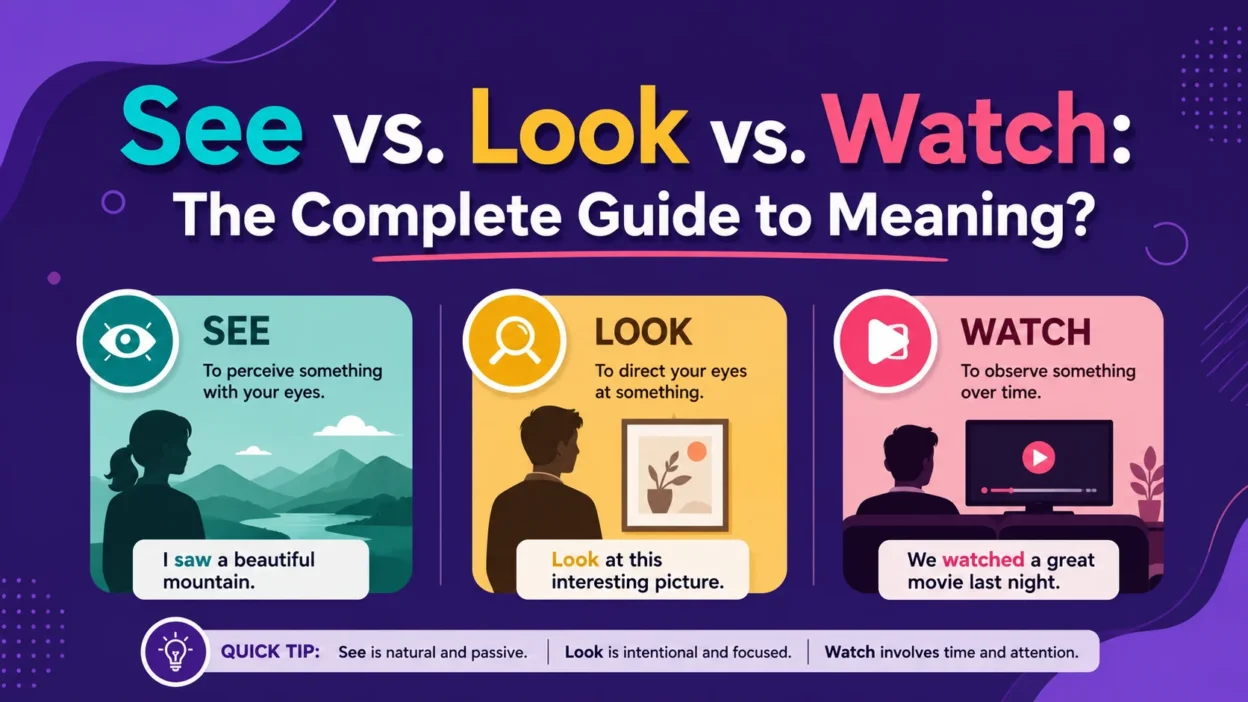
Learning “See” vs. “Look” vs. “Watch” helps English learners improve English, communication, and correct usage. These three verbs relate to using your eyes, vision, visual perception, and sight, but they have different meanings. See means to notice or become aware of someone or something naturally. Look means to direct your gaze and focus attention with intention, while Watch means to observe over time with attention, especially during a movie, TV show, activity, or event.
Many learners trip up because the English language and LanguageResources often lack enough context, examples, and clear grammar rules. A helpful guide explains sentence structure, verb usage, and correct grammar using watched, looked, and saw in real situations. With regular practice, you can correctly use these verbs, avoid incorrect usage, make the correct choice, and reduce common mistakes and other biggest challenges.
As you learn, discover, and master these verbs, you’ll improve English, grow your vocabulary, and build stronger English skills. Paying close attention to every sentence, meaning, and nuance improves understanding, awareness, and comprehension. Helpful memory tricks, idioms, and useful information make it easier to remember when to See, Look, or Watch in every situation.
The Short Answer: See vs. Look vs. Watch
If you only remember one thing, remember this:
- See means you notice something with your eyes without making a special effort.
- Look means you intentionally direct your eyes toward something.
- Watch means you keep your eyes on something that moves or changes over time.
Here’s a quick comparison.
| Verb | Meaning | Requires Intention? | Usually Involves Movement? | Example |
| See | Notice something with your eyes | No | No | I see a bird outside. |
| Look | Direct your eyes toward something | Yes | Usually no | Look at the painting. |
| Watch | Observe something for a period of time | Yes | Usually yes | We watched the football game. |
A Simple Example
Imagine you’re walking through a park.
- You see a butterfly because it suddenly flies past you.
- You look at the butterfly because it catches your attention.
- You watch the butterfly as it lands on flowers and flies around for several minutes.
The event changes, but the butterfly doesn’t. Your action does.
What Does “See” Mean?
See describes natural or automatic vision. You notice something because it enters your field of view, not because you deliberately searched for it.
Unlike look, see doesn’t usually require effort. Your eyes simply recognize what’s there.
Definition of “See”
See means to become aware of something through your eyes.
It often happens naturally.
Examples
- I see clouds in the sky.
- She saw a deer near the road.
- We can see mountains from our hotel.
- Did you see that shooting star?
In every example, nobody intentionally searched for the object first. They simply noticed it.
When to Use “See”
You should use see in several common situations.
When You Notice Something Naturally
Sometimes things simply appear before your eyes.
Examples:
- I saw a rainbow after the rain.
- We saw dolphins during the boat trip.
- She saw smoke coming from the building.
- I can see your car from here.
When You Recognize Someone
Recognition also uses see.
Examples:
- I saw Sarah at the grocery store.
- Have you seen my teacher today?
- We saw our neighbors yesterday.
When “See” Means Understand
English often uses see to express understanding.
Examples:
- I see your point.
- Now I see why you were upset.
- Do you see what I mean?
- I finally see the problem.
In these sentences, nobody is using their eyes literally. Instead, see means understand.
When Talking About Meeting Someone
Native speakers frequently use see when referring to meeting people.
Examples:
- I’m seeing my dentist tomorrow.
- We saw our grandparents last weekend.
- She’ll see her manager this afternoon.
Common Examples of “See”
Here are examples from everyday life.
| Situation | Example Sentence |
| Nature | I saw an eagle flying overhead. |
| School | Did you see today’s homework? |
| Office | I saw your email this morning. |
| Travel | We saw the Statue of Liberty. |
| Shopping | I saw a great deal online. |
| Family | I haven’t seen my cousin for months. |
Notice that each sentence focuses on noticing rather than intentionally observing.
Common Expressions with “See”
Many everyday expressions use see.
| Expression | Meaning | Example |
| See you later | Goodbye | See you tomorrow! |
| I see | I understand | I see what you’re saying. |
| See for yourself | Check personally | Don’t believe me. See for yourself. |
| See the point | Understand the reason | I finally see the point. |
| See what happens | Wait for the outcome | Let’s see what happens. |
These expressions appear constantly in spoken American English.
Quick Tip
Ask yourself:
Did I notice it naturally?
If the answer is yes, see is probably the correct choice.
What Does “Look” Mean?
Unlike see, look requires choice.
You decide where to point your eyes. That simple decision changes the verb.
Definition of “Look”
Look means to direct your eyes toward something intentionally.
Think of it as an action.
Examples:
- Look at this picture.
- Please look outside.
- Look over here.
- Look carefully before crossing.
Each sentence involves a deliberate action.
Why “Look” Usually Needs “At”
One of the most common grammar mistakes is forgetting at.
Correct:
- Look at me.
- Look at the screen.
- Look at the stars.
Incorrect:
- Look me.
- Look the stars.
- Look the picture.
The verb look usually needs the preposition at when you mention the object.
Formula
Look + at + object
Examples:
- Look at the map.
- Look at your notes.
- Look at that beautiful sunset.
When “Look” Doesn’t Need “At”
Sometimes look appears without at.
Examples:
- Look!
- Look over there!
- Look inside.
- Look ahead.
- Look around.
In these cases, the direction replaces the object.
When to Use “Look”
Giving Instructions
Teachers, parents, and managers often use look when giving directions.
Examples:
- Look at the board.
- Look at question five.
- Look at the chart.
- Look at your notes before the test.
Searching for Something
When you’re trying to find something, use look for.
Examples:
- I’m looking for my keys.
- She’s looking for a new apartment.
- They looked for the missing dog.
Notice the difference between:
- Look at
- Look for
They have completely different meanings.
Examining Details
Sometimes you need to inspect something closely.
Examples:
- Look at the label.
- Look at the instructions.
- Look at the damage carefully.
- Look at the numbers again.
Common Examples of “Look”
| Situation | Example |
| Classroom | Look at page twenty. |
| Office | Look at the report again. |
| Home | Look at this old photo. |
| Travel | Look at the beautiful beach. |
| Shopping | Look at the price tag first. |
Popular Phrasal Verbs with “Look”
English contains dozens of useful phrasal verbs with look.
| Phrase | Meaning | Example |
| Look after | Take care of | She looks after her younger brother. |
| Look for | Search | I’m looking for my wallet. |
| Look into | Investigate | Police will look into the matter. |
| Look like | Resemble | You look like your father. |
| Look forward to | Feel excited about | I look forward to vacation. |
| Look over | Review | Please look over my essay. |
| Look up | Search for information | Look up the word in the dictionary. |
| Look around | Explore | We looked around the museum. |
These expressions appear frequently in business English and everyday conversation.
A Helpful Analogy
Imagine using a flashlight.
Your eyes work like the flashlight.
When you point it somewhere on purpose, you’re looking.
Without choosing where to point it, you’re simply seeing.
What Does “Watch” Mean?
While look lasts only a moment, watch usually continues for a longer period.
That’s the biggest clue.
Definition of “Watch”
Watch means to observe someone or something carefully over time, especially if it moves, changes, or performs an action.
Movement often plays an important role.
Examples:
- We watched the movie.
- She watched the children.
- I watched the fireworks.
- They watched the football game.
Each activity lasts more than a few seconds.
When to Use “Watch”
Movies and Television
Examples:
- We watched Netflix all evening.
- I watched a documentary.
- They watched the news.
- She watches cooking shows every weekend.
Sports
Examples:
- We watched the basketball game.
- He watched the Olympics.
- They watched the race together.
Children
Parents frequently use watch.
Examples:
- Watch the baby while I’m cooking.
- Can you watch the kids this afternoon?
Here, watch means supervise.
Animals
Examples:
- We watched dolphins swimming.
- They watched birds build a nest.
- She watched the puppy play.
Traffic
Examples:
- Watch the road.
- Watch for cyclists.
- Watch the traffic before turning.
Safety often requires continuous attention.
Common Examples of “Watch”
| Situation | Example |
| Entertainment | We watched a comedy. |
| Sports | They watched baseball all afternoon. |
| Home | Watch the oven carefully. |
| School | Students watched the science experiment. |
| Office | Managers watched the presentation. |
| Nature | We watched the sunset together. |
Common Expressions with “Watch”
| Expression | Meaning | Example |
| Watch out | Be careful | Watch out for ice. |
| Watch over | Protect | Nurses watch over patients. |
| Watch closely | Pay careful attention | Watch closely as I demonstrate. |
| Watch your step | Walk carefully | Watch your step on the stairs. |
| Watch your mouth | Speak respectfully | Watch your mouth around children. |
| Keep watching | Continue observing | Keep watching until the end. |
These phrases appear naturally in American English conversations.
A Real-Life Example
Think about sitting in a movie theater.
You don’t simply look at the movie.
You watch it because you’re paying attention for two hours.
Likewise, you watch a soccer match, a TV series, fireworks, or a child playing in the yard because each activity unfolds over time.
The Biggest Difference Between See, Look, and Watch
Although these verbs all involve vision, each describes a different kind of action.
The easiest way to remember them is by thinking about intention, attention, and duration.
- See happens automatically.
- Look requires a conscious decision.
- Watch requires continuous attention.
Here’s a simple way to visualize the relationship.
Something appears.
│
▼
SEE
(Noticed naturally)
│
Choose to focus.
▼
LOOK
(Intentional action)
│
Keep observing.
▼
WATCH
(Continuous attention)
Side-by-Side Comparison
| Feature | See | Look | Watch |
| Main idea | Notice | Focus | Observe |
| Intentional | No | Yes | Yes |
| Time involved | Instant | Short | Longer |
| Requires movement | No | Usually no | Usually yes |
| Common objects | Birds, people, buildings | Photos, maps, signs | Movies, games, children |
| Grammar pattern | See + object | Look at + object | Watch + object |
| Typical purpose | Notice | Examine | Follow an activity |
| Example | I saw a deer. | Look at the deer. | Watch the deer run. |
A Mini Case Study
Imagine you’re visiting a zoo for the first time.
- As you walk in, you see an elephant because it’s standing in front of you.
- You look at the elephant to admire its size and features.
- Then you watch the elephant spray water, eat, and interact with other elephants for several minutes.
The animal hasn’t changed. Your level of attention has.
That simple progression captures the difference between see, look, and watch better than any grammar rule.
Grammar Rules for See vs. Look vs. Watch
Even if you understand the meanings of see, look, and watch, using the correct grammar is just as important. Each verb follows a different sentence pattern. Learning these patterns will help you sound more natural in both spoken and written English.
See + Object
The verb see usually takes a direct object. It does not require a preposition before the object.
Structure:
See + object
Examples:
- I saw a beautiful rainbow.
- We can see the mountains from our hotel.
- She saw her friend at the airport.
- Did you see the email I sent?
You can also use see with another verb to describe something you witnessed.
Examples:
- I saw him leave the office.
- They saw the bird fly away.
- We saw the children playing in the park.
Look + At + Object
Unlike see, the verb look usually needs the preposition at before the object.
Structure:
Look + at + object
Examples:
- Look at the picture.
- Please look at your notes.
- Everyone looked at the fireworks.
- Look at that beautiful sunset.
Without at, the sentence is generally incorrect.
❌ Look the picture.
✅ Look at the picture.
Watch + Object
The verb watch also takes a direct object, but it never uses at.
Structure:
Watch + object
Examples:
- We watched the football game.
- She watched the children play.
- I watched a documentary last night.
- They watched the sunset together.
Remember this simple rule:
- See + object
- Look + at + object
- Watch + object
Can You Say “Watch At”?
No. Watch at is not grammatically correct in modern English.
Correct examples include:
- Watch TV.
- Watch the movie.
- Watch the traffic.
- Watch the presentation.
Incorrect examples include:
- ❌ Watch at TV.
- ❌ Watch at the game.
- ❌ Watch at the movie.
Why Does “Look” Need “At”?
Think of look as pointing your eyes toward something. The preposition at connects your action to the object you’re focusing on.
For example:
- Look at the menu.
- Look at the clock.
- Look at this report.
This pattern is one of the easiest grammar rules to remember because it appears in everyday conversation.
Common Mistakes with See, Look, and Watch
Many English learners mix up these verbs because they have similar meanings. However, using the wrong one can make your sentence sound unnatural.
Mistake 1: Using “Look” Instead of “Watch”
❌ I looked TV last night.
✅ I watched TV last night.
Television, movies, sports, and performances happen over time, so watch is the correct choice.
Mistake 2: Using “Watch” for Pictures
❌ Watch this painting.
✅ Look at this painting.
A painting doesn’t move, so you look at it instead of watching it.
Mistake 3: Forgetting “At”
❌ Look me.
✅ Look at me.
❌ Look the board.
✅ Look at the board.
The missing preposition is one of the most common grammar mistakes.
Mistake 4: Using “Watch” Instead of “See”
❌ I watched my teacher in the supermarket.
✅ I saw my teacher in the supermarket.
If you simply noticed someone, use see.
Quick Comparison Table
| Situation | Correct Verb | Example |
| Notice naturally | See | I saw a rainbow. |
| Focus your eyes | Look | Look at the sign. |
| Observe over time | Watch | We watched the game. |
| Read a chart | Look | Look at the graph. |
| View a movie | Watch | We watched a comedy. |
| Spot a friend | See | I saw Emma downtown. |
Real-Life Examples of See, Look, and Watch
Learning grammar is easier when you see how native speakers use these verbs in everyday situations.
At Home
Family conversations often include all three verbs.
Examples
- I watched a movie after dinner.
- Look at this old family photo.
- I saw a spider in the garage.
- We watched our puppy play in the backyard.
At School
Teachers frequently use look, while students often use see and watch.
Examples
- Look at question three.
- We watched a science experiment.
- I saw my teacher in the hallway.
- Everyone looked at the projector.
At Work
Business communication also follows these rules.
Examples
- Please look at the report before the meeting.
- I saw your email this morning.
- We watched the product demonstration.
- The team watched the presentation carefully.
While Traveling
Travel creates many opportunities to use these verbs correctly.
Examples
- We saw dolphins during the cruise.
- Look at those snow-covered mountains.
- We watched the sunset from the beach.
- I saw an eagle flying above the lake.
During Sports
Sporting events almost always use watch.
Examples
- We watched the baseball game.
- Everyone watched the final match.
- Look at that incredible goal.
- I saw my favorite player after the game.
While Driving
Driving requires all three verbs.
Examples
- Watch the road.
- Look at the traffic light.
- I saw a deer near the highway.
- Watch for cyclists when turning.
Common Idioms Using See
English contains many idioms that use see. These expressions often have meanings beyond literal vision.
See Eye to Eye
Meaning: To agree with someone.
Example:
- We finally see eye to eye on the project.
See the Light
Meaning: To finally understand something.
Example:
- After reading the report, she saw the light.
See Red
Meaning: To become extremely angry.
Example:
- He saw red when he heard the accusation.
See for Yourself
Meaning: Verify something personally.
Example:
- Don’t just believe me. Go see for yourself.
Common Idioms Using Look
Look on the Bright Side
Meaning: Stay optimistic.
Example:
- Look on the bright side. Tomorrow is another chance.
Look Before You Leap
Meaning: Think carefully before acting.
Example:
- Investing without research isn’t wise. Always look before you leap.
Look Someone in the Eye
Meaning: Speak honestly and confidently.
Example:
- She looked the interviewer in the eye during the interview.
Look the Other Way
Meaning: Ignore something intentionally.
Example:
- The guard looked the other way.
Common Idioms Using Watch
Watch Your Step
Meaning: Be careful while walking.
Example:
- Watch your step on the wet floor.
Watch Your Mouth
Meaning: Speak respectfully.
Example:
- Watch your mouth around your grandparents.
Watch Your Back
Meaning: Stay alert because danger may exist.
Example:
- Always watch your back when traveling alone.
Watch This Space
Meaning: More information will come soon.
Example:
- Our company has exciting news. Watch this space.
See vs. Look vs. Watch in American English
American English follows the same grammar rules, but some expressions are more common than others.
Native speakers frequently say:
- Watch TV
- Watch Netflix
- Watch YouTube
- Look at your phone
- See a doctor
- See a movie
- See you later
One interesting exception is see a movie.
When Americans say “Let’s see a movie,” they mean go to the movie theater. However, once the movie starts, they watch it.
Both expressions are correct because they describe different actions.
An Easy Memory Trick
A simple memory trick can help you remember these verbs forever.
| Verb | Think Of |
| See | Notice |
| Look | Focus |
| Watch | Follow |
Imagine you’re walking through a park.
- First, you see a squirrel.
- Then, you look at the squirrel.
- Finally, you watch the squirrel climb a tree.
That sequence matches real life and makes the difference easy to remember.
Practice Quiz: Can You Choose the Correct Verb?
Choose the best answer.
- I ______ a rainbow after the rain.
- A. looked
- B. watched
- C. saw
- Please ______ the whiteboard.
- A. watch
- B. look at
- C. see
- We ______ the championship game together.
- A. watched
- B. looked
- C. saw at
- Did you ______ my text message?
- A. watch
- B. see
- C. look
- Everyone ______ the fireworks.
- A. watched
- B. looked
- C. saw at
Answer Key
- C
- B
- A
- B
- A
Conclusion
Choosing between See, Look, and Watch becomes much easier once you understand how each verb works. See is about noticing something naturally, Look means directing your eyes on purpose, and Watch means observing something over time. These small differences improve your English grammar, word choice, and everyday communication. With regular practice and real-life examples, you’ll quickly know which verb fits each situation and use them with confidence.
FAQs
Q1. What is the difference between “see,” “look,” and “watch”?
See means to notice something without trying, Look means to direct your eyes toward something intentionally, and Watch means to observe something carefully over a period of time, especially if it is moving or changing.
Q2. Is it correct to say “Look TV”?
No. The correct phrase is “Watch TV.” You watch television because you follow the action over time.
Q3. When should I use Look at instead of See?
Use Look at when you intentionally focus your eyes on something. Use See when you simply notice something without making a conscious effort.
Q4. Why do we say Watch a movie but Look at a picture?
A movie has continuous action, so you watch it. A picture is still, so you look at it to examine the details.
Q5. How can I easily remember See, Look, and Watch?
A simple trick is:
- See = Notice
- Look = Focus
- Watch = Observe over time
This memory rule helps you choose the correct verb in everyday English.