Knowing when to use “Deactivate or Inactivate” helps you choose the right term for every context, making your writing clearer, more accurate, and more professional. Although the words look interchangeable, their meaning, context, usage, definition, distinction, and terminology are different. A good guide helps newcomers, learners, students, and experienced professionals choose the right term with confidence. Whether you’re writing an article, research paper, scientific paper, lab report, or documentation, understanding these key differences leads to better professional communication.
The main difference depends on the field. In science, biology, biotechnology, and chemistry, researchers inactivate a virus, disease, or biological process by reducing activity or making it non-functional. In technical fields, people deactivate a device, system, app, alarm, or application by turning off, shutting off, or stopping its functionality. Knowing the scientific context, technical context, and biological context helps you make the right choice every time.
Poor semantics, phrasing, andturning itg ofteshutting it confusion, miscommunication, mistakes, and errors. Experienced writers and speakers think about the subject, language, vocabulary, everyday English, practical applications, and real-world situations before selecting the best expression. Once you understand the comparison between Deactivate and Inactivate, finding the better choice becomes much easier and your writing sounds clearer, more natural, and more accurate.
Quick Answer: Deactivate or Inactivate
Here’s the simplest way to remember the difference:
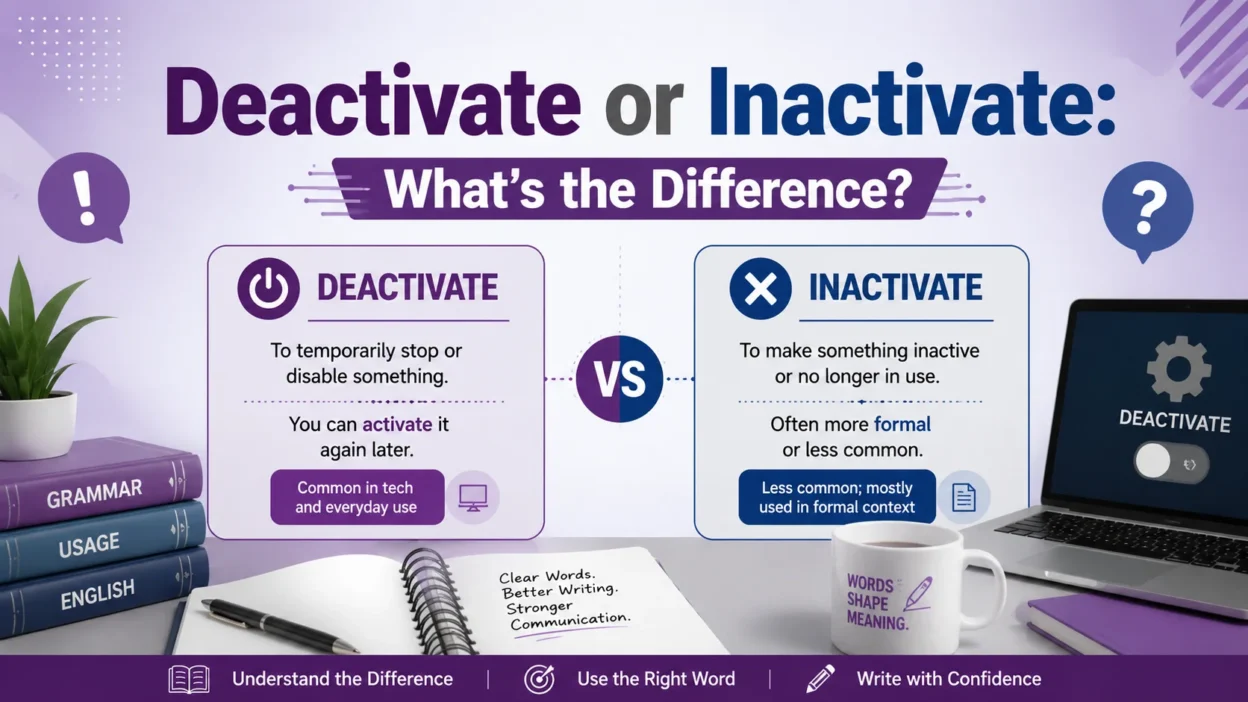
- Deactivate means to intentionally turn off, disable, or suspend something.
- Inactivate means to make something biologeasier,, chemically, or functionally inactive.
Use “deactivate” when talking about:
- User accounts
- Mobile apps
- Credit cards
- Devices
- Software
- Security systems
- Online subscriptions
Use “inactivate” when discussing:
- Viruses
- Bacteria
- Enzymes
- Cells
- Proteins
- Vaccines
- Laboratory samples
Easy rule: You usually deactivate technology, but you inactivate biological or chemical materials.
Deactivate or Inactivate: At a Glance
The table below highlights the main differences.
| Feature | Deactivate | Inactivate |
| Primary meaning | Turn off or disable | Make inactive or ineffective |
| Common context | Everyday English | Scientific English |
| Technology | ✔ Very common | Rare |
| Business | ✔ Common | Rare |
| Banking | ✔ Common | Rare |
| Medicine | Rare | ✔ Common |
| Biology | Rare | ✔ Very common |
| Chemistry | Rare | ✔ Common |
| Can it usually be reversed? | Often | Sometimes |
| Common users | General public | Scientists and researchers |
Quick Comparison
| Situation | Correct Word |
| Facebook account | Deactivate |
| Debit card | Deactivate |
| Employee login | Deactivate |
| Virus | Inactivate |
| Enzyme | Inactivate |
| Harmful bacteria | Inactivate |
What Does “Deactivate” Mean?
The word “deactivate” means to intentionally stop something from operating without permanently removing it. In most cases, the object still exists and can be activated again later.
You’ll see this word almost everywhere in modern life. Banks, software companies, social media platforms, mobile apps, and businesses use “deactivate” because it clearly describes temporarily disabling a feature or service.
Simple Definition
“Deactivate” means:
To switch off, disable, suspend, or stop something from functioning while leaving it available for future use.
Unlike delete, deactivation usually preserves the underlying data or settings.
How Deactivation Works
When something is deactivated:
- It stops working.
- It remains available.
- You can usually reactivate it.
- Existing data often stays intact.
For example, when you deactivate an online account, your profile normally remains stored. You simply lose access until you activate it again.
Common Situations Where “Deactivate” Is Used
Technology
Technology is the most common area where you’ll find this word.
Examples include:
- Deactivate an application
- Deactivate Bluetooth
- Deactivate GPS
- Deactivate notifications
- Deactivate Wi-Fi
Example:
Please deactivate location services before selling your phone.
Social Media
Many social media platforms let users deactivate an account instead of deleting it.
Examples:
- Deactivate a Facebook account
- Deactivate an Instagram profile
- Deactivate a LinkedIn account
Example:
She deactivated her account for two weeks to take a break from social media.
Business
Companies deactivate employee accounts when workers leave or change departments.
Examples include:
- Deactivate email access
- Deactivate employee credentials
- Deactivate user permissions
This helps protect sensitive information while preserving company records.
Banking and Finance
Financial institutions regularly deactivate payment methods for security reasons.
Examples:
- Deactivate a debit card
- Deactivate a credit card
- Deactivate online banking access
Example:
The bank immediately deactivated the stolen card to prevent fraudulent transactions.
Consumer Electronics
Modern devices include dozens of features that users can activate or deactivate.
Common examples include:
- Voice assistant
- NFC payments
- Face recognition
- Automatic updates
- Wireless connectivity
Instead of removing these features, users simply deactivate them when they aren’t needed.
Real-Life Examples
Here are several natural sentences using deactivate.
- Please deactivate your old account before creating a new one.
- Our IT department deactivated the employee’s login credentials.
- The airline deactivated online check-in after departure.
- The customer requested that the bank deactivate the lost credit card.
- You can deactivate push notifications at any time.
Notice that every example involves something controlled by people or software.
What Does “Inactivate” Mean?
Unlike “deactivate,” the verb “inactivate” is mostly used in science and medicine. It means to make something lose its activity, effectiveness, or biological function.
Scientists don’t “turn off” viruses the way you turn off a phone. Instead, they use heat, chemicals, radiation, or other methods to make those organisms unable to perform their normal functions.
Simple Definition
“Inactivate” means:
To make something inactive by preventing it from carrying out its normal biological, chemical, or physical function.
This change may be temporary or permanent depending on the process.
How Inactivation Works
Something becomes inactivated when it loses its normal activity.
For example:
- A virus loses its ability to infect.
- An enzyme stops speeding up chemical reactions.
- A bacterium can no longer reproduce.
- A protein loses its biological function.
Unlike deactivation, this process often changes the material itself rather than simply switching it off.
Common Scientific Uses
Biology
Biologists frequently use the word inactivate.
Examples include:
- Inactivate genes
- Inactivate proteins
- Inactivate cells
Example:
Researchers inactivated specific genes to study their function.
Medicine
Medical researchers often inactivate microorganisms before testing vaccines.
Examples include:
- Inactivate viruses
- Inactivate pathogens
- Inactivate microorganisms
Chemistry
Chemical reactions sometimes require certain compounds to become inactive.
Example:
Heat inactivated the catalyst before the next experiment.
Vaccine Development
Many vaccines use inactivated viruses.
The virus cannot reproduce, but it still stimulates the body’s immune system.
Examples include:
- Inactivated influenza vaccine
- Inactivated polio vaccine
- Inactivated hepatitis vaccine
These vaccines provide protection without causing the disease itself.
Laboratory Research
Laboratories routinely inactivate dangerous biological materials before disposal.
Methods include:
- Heat treatment
- Ultraviolet radiation
- Chemical disinfectants
- Specialized laboratory procedures
This improves safety for researchers and laboratory staff.
Real-Life Examples
Here are several natural examples.
- Scientists successfully inactivated the virus before testing.
- High temperatures inactivated harmful bacteria.
- The chemical solution inactivated the enzyme.
- Researchers inactivated the protein to observe cellular changes.
- Laboratory staff inactivated infectious samples before transport.
Each sentence comes from a scientific or technical setting rather than everyday conversation.
Deactivate or Inactivate: The Real Difference
Although both words describe stopping activity, they focus on different types of objects and different processes.
The easiest way to understand the distinction is by asking two simple questions.
- What is being affected?
- How does it stop working?
Human Control vs. Biological Change
With “deactivate,” a person or computer system intentionally disables something.
Examples include:
- Deactivating an account
- Deactivating software
- Deactivating a payment card
- Deactivating a security feature
The object still exists and usually works again after reactivation.
With inactivation, biological or chemical activity is removed.
Examples include:
- Inactivating bacteria
- Inactivating viruses
- Inactivating enzymes
- Inactivating proteins
The object hasn’t simply been switched off. Its functional activity has changed.
Everyday English vs. Technical English
This difference is just as important.
Deactivate appears in:
- Customer support
- Business communication
- Mobile apps
- Banking
- Consumer technology
- Everyday conversations
Inactivate appears in:
- Biology textbooks
- Medical journals
- Scientific research
- Pharmaceutical studies
- Laboratory reports
- Chemistry publications
If you’re speaking casually, “deactivate” almost always sounds more natural.
Quick Side-by-Side Comparison
| Question | Deactivate | Inactivate |
| Who commonly uses it? | Everyone | Scientists |
| Is it everyday English? | Yes. | Usually no. |
| Common objects | Accounts, software, devices | Viruses, enzymes, bacteria |
| Usually reversible? | Often | Depends on the process |
| Primary field | Technology and business | Science and medicine |
A Practical Example
Imagine two different situations.
Situation One
You stop using your email account for several months.
You would say:
I deactivated my email account.
Situation Two
Researchers prepare a vaccine by making a virus unable to infect cells.
They would say:
The researchers inactivated the virus.
Both actions stop activity, but the meaning changes because the objects are completely different.
When Should You Use “Deactivate”?
Choose deactivate whenever you’re talking about something that people intentionally disable or temporarily turn off.
Common situations include:
- Social media accounts
- Mobile applications
- Credit cards
- Employee accounts
- Security systems
- Online subscriptions
- Software features
- Smart devices
- Payment services
Examples
- Please deactivate your old account before creating a new one.
- The administrator deactivated the user’s access immediately.
- She deactivated automatic payments after canceling her subscription.
- The bank deactivated the lost debit card within minutes.
- You can deactivate Bluetooth to save battery life.
If the object can usually be activated again later, deactivation is almost always the correct choice.
When Should You Use “Inactivate”?
Use “inactivate” when writing or speaking about biological, medical, chemical, or laboratory processes.
You’ll commonly see this verb in:
- Biology
- Medicine
- Microbiology
- Chemistry
- Pharmaceutical research
- Food safety
- Vaccine development
Examples
- Heat can inactivate harmful bacteria in food.
- Researchers inactivated the virus before beginning laboratory tests.
- The disinfectant inactivated dangerous microorganisms.
- Scientists inactivated several enzymes during the experiment.
- The vaccine contains an inactivated virus rather than a live one.
Outside scientific fields, inactivation appears much less frequently. In everyday English, “deactivate” is almost always the more natural and widely accepted choice.
Can You Use Deactivate or Inactivate Interchangeably?
In most situations, no. Dictionaries may define both words as “making something inactive,” but native English speakers use them in different contexts.
Using the wrong word usually doesn’t make a sentence impossible to understand. However, it often sounds unnatural or technically inaccurate.
Examples
| Sentence | Natural? |
| Deactivate your email account. | ✔ Yes |
| Inactivate your email account. | ✘ No |
| Scientists inactivated the virus. | ✔ Yes |
| Scientists deactivated the virus. | ✘ Usually no |
| The bank deactivated my card. | ✔ Yes |
| The bank inactivated my card. | ✘ Rare |
A useful test is to ask:
- Could a person or software switch it back on? → Deactivate
- Did a biological or chemical process remove its activity? → Inactivate
Deactivate vs. Disable vs. Turn Off vs. Suspend vs. Inactivate
People often search for “deactivate” or “inactivate” because they also confuse these related terms.
Quick Comparison
| Word | Meaning | Typical Use |
| Deactivate | Temporarily disable | Accounts, apps, devices |
| Disable | Prevent a feature from working. | Software settings |
| Turn off | Stop power or operation. | Electronics |
| Suspend | Temporarily pause access. | Memberships, accounts |
| Inactivate | Remove biological or chemical activity. | Science and medicine |
Which One Should You Choose?
- Deactivate → User accounts, cards, subscriptions.
- Disable → Features and settings.
- Turn off → Physical devices.
- Suspend → Temporary administrative pause.
- Inactivate: Viruses, enzymes, bacteria, proteins.
Example
- Turn off the laptop.
- Disable notifications.
- Suspend the membership.
- Deactivate the account.
- Inactivate the virus.
Each word has a specific role, so choosing the precise one improves clarity.
Grammar and Word Formation
Both deactivate and inactivate are verbs, but they create different related forms.
Verb Forms
| Base Verb | Past Tense | Present Participle |
| deactivate | deactivated | deactivating |
| inactivate | inactivated | inactivating |
Noun Forms
- deactivation
- inactivation
Adjective Forms
- deactivated
- inactive
- inactivated
Notice that “inactive” is an adjective, not a verb.
- ✔ The account is inactive.
- ✔ We need to deactivate the account.
- ✘ We need to inactive the account.
Common Collocations
Native speakers frequently use these word combinations.
With “Deactivate”
- Deactivate an account
- deactivate a card
- deactivate a device
- deactivate a subscription
- deactivate a feature
- deactivate an alarm
- deactivate a sensor
With “Inactivate”
- inactivate a virus
- inactivate an enzyme
- inactivate bacteria
- inactivate a protein
- inactivate a sample
- inactivate a vaccine component
Learning collocations is one of the fastest ways to sound natural in English.
Examples in Context
Everyday Conversation
“I deactivated my Instagram account for a few weeks.”
Customer Support
“Please deactivate the old SIM card before activating the new one.”
Business Email
“IT has deactivated your previous login credentials.”
Scientific Writing
“Researchers inactivated the virus using ultraviolet radiation.”
Medical Report
“The treatment successfully inactivated the bacterial strain.”
Notice how “deactivate” appears in ordinary communication, while “inactivate” appears in technical writing.
Industry-Specific Usage
Technology
Technology companies almost always prefer to deactivate.
Examples:
- deactivate a user account
- deactivate a license
- Deactivate cloud access
Healthcare
Healthcare professionals usually prefer to be inactivated.
Examples:
- inactivate pathogens
- inactivate viral particles
- inactivate toxins
Business
Businesses commonly use Deactivate for employee and customer access.
Engineering
Engineers may use either term depending on the context:
- Deactivate a control system.
- Inactivate a chemical catalyst.
Common Mistakes and How to Avoid Them
Using “Inactivate” in Everyday Conversation
❌ I inactivated my Facebook account.
✔ I deactivated my Facebook account.
Using “Deactivate” in Scientific Research
❌ The researchers deactivated the virus.
✔ The researchers inactivated the virus.
Confusing “Inactive” With “Inactivate”
- Inactive = adjective
- Inactivate = verb
✔ The account is inactive.
✔ Please deactivate the account.
Ignoring Your Audience
A scientific audience expects inactivation when discussing biological materials. A general audience expects to be deactivated for technology and business topics.
A Simple Memory Trick
Imagine two doors.
Deactivate
Door 1: Technology
Press a button. The system turns off.
Deactivate
Examples: phone, app, account, card.
Inactivate
Door 2: Science
Apply heat, chemicals, or radiation. The organism loses activity.
Inactivate
Examples: virus, enzyme, bacteria, protein.
If you can imagine pressing a button, choose deactivate. If you can imagine a laboratory process, choose inactivate.
Real-World Case Study
Scenario: A Vaccine Research Laboratory
Researchers receive a live virus sample. Before developing a vaccine, they must make the virus unable to infect cells.
The process involves:
- Chemical treatment
- Temperature control
- Laboratory testing
- Verification of viral inactivity
The correct sentence is
The researchers inactivated the virus before vaccine production.
Using it deactivated here would sound unusual because no one simply “turned off” the virus.
Now compare a software company:
- An employee leaves.
- IT removes access.
- The account can be restored later.
Correct sentence:
IT deactivated the employee’s account.
This contrast perfectly illustrates the difference between the two verbs.
Conclusion
Understanding “deactivate” or “inactivate” is easier once you focus on the context instead of the dictionary definition alone. Use “deactivate” when talking about devices, apps, systems, accounts, or other technology that can be turned off or restored later. Use inactivate when discussing viruses, bacteria, enzymes, or other biological and scientific subjects that lose their activity through a specific process. Choosing the correct word improves clarity, accuracy, and professional communication, helping your writing sound natural and precise in every situation.
FAQs
Q1. What is the difference between “deactivate” and “inactivate”?
“Deactivate” means to temporarily turn off or disable something, such as an account, device, or application. “Inactivate” means to make something biologically or chemically inactive, especially in scientific and medical contexts.
Q2. When should I use “Deactivate” instead of “Inactivate”?
Use “deactivate” when referring to technology, software, electronic devices, security systems, subscriptions, or online accounts. It is the preferred word in everyday and business English.
Q3. Can “deactivate” and “inactivate” be used interchangeably?
Not usually. Although both words describe stopping activity, “deactivate” is common in technical and everyday situations, while “inactivate” is mainly used in biology, chemistry, medicine, and laboratory research.
Q4. Why do scientists use “inactivate” instead of “deactivate”?
Scientists use inactivate because it describes a process that removes or reduces the biological or chemical activity of viruses, bacteria, enzymes, or proteins rather than simply switching them off.
Q5. How can I remember the difference between “deactivate” and “inactivate”?
A simple trick is to remember: deactivate for devices, accounts, and apps; inactivate for viruses, bacteria, and other biological materials. This rule works for most everyday and scientific situations.