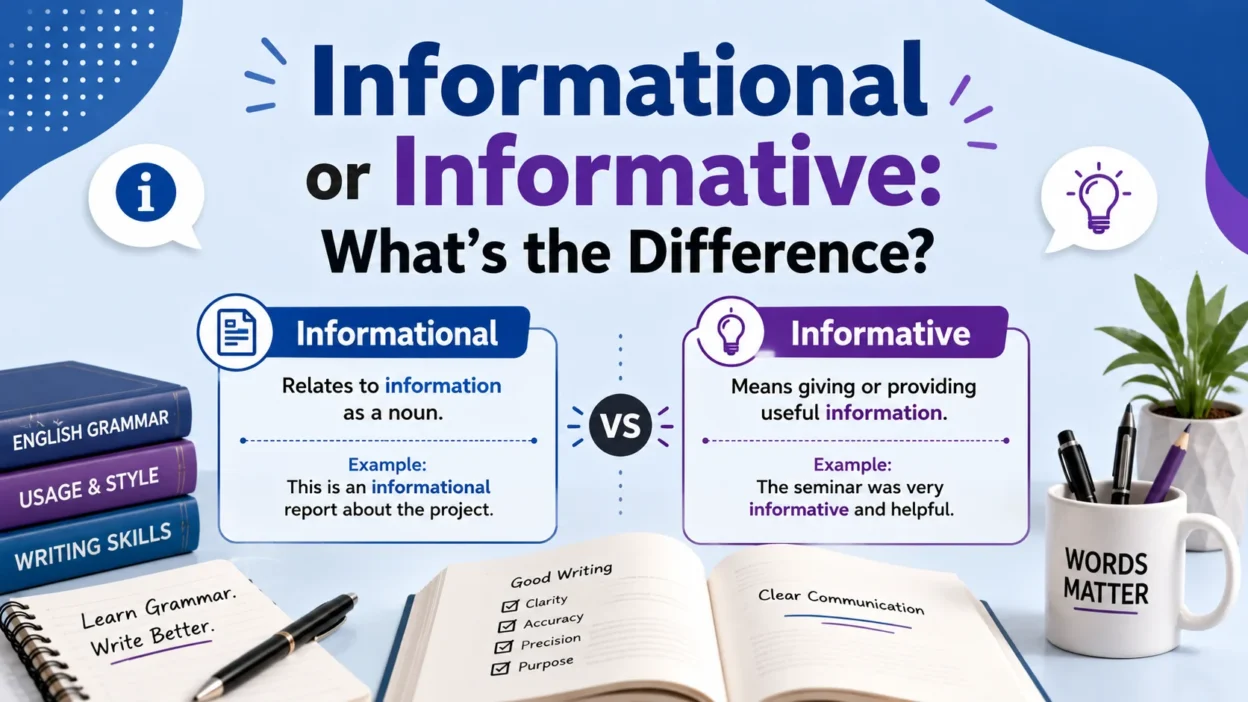
Informational or informative helps you make better word choices by improving meaning, usage, context, and communication. Although both words come from “inform” and share common ground, they aren’t interchangeable. They both involve providing information, useful information, facts, data, details, knowledge, and information sharing, but each serves a different purpose. Good English, language learning, vocabulary, grammar, writing, and speaking improve clarity, readability, reader understanding, reader comprehension, writing accuracy, and communication effectiveness, helping you choose the right word instead of making a second guess.
Informational content relies on a clear content structure with headings, paragraphs, tables, examples, patterns, relationships, and organization. In contrast, informative content and informative writing use definition, comparison, explanation, concepts, guides, teaching, clarification, learning, and insights to build knowledge sharing, comprehension, and effective communication. This approach strengthens academic writing, professional writing, business content, educational content, documentation, reports, and reference materials through a simple, human, and practical approach.
Modern tools such as natural language processing, NLP, semantic analysis, content analysis, AI, artificial intelligence, machine learning, algorithms, entity recognition, classification, tokenization, and knowledge representation help learners, students, writers, and professionals analyze, interpret, and represent language through semantic meaning, semantic patterns, contextual meaning, contextual relevance, linguistic structures, and linguistics. These technologies reduce language mistakes, improve understanding, and make the difference between the two words much more straightforward.
Quick Answer: Informational or Informative
If you’re short on time, remember this simple rule.
| Word | Meaning | Best Used For |
| Informational | Contains or provides information | Describing the type or purpose of content |
| Informative | Provides clear, useful, or valuable information | Describing how helpful or effective the content is |
The Easiest Way to Remember
Use “informational” when you’re talking about what something is.
Use “informative” when you’re talking about how useful it is.
For example:
- ✅ This is an informational website about home gardening.
- ✅ The website is very informative because it explains every step clearly.
The first sentence identifies the website’s purpose. The second praises its quality.
Informational or Informative at a Glance
Although both words come from the same root, they serve different purposes in English.
Side-by-Side Comparison
| Feature | Informational | Informative |
| Part of Speech | Adjective | Adjective |
| Focus | Purpose or category | Quality or usefulness |
| Tone | Neutral | Positive |
| Common in SEO | Yes. | Sometimes |
| Common in Education | Yes. | Yes. |
| Used to Evaluate Content | No | Yes. |
The Main Difference
Think of it like this:
- Informational answers the question, “What kind of content is this?”
- Informative answers the question, “Was this content actually helpful?”
That’s the key distinction.
Where You’ll Commonly See Each Word
You’ll often find information in:
- SEO
- Education
- Government publications
- Business documents
- Technical manuals
You’ll often see informative in:
- Reviews
- Presentations
- Books
- Articles
- Videos
- Speeches
What Does “Informational” Mean?
The word “informational” describes something created to provide facts or information. It doesn’t judge whether the information is interesting or useful. Instead, it simply describes the content’s purpose.
Definition of Informational
Informational means:
Designed to provide information or present facts rather than persuade or entertain.
It’s a neutral adjective.
Why Informational Is Neutral
Imagine picking up a government brochure about taxes.
It’s an informational brochure because its purpose is to explain tax rules.
Whether it’s easy to understand or painfully confusing doesn’t matter. Its purpose remains informational.
Examples of Informational Sentences
- The museum offers informational displays about local wildlife.
- Our company published an informational guide for new employees.
- Parents received an informational packet before the school year started.
- The website contains informational articles about personal finance.
- The health department released an informational flyer about flu prevention.
Each sentence identifies the content’s purpose rather than its quality.
Common Informational Phrases
You’ll often encounter these expressions:
- informational article
- informational website
- informational brochure
- informational video
- informational interview
- informational text
- informational campaign
- informational search intent
- informational guide
- informational document
These collocations are especially common in education, SEO, and business writing.
What Does “Informative” Mean?
Unlike informational, informative tells readers that something provides valuable or meaningful information.
It’s a positive description.
Definition of Informative
Informative means:
Providing useful, interesting, or valuable information that helps someone understand a topic.
Unlike informational, informative evaluates quality.
Why Informative Suggests Value
Imagine attending two workshops.
Both cover the same topic.
The first speaker reads facts directly from slides.
The second explains each idea with stories, examples, and practical advice.
Both workshops are informational.
Only the second is truly informative.
Examples of Informative Sentences
- The documentary was extremely informative.
- Her presentation was clear and informative.
- I found the article surprisingly informative.
- The webinar gave an informative introduction to investing.
- Their guide is short but highly informative.
Each sentence expresses approval because the content successfully teaches the audience.
Common Informative Phrases
You’ll frequently hear these combinations:
- informative article
- informative speech
- informative presentation
- informative book
- informative discussion
- informative podcast
- informative video
- informative report
- informative lecture
- informative review
These phrases focus on usefulness rather than classification.
The Real Difference Between Informational and Informative
Many dictionaries define both words using the word information, which makes them easy to confuse.
The real difference lies in purpose versus value.
Informational Classifies Content
When you use information, you’re identifying the type of content.
Examples include:
- informational website
- informational brochure
- informational guide
- informational interview
These labels don’t tell readers whether the content is easy to understand.
Informative and Evaluative Content
When you use “informative,” you’re commenting on how effective the content is.
For example:
- informative presentation
- informative article
- informative podcast
These phrases tell readers the content teaches something valuable.
Can Something Be Informational but Not Informative?
Yes.
Imagine downloading a software manual.
It includes every instruction you need.
Unfortunately, the explanations are confusing and poorly organized.
The manual is still informational because it provides information.
It isn’t very informative because readers struggle to understand it.
Can Something Be Informative Without Being Informational?
Yes.
A friend may tell you a personal story about buying a house.
The conversation isn’t an informational document.
Still, you might learn practical lessons that help you later.
That makes the conversation informative.
A Simple Way to Think About It
Think about cooking.
A recipe card lists ingredients.
That’s informational.
A skilled chef explains why each ingredient matters and shares practical tips.
That’s informative.
The information is similar, but the experience is completely different.
Grammar Behind Informational or Informative
Although informational and informative are both adjectives, they don’t perform the same job in a sentence. Understanding their grammatical role makes it much easier to choose the correct word every time.
Both Words Are Adjectives
Both “informational” and “informative” describe nouns. However, they emphasize different ideas.
- Informational describes the purpose of something.
- Informative: describes the quality or effectiveness of something.
For example:
- Informational website → A website created to provide information.
- Informative website → A website that explains information clearly and effectively.
The noun stays the same. The meaning changes because of the adjective.
How Context Changes the Correct Choice
Context always determines which word sounds natural.
If you’re describing the type of content, choose informational.
If you’re describing how useful the content is, choose informative.
Consider these examples:
| Correct Sentence | Why It Works |
| This is an informational brochure about home insurance. | The brochure’s purpose is to provide information. |
| The brochure is extremely informative. | The brochure explains the topic well. |
| The website contains informational articles. | The articles belong to an informational category. |
| The articles are very informative. | The articles are helpful and easy to understand. |
A simple question can help:
Are you describing what the content is or how good it is?
If you’re describing what it is, use informational.
If you’re describing how good it is, use informative.
Formal and Everyday Usage
Both words appear in formal and informal English, but their usage varies slightly.
Informational is more common in:
- Academic writing
- Government publications
- Educational resources
- Technical documentation
- SEO and digital marketing
Informative appears more often in:
- Product reviews
- Book reviews
- Presentations
- Everyday conversations
- Classroom discussions
- Customer feedback
Neither word is more formal than the other. The surrounding context determines which one fits naturally.
Informational or Informative in Real-Life Examples
Grammar rules become much easier to remember when you see them in everyday situations.
Let’s look at how professionals use these words across different industries.
Education
Teachers often assign informational texts because students need to read factual material about science, history, or current events.
After reading those texts, students might say the lesson was informative because they learned something new.
For example:
- The teacher assigned an informational article about volcanoes.
- The article was surprisingly informative because it explained complex ideas with simple examples.
Notice how the first sentence describes the article’s purpose while the second evaluates its quality.
Business Writing
Businesses regularly create informational documents for employees and customers.
Examples include:
- Employee handbooks
- Company policies
- Safety guidelines
- Product manuals
- HR documents
Whether those documents are actually easy to understand is another matter.
Example:
- The company emailed an informational guide explaining its new vacation policy.
- Employees said the guide was very informative because it answered every common question.
Marketing
Content marketing provides one of the clearest examples of this distinction.
Companies publish informational content to educate potential customers before asking them to buy anything.
The most successful brands don’t stop there.
They create content that’s genuinely informative, making readers feel confident instead of overwhelmed.
For example:
A travel company publishes a guide titled “How to Plan a Weekend Trip to Chicago.”
The guide is informational because it provides travel information.
If it includes budgeting tips, local recommendations, packing advice, and interactive maps, readers will probably describe it as informative.
SEO and Blogging
Search engine optimization uses the word “informational” constantly.
Google organizes searches into different types of intent.
One of the most common is informational search intent.
Someone searching:
- “How to change a tire”
- “Why do leaves change color?”
- “What is cloud storage?”
- “How does compound interest work?”
is looking for information rather than a product.
The article answering those questions belongs to the informational content category.
However, if the article includes clear explanations, practical examples, visuals, and actionable advice, readers will likely call it informative.
That’s why the best SEO content succeeds.
It’s both informational and informative.
Healthcare
Hospitals and healthcare providers distribute countless informational materials every year.
These include:
- Patient instructions
- Vaccination guides
- Prescription information
- Medical brochures
- Health awareness campaigns
A brochure explaining diabetes management is informational because it shares medical facts.
If patients finish reading it with a clear understanding of blood sugar, diet, exercise, and medication, they’ll also consider it informative.
Technology
Technology companies rely heavily on documentation.
Common examples include:
- User manuals
- Installation guides
- Knowledge bases
- FAQ pages
- Troubleshooting articles
These resources are informational by design.
The best documentation also becomes informative by solving problems quickly.
Think about two software manuals.
One simply lists every feature.
The other includes screenshots, examples, and troubleshooting tips.
Both are informational.
Only one feels informative.
Government and Public Services
Government agencies publish informational resources to educate citizens.
Examples include:
- Voting guides
- Tax instructions
- Public health notices
- Emergency preparedness guides
- Licensing requirements
Many people appreciate documents that explain complicated rules using everyday language.
Those publications become informative because they reduce confusion instead of creating it.
Case Study: Why Word Choice Matters
Imagine two companies launching the same financial planning guide.
Company A
The guide contains accurate facts.
It lists retirement rules, tax information, and investment terminology.
However, the explanations are technical and difficult for beginners.
Readers understand that it’s an informational guide, but many stop reading before finishing it.
Company B
This guide covers the same facts.
Instead of using technical language, it includes:
- Real-life examples
- Visual charts
- Simple definitions
- Step-by-step instructions
- Frequently asked questions
Readers describe the guide as informative because it helps them understand complicated topics.
The Lesson
Both companies published informational content.
Only one created informative content.
That’s the difference successful writers focus on.
Expert Insight
“The purpose of communication is not simply to transmit information but to create understanding.”
This principle explains the distinction perfectly.
Providing information is only the first step.
Helping readers understand it makes your writing informative.
Conclusion
Choosing between informational and informative becomes much easier once you understand their purpose. “Informational” describes content that provides facts or information, while “informative” describes content that explains those facts clearly and helps readers learn. Although the words share the same root, they aren’t always interchangeable. Using the correct term improves your writing, communication, and grammar, making your message more accurate and professional. When in doubt, ask yourself whether you’re describing the type of content or its usefulness. That simple question will usually lead you to the right choice.
FAQs
Q1. What is the difference between informational and informative?
“Informational” describes content that provides information or facts. Informative describes content that is helpful, clear, and easy to understand. In short, one identifies the purpose of the content, while the other evaluates its quality.
Q2. Can “informational” and “informative” be used interchangeably?
Not always. While both words relate to information, informational is used for categories or types of content, whereas informative is used to describe how useful or educational that content is.
Q3. Is informational content always informative?
No. An article, brochure, or manual can be informational because it contains facts, but it may not be informative if the information is confusing, incomplete, or difficult to understand.
Q4. Which word should I use in SEO writing?
For SEO, “informational” is commonly used when discussing informational search intent or informational content. Use informative language when describing content that provides clear explanations and delivers value to readers.
Q5. How can I easily remember the difference between informational and informative?
A simple trick is to remember this: Informational tells you what the content is, while informative tells you how helpful the content is. If you’re describing the purpose, choose informational. If you’re praising the quality, choose informative.