Learning More Smart vs Smarter becomes easier once you understand one simple grammar pattern used in everyday English writing and speech.When I first started improving my English proficiency, I noticed many English learners struggled with more smart and smarter. The mistake usually happened because they tried to apply one grammar rule to every adjective. In American English and standard English, smart is a one-syllable adjective, so the correct comparative is smarter. This follows the normal pattern for comparative adjectives, where you add -er instead of using more. Learning comparative forms, superlatives, and superlative forms makes adjective comparison much easier.
As I practiced more, I realized that natural English depends on clarity, simplicity, and correctness. A sentence like “She is smarter than her brother” sounds smooth and polished, while “She is more smart than her brother” feels awkward, tangled, and slightly odd to most native speakers. These grammar rules apply across English-speaking countries whether you are writing, speaking, or delivering a speech. Reviewing short sentences, studying examples and practical examples, and paying attention to common usage made the decision feel almost automatic. Regular practice builds better habits than memorizing rules alone.
A helpful guide is to remember that short adjectives usually take -er, while longer adjectives normally use more. That simple formula quickly became a piece of cake after consistent language learning and learning English through daily communication. Keeping a notebook of vocabulary, phrases, qualities, and adjectives related to intelligence, ability, abilities, or a higher degree of something makes learning easier. Add easy tips, practical tips, and regular English writing and English speaking practice to improve your writing skills, speaking skills, and overall fluency.
Quick Answer: Is It “More Smart” or “Smarter”?
The short answer is simple.
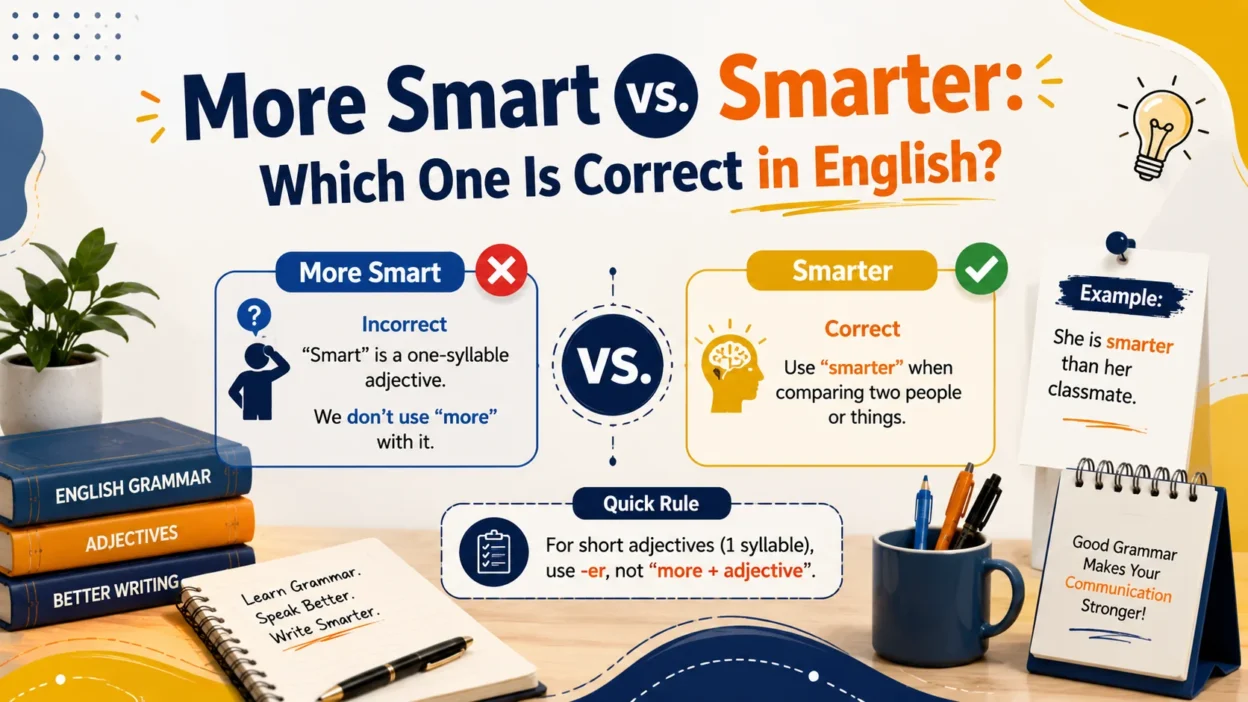
Smarter is the correct comparative form of smart in standard English.
More smart than his brother.
Smarter than his brother.
Because smart is a one-syllable adjective, English normally forms its comparative by adding -er instead of placing more before the adjective.
Here’s a quick comparison.
| Phrase | Correct? | Common in Modern English? |
| Smarter | Yes | Yes |
| More smart | ⚠️ Rare | No |
In everyday conversations, academic writing, business communication, and professional emails, native English speakers almost always choose smarter.
Consider these examples.
- Sarah is smarter than her classmates.
- This software is smarter than the previous version.
- You need a smarter strategy to solve the problem.
- My younger brother has become much smarter over the past year.
Each sentence sounds natural because smarter follows standard English grammar.
Now compare them with the alternative.
- Sarah is more smart than her classmates.
- This software is more smart than the previous version.
Although many people understand the meaning, these sentences sound awkward to native speakers because they don’t follow the normal comparative pattern.
Why Do Learners Say “More Smart”?
Most learners don’t make this mistake randomly. They often apply a grammar rule correctly in the wrong place.
For example:
- more beautiful
- more expensive
- more comfortable
Since these adjectives use more, learners naturally assume smart should follow the same pattern.
However, English divides adjectives into different groups. Smart belongs to the group that adds -er instead.
Think of it like choosing the right key for a lock. Both keys look similar, yet only one opens the door.
Quick Rule to Remember
If an adjective has one syllable, add “-er.” If it has three or more syllables, use “more.”
Like every grammar rule, there are exceptions. You’ll learn those later in this guide.
For now, remember this simple sentence:
Say “smarter,” not “more smart,” in almost every situation.
Why “Smarter” Is Grammatically Correct
The reason smarter sounds natural isn’t based on preference alone. English grammar follows predictable patterns for forming comparisons, and smart fits one of those patterns perfectly.
When you compare two people, objects, or ideas, you usually use a comparative adjective.
Examples include:
- tall → taller
- fast → faster
- old → older
- smart → smarter
Each comparative shows that one thing has more of a certain quality than another.
How English Forms Comparative Adjectives
English generally creates comparative adjectives in two different ways.
Method One: Add -er
Used mainly with short adjectives.
Examples:
| Base Adjective | Comparative |
| Tall | Taller |
| Small | Smaller |
| Fast | Faster |
| Smart | Smarter |
| Young | Younger |
| Bright | Brighter |
Method Two: Add More
Used mainly with longer adjectives.
Examples:
| Base Adjective | Comparative |
| Beautiful | More beautiful |
| Difficult | More difficult |
| Comfortable | More comfortable |
| Intelligent | More intelligent |
| Expensive | More expensive |
Notice something interesting.
You don’t mix the two systems.
Correct:
- taller
- more beautiful
Incorrect:
- more taller
- beautifuler
The same logic explains why more smart sounds unnatural.
Why “Smart” Takes “-er”
The adjective smart contains only one syllable.
Say it aloud.
Smart
One beat.
Because it’s short, English naturally forms the comparative by adding -er.
- smart
- smarter
- smartest
This pattern has existed for centuries and appears consistently in modern dictionaries, grammar books, newspapers, novels, and academic writing.
You’ll hear native speakers say things like:
- She became smarter after years of experience.
- We need a smarter solution.
- This phone is smarter than older models.
- The second attempt was much smarter.
Using more smart instead immediately sounds unusual because it breaks this familiar rhythm.
The Grammar Rule Behind the Comparison
Comparative adjectives answer one important question.
Which one has more of a quality?
For example:
- Which car is faster?
- Which student is smarter?
- Which building is taller?
Each comparison involves two things.
The basic formula looks like this:
Subject + be + comparative adjective + than + object
Examples:
- Emma is smarter than Liam.
- This laptop is faster than mine.
- Winter is colder than autumn.
The word than completes the comparison.
Without it, the sentence often feels incomplete unless the comparison is already obvious.
Correct:
- She is smarter than her sister.
Also correct:
- She is much smarter now.
Both follow natural English usage.
Why Native Speakers Instinctively Choose “Smarter”
Languages develop habits over hundreds of years.
Native speakers rarely stop to think about comparative rules. Instead, they rely on patterns they’ve heard since childhood.
Imagine hearing these sentences.
- He’s taller.
- She’s faster.
- They’re stronger.
- You’re smarter.
Everything sounds smooth.
Now replace one of them.
- He’s more tall.
Most speakers notice immediately that something feels wrong.
The same reaction happens with more smart.
It’s understandable. It simply doesn’t match the rhythm English speakers expect.
Comparative Forms in Everyday English
You’ll encounter smarter almost everywhere.
Conversation
“You should make a smarter decision next time.”
School
“The smarter students finished early.”
Business
“Our team developed a smarter marketing strategy.”
Technology
“Today’s smartphones are smarter than ever.”
Sports
“The winning team played smarter, not harder.”
These examples show that smarter works naturally across different situations.
What Does “Smart” Mean?
Before comparing smart and smarter, it’s helpful to understand what smart actually means.
Many learners think smart only refers to intelligence. In reality, the word has several meanings depending on the context.
That flexibility makes it one of the most common adjectives in modern English.
Definition of Smart
The adjective smart generally describes someone or something that shows intelligence, quick thinking, good judgment, or efficiency.
Common dictionary meanings include:
- Intelligent
- Clever
- Quick to learn
- Good at solving problems
- Well designed
- Stylish or neatly dressed
- Powered by advanced technology
The intended meaning depends entirely on the sentence.
Smart Meaning: Intelligence
This is the most common use.
Examples:
- Maya is a smart student.
- He’s incredibly smart for his age.
- You made a smart choice.
- That’s a smart answer.
Here, smart describes someone’s ability to think, understand, or solve problems.
Smart Meaning: Clever Decisions
Sometimes smart refers to judgment instead of raw intelligence.
Examples:
- Buying early was a smart move.
- Saving money every month is a smart habit.
- Hiring experienced staff was a smart business decision.
In these examples, smart means wise, practical, or well planned.
Smart Meaning: Fashionable
In British English especially, smart often describes appearance.
Examples:
- She wore a smart black suit.
- He looked smart at the wedding.
- That’s a very smart jacket.
Here, the meaning shifts from intelligence to neatness and style.
Smart Meaning: Technology
Technology has introduced another common meaning.
Today we frequently hear:
- smart phone
- smart watch
- smart TV
- smart speaker
- smart home
- smart car
In these examples, smart means connected, automated, or capable of performing advanced digital functions.
For example:
- A smart thermostat adjusts the temperature automatically.
- Smart security cameras detect unusual movement.
- Smart lighting saves electricity through automation.
Smart in Everyday Expressions
English also includes many expressions using smart.
| Expression | Meaning |
| Smart move | A wise decision |
| Smart thinking | Good reasoning |
| Street smart | Practical knowledge from experience |
| Book smart | Knowledge gained through study |
| Smart choice | A well-considered decision |
| Smart investment | A financially wise decision |
These expressions appear frequently in business, education, finance, and daily conversation.
Smart Can Be Both an Adjective and a Verb
Most people know smart as an adjective.
Less commonly, smart also functions as a verb meaning to feel sharp pain.
Examples:
- My eyes smart after swimming.
- The cut still smarts.
This meaning appears far less often in everyday American English, yet you’ll still encounter it in literature and formal writing.
Understanding these different meanings makes it much easier to recognize the correct comparative form in any context.
Smarter vs. More Smart: What’s the Difference?
Now let’s compare the two phrases directly.
Although both express the same basic idea, they don’t carry the same level of grammatical acceptance.
Side-by-Side Comparison
| Feature | Smarter | More Smart |
| Grammatically standard | Yes | Usually no |
| Common in American English | Very common | Extremely rare |
| Preferred in academic writing | Yes | No |
| Preferred in business writing | Yes | No |
| Sounds natural | Yes | Usually awkward |
The difference isn’t about meaning. It’s about correct English usage.
Why “Smarter” Sounds Better
English naturally favors shorter comparative forms whenever possible.
Compare these pairs.
- taller
- faster
- brighter
- stronger
- smarter
Each word follows the same pattern. The result feels smooth, familiar, and easy to pronounce.
Now compare them with alternatives.
- more tall
- more fast
- more bright
- more strong
- more smart
Every sentence sounds unusual because English doesn’t normally build comparisons this way.
Real-Life Examples
Correct:
- She’s smarter than her older brother.
- We found a smarter way to organize the project.
- The newer software is smarter and faster.
- That was the smarter decision.
Incorrect in standard English:
- She’s more smart than her older brother.
- We found a more smart solution.
- The software is more smart now.
Even though the meaning remains clear, the wording feels unnatural.
Which Form Appears More Often?
Books, newspapers, universities, businesses, and professional writers overwhelmingly choose smarter.
You’ll see it in:
- academic textbooks
- newspaper articles
- novels
- corporate reports
- professional emails
- educational websites
- standardized English exams
That’s another strong reason to use smarter whenever you compare intelligence, judgment, or capability.
Is “More Smart” Ever Correct?
After learning the basic rule, many people ask an important question.
Can “more smart” ever be correct?
The answer is yes—but only in rare situations.
Most grammar guides recommend smarter, and that’s the form you should use almost every time. Still, English isn’t completely rigid. Writers and speakers occasionally choose more smart for stylistic reasons rather than grammatical necessity.
Understanding these exceptions helps you recognize them without assuming they are the standard.
Rare Cases of Emphasis
Sometimes a speaker places extra stress on more to highlight the degree of improvement.
For example:
We don’t need a faster solution. We need a more smart solution.
Although many native speakers would naturally rephrase this as a smarter solution, the original wording may appear in conversation to emphasize the contrast between fast and smart.
Even then, editors usually revise it because smarter sounds cleaner and more idiomatic.
Literary and Creative Writing
Authors occasionally bend grammar rules to create a particular rhythm, voice, or character.
Imagine a novel in which a character speaks broken English or imitates a regional dialect. The writer might intentionally use more smart to reflect that character’s speech.
For example:
“Next time I’ll be more smart about it,” the traveler promised.
Here, the unusual wording serves the story rather than establishing a grammar rule.
Influence of Other Languages
Many English learners come from languages that form comparisons by adding a word equivalent to more before every adjective.
As a result, they naturally produce sentences like:
- more happy
- more fast
- more smart
This pattern makes sense from the learner’s perspective, yet it doesn’t match standard English grammar.
With practice, most learners begin to recognize which adjectives take -er and which require more.
What Style Guides Recommend
Professional editors, English teachers, dictionaries, and grammar references consistently recommend smarter.
If you’re writing:
- school assignments
- business emails
- blog posts
- reports
- resumes
- research papers
- professional documents
choose smarter without hesitation.
It’s the form readers expect, and it reflects modern standard English.
Comparative Adjectives Explained Simply: Why English Uses -er or More
Comparative adjectives help you compare two people, places, objects, or ideas. They answer questions like Who is taller? Which option is better? What is more expensive?
English has a clear system for forming comparatives, although a few exceptions make it seem confusing at first. Once you understand the patterns, you’ll know immediately whether to use smarter or more smart.
One-Syllable Adjectives
Most one-syllable adjectives form the comparative by adding -er.
This is exactly why smart becomes smarter.
Here are some common examples.
| Base Adjective | Comparative | Superlative |
| Smart | Smarter | Smartest |
| Tall | Taller | Tallest |
| Fast | Faster | Fastest |
| Long | Longer | Longest |
| Small | Smaller | Smallest |
| Old | Older | Oldest |
| Young | Younger | Youngest |
| Short | Shorter | Shortest |
| Cold | Colder | Coldest |
| Warm | Warmer | Warmest |
Examples in sentences:
- Emma is smarter than her cousin.
- This road is shorter than the highway.
- My new laptop is faster than the old one.
- Winter feels colder this year.
Notice how natural these sentences sound. Native speakers rarely replace these forms with more.
Two-Syllable Adjectives
Two-syllable adjectives are a little more flexible.
Some take -er, while others use more. In a few cases, both forms are acceptable, although one often sounds more natural.
| Adjective | Preferred Comparative | Alternative |
| Happy | Happier | — |
| Busy | Busier | — |
| Friendly | Friendlier | More friendly |
| Quiet | Quieter | More quiet |
| Simple | Simpler | — |
| Narrow | Narrower | — |
| Clever | Cleverer | More clever |
| Gentle | Gentler | More gentle |
For example:
- She’s happier now than last year.
- This explanation is simpler than the first one.
- Our neighbors have become friendlier over time.
Some style guides accept both friendlier and more friendly, but friendlier usually sounds more natural in everyday American English.
Multi-Syllable Adjectives
Adjectives with three or more syllables almost always use more.
Adding -er would create words that sound awkward or impossible to pronounce.
| Base Adjective | Comparative |
| Beautiful | More beautiful |
| Comfortable | More comfortable |
| Expensive | More expensive |
| Intelligent | More intelligent |
| Interesting | More interesting |
| Important | More important |
| Reliable | More reliable |
| Creative | More creative |
Examples:
- This neighborhood is more peaceful than downtown.
- The second proposal is more practical.
- Her explanation was more detailed.
These follow the opposite rule from smart, which explains why more smart feels unusual.
Irregular Comparative Forms
Some adjectives ignore both rules and use completely different words.
These are called irregular comparatives.
| Positive | Comparative | Superlative |
| Good | Better | Best |
| Bad | Worse | Worst |
| Far | Farther/Further | Farthest/Furthest |
| Little | Less | Least |
| Many | More | Most |
| Much | More | Most |
Examples:
- This solution is better than the first one.
- Today’s weather is worse than yesterday’s.
- She has more experience than I do.
These words must simply be memorized because they don’t follow the normal patterns.
When to Use -er Instead of More
A simple rule saves you from many grammar mistakes.
If the adjective has one syllable, add “-er.”
That rule covers thousands of everyday adjectives.
Common Examples
| Correct | Incorrect |
| Smarter | More smart |
| Taller | More tall |
| Faster | More fast |
| Stronger | More strong |
| Cleaner | More clean |
| Richer | More rich |
| Safer | More safe |
| Brighter | More bright |
Let’s put them into real sentences.
- This method is smarter than the old one.
- My sister is taller than me.
- Fiber internet is faster than DSL.
- Exercise makes your heart stronger.
- LED lights are brighter than traditional bulbs.
Each sentence follows standard English grammar.
Adjectives Ending in -y
Another important pattern involves adjectives ending in -y.
Instead of simply adding -er, change the y to i first.
| Base Word | Comparative |
| Happy | Happier |
| Easy | Easier |
| Busy | Busier |
| Funny | Funnier |
| Healthy | Healthier |
Examples:
- Online banking is easier than visiting the branch.
- She’s much happier in her new job.
- This route is busier during rush hour.
These spelling changes become automatic with practice.
Words That Double the Final Consonant
Some short adjectives double the final consonant before adding -er.
| Base Word | Comparative |
| Big | Bigger |
| Hot | Hotter |
| Thin | Thinner |
| Sad | Sadder |
| Fat | Fatter |
Examples:
- Texas is bigger than many countries.
- Summer feels hotter every year.
- My new phone is thinner than the previous model.
These spelling rules keep pronunciation consistent.
When to Use More Instead of Adding -er
Longer adjectives generally require more.
Trying to attach -er creates unnatural words that English speakers never use.
Common Examples
| Correct Comparative | Incorrect Form |
| More beautiful | Beautifuler |
| More expensive | Expensiver |
| More comfortable | Comfortabler |
| More important | Importanter |
| More effective | Effectiver |
| More difficult | Difficulter |
| More reliable | Reliabler |
| More interesting | Interestinger |
Examples:
- This hotel is more comfortable than the last one.
- Solar energy is becoming more affordable every year.
- The updated report is more detailed.
- That explanation sounds more convincing.
Notice how more makes the comparison smooth and natural.
A Quick Memory Trick
If the adjective feels long when you say it aloud, chances are you’ll use more instead of -er.
For example:
- beautiful → more beautiful
- dangerous → more dangerous
- successful → more successful
This isn’t perfect because English has exceptions, yet it’s a reliable guideline.
Why English Doesn’t Say “More Smart”
Many learners ask why English chose smarter instead of more smart.
The answer comes from the history of the language.
English Preferred Short Comparatives
Old English formed comparisons by adding endings rather than separate words.
That’s why words like these have survived for centuries.
- older
- stronger
- wiser
- faster
- smarter
The -er ending became deeply rooted in the language long before more became common as a comparative marker.
As English evolved, speakers naturally continued using -er with short adjectives because it was shorter, easier to pronounce, and more efficient.
Why Native Speakers Prefer Shorter Forms
Human speech favors rhythm.
Compare these two sentences.
She’s smarter than her brother.
Now compare:
She’s more smart than her brother.
The first sentence flows naturally.
The second requires an extra word without adding any extra meaning.
Over time, English speakers favored the shorter construction because it’s quicker to say and easier to process.
That’s one reason modern English still uses smarter almost universally.
Language Changes Through Usage
Grammar isn’t created overnight.
It develops through millions of conversations over hundreds of years.
When enough speakers consistently choose one form, that form becomes the standard.
Today, dictionaries, teachers, publishers, and style guides all recognize smarter as the accepted comparative.
That doesn’t mean more smart is impossible. It simply means the overwhelming majority of fluent speakers don’t use it in ordinary communication.
A Practical Comparison
Imagine you’re writing an email to your manager.
Which sentence sounds more professional?
- We need a smarter approach to customer service.
- We need a more smart approach to customer service.
Almost every native speaker would choose the first version because it feels polished and idiomatic.
The same applies to essays, blog posts, presentations, interviews, and academic writing.
A Simple Decision Chart
Use this quick reference whenever you’re unsure.
| If the adjective is… | Usually use… | Example |
| One syllable | -er | smart → smarter |
| Ends in -y | Change y to i + -er | happy → happier |
| Short with consonant-vowel-consonant pattern | Double final consonant + -er | big → bigger |
| Three or more syllables | More | intelligent → more intelligent |
| Irregular | Memorize the form | good → better |
Keeping these patterns in mind makes it much easier to choose the correct comparative every time. Instead of guessing, you’ll rely on grammar that native speakers use naturally every day.
Smart vs. Intelligent: Are They the Same?
People often use smart and intelligent interchangeably. While they overlap in meaning, they aren’t always identical. Understanding the difference helps you choose the most natural word for each situation.
In everyday American English, smart is the more common choice. It describes someone who learns quickly, solves problems efficiently, or makes good decisions. Intelligent usually sounds more formal and emphasizes a person’s overall intellectual ability or capacity for reasoning.
Meaning Differences
Here’s a simple comparison.
| Smart | Intelligent |
| Common in everyday speech | More formal |
| Focuses on practical thinking | Focuses on intellectual ability |
| Often describes quick decisions | Often describes deep knowledge or reasoning |
| Used in casual and professional settings | Common in academic and scientific contexts |
For example:
- She’s smart enough to solve the puzzle in minutes.
- The scientist is highly intelligent and respected worldwide.
- It was a smart investment that paid off.
- Dolphins are considered highly intelligent animals.
Both words describe mental ability, but they emphasize different aspects of it.
When Smart Fits Better
Use smart when you’re talking about:
- Everyday intelligence
- Clever decisions
- Quick thinking
- Practical problem-solving
- Modern technology
- Stylish appearance (especially in British English)
Examples:
- That was a smart way to save money.
- Jake made a smart career move.
- We need a smarter marketing strategy.
- This is a smart home with automated lighting.
When Intelligent Is the Better Choice
Choose intelligent when discussing:
- Academic ability
- Scientific research
- Analytical thinking
- Formal writing
- Psychology
- Artificial intelligence
Examples:
- She is an intelligent researcher.
- The report presents an intelligent analysis of the data.
- Modern AI systems are becoming more intelligent every year.
Example Comparisons
Notice how the tone changes.
| Sentence with Smart | Sentence with Intelligent |
| That was a smart idea. | That was an intelligent solution. |
| He’s a smart kid. | He’s an intelligent student. |
| We need a smarter plan. | We need a more intelligent approach. |
| She made a smart choice. | She demonstrated intelligent judgment. |
Neither word is wrong. The best choice depends on your audience and the context.
Common Mistakes English Learners Make
Comparative adjectives cause many small mistakes, especially for learners whose first language forms comparisons differently.
Fortunately, most of these errors follow predictable patterns.
Mistake 1: Saying More Smart
She is more smart than her sister.
She is smarter than her sister.
Because smart is a one-syllable adjective, add -er instead of more.
Mistake 2: Using Double Comparatives
Some learners combine more with -er, creating double comparatives.
Incorrect:
- More taller
- More happier
- More smaller
- More faster
Correct:
- Taller
- Happier
- Smaller
- Faster
Only one comparative marker is needed.
Mistake 3: Using Double Superlatives
The same mistake happens with superlatives.
Incorrect:
- Most smartest
- Most fastest
- Most easiest
Correct:
- Smartest
- Fastest
- Easiest
Mistake 4: Forgetting Irregular Forms
Not every adjective follows regular rules.
Incorrect:
- Gooder
- Badder
- More good
Correct:
- Better
- Worse
- More is not used with good.
Mistake 5: Comparing More Than Two Things Incorrectly
Comparatives compare two items.
Superlatives compare three or more.
Examples:
- Mia is smarter than Noah.
- Mia is the smartest student in the class.
Knowing the difference improves both your speaking and writing.
Examples of Correct Usage
Seeing grammar in context makes it easier to remember.
Everyday Conversations
- My younger brother is smarter than I was at his age.
- You made the smarter choice.
- This restaurant is better than the one downtown.
- We found a faster route home.
Academic Writing
- Students who practice regularly often develop stronger writing skills.
- The revised hypothesis provides a more accurate explanation.
- This experiment produced better results than expected.
Business English
- Our company needs a smarter pricing strategy.
- The updated software offers a more secure platform.
- This proposal is more practical than the previous version.
Technology
Technology articles frequently use smart.
Examples include:
- smarter algorithms
- smarter devices
- smarter cities
- smarter healthcare
- smarter transportation
- smarter energy management
Example sentence:
New software helps businesses make smarter decisions through real-time data analysis.
American vs. British Usage
Both American and British English prefer smarter.
The difference appears in other meanings of smart.
In American English:
She’s smart.
Usually means:
She’s intelligent.
In British English:
He looks smart.
Often means:
He’s well dressed.
Despite this difference, the comparative remains the same.
- smarter
- smartest
Similar Grammar Confusions You Should Know
The confusion surrounding more smart vs. smarter isn’t unique.
Many adjectives raise similar questions.
Clever vs. Cleverer vs. More Clever
Both forms are accepted.
Examples:
- She’s cleverer than her classmates.
- She’s more clever than her classmates.
In American English, more clever appears slightly more often than cleverer, although both are correct.
Friendly vs. Friendlier vs. More Friendly
Again, both forms work.
Examples:
- Our neighbors became friendlier.
- Our neighbors became more friendly.
Most style guides slightly prefer friendlier.
Quiet vs. Quieter vs. More Quiet
Both are grammatical.
Examples:
- The library is quieter today.
- The library is more quiet than usual.
Quieter sounds more natural in everyday speech.
Polite vs. Politer vs. More Polite
This adjective shows genuine variation.
Both are acceptable.
Examples:
- Please be more polite.
- He became politer after the conversation.
Many modern writers favor more polite.
Simple vs. Simpler
This one follows the regular rule.
Correct:
- simpler
Incorrect:
- more simple (less common in standard usage)
Tips to Remember the Correct Form Every Time
Grammar becomes much easier when you use simple strategies instead of memorizing hundreds of individual words.
Count the Syllables
Ask yourself how many beats the adjective has.
Examples:
- smart
- tall
- fast
One beat usually means adding -er.
Learn Common Patterns
Most everyday adjectives fit predictable groups.
Use -er
- smart
- tall
- fast
- cold
- rich
- bright
Use more
- beautiful
- important
- intelligent
- expensive
- comfortable
- successful
The more examples you see, the easier these patterns become.
Read Authentic English
Books, newspapers, blogs, and magazines expose you to natural grammar.
Pay attention to comparative adjectives as you read.
You’ll quickly notice phrases like:
- smarter decision
- better choice
- faster service
- more effective strategy
Repeated exposure strengthens your intuition.
Listen to Native Speakers
Movies, podcasts, interviews, and news broadcasts help reinforce correct grammar.
Notice how often speakers say:
- smarter
- faster
- stronger
- better
You’ll almost never hear more smart in everyday conversation.
Practice With Complete Sentences
Don’t memorize isolated words.
Instead, practice with full examples.
For instance:
- This solution is smarter than the previous one.
- She became more confident after graduation.
- Our new office is larger than the old one.
- This explanation is more detailed.
Using complete sentences helps you remember grammar in context.
Quick Reference Chart
Keep this table in mind whenever you’re unsure.
| Adjective | Correct Comparative | Incorrect Comparative |
| Smart | Smarter | More smart |
| Tall | Taller | More tall |
| Fast | Faster | More fast |
| Happy | Happier | More happy |
| Big | Bigger | More big |
| Beautiful | More beautiful | Beautifuler |
| Intelligent | More intelligent | Intelligenter |
| Comfortable | More comfortable | Comfortabler |
| Good | Better | Gooder |
| Bad | Worse | Badder |
This chart covers many of the comparative forms you’ll encounter most often.
Conclusion
Choosing between More Smart vs Smarter becomes simple once you understand how English forms comparative adjectives. Because smart is a one-syllable adjective, the correct comparative form is smarter, not more smart. This rule applies in everyday conversations, academic writing, business communication, and professional documents. While you may occasionally encounter more smart in creative writing or non-native speech, it isn’t the standard form that fluent speakers use.
The easiest way to improve your grammar is to practice with real sentences instead of memorizing long lists of rules. Read books, listen to native speakers, and notice how comparative adjectives appear naturally in context. Over time, you’ll recognize these patterns without thinking about them. The more you practice, the smarter your grammar choices will become, helping your writing and speaking sound clear, confident, and natural.
Q1. Is more smart ever grammatically correct?
In standard English, smarter is the preferred comparative form because smart is a one-syllable adjective. Although more smart may occasionally appear in creative writing or for stylistic emphasis, it isn’t the normal choice in everyday English.
Q2. Why do people say more smart instead of smarter?
Many English learners apply the rule used for longer adjectives, such as more beautiful or more important, to every adjective. Since smart follows a different pattern, the correct comparative is smarter.
Q3. Is smarter used in both American and British English?
Yes. Both American English and British English use smarter as the standard comparative form of smart. The grammar rule is the same in both varieties of English.
Q4. Can I use much smarter or far smarter?
Yes. Words like much, far, even, slightly, and a lot commonly modify comparative adjectives.
Examples:
- She is much smarter than her brother.
- This solution is far smarter than the previous one.
- The updated system is even smarter than before.
Q5. How can I remember when to use -er instead of more?
A simple rule works most of the time. Use -er with most one-syllable adjectives, such as smart → smarter, fast → faster, and tall → taller. Use more with most longer adjectives, such as more intelligent, more beautiful, and more comfortable. Regular reading and practice will help these patterns become second nature.