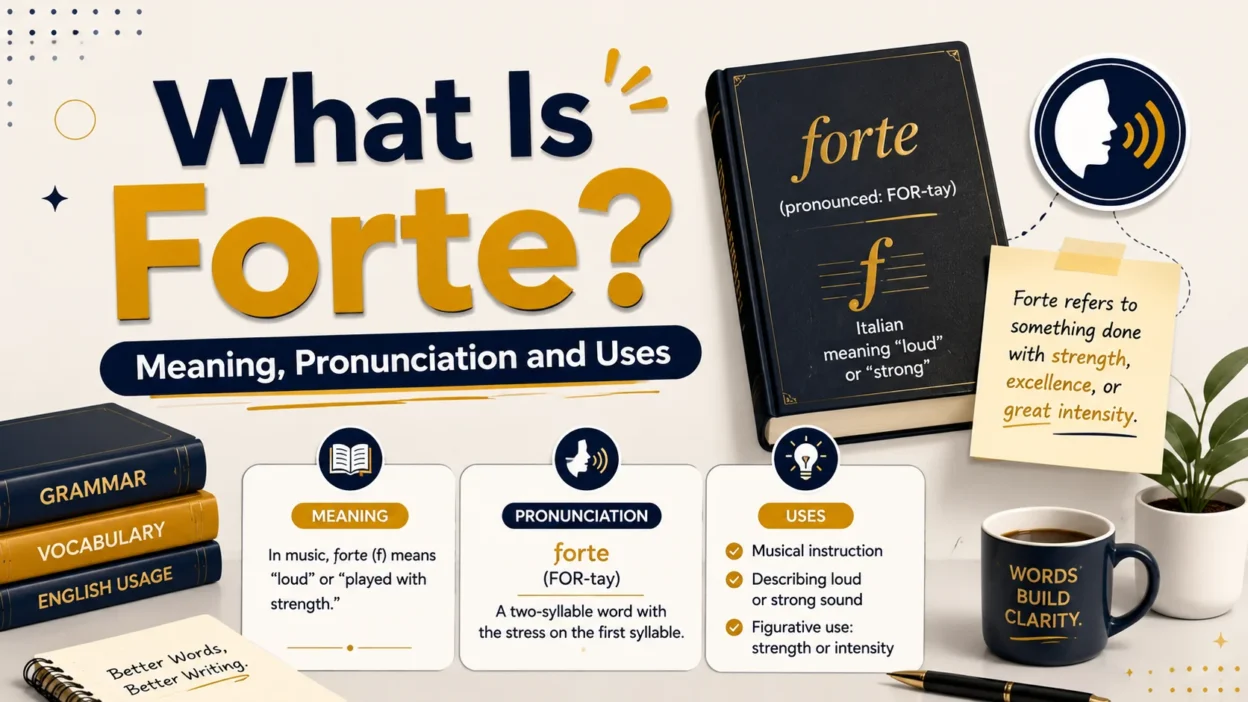
What Is Forte? begins with knowing the meaning of forte in the right context, improving your vocabulary and language skills. Forte Meaning Explained starts with understanding that the meaning of forte depends on the context, not a single rule. In everyday English, general English, and the wider English language, this versatile word describes a person’s greatest strength, strength, talent, ability, skill, or area of expertise. Whether you are a student, writer, professional, or English learner, you will encounter it in everyday conversations, conversation, professional writing, formal writing, effective writing, speech, interviews, and professional communication.
The history and origin of forte explain why many English speakers still face confusion. This borrowed word evolved through French and Italian, creating both a figurative meaning and a musical meaning. In music, sheet music, and musical discussions, performers often see the word beside a passage that should be play loudly, played loudly, or simply loudly. Modern dictionaries include several definitions, a detailed pronunciation guide, accepted pronunciation differences, and helpful notes about linguistic traditions. Paying attention to context clues, contextual meaning, linguistic meaning, semantic meaning, interpretation, expression, and the full explanation reduces common mistakes and clears up many misunderstood words.
A reliable guide uses clear examples, practical examples, practical applications, and expert tips instead of isolated facts. This approach builds lasting learning, strengthens mastery and proficiency, improves clarity, and helps you understand the correct terminology. As you compare the word across music, everyday language, and real communication, the goal remains simple: achieve natural usage by understanding forte correctly in every situation..
What Is Forte?
The word forte has two widely recognized meanings in modern English. Although both meanings share the same spelling, they belong to different contexts.
In everyday language, forte means a person’s strongest skill, natural talent, or area of expertise.
For example:
- Public speaking is her forte.
- Problem-solving has always been his forte.
- Graphic design isn’t really my forte.
In music, forte is a dynamic marking that tells musicians to perform loudly.
Because these meanings developed through different historical paths, many people mistakenly think they are unrelated. In reality, both meanings stem from the broader idea of strength or force.
Dictionary Definition of Forte
Most major dictionaries define forte in two ways.
| Meaning | Definition | Example |
| Everyday English | A person’s strongest skill or area of expertise | Teaching is her forte. |
| Music | A directive to play loudly | The conductor asked the orchestra to play forte. |
The everyday definition appears frequently in business, education, sports, and casual conversations. The musical definition appears in sheet music and performance instructions around the world.
Forte in Simple English
If someone asks, “What is your forte?”, they’re really asking:
- What are you especially good at?
- What’s your strongest ability?
- What comes naturally to you?
- Which skill stands out the most?
Imagine a chef who creates amazing desserts but struggles with baking bread. You could honestly say:
Desserts are the chef’s forte.
Likewise, if you’re excellent at organizing projects but dislike public speaking, project management might be your forte while presentations are not.
The word highlights a person’s greatest strength, not simply something they can do.
The Origin of the Word Forte
Understanding the history of forte makes its modern meanings much easier to remember.
The word traces back to the Latin adjective fortis, meaning strong or powerful.
From Latin, the word entered Italian as forte, where it continued to mean strong. Italian composers later adopted it as a musical direction indicating strong or loud playing.
Meanwhile, French also used fort and forte to describe strength and ability. English eventually borrowed both musical and figurative uses.
Here’s a simplified timeline.
| Period | Development |
| Latin | Fortis = strong |
| Italian | Forte = strong; later loud in music |
| French | Forte = strength or strong point |
| English | Adopted both meanings |
Although both meanings entered English from different influences, they continue to revolve around the central idea of strength.
Why Forte Has More Than One Meaning
English borrows thousands of words from other languages.
Sometimes a borrowed word keeps its original meaning. Other times it develops additional meanings after speakers begin using it differently.
That’s exactly what happened with forte.
Musicians continued using it as a performance instruction.
Everyone else gradually began using it to describe someone’s strongest ability.
Today, both meanings are considered standard English.
How Do You Pronounce Forte?
Pronunciation creates one of the biggest debates surrounding this word.
You may hear someone pronounce it as:
- FORT
- FOR-tay
Interestingly, both pronunciations have long histories in English, although they developed differently.
Is It Pronounced “FORT” or “FOR-TAY”?
The answer depends on which meaning you’re using and, sometimes, where you live.
When talking about someone’s strength or specialty, many American English speakers commonly say:
FOR-tay
Example:
Writing is my FOR-tay.
When discussing music, trained musicians often pronounce the Italian musical term more like:
FOR-tay
However, you’ll also hear FORT in certain dictionaries and among speakers who follow older English pronunciation traditions.
Modern dictionaries generally recognize both pronunciations as acceptable for the figurative meaning.
American English vs British English
Pronunciation preferences differ slightly across regions.
| Region | More Common Pronunciation |
| United States | FOR-tay |
| Canada | FOR-tay |
| United Kingdom | Both accepted depending on context |
| Classical music | Italian-style FOR-tay often preferred |
Language constantly evolves. Because FOR-tay became so widespread in North America, it’s now the pronunciation most English learners encounter first.
Why Do People Pronounce Forte Differently?
The difference comes from the word’s history.
The musical meaning came directly from Italian.
The figurative meaning entered English through French influence, where the pronunciation changed over time.
Eventually, the Italian pronunciation became popular even when speakers used the figurative meaning. Today, dictionaries generally accept this widespread usage.
This isn’t unusual. English contains many borrowed words whose pronunciation changes as they become part of everyday speech.
IPA Pronunciation Guide
Here’s a simple pronunciation chart.
| Pronunciation | IPA |
| FOR-tay | /ˈfɔːr.teɪ/ |
| FORT | /fɔːrt/ |
If you’re unsure which version to use in everyday conversation, FOR-tay will sound natural to most American listeners.
An Easy Way to Remember the Pronunciation
Think of the musical phrase:
Play forte.
Since the musical term always comes from Italian, remembering FOR-tay becomes much easier.
Then extend that pronunciation to everyday speech if you’re speaking American English.
What Does Forte Mean in Music?
Long before forte became a popular way to describe someone’s talents, musicians were already using it in written compositions.
In music, forte tells performers to play loudly. It doesn’t mean playing aggressively or carelessly. Instead, it signals a stronger dynamic level that fits the emotion of the piece.
You’ll usually see the lowercase letter f beneath the staff.
That simple symbol tells every performer to increase the volume.
Forte as a Musical Dynamic
Musical dynamics describe how loudly or softly music should be played.
They help performers shape emotion rather than simply playing every note at the same volume.
Imagine watching a movie where every actor spoke at exactly the same loudness. It would feel flat and unrealistic.
Music works the same way.
Dynamic markings create contrast.
For example:
- Quiet moments build suspense.
- Loud passages create excitement.
- Gradual changes add emotion.
- Sudden changes capture attention.
The symbol f indicates a loud dynamic but not the loudest possible volume.
Dynamic Levels in Music
The following table shows where forte fits among common musical dynamics.
| Symbol | Italian Term | Meaning |
| pp | Pianissimo | Very soft |
| p | Piano | Soft |
| mp | Mezzo piano | Moderately soft |
| mf | Mezzo forte | Moderately loud |
| f | Forte | Loud |
| ff | Fortissimo | Very loud |
| fff | Fortississimo | Extremely loud |
These markings help musicians interpret a composer’s intentions more accurately.
Forte Doesn’t Simply Mean “Play as Loud as Possible”
This is a common misunderstanding.
A conductor rarely wants an orchestra to perform at maximum volume throughout an entire piece.
Instead, forte represents a balanced loudness appropriate for the music.
Professional musicians constantly adjust their playing based on:
- Instrument type
- Ensemble size
- Concert hall acoustics
- Musical style
- Emotional expression
A violin’s forte naturally sounds different from a trumpet’s forte.
That’s perfectly normal.
Why Dynamics Matter So Much
Dynamics transform written notes into expressive performances.
Without them, even famous compositions would sound mechanical.
Consider the opening of a dramatic film soundtrack.
It might begin quietly before building toward a powerful forte section that fills the room with energy.
Those changes create emotional impact.
That’s why composers carefully include dynamic markings throughout their music.
Common Musical Terms Related to Forte
Learning a few related terms helps place forte in context.
| Musical Term | Meaning |
| Piano | Soft |
| Forte | Loud |
| Fortissimo | Very loud |
| Mezzo forte | Moderately loud |
| Crescendo | Gradually louder |
| Diminuendo | Gradually softer |
| Sforzando | Suddenly emphasized |
These terms appear in nearly every style of Western classical music and continue to influence modern orchestral, film, and concert performances.
A Real-World Example
Imagine a school orchestra performing a movie soundtrack.
The opening begins softly as the audience settles into their seats.
Then the conductor raises both hands and points toward the f marking.
Suddenly, the brass section enters with confidence. The strings become fuller. The percussion adds power. The entire room feels the shift in energy.
That single symbol—forte—changed the emotional direction of the performance.
It’s a small word with enormous expressive power.
What Does Forte Mean Outside Music?
Although musicians have used forte for centuries, most people now encounter the word in everyday conversations rather than concert halls.
Outside music, forte describes a person’s greatest strength, natural ability, or area of expertise.
Whether someone excels at leadership, creative writing, mathematics, cooking, or public speaking, people often refer to that skill as their forte.
In other words, forte isn’t just something you’re good at. It’s what you do exceptionally well.
Forte as a Personal Strength
Everyone has skills that come more naturally than others. Some people solve complex problems with ease while others communicate ideas in a way that inspires a room full of people. Those standout abilities are often called a person’s forte.
Unlike a hobby or an interest, a forte usually develops through a combination of natural talent, experience, and consistent practice.
Here are a few examples:
- Data analysis is Maria’s forte.
- Negotiation has always been James’s forte.
- Customer service isn’t my forte, but I’m improving.
- Her forte is building relationships with clients.
Notice that the word usually follows a linking verb such as is, has been, or remains.
Forte in Business and the Workplace
You’ll often hear forte in professional settings because it offers a concise way to describe someone’s strengths.
For example, a hiring manager might say:
“Strategic planning is her forte.”
A project manager could write:
“His forte is coordinating cross-functional teams.”
Using forte helps highlight a person’s greatest contribution without sounding exaggerated.
Where You’ll See Forte at Work
- Performance reviews
- Job interviews
- Leadership meetings
- LinkedIn profiles
- Résumés
- Recommendation letters
- Career coaching sessions
Example
Instead of writing:
I’m good at solving problems.
You could write:
Problem-solving is my forte, especially when projects involve tight deadlines and multiple stakeholders.
The second sentence sounds more confident and specific.
Forte in Education
Teachers also use forte to describe students’ strongest academic areas.
Examples include:
- Science is Ethan’s forte.
- Creative writing has always been Olivia’s forte.
- Mathematics isn’t her forte, but she continues to improve.
The word helps distinguish someone’s strongest subject from subjects they simply perform well in.
How to Use Forte in a Sentence
Learning definitions is helpful, but seeing forte in context makes the word much easier to remember.
Everyday Conversation
- Cooking is definitely my forte.
- Technology isn’t really his forte.
- Her forte has always been communication.
- Organization is one of your greatest fortes.
Workplace Examples
- Budget planning is our finance director’s forte.
- His forte is leading international teams.
- Product design remains the company’s forte.
Academic Examples
- Biology became her forte during college.
- Debate isn’t my forte, but I enjoy participating.
- Research has always been the professor’s forte.
Music Examples
- The conductor signaled forte before the orchestra reached the climax.
- Every musician increased volume at the f marking.
- Beethoven frequently used forte to create dramatic contrast.
Is It Correct to Say “My Forte”?
Yes. This expression is completely correct and widely accepted in modern English.
You’ll hear native speakers say:
- That’s my forte.
- It’s not my forte.
- Writing is my forte.
- Photography has become my forte.
These expressions appear in both casual conversations and professional communication.
Common Expressions with Forte
| Expression | Meaning |
| That’s my forte. | That’s my strongest skill. |
| Not my forte. | I’m not especially skilled at it. |
| His forte is… | His greatest strength is… |
| Her forte has always been… | Her strongest ability has consistently been… |
| Playing to your forte | Using your strongest skills |
These phrases sound natural because they focus on genuine strengths rather than making broad claims.
Common Mistakes People Make with Forte
Even fluent English speakers occasionally misuse forte. Most errors involve pronunciation, grammar, or confusing its musical and figurative meanings.
Understanding these mistakes will help you avoid them.
Confusing the Musical Meaning with the Everyday Meaning
Remember that context determines the meaning.
Music
Play this section forte.
Everyday English
Public speaking is her forte.
The first refers to volume. The second refers to ability.
Using Forte as a Verb
This is incorrect.
He fortes every presentation.
Correct alternatives include:
Presenting is his forte.
His forte is presenting.
Assuming Only One Pronunciation Is Correct
Many people insist there’s only one acceptable pronunciation.
In reality, major dictionaries recognize both pronunciations for the figurative meaning, although FOR-tay is the form most American English speakers use today.
Using Forte for Average Skills
Your forte isn’t something you do reasonably well.
It represents your strongest ability.
For example:
- Good at spreadsheets? Maybe.
- Excellent financial analyst trusted across the company? That’s a forte.
The word implies distinction.
Forte vs Strength vs Specialty vs Expertise
These words seem similar, but they aren’t interchangeable in every situation.
| Word | Best Use | Tone | Example |
| Forte | Greatest natural strength | Neutral | Writing is her forte. |
| Strength | General ability | Neutral | Patience is his greatest strength. |
| Specialty | Professional focus | Formal | Pediatric medicine is her specialty. |
| Expertise | Advanced knowledge gained through experience | Formal | His expertise is cybersecurity. |
When to Choose “Forte”
Use forte when you want to emphasize someone’s standout ability rather than their job title or professional specialization.
For example:
A doctor’s specialty might be cardiology.
Her forte could be explaining complex medical conditions in simple language.
Those ideas complement each other instead of competing.
Synonyms of Forte
English offers many alternatives depending on the situation.
Common Synonyms
- Strength
- Talent
- Gift
- Skill
- Ability
- Expertise
- Specialty
- Strong suit
- Aptitude
- Competence
- Proficiency
- Niche
- Capability
Which Synonym Fits Best?
| Word | Best Context |
| Strong suit | Informal conversation |
| Expertise | Professional writing |
| Talent | Natural ability |
| Specialty | Career or academic focus |
| Forte | Greatest overall strength |
Each carries a slightly different nuance, so choosing the right word makes your writing more precise.
Antonyms of Forte
When discussing weaknesses, these words provide useful opposites.
- Weakness
- Limitation
- Shortcoming
- Inexperience
- Incompetence
- Deficiency
- Poor skill
- Lack of experience
Example:
Time management isn’t his forte, so he relies on digital planning tools to stay organized.
Forte in Idioms and Similar Expressions
English doesn’t have many idioms built around forte, but several expressions communicate the same idea.
Strong Suit
Customer service is her strong suit.
Play to Your Strengths
This expression encourages people to focus on what they naturally do well.
In Your Wheelhouse
Common in American English.
Data visualization is right in her wheelhouse.
Area of Expertise
Frequently used in professional settings.
Tax law is his area of expertise.
Although these expressions aren’t exact synonyms, they often replace forte naturally.
Real-Life Examples of Forte
Understanding the word becomes easier when you see it in everyday situations.
Job Interview
An interviewer asks:
“What would you say is your greatest professional strength?”
A strong response might be:
Team leadership is my forte because I’ve managed cross-functional projects for eight years while consistently meeting deadlines and exceeding performance goals.
The answer is confident, specific, and supported by experience.
College Application
A student writes:
Scientific research became my forte after leading three environmental science projects during high school.
The sentence highlights both ability and achievement.
Sports
A basketball coach might say:
Defense is our team’s forte this season.
The statement identifies the team’s biggest competitive advantage.
Creative Careers
A graphic designer explains:
Brand identity design has always been my forte because I enjoy transforming complex ideas into memorable visuals.
The word naturally emphasizes specialization without sounding boastful.
Case Study: Finding Your Forte
Imagine two marketing professionals.
Emily enjoys every part of marketing but consistently delivers exceptional email campaigns. Her open rates exceed industry averages, and her campaigns generate strong customer engagement.
David performs well across multiple tasks but excels at analyzing campaign data and identifying growth opportunities.
Both professionals have broad marketing knowledge, yet each has a different forte.
Emily’s forte is email marketing.
David’s forte is marketing analytics.
Recognizing these strengths allows each person to focus on projects where they create the greatest value.
Lesson: Your forte isn’t necessarily what you spend the most time doing. It’s the area where your skills consistently produce outstanding results.
Is Forte Formal or Informal?
One reason forte remains popular is its flexibility.
It works well in casual conversations, academic writing, and professional communication.
Casual Conversation
Baking isn’t really my forte.
Business Writing
Client relationship management remains her forte.
Academic Writing
Quantitative analysis became the researcher’s forte during graduate studies.
Professional Emails
You can also use forte in workplace emails.
Example:
Based on your background, stakeholder communication appears to be your forte.
The word sounds polished without being overly formal.
Quick Tips for Using Forte Correctly
Keep these practical guidelines in mind.
- Use forte as a noun when referring to someone’s strongest ability.
- Match the meaning to the context.
- Don’t use it as a verb.
- Choose it only for standout strengths, not average skills.
- Use FOR-tay if you’re speaking American English and want the pronunciation most listeners expect.
- Remember the musical meaning when reading sheet music
Conclusion
Understanding what is forte becomes much easier once you recognize that the word has two distinct meanings. In everyday English, forte refers to a person’s greatest strength, natural talent, or area of expertise. In music, it tells performers to play loudly. Knowing the difference helps you choose the right meaning based on the context.
Learning the correct pronunciation, usage, and origin of forte also makes your writing and speech more accurate. Whether you’re preparing for a job interview, improving your English vocabulary, or reading sheet music, using forte correctly shows confidence and a strong command of the language. The more you see the word in real-life situations, the more natural it will become.
Q1. What is forte in simple words?
In simple terms, forte means a person’s strongest skill or natural talent. In music, it means to play loudly. The correct meaning depends entirely on the context.
Q2. Is it correct to say “That’s my forte”?
Yes. “That’s my forte” is a common and grammatically correct expression. It means that something is your strongest ability or the skill you perform best.
Q3. Why does forte have two different meanings?
The word forte entered English through different linguistic influences. Its everyday meaning comes from French usage, while its musical meaning comes directly from Italian. Over time, both meanings became standard in English.
Q4. How do you pronounce forte correctly?
In American English, FOR-tay is the pronunciation most people use for both meanings. Some dictionaries also recognize FORT, especially in certain traditional or regional contexts.
Q5. What is the difference between forte and strength?
A strength is any positive quality or ability you possess. A forte is your greatest or most outstanding strength—the skill or talent that sets you apart from others.