“Sole” vs. “soul” often confuses writers because both words sound the same but have different meanings in everyday English. Many English learners students and native speakers face this challenge while writing reading and speaking. These words are homophones with the same pronunciation but different meanings and spellings. A good pronunciation guide strong grammar and careful word choice help you choose the correct word through context and context clues. This complete guide explains the meanings practical usage real-world examples common expressions and memory tricks to improve your communication and confidence.
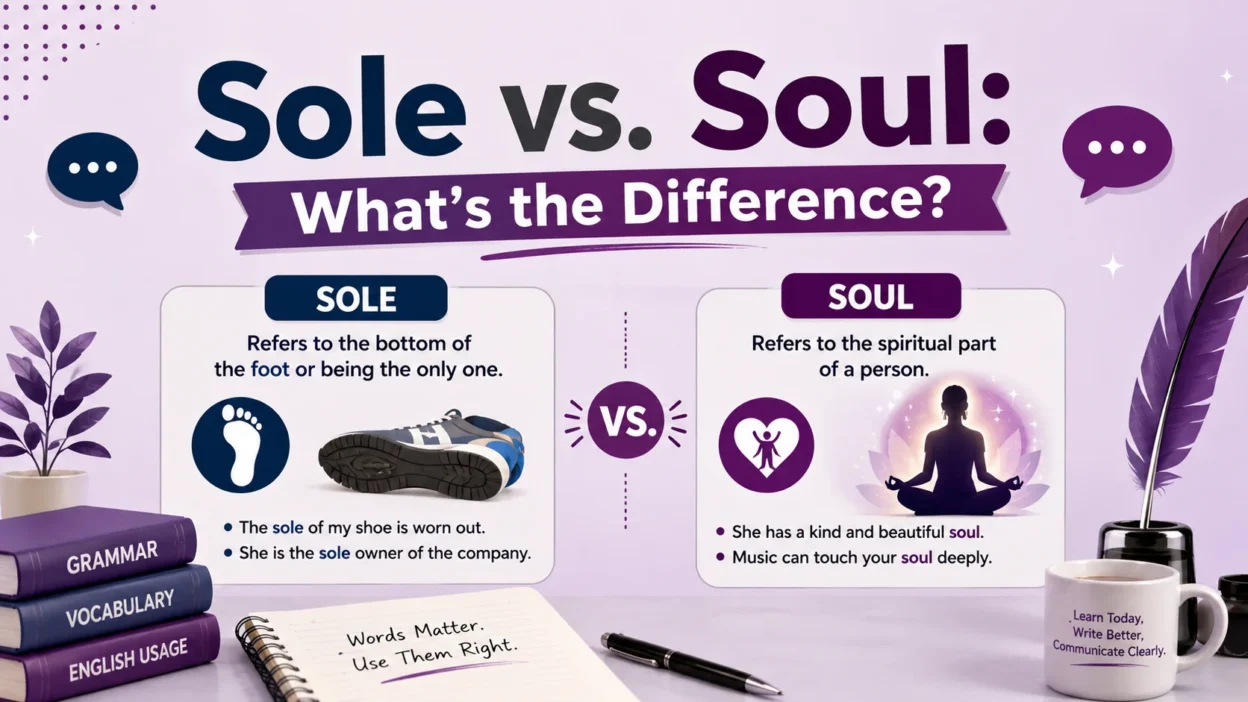
Sole works as both a noun and an adjective. It can mean the only one the bottom of a shoe the bottom of a foot or a flatfish. Soul refers to a person’s spirit inner self spiritual essence feelings character and emotions. Remember this simple rule: sole relates to being alone or something physical while soul connects to your inner being.
Building your vocabulary takes practice and careful language learning. Use spell-check as a helper but always review your work because it cannot detect every wrong word. Read examples compare meanings and practice regularly to avoid confusion. Over time you’ll improve your writing skills, reading comprehension and speaking skills while using “sole” vs. “soul” correctly in every situation.
Sole vs. Soul at a Glance
Before diving into the details, here’s a quick overview that highlights the key differences.
| Feature | Sole | Soul |
| Pronunciation | /soʊl/ | /soʊl/ |
| Meaning | Only one, bottom of a foot or shoe, a flatfish | Spirit, inner self, emotions, character |
| Part of Speech | Noun, adjective | Noun |
| Common Contexts | Business, law, footwear, anatomy | Religion, literature, psychology, music, everyday speech |
| Example | She is the sole owner of the company. | His kindness touched my soul. |
Although both words share the same pronunciation, their meanings never overlap. Your choice depends entirely on what you’re trying to express.
Quick Comparison Table
| If You Mean… | Use This Word | Example |
| Only one | Sole | She was the sole applicant. |
| Bottom of a shoe | Sole | The sole of my shoe is worn out. |
| Bottom of a foot | Sole | I stepped on a pebble and hurt the sole of my foot. |
| Spirit or inner being | Soul | Music feeds the soul. |
| Deep feelings | Soul | He spoke from the soul. |
A quick glance at these examples makes the distinction much easier to remember.
Why Are Sole and Soul So Confusing?
Many commonly confused English words have different pronunciations that help readers distinguish them. Sole and soul don’t offer that advantage. They sound exactly alike, which means listeners rely completely on context to understand the intended meaning.
In spoken English, confusion rarely lasts more than a few seconds because the surrounding words reveal the correct interpretation. In writing, however, choosing the wrong spelling changes the meaning immediately.
Imagine reading these sentences:
- She is the soul owner of the business.
- The sole of the singer moved everyone.
Both are grammatically correct, but each contains the wrong word. The first should use sole, while the second should use soul.
These mistakes happen because English contains thousands of homophones that developed through centuries of language change. Different words gradually evolved until they shared identical pronunciation despite having separate origins and meanings.
They Are Perfect Homophones
A homophone is a pair of words that share the same pronunciation but differ in spelling and meaning.
Some well-known examples include:
- Right and Write
- Flour and Flower
- Sea and See
- Pair and Pear
- Knight and Night
Sole and soul belong to this same group.
Because pronunciation cannot distinguish them, correct spelling depends entirely on understanding each word’s meaning.
Why Context Matters More Than Sound
Context acts like a roadmap. Even if two words sound identical, nearby words usually make the intended meaning obvious.
Consider these examples.
Business
- She is the sole shareholder.
The discussion centers on ownership, so sole means “only.”
Religion
- Many people believe the soul lives forever.
Here the topic concerns spirituality, making soul the correct choice.
Footwear
- The rubber sole provides extra grip.
Since shoes are being discussed, sole clearly refers to the bottom part.
Personal Reflection
- His words came straight from the soul.
The sentence describes deep emotion rather than ownership or footwear.
Whenever you’re unsure, pause for a moment and ask yourself what the sentence is actually discussing. The answer almost always points to the correct word.
Other Homophones That Cause Similar Mistakes
English learners often confuse several homophone pairs besides sole and soul.
| Word Pair | Difference |
| Whole vs. Hole | Complete vs. an opening |
| Right vs. Write | Correct or direction vs. putting words on paper |
| Brake vs. Break | Stopping a vehicle vs. separating into pieces |
| Peace vs. Piece | Calmness vs. a part of something |
| Stationary vs. Stationery | Not moving vs. writing paper |
Learning these groups together strengthens your spelling skills because you begin recognizing patterns instead of memorizing isolated words.
What Does “Sole” Mean?
The word sole has several meanings, but they all remain connected to the idea of uniqueness or a specific physical object. It functions as both a noun and an adjective, making it surprisingly versatile.
Understanding the context helps you identify which meaning applies.
Sole as an Adjective
As an adjective, sole means only, single, or exclusive.
This meaning appears frequently in business, legal writing, education, and formal communication.
Examples include:
- She became the sole owner after buying the remaining shares.
- The scholarship is awarded to the sole winner.
- His sole responsibility is customer support.
- Safety remains our sole concern.
- The company has one sole supplier for that material.
In each sentence, sole emphasizes that there is just one person, object, or responsibility.
Some common combinations include:
- Sole owner
- Sole responsibility
- Sole purpose
- Sole beneficiary
- Sole authority
- Sole applicant
- Sole survivor
- Sole custody
These collocations appear regularly in contracts, legal documents, government records, and business communication.
Sole as a Noun
As a noun, sole most commonly refers to the bottom surface of a foot or shoe.
Examples include:
- The sole of my hiking boot has started peeling away.
- Sand stuck to the sole of her foot.
- These running shoes have thick rubber soles.
- The doctor examined the sole of his injured foot.
Manufacturers design shoe soles using different materials depending on the intended purpose.
Common sole materials include:
- Rubber
- Leather
- Polyurethane (PU)
- EVA foam
- Cork
- Thermoplastic rubber (TPR)
Athletic shoes often combine several materials to improve comfort, flexibility, durability, and traction.
Sole as a Type of Fish
Less commonly, sole refers to a family of flatfish found mainly in European waters.
Many varieties are valued for their mild flavor and delicate texture.
Some well-known species include:
- Dover sole
- Lemon sole
- Common sole
Because this meaning appears mostly in cooking and seafood menus, most learners encounter it less frequently than the adjective or footwear definitions.
Example:
- The restaurant serves grilled sole with vegetables and lemon butter.
Understanding all three meanings helps prevent confusion when reading newspapers, restaurant menus, legal documents, or novels.
Common Expressions Using Sole
The adjective sole appears in many everyday expressions. Learning them makes your English sound more natural.
| Expression | Meaning |
| Sole owner | Only owner of a business or property |
| Sole purpose | The only reason something exists |
| Sole responsibility | Complete responsibility belongs to one person |
| Sole survivor | Only person remaining alive after an event |
| Sole beneficiary | Only person receiving benefits or inheritance |
| Sole authority | Only person with decision-making power |
| Sole custody | One parent has primary legal custody |
These phrases occur frequently in professional writing, legal documents, and news reports.
Real-Life Example Sentences Using Sole
Reading complete sentences helps reinforce the meaning.
- Emma became the sole owner after purchasing her partner’s shares.
- The sole objective of the meeting was to finalize the budget.
- The hiking boots have durable rubber soles that grip wet rocks.
- A sharp shell cut the sole of his foot while he walked on the beach.
- She remained the sole witness to the accident.
- The child was placed in the sole custody of his mother.
- Every employee understood that customer satisfaction was the company’s sole priority.
- Fresh Dover sole appeared on tonight’s restaurant menu.
Notice how every example fits one of the three accepted meanings without creating ambiguity.
What Does “Soul” Mean?
Unlike sole, which often describes something physical or exclusive, soul refers to ideas connected with the inner person. Depending on the context, it may describe spirituality, personality, emotion, creativity, or deep human feeling.
Although definitions vary among cultures and religions, the general meaning remains remarkably consistent. A soul represents the invisible essence of a person rather than the physical body.
Soul as a Spiritual Concept
Many religions teach that every human being possesses a soul. It represents the spiritual part of a person that exists beyond physical life.
In religious writing, the word often appears in discussions about:
- Faith
- Eternal life
- Morality
- Salvation
- Compassion
- Human dignity
Examples include:
- Many people believe the soul continues after death.
- The ceremony focused on peace for every soul.
- She prayed for the healing of his soul.
Whether someone follows a particular religion or not, the word frequently appears in discussions about spirituality and personal beliefs.
Soul as Personality or Character
Outside religious contexts, soul often describes someone’s deepest character, emotions, or authentic self.
You might hear expressions such as:
- She has a kind soul.
- He’s an old soul.
- They poured their heart and soul into the project.
- His writing reveals the soul of the community.
Here, soul symbolizes sincerity, compassion, wisdom, and emotional depth rather than a religious belief.
Writers frequently use the word because it conveys feelings that words like personality or character cannot fully capture.
Soul in Music and Culture
The word soul also holds an important place in music and popular culture. Soul music emerged in the United States during the 1950s and 1960s by blending gospel, rhythm and blues, and jazz influences. The genre became known for powerful vocals, emotional expression, and heartfelt storytelling.
Beyond music, people use soul to describe anything that feels genuine, passionate, or deeply moving.
For example:
- That performance had real soul.
- The small café has more soul than the large chain restaurant.
- Great storytelling connects with the audience’s soul.
In these examples, soul represents authenticity and emotional impact rather than a literal spiritual concept.
Soul in Literature and Everyday Speech
Authors, poets, and speakers often choose soul when they want to express ideas that go beyond the surface. It appears in novels, speeches, songs, and everyday conversations because it captures emotions that are difficult to describe with simpler words.
Common phrases such as heart and soul, old soul, bare your soul, and soul-searching show how deeply rooted the word is in modern English. Whether someone is discussing personal growth, creativity, or meaningful relationships, soul adds depth that few other words can match.
Sole vs. Soul: Side-by-Side Meaning Comparison
Now that you’ve learned the individual meanings of sole and soul, it’s time to compare them directly. Looking at both words together makes it much easier to recognize which one belongs in a sentence.
Although they sound identical, they belong to completely different areas of the English language. One usually refers to being the only one or the bottom of a shoe or foot, while the other relates to a person’s spirit, character, or inner self.
Definition Comparison
| Word | Primary Meaning | Secondary Meaning |
| Sole | Only one or exclusive | Bottom of a shoe or foot, a flatfish |
| Soul | Spirit or inner self | Emotional depth, personality, passion |
A simple way to think about it is this:
- If you’re talking about one person, ownership, or shoes, use sole.
- If you’re talking about feelings, spirituality, or human nature, use soul.
Grammar Comparison
The two words also function differently in grammar.
| Feature | Sole | Soul |
| Adjective | ✔ Yes | ✘ No |
| Noun | ✔ Yes | ✔ Yes |
| Verb | ✘ No | ✘ No |
| Plural Form | Soles | Souls |
Notice that sole can act as both an adjective and a noun, while soul functions only as a noun.
Examples:
- She is the sole owner. (adjective)
- The sole of my shoe is cracked. (noun)
- His soul remained hopeful. (noun)
Pronunciation Comparison
One reason these words cause confusion is that they share the exact same pronunciation.
| Word | IPA | Pronunciation |
| Sole | /soʊl/ | SOHL |
| Soul | /soʊl/ | SOHL |
Because pronunciation offers no clue, spelling depends entirely on meaning.
Usage Comparison
The context usually tells you which word belongs.
| Situation | Correct Word | Example |
| Business ownership | Sole | She is the sole proprietor. |
| Shoe repair | Sole | The sole needs replacing. |
| Anatomy | Sole | The sole of his foot hurts. |
| Religion | Soul | Many religions discuss the soul. |
| Personal growth | Soul | She nourishes her soul through meditation. |
| Music | Soul | Soul music emphasizes emotion. |
Example Sentences Compared
Seeing both words side by side helps reinforce the difference.
| Sole | Soul |
| He was the sole witness. | His honesty came from the soul. |
| She became the sole owner. | Music touched her soul. |
| Replace the worn sole. | The poem spoke to my soul. |
| This is our sole objective. | She has a generous soul. |
Reading these pairs makes the distinction almost effortless.
Sole vs. Soul in Everyday English
Both words appear regularly in daily life, but they show up in very different situations.
Understanding where they’re commonly used helps you remember which one fits naturally.
At School
Students often encounter sole in reading passages about business, law, or ownership. They usually meet soul in literature, history, poetry, and religious studies.
Examples:
- She was the sole participant in the competition.
- The novel explores the human soul.
At Work
Business professionals frequently use sole.
Common workplace phrases include:
- Sole responsibility
- Sole supplier
- Sole decision-maker
- Sole distributor
- Sole proprietor
Meanwhile, soul appears more often in motivational speeches, leadership books, and creative industries.
For example:
- Great leadership inspires the soul, not just productivity.
In Legal Writing
Legal English uses sole far more often than soul.
You’ll regularly see phrases like:
- Sole custody
- Sole ownership
- Sole beneficiary
- Sole authority
- Sole heir
Each phrase identifies a single person with exclusive rights or responsibilities.
In Religious Contexts
Religious writing almost always uses soul.
Examples include:
- Care for your soul.
- Save your soul.
- The soul is eternal.
- Every soul deserves compassion.
Here, sole would never be appropriate.
In Conversations
Everyday speech includes both words naturally.
Examples using sole:
- That’s my sole concern.
- She’s the sole owner.
- The sole came off my shoe.
Examples using soul:
- He’s a kind soul.
- That song has soul.
- She poured her heart and soul into the project.
In Books and Articles
Journalists and authors choose the word based entirely on context.
A business article might discuss the sole shareholder.
A novel might explore the soul of its main character.
A sports article may mention replacing the sole of a running shoe.
A travel writer may describe the soul of a historic city.
Context always determines the correct choice.
Common Phrases and Idioms
Many learners remember vocabulary faster by studying common expressions rather than isolated words.
Expressions with Sole
These combinations appear frequently in American English.
| Expression | Meaning |
| Sole owner | Only owner |
| Sole purpose | Only reason |
| Sole responsibility | Complete responsibility |
| Sole survivor | Only remaining survivor |
| Sole custody | Exclusive legal custody |
| Sole beneficiary | Only person receiving benefits |
| Sole authority | Only person allowed to decide |
| Sole provider | Only financial supporter |
Example:
Sarah became the sole beneficiary of her grandmother’s estate.
Expressions with Soul
The word soul appears in many well-known idioms.
| Expression | Meaning |
| Heart and soul | Complete dedication |
| Soul mate | Deeply compatible person |
| Bare your soul | Reveal your deepest feelings |
| Soul-searching | Deep self-reflection |
| Old soul | Someone wise beyond their years |
| Lost soul | Someone who lacks direction |
| Food for the soul | Something emotionally fulfilling |
| Soul of the party | The most lively person present |
Example:
The volunteers put their heart and soul into rebuilding the community center.
These expressions appear regularly in books, movies, interviews, and everyday conversations.
Sole vs. Soul in Grammar
Grammar helps explain why these words behave differently.
Parts of Speech
Sole
- Adjective
- Noun
Soul
- Noun only
This distinction explains why sole modifies nouns while soul does not.
Examples:
- The sole applicant arrived early.
- Her soul remained hopeful.
Countable and Uncountable Usage
Both words are usually countable nouns.
Examples:
- Three shoe soles
- Many kind souls
However, soul sometimes acts as an abstract concept.
Example:
- Music speaks to the soul.
Singular and Plural Forms
| Singular | Plural |
| Sole | Soles |
| Soul | Souls |
Examples:
- The soles of my boots are worn.
- Thousands of souls attended the memorial.
Common Collocations
Learning collocations helps your English sound natural.
Common collocations with Sole
- Sole owner
- Sole purpose
- Sole responsibility
- Sole source
- Sole survivor
- Sole custody
- Sole authority
- Sole beneficiary
Common collocations with Soul
- Human soul
- Kind soul
- Gentle soul
- Soul music
- Soul mate
- Soul-searching
- Soul food
- Heart and soul
These combinations occur far more often than random word pairings.
Examples in Sentences
Reading examples in context reinforces vocabulary faster than memorizing definitions.
Examples Using Sole
- Emma became the sole owner of the company.
- Customer satisfaction remains our sole objective.
- The sole of my hiking boot needs repair.
- She walked barefoot because the sole of her sandal came loose.
- He was the sole survivor of the accident.
- The court granted sole custody to the child’s father.
- This grant has one sole requirement.
- Fresh sole is today’s seafood special.
- They relied on one sole supplier.
- The doctor examined the sole of her foot.
- She became the sole applicant.
- His sole responsibility is payroll.
- That was the sole reason for the delay.
- The rubber sole improves traction.
- The museum displayed an ancient leather sole.
Examples Using Soul
- The speech touched everyone’s soul.
- She has a generous soul.
- Music feeds the soul.
- The novel explores the human soul.
- He poured his heart and soul into the project.
- She’s an old soul.
- Meditation helps calm the soul.
- Their friendship nourished his soul.
- The artist paints with incredible soul.
- The choir sang with remarkable soul.
- That journey changed her soul.
- Every soul deserves respect.
- The poem reached my soul.
- His words came straight from the soul.
- Their kindness warmed my soul.
Sentences Showing Both Words Together
These examples demonstrate how both words can appear in the same sentence without confusion.
- The sole survivor carried a hopeful soul despite the tragedy.
- The worn sole of his shoe couldn’t stop his determined soul.
- She became the sole owner while keeping the company’s soul alive.
- The sole purpose of the charity is to help every struggling soul.
- A strong soul often overcomes problems that no shoe sole ever could.
Conclusion
Understanding Sole vs. Soul becomes much easier once you focus on the meaning instead of the pronunciation. Although both words sound alike they serve completely different purposes in English. Sole usually refers to the only one something related to a shoe or foot while Soul describes a person’s spirit inner self or emotions. The more you read write and practice these words in context the more natural the correct choice will become. Keep this simple distinction in mind and you’ll avoid one of the most common homophone mistakes with confidence.
Q1. What is the difference between Sole and Soul?
Sole means the only one the bottom of a shoe or foot or a type of flatfish. Soul refers to a person’s spirit inner self or emotional essence. Although they sound the same they have completely different meanings.
Q2. Why do people confuse Sole and Soul?
People confuse them because they are homophones. They have the same pronunciation but different spellings and meanings. Without paying attention to the sentence context it’s easy to choose the wrong word.
Q3. Can spell-check detect Sole vs. Soul mistakes?
Not always. Most spell-check tools only check spelling not meaning. If both words are spelled correctly the software may not recognize that you’ve used the wrong one.
Q4. How can I remember when to use Sole and Soul?
Think of sole as something related to a shoe foot or being the only one. Think of soul as your spirit heart or inner self. This simple memory trick makes the difference easier to remember.
Q5. Is Sole vs. Soul important in professional writing?
Yes. Using the correct word improves clarity and makes your writing look more professional. Whether you’re writing emails essays reports or business documents choosing Sole or Soul correctly helps communicate your message accurately.