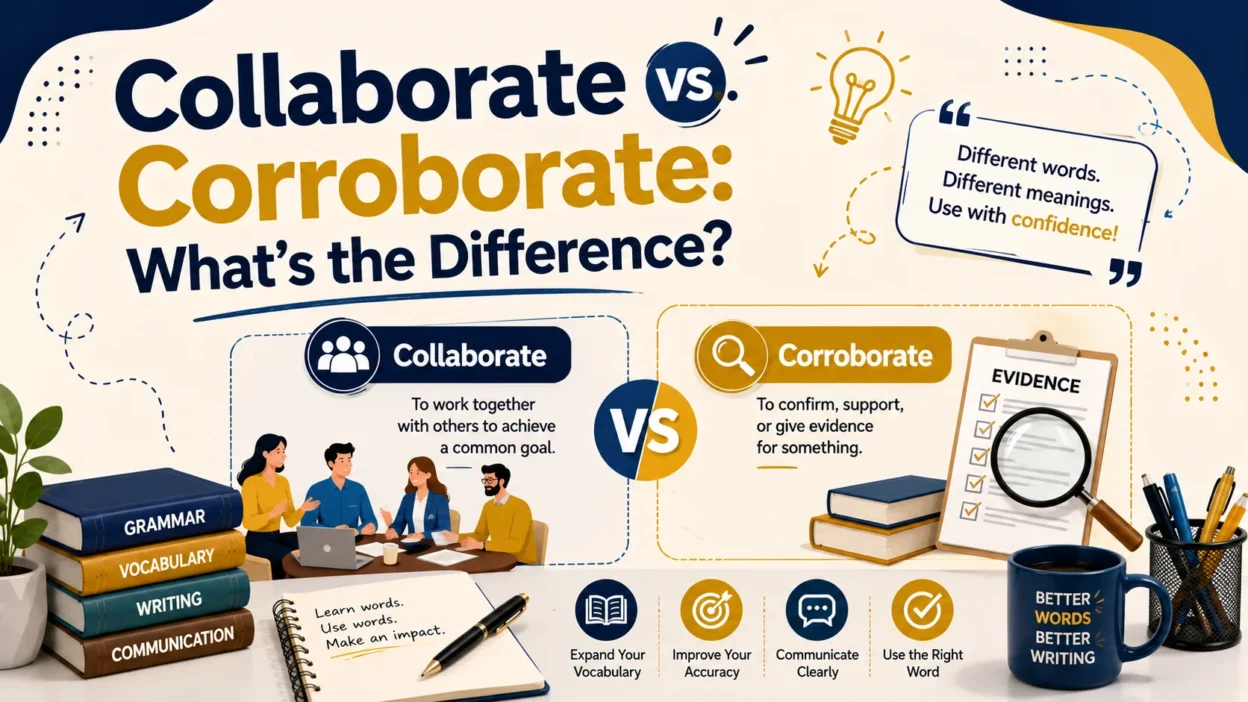
Many English learners find “collaborate” vs. “corroborate” confusing because the words have similar spellings, similar endings, and sound similar. From my experience guiding learners, I have found that mastering these homophones becomes easier when you understand the difference in their meanings. Collaborate means to work together through teamwork, team effort, active teamwork, joint effort, joining forces, or a partnership to complete a project, task, and reach a shared goal or common goal. Corroborate means to confirm a statement, claim, or story with support, supporting evidence, reliable evidence, verification, validation, confirmation, proof, and information, making something true with greater accuracy, trustworthiness, and clarity.
In everyday writing, professional writing, academic writing, business writing, and text exchanges, choosing the correct word depends on the context. Strong writing clarity, writing skills, grammar, vocabulary, English vocabulary, language learning, language mastery, English usage, proper usage, professional usage, functional usage, semantic precision, semantic understanding, semantics, and careful word choice improve communication, effective communication, comprehension, and reduce confusion, mix-up, and mix up between collaboration and corroboration.
The best way to remember the distinction is through examples, easy examples, practice, instructional content, guidance, explanation, clarity-focused instruction, and practical application in real-life contexts and conversation. Even if learning feels tricky, regular attention builds understanding, precision, skill, confidence, and lasting memory with helpful memory tricks. For example, engineers Collaborate to build a bridge, while testing data and other data Corroborate that it meets safety standards.
Collaborate vs. Corroborate at a Glance
If you’re in a hurry, this comparison table gives you the key difference in seconds.
| Feature | Collaborate | Corroborate |
| Meaning | Work together toward a common goal | Confirm or support with evidence |
| Part of Speech | Verb | Verb |
| Main Idea | Cooperation | Verification |
| Usually Involves | People or organizations | Facts, evidence, testimony, research |
| Common Settings | Business, education, technology, healthcare | Law, journalism, science, research |
| Example | Our team collaborated on the project. | The evidence corroborated the witness’s story. |
| Easy Memory Tip | Teamwork | Proof |
Here’s an even easier way to remember the difference.
- Collaborate = Create together
- Corroborate = Confirm with evidence
Whenever you ask yourself whether people are working together or whether evidence is supporting a claim, the correct word usually becomes obvious.
What Does Collaborate Mean?
The verb collaborate means to work jointly with another person or group to accomplish something. Everyone contributes ideas, skills, knowledge, or resources to reach the same objective.
Collaboration happens everywhere. Businesses collaborate to launch products. Teachers collaborate to improve lesson plans. Scientists collaborate on medical research. Musicians collaborate to create songs. Software developers collaborate to build applications.
The key idea is shared effort.
Instead of working alone, people combine their strengths to produce better results.
Definition
Collaborate (verb): To work together with one or more people on a shared task, project, or objective.
Pronunciation
kuh-LAB-uh-rate
The stress falls on the second syllable.
When to Use Collaborate
Use collaborate whenever people actively work together.
Common situations include:
- Business partnerships
- School projects
- Scientific research
- Marketing campaigns
- Software development
- Medical teams
- Creative projects
- Community programs
- International partnerships
If multiple people contribute toward the same outcome, collaborate is almost always the correct choice.
Common Synonyms
Several words share a similar meaning, although each has a slightly different nuance.
- Cooperate
- Work together
- Team up
- Join forces
- Partner
- Coordinate
- Unite
- Combine efforts
For example, coordinate often emphasizes organization while collaborate emphasizes shared participation and decision-making.
Common Collocations
Native speakers frequently pair collaborate with certain words and phrases.
| Common Expression | Example |
| Collaborate with | She collaborated with architects on the design. |
| Collaborate on | They collaborated on a bestselling novel. |
| Collaborate closely | Researchers collaborated closely throughout the study. |
| Collaborate successfully | The two companies collaborated successfully for years. |
| Collaborate across departments | Employees collaborated across departments. |
| Collaborate internationally | Scientists collaborated internationally during the project. |
Learning these natural combinations helps your writing sound more fluent and professional.
Examples of Collaborate in Sentences
- Our marketing team collaborated with graphic designers to launch the campaign.
- Universities around the world collaborate on climate research.
- Students collaborated to prepare their final presentation.
- The two companies decided to collaborate instead of competing.
- Doctors from different specialties collaborated to treat the patient.
Notice that every example involves people sharing work or responsibilities.
What Does Corroborate Mean?
Unlike collaborate, the word corroborate has nothing to do with teamwork.
Instead, corroborate means to support, strengthen, or confirm a statement by providing independent evidence.
This word appears most often in legal, scientific, journalistic, academic, and investigative writing because those fields rely heavily on facts and evidence.
Imagine someone reports witnessing a traffic accident. Investigators review security camera footage and interview additional witnesses. If those sources match the original statement, they corroborate the witness’s account.
The evidence doesn’t create the story.
It confirms the story.
Definition
Corroborate (verb): To support or verify a statement, claim, or theory with additional evidence.
Pronunciation
kuh-ROB-uh-rate
Again, the stress falls on the second syllable.
When to Use Corroborate
Use corroborate whenever evidence supports an existing claim.
Common situations include:
- Criminal investigations
- Court cases
- Scientific experiments
- Academic research
- Journalism
- Medical studies
- Financial audits
- Historical research
- Data analysis
Whenever facts or evidence strengthen a conclusion, corroborate is the right choice.
Common Synonyms
These words have related meanings.
- Confirm
- Verify
- Validate
- Support
- Substantiate
- Authenticate
- Reinforce
- Back up
Although these words overlap, corroborate usually implies that independent evidence supports an existing claim.
Common Collocations
Professional writers often use corroborate with these nouns.
| Common Expression | Example |
| Corroborate evidence | DNA evidence corroborated the suspect’s statement. |
| Corroborate testimony | Two witnesses corroborated the testimony. |
| Corroborate findings | Additional studies corroborated the findings. |
| Corroborate claims | Financial records corroborated the claims. |
| Corroborate reports | Medical documents corroborated the report. |
| Corroborate data | Multiple sources corroborated the survey data. |
These combinations appear frequently in newspapers, research papers, and legal documents.
Examples of Corroborate in Sentences
- Security footage corroborated the witness’s account.
- Independent researchers corroborated the original findings.
- Financial documents corroborated the company’s statements.
- Medical records corroborated the patient’s history.
- New evidence corroborated the investigator’s theory.
Every example focuses on evidence rather than cooperation.
Collaborate vs. Corroborate: The Core Difference
Although these verbs share similar spelling, they belong to completely different ideas.
Collaborate is about working together.
Corroborate is about confirming something with evidence.
That one distinction solves almost every usage problem.
The comparison below makes the difference even clearer.
| Collaborate | Corroborate |
| People work together | Evidence confirms information |
| Focuses on teamwork | Focuses on proof |
| Produces something | Supports something already claimed |
| Used during projects | Used after a claim or statement |
| Involves cooperation | Involves verification |
Think about a newspaper investigating an important story.
First, reporters collaborate by conducting interviews, reviewing documents, and writing articles together.
Next, editors corroborate every important fact by checking official records, interviewing additional sources, and verifying documents.
The reporters cooperate.
The evidence confirms.
That’s the difference.
A Practical Workplace Example
Imagine a technology company creating a new mobile app.
Designers, programmers, and product managers collaborate throughout development. They exchange ideas, solve problems, and improve the product together.
After launching the app, analysts collect customer feedback and performance metrics. Those results corroborate whether the team’s assumptions were correct.
One action creates.
The other verifies.
A Legal Example
Suppose a witness tells police they saw a suspect leave a building at 9:00 p.m.
Investigators later discover security camera footage showing the same person leaving at exactly that time.
The witness did not collaborate with the camera.
The video corroborated the witness’s statement.
This example highlights why using the correct word matters.
Why People Mix Up Collaborate and Corroborate
Even experienced writers occasionally confuse these words. Several factors make the mistake understandable.
Fortunately, understanding those reasons makes the difference much easier to remember.
Their Spellings Look Similar
Both words:
- Begin with co-
- End with -ate
- Contain four syllables
- Share several identical letters
When you read quickly, your brain may assume they’re closely related even though their meanings are entirely different.
| Word | Letter Pattern |
| Collaborate | Co-llab-or-ate |
| Corroborate | Co-rrob-or-ate |
That visual similarity causes countless writing mistakes every year.
Their Pronunciation Is Similar
Say these words aloud.
- Collaborate
- Corroborate
Both follow nearly identical stress patterns, which makes them easy to confuse during conversation.
Fortunately, pronunciation alone doesn’t determine meaning.
Context does.
Both Words Come From Latin
These verbs also share Latin origins, which explains why they resemble each other.
Collaborate comes from the Latin word collaborare, meaning to work together.
Corroborate comes from corroborare, meaning to strengthen or make stronger.
Although both begin with the prefix co-, their roots point to completely different actions.
| Word | Latin Root | Original Meaning |
| Collaborate | collaborare | Work together |
| Corroborate | corroborare | Strengthen or confirm |
Understanding their origins makes their meanings much easier to remember.
Both Commonly Appear in Formal Writing
You’ll encounter these words more often in professional settings than in casual conversation.
For example:
- Research papers
- Business reports
- Legal documents
- Academic journals
- News articles
- Government publications
Because many people don’t use these words every day, they’re easier to confuse when writing.
Both Can Involve Multiple People
This subtle point causes another common misunderstanding.
Several researchers may collaborate on a scientific study.
Later, independent researchers may corroborate those findings by repeating the experiment and obtaining the same results.
The same people may appear in both situations.
The action changes completely.
An Easy Question to Ask Yourself
Whenever you’re unsure which word fits your sentence, ask one simple question.
Are people working together or is evidence proving something?
If people are sharing ideas or completing a task together, choose collaborate.
If evidence is supporting or confirming a statement, choose corroborate.
That simple habit will help you choose the correct word almost every time.
When to Use Collaborate
The word collaborate belongs anywhere people share knowledge, skills, or responsibilities to achieve a common objective. The focus stays on teamwork, communication, and collective effort rather than individual achievement.
Whether you’re writing a business email, a research paper, or a social media post, use collaborate when two or more people actively contribute to the same outcome.
Business and Workplace
Modern businesses depend on collaboration. Departments rarely work in isolation because successful projects require different areas of expertise.
For example, launching a new product might involve:
- Marketing creating promotional campaigns
- Designers developing branding
- Engineers building the product
- Sales teams preparing customer outreach
- Customer support creating help resources
Each department collaborates to ensure the launch succeeds.
Examples
- The marketing department collaborated with the sales team to increase revenue.
- Our designers collaborated with software engineers throughout the project.
- Several startups collaborated to develop sustainable technology.
Education and Group Projects
Schools and universities encourage collaboration because students often learn more by exchanging ideas than by working alone.
Teachers also collaborate to improve lesson plans, design assessments, and share teaching strategies.
Examples
- Students collaborated on a science presentation.
- Teachers collaborated to create a new curriculum.
- The university collaborated with local businesses to provide internships.
Creative Industries
Artists rarely create every part of a project by themselves. Movies, music, books, and games all depend on collaboration.
A single film may involve hundreds of professionals, including:
- Directors
- Screenwriters
- Actors
- Editors
- Costume designers
- Sound engineers
- Visual effects artists
Each person contributes a unique skill.
Examples
- The singer collaborated with an award-winning producer.
- Several authors collaborated on the anthology.
- The architect collaborated with landscape designers.
Software Development
Software development is one of the best examples of collaboration in action.
Developers write code while designers improve the interface. Product managers gather customer feedback. Quality assurance teams test every feature before release.
Without collaboration, building complex software would be nearly impossible.
Examples
- Developers collaborated using GitHub.
- Engineers collaborated across multiple time zones.
- Product managers collaborated closely with customers.
Healthcare Teams
Healthcare professionals constantly collaborate to provide better patient care.
A single patient may receive treatment from:
- Physicians
- Nurses
- Pharmacists
- Physical therapists
- Radiologists
- Nutritionists
Each professional contributes specialized knowledge.
Example
The medical team collaborated to develop a personalized treatment plan.
International Partnerships
Global organizations often collaborate across countries to solve challenges that affect millions of people.
Examples include:
- Climate research
- Vaccine development
- Space exploration
- Disaster relief
- Environmental conservation
These partnerships combine expertise that no single organization could provide alone.
Example
Scientists from twelve countries collaborated on the climate study.
When to Use Corroborate
Unlike collaborate, corroborate focuses on evidence rather than cooperation.
Whenever additional information confirms an existing statement, corroborate is the correct choice.
Think of corroboration as adding another layer of proof.
Law and Court Cases
Legal professionals frequently use corroborate because court decisions rely on evidence rather than assumptions.
Evidence that may corroborate testimony includes:
- DNA analysis
- Security camera footage
- Phone records
- Financial transactions
- Fingerprints
- Witness statements
The more independent evidence supports a claim, the stronger the case becomes.
Examples
- DNA evidence corroborated the suspect’s confession.
- Security footage corroborated the witness’s testimony.
- Financial records corroborated the prosecutor’s argument.
Journalism
Responsible journalists don’t publish important claims without corroboration.
Instead, they confirm information through multiple independent sources before reporting it.
Professional newsrooms often require reporters to corroborate facts by checking:
- Official documents
- Public records
- Expert interviews
- Government databases
- Eyewitness accounts
This process improves accuracy and builds public trust.
Example
Editors corroborated the story before publication.
Scientific Research
Scientific discoveries become more reliable when multiple studies produce similar results.
Researchers often repeat experiments to corroborate previous findings.
This process helps eliminate bias and strengthens confidence in scientific conclusions.
Examples
- Independent laboratories corroborated the original study.
- Additional testing corroborated the hypothesis.
- New experiments corroborated earlier research.
Academic Writing
Students and researchers strengthen arguments by citing reliable evidence.
Instead of making unsupported claims, academic writers corroborate their conclusions with:
- Peer-reviewed studies
- Historical documents
- Statistical analysis
- Survey data
- Published research
Well-supported writing is more persuasive because readers can verify the evidence.
Example
Multiple sources corroborated the historian’s conclusion.
Police Investigations
Investigators rarely rely on a single witness.
Instead, they gather independent evidence to corroborate each statement.
Common investigative evidence includes:
- CCTV recordings
- GPS data
- Text messages
- Digital records
- Physical evidence
- Witness interviews
Each additional piece of evidence strengthens the investigation.
Example
Phone records corroborated the suspect’s location.
Data Analysis and Audits
Businesses also use corroboration.
Auditors compare financial reports with bank statements, invoices, and receipts to ensure accuracy.
Analysts compare multiple datasets before making important business decisions.
Examples
- Sales records corroborated quarterly revenue figures.
- Independent audits corroborated the financial statements.
- Customer surveys corroborated market research.
Collaborate vs. Corroborate in Everyday Examples
Understanding definitions helps, but seeing both words in real situations makes the difference much easier to remember.
Workplace
Collaborate
The design team collaborated with engineers to improve the product.
Corroborate
Customer feedback corroborated the team’s design decisions.
School
Collaborate
Students collaborated on a history presentation.
Corroborate
Several historical documents corroborated the author’s account.
Journalism
Collaborate
Reporters collaborated on an investigative series.
Corroborate
Official records corroborated the newspaper’s findings.
Healthcare
Collaborate
Doctors collaborated to treat a complex medical condition.
Corroborate
Laboratory results corroborated the diagnosis.
Scientific Research
Collaborate
Scientists collaborated across multiple universities.
Corroborate
Independent studies corroborated the research findings.
Daily Conversation
Collaborate
Let’s collaborate on the neighborhood fundraiser.
Corroborate
Photos from the event corroborated her story.
Side-by-Side Sentence Comparison
The table below highlights how each word changes the meaning of a sentence.
| Situation | Collaborate | Corroborate |
| Office Project | Employees collaborated on the proposal. | Sales data corroborated the proposal’s assumptions. |
| Criminal Investigation | Detectives collaborated with local police. | DNA evidence corroborated the suspect’s confession. |
| Scientific Study | Researchers collaborated on the experiment. | Independent trials corroborated the results. |
| Marketing Campaign | Designers collaborated with marketers. | Customer surveys corroborated the campaign strategy. |
| University Assignment | Students collaborated on the presentation. | Research articles corroborated their conclusions. |
| News Report | Journalists collaborated during the investigation. | Government records corroborated the published report. |
Notice a clear pattern.
People collaborate.
Evidence corroborates.
Keeping that simple distinction in mind will help you choose the correct word almost every time.
Collaborate vs. Corroborate in Grammar
Both words are verbs, but they function differently because they describe different kinds of actions.
Parts of Speech
| Word | Part of Speech | Meaning |
| Collaborate | Verb | To work together |
| Corroborate | Verb | To confirm with evidence |
Both verbs follow regular English conjugation patterns.
Verb Forms of Collaborate
| Form | Example |
| Collaborate | We collaborate regularly. |
| Collaborates | She collaborates with experts. |
| Collaborated | They collaborated last year. |
| Collaborating | The teams are collaborating today. |
Verb Forms of Corroborate
| Form | Example |
| Corroborate | The records corroborate the claim. |
| Corroborates | The evidence corroborates the statement. |
| Corroborated | DNA corroborated the witness’s account. |
| Corroborating | Investigators are corroborating the timeline. |
Typical Sentence Patterns
These sentence structures appear frequently in professional writing.
Collaborate
- Collaborate with someone
- Collaborate on something
- Collaborate to achieve something
Examples
- We collaborated with industry experts.
- They collaborated on the new software.
- Researchers collaborated to solve the problem.
Corroborate
- Corroborate a claim
- Corroborate evidence
- Corroborate testimony
- Corroborate findings
Examples
- The documents corroborated the report.
- Medical records corroborated the diagnosis.
- Independent studies corroborated the conclusion.
Common Phrases and Expressions
Learning common word combinations helps your writing sound more natural because native speakers use these expressions regularly.
Common Phrases with Collaborate
- Collaborate with colleagues
- Collaborate on a project
- Collaborate across departments
- Collaborate effectively
- Collaborate remotely
- Collaborate internationally
- Collaborate with clients
- Collaborate closely
Common Phrases with Corroborate
- Corroborate evidence
- Corroborate testimony
- Corroborate findings
- Corroborate allegations
- Corroborate reports
- Corroborate claims
- Corroborate data
- Corroborate conclusions
Expressions You Should Avoid
Some combinations sound unnatural because they don’t match the meaning of the word.
❌ The documents collaborated the report.
✅ The documents corroborated the report.
❌ The employees corroborated on a project.
✅ The employees collaborated on the project.
Choosing the correct verb makes your writing clearer and more professional.
Common Mistakes Writers Make
Many mistakes happen because writers focus on how these words look instead of what they actually mean.
Here are the most common errors.
Using Collaborate Instead of Corroborate
Incorrect:
The laboratory tests collaborated the doctor’s diagnosis.
Correct:
The laboratory tests corroborated the doctor’s diagnosis.
The laboratory isn’t working together with the diagnosis.
It is confirming the diagnosis.
Using Corroborate Instead of Collaborate
Incorrect:
The engineering teams corroborated on the new bridge.
Correct:
The engineering teams collaborated on the new bridge.
The teams worked together.
They didn’t confirm each other with evidence.
Confusing Business and Legal Contexts
Business professionals usually collaborate.
Evidence usually corroborates.
Keeping those contexts separate eliminates many writing mistakes.
Using the Wrong Preposition
The most common pattern is:
- Collaborate with someone
- Collaborate on something
Examples:
- She collaborated with the marketing department.
- They collaborated on the annual report.
For corroborate, you normally don’t use with after the verb.
Instead, the evidence directly corroborates something.
Example:
The witness’s statement corroborated the evidence.
Not:
The witness corroborated with the evidence.
Collaborate vs. Corroborate in Professional Writing
Choosing the correct word makes your writing more precise and credible.
Whether you’re preparing a business proposal, research paper, legal document, or news article, understanding the distinction improves clarity.
Business Emails
Business professionals almost always use collaborate.
Example
Our teams will collaborate on the upcoming product launch.
Academic Papers
Researchers frequently use both words.
Scientists collaborate during research.
Their findings corroborate previous studies.
Legal Documents
Legal writing relies heavily on corroborate because evidence must support every important claim.
Example
Independent witnesses corroborated the defendant’s statement.
Research Reports
Researchers often collaborate throughout a project and later use independent evidence to corroborate their conclusions.
Both words can appear in the same report without causing confusion because each serves a completely different purpose.
News Articles
Professional journalists collaborate with editors, photographers, and fact-checkers to produce accurate reporting.
Before publication, they corroborate important facts using reliable documents, official records, and independent sources.
This distinction explains why both words appear frequently in high-quality journalism while never replacing one another.
Conclusion
Understanding “collaborate” vs. “corroborate” becomes much easier once you focus on the purpose of each word instead of their similar spelling. “Collaborate” means working together toward a shared goal, while “corroborate” means confirming a statement with evidence. Although they look and sound alike, they belong in very different contexts. By practicing with real examples and paying attention to the situation, you’ll choose the correct word with confidence and write more clearly in academic, professional, and everyday English.
FAQs
Q1. What is the difference between collaborate and corroborate?
Collaborate means to work together with one or more people on a shared task or goal. Corroborate means to support or confirm a statement, claim, or idea with evidence or facts.
Q2. Can collaborate and corroborate be used interchangeably?
No. These words have different meanings and cannot replace each other. Use collaborate when talking about teamwork and corroborate when talking about evidence or verification.
Q3. How can I remember the difference between collaborate and corroborate?
A simple memory trick is to think of collaborate as cooperate and create together. Think of corroborate as confirm with proof. If people are working together, use collaborate. If evidence supports a claim, use corroborate.
Q4. Can you give an example of collaborate and corroborate in the same context?
Yes. Researchers collaborated on a medical study, and later independent experiments corroborated their findings. In this example, the researchers worked together while the later evidence confirmed their results.
Q5. Why is it important to know the difference between collaborate and corroborate?
Using the correct word makes your writing more accurate and professional. It helps avoid confusion, improves communication, and ensures your message is clear whether you’re writing for school, work, research, or everyday conversations.