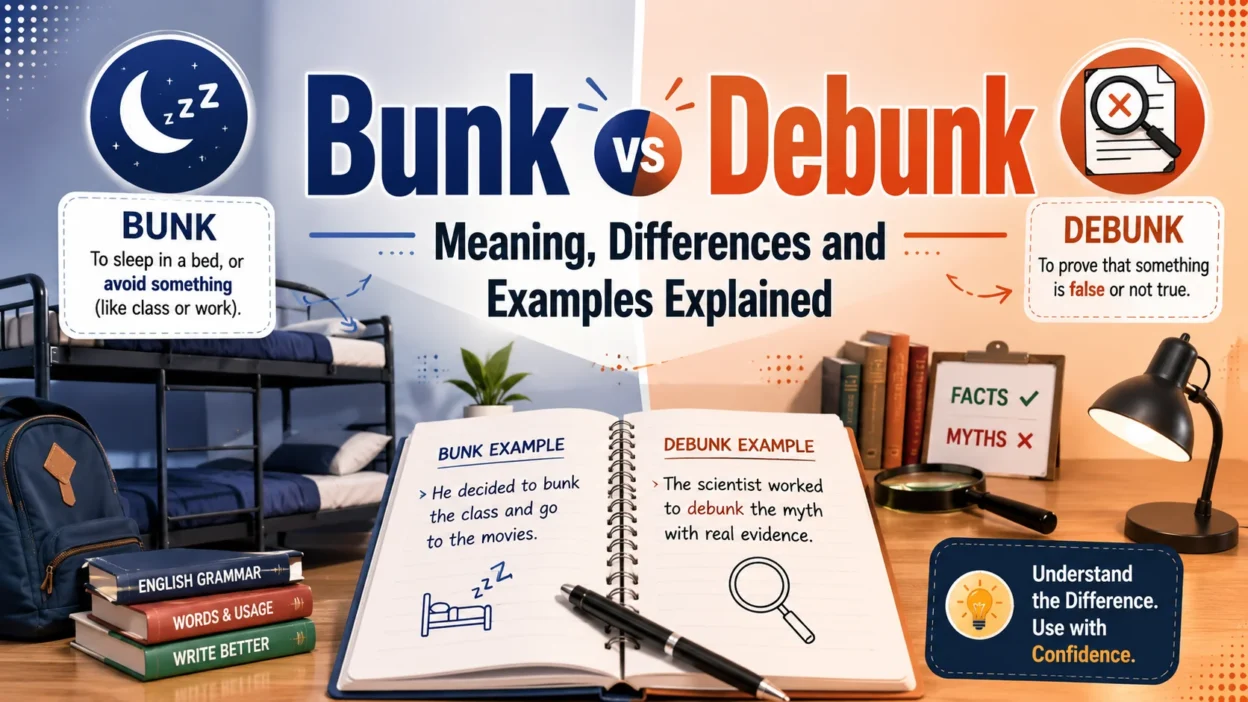
Bunk vs. Debunk helps you understand the difference between two English words that look related but have very different meanings in everyday language. Bunk usually means nonsense, a false belief, a misleading idea, or something that should not be accepted as truth. Debunk, on the other hand, means to expose, prove false, or correct a claim, myth, theory, or misconception by presenting reliable evidence. Learning this distinction makes it easier to choose the correct word in both speaking and writing.
Many people accidentally use Bunk when they actually mean Debunk, but the two words cannot replace one another. If someone says a story is bunk, they are calling it nonsense. If a scientist, journalist, or researcher debunks a story, they are using facts to show why it is false or untrue. This difference appears often in news, articles, classrooms, and everyday conversations, especially when discussing misinformation, urban legends, or popular myths. Understanding the proper usage improves your grammar, vocabulary, and overall confidence in English.
From personal editing experience, confusing these words is more common than most people realize. Writers often focus on how similar they look instead of how they function in a sentence. A simple memory trick can help: think of Bunk as the false information and Debunk as the action that removes it. Once you remember that Debunk relies on evidence to challenge a belief, claim, or theory, choosing the correct word becomes much easier. This small distinction strengthens your writing, makes your message clearer, and helps you communicate with greater accuracy.
Bunk vs Debunk at a Glance
If you only remember one thing from this article, remember this:
- Bunk usually means nonsense, foolish talk, or something untrue. It can also refer to a bed or mean to skip school in certain regions.
- Debunk means to expose a myth, rumor, claim, or belief as false by using evidence or facts.
Although debunk developed from bunk, the two words no longer have the same meaning. Today, they perform different jobs in both spoken and written English.
Quick Comparison Table
| Feature | Bunk | Debunk |
| Primary meaning | Nonsense or foolish talk | Prove a claim is false |
| Part of speech | Noun, verb | Verb |
| Tone | Informal | Neutral to formal |
| Common use | “That’s bunk.” | “Scientists debunked the myth.” |
| Refers to evidence? | No | Yes |
| Common in journalism | Occasionally | Very common |
| Used in academic writing | Rarely | Frequently |
| Can describe misinformation? | Yes | Yes, by exposing it |
The easiest way to think about the two words is this:
Bunk is the false idea. Debunk is the act of proving that false idea wrong.
That simple distinction will help you choose the correct word almost every time.
The Short Answer
Here’s the difference in one sentence:
- Bunk = nonsense.
- Debunk = expose nonsense.
For example:
❌ The scientist bunked the conspiracy theory.
✅ The scientist debunked the conspiracy theory.
Another example:
✅ That rumor is complete bunk.
Notice how bunk names the false information, while debunk describes the action of disproving it.
Why People Confuse These Words
Several factors make these words easy to mix up.
First, debunk contains the entire word bunk, making many people believe it’s simply another form of the same word.
Second, both words often appear in conversations about misinformation, rumors, hoaxes, conspiracy theories, and myths.
Third, English learners sometimes assume removing or adding the prefix de- simply changes emphasis rather than meaning.
Finally, many people encounter debunk far more often than bunk, especially in news headlines such as:
- Scientists debunk popular health myths.
- Experts debunk viral social media claims.
- Historians debunk a long-standing legend.
Because bunk appears less frequently in modern writing, its meaning becomes less familiar.
What Does “Bunk” Mean?
The word bunk has several meanings, and the intended meaning depends entirely on context. While dictionaries list multiple definitions, the most common one in everyday American English is nonsense or something that isn’t true.
Definition and Dictionary Meaning
As a noun, bunk commonly means:
- Nonsense
- Foolish ideas
- Worthless statements
- False claims
- Empty talk
Examples include:
- That’s complete bunk.
- His explanation was nothing but bunk.
- Nobody believed the politician’s bunk.
In these examples, bunk refers to statements that lack truth or credibility.
However, the word has other established meanings.
It may also refer to:
- A bed built into a wall
- A bunk bed
- A sleeping compartment on trains or ships
- Leaving school without permission (mainly in certain English dialects)
Context tells readers which meaning is intended.
Origin and Etymology
The history of bunk is surprisingly interesting.
The modern sense of bunk meaning nonsense is widely believed to come from the American expression “bunkum.”
The story dates back to the early nineteenth century when a congressman from Buncombe County, North Carolina, reportedly delivered a long speech meant only for local political audiences rather than meaningful debate.
Listeners began referring to empty political speeches as Buncombe, which gradually evolved into bunkum, and later shortened to bunk.
Over time, the word expanded beyond politics and came to describe almost any statement considered foolish, exaggerated, or false.
Meanwhile, the sleeping-place meaning of bunk developed separately and has Germanic roots connected to built-in wooden beds found on ships and in military housing.
Although these meanings share the same spelling, they have different historical origins.
Different Meanings of “Bunk”
English often gives one word several meanings, and bunk is a perfect example.
Understanding each meaning helps prevent confusion.
Bunk Meaning “Nonsense”
This is the definition most relevant when comparing bunk vs debunk.
Here, bunk means:
- Lies
- Falsehoods
- Silly ideas
- Empty claims
- Unbelievable statements
Examples:
- That conspiracy theory is pure bunk.
- Most internet rumors turn out to be bunk.
- The advertisement promised impossible results, and consumers quickly called it bunk.
Notice that the speaker isn’t proving anything false. They’re simply describing it as nonsense.
Bunk as a Bed or Bunk Bed
In another common meaning, bunk refers to a sleeping space.
Examples include:
- The children slept in a bunk bed.
- Every sailor had a small bunk.
- She climbed into the top bunk.
Here, the word has nothing to do with truth or falsehood.
This meaning appears frequently in:
- Military settings
- Summer camps
- Ships
- Hostels
- Trains
- Dormitories
Bunk as a Verb (To Skip or Leave)
In some regions, particularly parts of South Asia and in certain informal dialects, to bunk means:
- Skip class
- Miss school intentionally
- Leave without permission
Examples:
- They decided to bunk chemistry class.
- Several students bunked school before the holiday.
This usage is uncommon in American English but remains popular in countries such as India.
Because audiences differ, writers should consider regional readers before using this meaning.
Common Expressions with “Bunk”
Native speakers often use bunk in familiar expressions.
Some examples include:
- That’s bunk.
- Complete bunk.
- Utter bunk.
- Pure bunk.
- Nothing but bunk.
Each expression suggests disbelief.
For example:
“The miracle cure sounds like complete bunk.”
The speaker believes the claim lacks evidence or credibility.
Everyday Examples of “Bunk”
Reading real-world examples helps reinforce meaning.
Here are several examples using bunk correctly.
Example 1
“Don’t believe everything you read online. Some of it is complete bunk.”
Example 2
“The salesperson’s promises sounded like bunk from the beginning.”
Example 3
“My brother always wanted the top bunk when we stayed at our grandparents’ house.”
Example 4
“The campers unpacked their bags before choosing their bunks.”
Example 5
“Several students bunked their afternoon lecture.”
Notice how only context tells you which definition applies.
What Does “Debunk” Mean?
Unlike bunk, the word debunk has one primary meaning in modern English.
It means to show that a claim, myth, belief, rumor, or widely accepted idea is false by presenting facts or evidence.
You’ll encounter debunk regularly in journalism, science, education, history, politics, and fact-checking.
Whenever experts investigate questionable claims, they often debunk them.
Definition and Dictionary Meaning
Modern dictionaries define debunk as:
- To expose falseness
- To reveal the truth behind a myth
- To disprove false claims
- To remove misconceptions through evidence
The key element is evidence.
Someone doesn’t simply disagree with an idea.
Instead, they provide facts showing why it isn’t true.
Examples:
- Scientists debunked the myth.
- Researchers debunked several health misconceptions.
- Historians debunked the popular legend.
Each sentence involves investigation and proof.
Origin and History
The word debunk first appeared in American English during the early twentieth century.
It comes directly from bunk, meaning nonsense.
The prefix de- often suggests:
- Remove
- Reverse
- Undo
- Eliminate
When attached to bunk, the new word literally developed the sense of removing the nonsense or stripping away false beliefs.
The term became especially popular in journalism.
Writers began publishing articles that aimed to debunk political myths, exaggerated stories, urban legends, miracle cures, and fraudulent claims.
Today, the word remains common in newspapers, documentaries, scientific publications, and online fact-checking websites.
What Does It Mean to Debunk a Myth?
One of the most common phrases in English is:
Debunk a myth.
This means proving that a commonly accepted belief isn’t actually true.
Consider these examples:
Myth: Humans only use 10% of their brains.
Reality: Neuroscientists have repeatedly debunked this claim through brain imaging and decades of research.
Another example:
Myth: Goldfish have a three-second memory.
Reality: Researchers have debunked this belief by demonstrating much longer memory abilities.
The process of debunking generally follows these steps:
- Identify the claim.
- Gather reliable evidence.
- Compare facts with the claim.
- Present clear conclusions.
- Explain why the original belief is inaccurate.
That’s why debunk appears frequently in science communication.
How “Debunk” Is Used Today
Modern English uses debunk across many fields.
Here are some common contexts.
| Field | Example |
| Science | Researchers debunked the myth with new evidence. |
| Journalism | Reporters debunked false election claims. |
| Medicine | Doctors debunk common health myths every year. |
| History | Historians debunk legends using historical records. |
| Technology | Experts debunk fake AI rumors circulating online. |
| Education | Teachers debunk misconceptions during lessons. |
Notice a clear pattern.
Someone investigates information, checks reliable evidence, and corrects misinformation.
Everyday Examples of “Debunk”
These sentences show natural usage.
Example 1
“Scientists debunked the rumor after conducting several experiments.”
Example 2
“The documentary debunks popular conspiracy theories with historical evidence.”
Example 3
“Fact-checkers quickly debunked the viral social media post.”
Example 4
“Archaeologists debunked the claim after examining newly discovered artifacts.”
Example 5
“Medical experts continue to debunk myths about vaccines through peer-reviewed research.”
In every example, the word implies evidence, investigation, and proof, not just personal opinion.
Understanding this distinction is essential because it separates debunk from simply saying that something is bunk.
Bunk vs Debunk: What’s the Difference?
Although bunk and debunk share the same root, they don’t mean the same thing. One refers to false, foolish, or meaningless information, while the other describes the process of exposing that information as false.
Think of it this way:
- Bunk is the problem.
- Debunk is the solution.
For example, imagine someone claims that drinking coffee permanently stunts your growth. If the claim lacks scientific support, you might call it bunk. When researchers publish studies proving the claim false, they debunk the myth.
That’s the difference in action.
Side-by-Side Comparison Table
| Feature | Bunk | Debunk |
| Meaning | Nonsense, false talk, foolish ideas | To expose a false claim with evidence |
| Part of Speech | Noun, verb | Verb |
| Common Context | Informal conversations | Journalism, science, education, history |
| Requires Evidence? | No | Yes |
| Tone | Informal | Neutral to formal |
| Example | “That’s complete bunk.” | “Experts debunked the rumor.” |
| Common Object | Claims, stories, excuses | Myths, rumors, legends, misinformation |
The table highlights an important point. Debunk almost always involves facts, while bunk is simply a judgment about the quality or truthfulness of something.
Meaning
The simplest distinction comes down to meaning.
Bunk describes something that is:
- False
- Foolish
- Worthless
- Misleading
- Ridiculous
Examples:
- That explanation is bunk.
- The advertisement is pure bunk.
- Nobody believed his excuse because it sounded like bunk.
Debunk describes an action.
Someone:
- Investigates a claim.
- Collects evidence.
- Shows why the claim is wrong.
Examples:
- Scientists debunked the myth.
- The documentary debunks several internet rumors.
- Historians debunked the long-standing legend.
One word labels misinformation. The other removes it.
Part of Speech
Grammar also separates these words.
| Word | Part of Speech | Example |
| Bunk | Noun | That’s complete bunk. |
| Bunk | Verb (regional) | They bunked class yesterday. |
| Debunk | Verb | Researchers debunked the theory. |
Notice that debunk functions only as a verb in standard English.
You wouldn’t normally say:
❌ The article is a debunk.
Instead, you’d write:
✅ The article debunks the claim.
Purpose and Context
The situations where these words appear also differ.
Bunk commonly appears in:
- Casual conversations
- Opinion pieces
- Informal writing
- Everyday speech
Example:
“Those miracle weight-loss pills are bunk.”
The speaker is expressing disbelief.
Debunk appears in more evidence-based contexts, including:
- Scientific studies
- News reports
- Research papers
- Fact-checking articles
- Historical investigations
- Educational content
Example:
“Researchers debunked the claim after analyzing the available evidence.”
The writer isn’t just expressing an opinion. They’re referring to proof.
Tone and Connotation
Tone matters in writing.
Bunk often sounds:
- Informal
- Slightly sarcastic
- Dismissive
- Opinionated
For example:
“That’s complete bunk.”
The sentence immediately tells readers the speaker rejects the claim.
By contrast, debunk sounds:
- Objective
- Informative
- Professional
- Evidence-based
For example:
“The study debunks several misconceptions about nutrition.”
This wording feels more appropriate in academic or journalistic writing.
Common Collocations
Some words naturally appear together.
Here are the most common collocations with bunk.
| Common Phrase | Example |
| Complete bunk | That’s complete bunk. |
| Pure bunk | The rumor is pure bunk. |
| Utter bunk | His explanation is utter bunk. |
| Nothing but bunk | The advertisement was nothing but bunk. |
Now compare those with debunk.
| Common Phrase | Example |
| Debunk a myth | Scientists debunked a myth. |
| Debunk a rumor | Officials debunked the rumor. |
| Debunk misinformation | Experts debunk misinformation daily. |
| Debunk a conspiracy theory | Researchers debunked the conspiracy theory. |
| Debunk a claim | Journalists debunked the claim. |
Learning these natural word pairings makes your writing sound much more fluent.
When to Use Each Word
Ask yourself one question:
Am I describing false information, or am I proving it false?
If you’re describing false information, choose bunk.
If you’re proving false information wrong, choose debunk.
Here’s a quick decision guide.
| Situation | Correct Word |
| Calling an excuse nonsense | Bunk |
| Exposing a myth with evidence | Debunk |
| Talking about fake internet rumors | Either, depending on context |
| Writing a scientific article | Usually debunk |
| Casual conversation | Often bunk |
Bunk vs Debunk in Sentences
Reading complete sentences is one of the fastest ways to understand the difference.
Examples Using “Bunk”
These examples use bunk correctly.
- That conspiracy theory is complete bunk.
- Most chain emails contain nothing but bunk.
- I stopped believing that story because it sounded like bunk.
- The salesman filled his presentation with bunk instead of facts.
- Those miracle investment promises are pure bunk.
- Every camper chose a comfortable bunk before bedtime.
- She climbed onto the top bunk with a flashlight and a novel.
Notice that the first five examples refer to nonsense, while the last two refer to beds.
Context always determines the meaning.
Examples Using “Debunk”
Now look at debunk.
- Scientists debunked the popular myth through extensive research.
- The journalist debunked the viral rumor.
- Historians debunked the legend using newly discovered documents.
- Medical experts continue to debunk health myths online.
- Independent fact-checkers debunked the misleading video.
- Archaeologists debunked claims about the ancient city.
- The documentary carefully debunks common misconceptions.
Each sentence includes investigation and evidence.
Examples Showing the Difference
Seeing both words together makes the contrast even clearer.
| Incorrect Thinking | Correct Understanding |
| The internet rumor is bunk. | The journalist debunked the internet rumor. |
| The miracle cure is bunk. | Doctors debunked the miracle cure claim. |
| That urban legend is bunk. | Researchers debunked the urban legend. |
| The conspiracy theory is bunk. | Evidence debunked the conspiracy theory. |
Notice the pattern.
The first sentence identifies misinformation.
The second explains who disproved it.
Is “Debunk” Related to “Bunk”?
Yes. The two words are historically connected.
However, they no longer perform the same job in English.
Understanding their relationship helps explain why they’re so often confused.
How the Prefix “De-” Changes the Meaning
Many English words begin with the prefix de-.
Although the prefix doesn’t always carry exactly the same meaning, it frequently suggests one of these ideas:
- Remove
- Reverse
- Undo
- Eliminate
- Take away
Consider a few familiar examples.
| Word | Meaning |
| Decode | Remove the code by interpreting it |
| Deactivate | Make something inactive |
| Decompose | Break something down |
| Defrost | Remove frost |
| Debunk | Remove false beliefs |
In debunk, the prefix creates the idea of removing the nonsense rather than simply identifying it.
That explains why debunk developed into a verb rather than another noun.
Why the Relationship Confuses Many Learners
Several reasons explain the confusion.
The spelling is almost identical.
The only visible difference is the prefix de-.
Both words appear around misinformation.
News articles often discuss fake claims and then explain how experts debunked them.
For example:
The article discussed vaccine myths.
Later it says:
Scientists debunked those myths.
A reader unfamiliar with both words may assume they have identical meanings.
One word appears far more often.
Modern media uses debunk constantly.
Headlines such as these appear every day:
- Experts debunk AI myths.
- Scientists debunk health misinformation.
- Historians debunk famous legends.
Meanwhile, bunk meaning “nonsense” appears less frequently outside informal conversation.
As a result, many English learners recognize debunk but have never learned the original meaning of bunk.
Understanding the historical connection makes both words much easier to remember. In the next section, you’ll learn the most common mistakes writers make with bunk and debunk, along with practical tips to avoid them.
Common Mistakes and How to Avoid Them
Even experienced writers occasionally misuse bunk and debunk because the words look so similar. Most mistakes happen when someone focuses on the spelling instead of the meaning.
The good news is that these errors are easy to avoid once you understand how each word works.
Using “Bunk” Instead of “Debunk”
This is by far the most common mistake.
Some writers assume bunk can mean “to prove something false.” It can’t.
Consider these examples.
❌ The journalist bunked the rumor.
✅ The journalist debunked the rumor.
Why?
Because the journalist performed an action. They investigated the claim and showed why it wasn’t true.
Now compare another example.
❌ Scientists bunked the conspiracy theory.
✅ Scientists debunked the conspiracy theory.
Whenever someone disproves a claim using evidence, debunk is the correct verb.
Thinking “Debunk” Means “Disagree”
Another common misunderstanding is believing that debunk simply means to disagree with someone.
It doesn’t.
Disagreement alone isn’t enough.
For example:
“I don’t like that theory.”
This isn’t debunking.
Now consider this sentence:
“Researchers examined ten years of data and demonstrated why the theory was incorrect.”
That is debunking because evidence supports the conclusion.
A helpful rule is this:
No evidence, no debunking.
Misunderstanding the Different Meanings of “Bunk”
Because bunk has several meanings, readers sometimes choose the wrong one.
For example:
The campers found their bunks.
Clearly, bunks means beds.
Now compare:
His explanation was bunk.
Here, the word means nonsense.
Always look at the surrounding words before deciding which meaning applies.
Confusing Informal and Formal Usage
Another mistake involves tone.
Suppose you’re writing an academic paper.
This sentence sounds too casual:
The author’s argument is complete bunk.
A more professional version would be:
The available evidence debunks the author’s claim.
Academic writing usually favors objective language instead of emotional language.
Assuming Every False Statement Is Automatically “Bunk”
Sometimes a statement turns out to be incorrect because new information becomes available.
That doesn’t necessarily make it bunk.
For instance, scientists may revise a theory after discovering new evidence. The original idea wasn’t nonsense—it reflected the best knowledge available at the time.
Calling something bunk usually suggests that it’s clearly false, misleading, or lacks credibility rather than simply being outdated.
Quick Checklist to Avoid Mistakes
Before using either word, ask yourself these questions:
- Am I describing false information?
- Use bunk.
- Am I exposing false information with evidence?
- Use debunk.
- Am I talking about a bed?
- Use bunk.
- Am I writing formally?
- Debunk often fits better.
- Am I only expressing an opinion?
- Avoid saying you’ve debunked something unless you’ve presented supporting evidence.
Synonyms and Related Words
Learning synonyms expands your vocabulary and helps you choose the most accurate word for each situation.
Although no synonym matches bunk or debunk perfectly, several come close depending on the context.
Synonyms of “Bunk”
When bunk means nonsense, these words often work as alternatives.
| Synonym | Best Used For |
| Nonsense | General conversations |
| Rubbish | British English |
| Baloney | Informal American English |
| Hogwash | Informal speech |
| Claptrap | Pretentious or meaningless talk |
| Drivel | Silly speech or writing |
| Garbage | Casual conversations |
| Absurdity | Formal writing |
| Falsehood | Academic or legal writing |
| Fiction | Stories presented as fact |
Examples:
- That’s complete nonsense.
- His explanation was pure hogwash.
- The article contained several falsehoods.
Each conveys a slightly different tone.
Synonyms of “Debunk”
Because debunk emphasizes proving something false, its synonyms often involve investigation or evidence.
| Synonym | Typical Context |
| Disprove | Science |
| Refute | Academic writing |
| Expose | Journalism |
| Invalidate | Research |
| Challenge | Debate |
| Correct | Education |
| Dismiss | Legal or professional writing |
| Verify as false | Fact-checking |
| Reveal the truth | News reporting |
Examples:
- Researchers refuted the claim.
- Scientists disproved the theory.
- Journalists exposed the fraud.
Although these words overlap, debunk remains especially common when discussing myths, rumors, legends, and misinformation.
Related Words That Are Often Confused
Several English words appear in similar discussions.
| Word | Meaning |
| Myth | A widely believed but false idea |
| Misconception | An incorrect understanding |
| Hoax | A deliberate deception |
| Rumor | Unverified information |
| Propaganda | Biased information used to influence opinions |
| Misinformation | False information shared without intent to deceive |
| Disinformation | False information shared intentionally |
These words often appear alongside debunk because journalists and researchers frequently investigate them.
For example:
Fact-checkers debunked the misinformation before it spread further.
Memory Tricks to Remember the Difference
One of the easiest ways to master confusing words is by using memory techniques.
Fortunately, bunk and debunk are perfect candidates for simple mnemonics.
Easy Mnemonics
Remember this sentence:
Bunk belongs in the trash. Debunk takes out the trash.
Here, the “trash” represents false information.
Another useful reminder is:
Bunk = bogus.
Both words begin with B.
That connection helps many learners remember that bunk refers to something false or foolish.
Now consider debunk.
Think of the prefix de- as meaning remove.
So:
Debunk = remove bogus ideas.
This simple association works surprisingly well.
Visual Association Technique
Imagine a detective standing in front of a large bulletin board.
The board is covered with newspaper headlines, conspiracy theories, fake quotes, and internet rumors.
Every time the detective proves one of them false, they remove it from the board.
The fake stories are bunk.
Removing them is debunking.
Mental pictures like this help your brain retain vocabulary much faster than memorizing dictionary definitions.
Quick Rule You Can Remember
If you’re still unsure, remember this one-line rule:
Bunk is the lie. Debunk is proving the lie wrong.
That sentence covers nearly every modern use.
Bunk vs Debunk in Literature, News, and Everyday Conversation
Neither word belongs only to dictionaries.
Both appear regularly in books, newspapers, documentaries, podcasts, classrooms, and daily conversations.
Seeing them in authentic contexts makes their meanings much easier to remember.
Examples from Books
Authors often use bunk when characters dismiss an idea as foolish or unbelievable.
For example:
“That’s absolute bunk,” the detective said after hearing the suspect’s explanation.
Writers also use bunk in stories set aboard ships, at military camps, or in summer camps.
Example:
He climbed into the upper bunk and fell asleep almost immediately.
The meaning changes completely depending on the setting.
Meanwhile, nonfiction writers frequently use debunk.
History books may explain how scholars debunk long-held legends.
Science books often debunk myths about nutrition, space, or human biology.
Popular psychology books regularly debunk misconceptions about behavior and memory.
Examples from Journalism
News organizations rely heavily on debunk because modern journalism often involves fact-checking.
Common headlines include:
- Experts debunk online scams.
- Scientists debunk health misinformation.
- Officials debunk fake emergency alerts.
- Researchers debunk climate myths.
- Historians debunk viral historical claims.
Notice how nearly every headline involves evidence.
Journalists rarely write:
Experts say the claim is bunk.
Instead, they usually explain how experts debunked it through research or documentation.
Examples from Everyday Speech
In daily conversations, bunk appears more often than debunk because it’s shorter and more casual.
You might hear someone say:
- That’s bunk.
- Don’t believe that. It’s complete bunk.
- His excuse sounded like bunk to me.
On the other hand, debunk appears when people discuss facts or investigations.
For example:
- That documentary debunked several urban legends.
- I watched a video that debunked common fitness myths.
- The professor debunked a popular misconception during class.
Mini Case Study: How Scientists Debunk a Myth
Imagine a viral social media post claims that a particular fruit can cure every disease.
Millions of people share it without checking the facts.
Researchers then conduct laboratory studies, review medical evidence, and publish peer-reviewed findings showing there’s no scientific support for the claim.
Here’s what happened:
| Step | Action |
| Claim spreads online | False health advice gains attention |
| Scientists investigate | Studies and clinical evidence are reviewed |
| Results are published | Evidence contradicts the claim |
| Public learns the truth | The myth is debunked |
The original claim was bunk.
The scientific investigation debunked it.
Conclusion
Understanding “bunk” vs. “debunk” is easier once you remember the role each word plays. Bunk refers to nonsense, false ideas, or misleading claims, while Debunk means proving those claims false with facts and evidence. Although the words share the same root, they are not interchangeable. Using the correct term makes your writing clearer, strengthens your communication, and helps you avoid a common English mistake. Whether you’re reading the news, writing an essay, or discussing popular myths, knowing the difference between Bunk and Debunk will help you express your ideas with confidence and accuracy.
FAQs
Q1. What is the difference between bunk and debunk?
Bunk means nonsense, foolish talk, or a false idea. Debunk means to expose or prove that a belief, myth, or claim is false by using evidence.
Q2. Can bunk and debunk be used interchangeably?
No. They have different meanings. Bunk describes false or meaningless information, while Debunk describes the action of showing that information is false.
Q3. Why do people confuse bunk and debunk?
People often confuse these words because Debunk contains the word Bunk and both are commonly used when discussing myths, rumors, and misinformation.
Q4. What are some common examples of debunking?
Scientists debunk health myths, historians debunk historical legends, and fact-checkers debunk false stories shared on social media by presenting reliable evidence.
Q5. Does bunk have more than one meaning?
Yes. Besides meaning nonsense or foolish talk, Bunk can also refer to a bed, such as a bunk bed, and in some regions it can mean skipping school or leaving quickly, depending on the context.