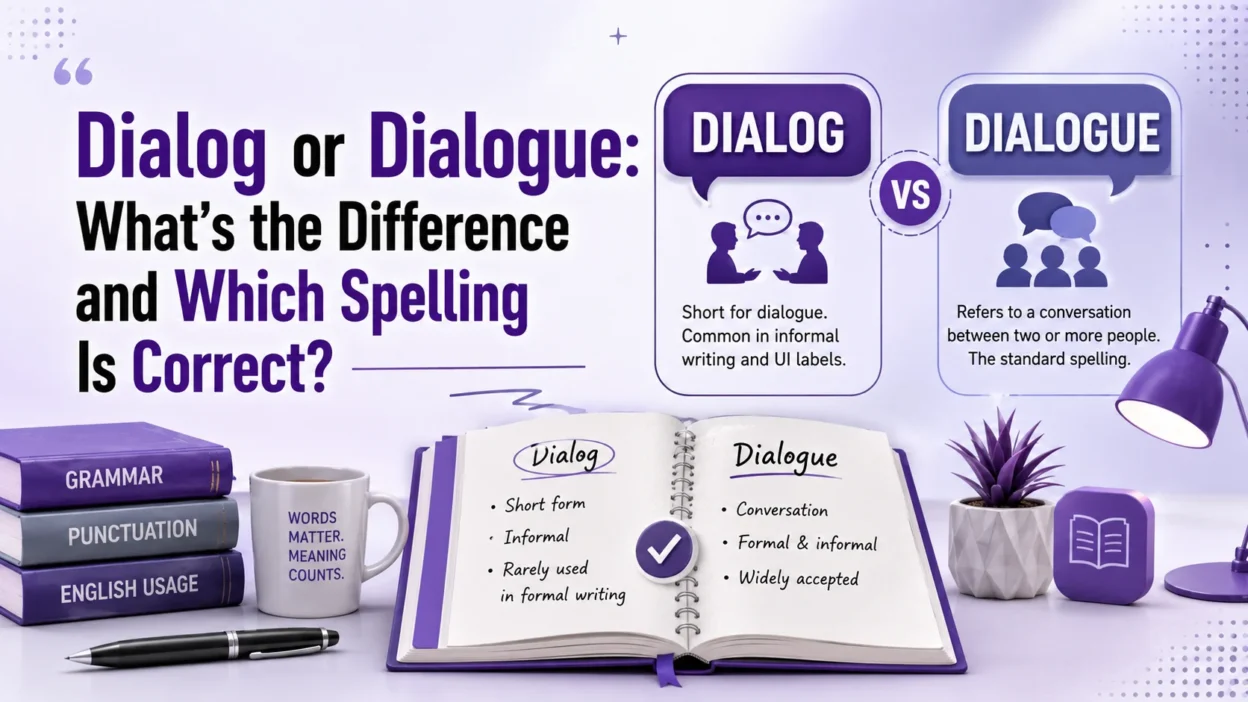
The main difference between “dialog” and “dialogue” is their spelling and regional usage, not their meaning. In American English, dialog is commonly used in software, computer interfaces, dialog boxes, and other technology-related contexts. In British English, dialogue is the preferred spelling for books, scripts, plays, novels, movies, and other forms of creative writing.
The best choice depends on your audience and the style you are following. Both words mean the same thing, but using the correct spelling improves clarity, grammar, and professional writing. Understanding this small difference helps writers, students, and professionals communicate more naturally and confidently.
The spelling variation also reflects the evolution of English. Merriam-Webster accepts dialog as an alternative spelling, while dialogue remains the traditional and more widely used form in literature. Knowing when to use each version strengthens your English vocabulary, writing skills, and overall communication.
Dialog or Dialogue at a Glance
If you only remember one rule, remember this:
Use “dialogue” for general writing. Use “dialog” primarily for software, computing, and technical documentation.
Although both spellings describe an exchange of spoken words or ideas, dialogue remains the standard form throughout most of the English-speaking world. Dialog survives mainly because technology adopted it as a shorter, more practical spelling.
Here’s a quick comparison.
| Feature | Dialog | Dialogue |
| Meaning | Conversation or exchange | Conversation or exchange |
| Pronunciation | DYE-uh-log | DYE-uh-log |
| General English | Less common | Standard |
| American English | Accepted in technical contexts | Standard |
| British English | Rare | Standard |
| Academic Writing | Rarely used | Preferred |
| Literature | Uncommon | Standard |
| Software & Computing | Common | Less common |
The Easiest Rule to Remember
If you’re unsure which spelling to choose, follow these simple guidelines.
- Use dialogue when writing about conversations between people.
- Use dialog when discussing software windows, user interfaces, or programming.
- If your audience is general readers, dialogue is almost always the safer choice.
For example:
✅ The dialogue between the two detectives made the mystery more engaging.
✅ The application opens a print dialog before sending the document to the printer.
These examples demonstrate how context determines the preferred spelling.
What Does “Dialog” Mean?
The word “dialog” is a shortened spelling of “dialogue.” It carries the same basic meaning—an exchange of spoken words or ideas—but modern usage has narrowed its role significantly.
Today, dialog appears most often in software development, user interface design, programming, and other technical fields. Outside those areas, it is much less common.
Definition
“Dialogue” refers to:
- A conversation or exchange between two or more participants.
- Communication between a user and a computer system.
- A software window that requests information or displays options.
- An interface element that requires user interaction before continuing.
Although dictionaries recognize dialog as a valid spelling, many note that it is primarily used in computing and technical documentation.
Pronunciation
There is no pronunciation difference between the two spellings.
- Dialog → DYE-uh-log
- Dialogue → DYE-uh-log
The spelling changes, but the spoken word remains exactly the same.
Common Uses of “Dialog”
You’ll most often encounter dialog in technical environments.
Common examples include:
- Dialog box
- Dialog window
- Save Dialog
- Open File Dialog
- Print Dialog
- Login Dialog
- Error Dialog
- Confirmation Dialog
- Modal dialog
- Dialog manager
- Dialog editor
- Dialog component
If you’ve used a computer today, you’ve probably interacted with several dialogs without realizing it.
Example Sentences
- The application displays a confirmation dialog before deleting files.
- Users can customize settings through the preferences dialog.
- The login dialog now supports biometric authentication.
- Clicking Print opens a dialog where users select paper size and orientation.
Each sentence belongs naturally in technical writing.
Why Technical Writers Prefer “Dialog”
Technology values clarity, consistency, and efficiency.
Early computer systems offered limited screen space, so software designers often shortened words wherever possible. The spelling dialog fit comfortably inside menus, buttons, programming libraries, and documentation.
As software platforms matured, this shorter form became deeply embedded in technical terminology. Developers continued using it because it aligned with existing frameworks, class names, and interface conventions.
Today, many programming environments include objects or classes with names such as the following:
- FileDialog
- PrintDialog
- ColorDialog
- DialogResult
These names have become industry standards.
A Practical Example
Imagine you’re editing a document.
You click Export.
A small window appears asking you to choose:
- File format
- Image quality
- Save location
- Compression settings
Software documentation typically calls this window an Export Dialog.
Calling it an “export dialogue” wouldn’t necessarily be incorrect, but it would sound unfamiliar to most developers and technical writers.
What Does “Dialogue” Mean?
While dialog dominates technical writing, dialogue remains the standard spelling in almost every other form of English.
You’ll find it in novels, newspapers, magazines, classrooms, research papers, business reports, speeches, interviews, and everyday conversations.
Definition
Dialogue refers to
- “Dialogue”: a conversation between two or more people.
- Spoken exchanges in literature, theater, or film.
- Meaningful communication between groups.
- Constructive discussion intended to solve problems or build understanding.
The word also extends beyond ordinary conversation.
Examples include:
- diplomatic dialogue
- political dialogue
- cultural dialogue
- community dialogue
- interfaith dialogue
- strategic dialogue
In each case, dialogue describes thoughtful communication rather than casual talk.
Dialogue in Literature
Dialogue is one of the most powerful storytelling tools.
Instead of telling readers how characters feel, writers allow those characters to express themselves naturally through conversation.
Consider this example.
“Do you really think this will work?”
“It has to,” James replied. “We don’t have another option.”
Those two short lines reveal uncertainty, determination, and tension without lengthy explanation.
Strong dialogue helps readers connect emotionally with the story.
Dialogue in Business
Businesses also rely on dialogue.
Leaders encourage open dialogue because honest communication improves collaboration, strengthens relationships, and helps solve problems before they become larger issues.
Common expressions include:
- customer dialogue
- employee dialogue
- executive dialogue
- leadership dialogue
- stakeholder dialogue
In each example, dialogue refers to meaningful communication between people.
Dialogue in Education
Teachers frequently discuss dialogue while explaining literature and communication skills.
Students learn how to:
- write realistic dialogue
- punctuate dialogue correctly
- analyze dialogue in novels
- identify dialogue tags
- improve dialogue in creative writing
Because educational resources overwhelmingly use dialogue, students should almost always choose this spelling unless discussing software terminology.
Example Sentences
- The novel features believable dialogue that reflects each character’s personality.
- Honest dialogue often resolves misunderstandings before they become conflicts.
- The documentary encourages public dialogue about environmental issues.
- Effective leaders promote open dialogue throughout their organizations.
Unlike dialog, these examples belong naturally in general English.
Why “Dialogue” Remains the Standard
English has traditionally favored words ending in “-ogue,” including
- dialogue
- catalogue
- monologue
- travelogue
Although American English simplified many spellings over time, dialogue remained dominant outside technical writing because publishers, educators, journalists, and editors continued using the traditional form.
Today, if you’re writing for a broad audience, dialogue is the spelling readers expect.
Dialog or Dialogue: The Key Differences Explained
The biggest misconception is that dialog and dialogue have different definitions.
They don’t.
The difference lies in usage, audience, industry, and writing convention, not meaning.
The comparison below highlights the distinctions.
| Category | Dialog | Dialogue |
| Meaning | Conversation or exchange | Conversation or exchange |
| Pronunciation | Same | Same |
| General Writing | Rare | Standard |
| Literature | Rare | Preferred |
| Journalism | Rare | Preferred |
| Academic Writing | Rare | Preferred |
| Business Communication | Rare | Preferred |
| Software Documentation | Common | Less common |
| Programming | Common | Rare |
Purpose
Always think about your audience.
If you’re writing for:
- readers
- teachers
- editors
- publishers
- students
- business professionals
choose dialogue.
If you’re writing for:
- programmers
- software developers
- UI designers
- technical writers
- system administrators
dialog is usually the better choice.
Consistency Matters
Consistency makes writing look polished.
For example:
❌ The software opens a dialog, and the dialogue asks users to confirm their choice.
A technical manual should consistently use dialog.
A novel, essay, or blog post should consistently use dialogue.
Readers notice inconsistent spelling even when both forms are technically acceptable.
Which Spelling Is More Common?
Outside computing, dialogue appears far more frequently.
You’ll see it in:
- bestselling novels
- academic journals
- newspapers
- magazines
- government publications
- business reports
- educational resources
Meanwhile, dialog remains firmly established in programming, software engineering, interface design, and technical documentation.
Understanding that difference helps you match your writing to your audience.
Is There Any Difference in Meaning?
The short answer is no.
Both dialog and dialogue describe the same fundamental idea: an exchange of spoken words, thoughts, or ideas.
The distinction comes from convention, not definition.
Context Determines the Preferred Spelling
Consider these examples.
General English
The dialogue between the lawyer and the witness revealed the truth.
Software Documentation
The dialog prompts users to confirm file deletion.
Both sentences are correct.
The meaning stays the same, but the spelling changes because the audience changes.
Language Evolves Through Usage
English constantly adapts to new industries.
Software developers adopted dialog because it fit naturally within programming environments, interface labels, and technical documentation.
Meanwhile, publishers and educators continued using dialogue, preserving the traditional spelling for general communication.
This evolution demonstrates an important principle of language:
Correct usage depends on context as much as grammar.
An Easy Analogy
Think about similar spelling pairs.
- Catalog or Catalogue
- Analog or Analogue
- Program or Programme
Each pair shares the same meaning while differing according to region, audience, or industry.
Dialog and dialogue follow the same pattern.
Why American English Sometimes Uses “Dialog”
If dialogue has been the traditional spelling for centuries, why does dialog appear so often in American software, programming guides, and technical documentation?
The answer lies in the way American English has evolved. Over time, many American spellings became shorter than their British counterparts. This simplification affected dozens of words, although not every word followed the same pattern. While dialogue remained the standard for books and everyday communication, dialog gradually became accepted in technical fields where concise terminology was valued.
Today, both spellings exist in American English, but they serve different audiences. Understanding that distinction helps you choose the right spelling every time.
Historical Development in American English
American English has a long history of simplifying inherited British spellings.
Some familiar examples include:
| Traditional Spelling | American Spelling |
| Catalogue | Catalog |
| Analogue | Analog |
| Programme | Program |
| Jewellery | Jewelry |
| Cheque | Check |
| Dialogue | Dialog (mainly technical) |
Many of these shorter forms gained widespread acceptance because they removed unnecessary letters without changing pronunciation or meaning.
However, dialogue followed a slightly different path.
Unlike “catalogue,” which became “catalog” in nearly every American context, “dialogue” continued to dominate literature, journalism, education, and publishing. At the same time, software developers adopted dialog because it suited programming conventions and interface terminology.
As a result, modern American English settled on two accepted spellings with different purposes.
Dictionary Recognition
Another common misconception is that “dialog” isn’t a legitimate word.
In reality, major dictionaries recognize dialog as an accepted variant of dialogue.
Most dictionary entries describe it as
- A variant spelling.
- Primarily used in American English.
- Common in computing and software documentation.
- Less common in everyday writing.
This explains why modern spell-checkers usually accept both spellings, while style recommendations often favor dialogue outside technical contexts.
Editorial Preferences
Professional editors choose the spelling that best matches the publication’s audience.
For example, newspapers, magazines, educational publishers, and book editors almost always use dialogue.
Examples include:
- political dialogue
- customer dialogue
- dialogue between nations
- classroom dialogue
- dialogue in a novel
Technical writers, however, often prefer the following:
- dialog box
- print dialog
- modal dialog
- dialog manager
- dialog editor
Neither choice is inherently better. The preferred spelling simply depends on the subject matter.
Why Audience Matters
Imagine reading a novel where every conversation is called a dialog.
Most readers would notice the unusual spelling immediately because it doesn’t match common literary conventions.
Now imagine opening software documentation that repeatedly refers to a dialogue box instead of a dialog box.
Developers would probably understand it, but it would feel unfamiliar because the technology industry has standardized the shorter spelling.
Successful writing always considers the expectations of the reader.
A Simple Tip
Whenever you’re unsure, ask yourself one question.
Am I writing about communication between people or interaction with software?
If the answer is people, choose dialogue.
If the answer is software, dialog is usually the better fit.
That single question solves most spelling decisions.
Why “Dialogue” Remains the Standard Worldwide
Although “dialog” has become common in computing, “dialogue” remains the preferred spelling throughout most of the English-speaking world.
You’ll encounter dialogue in novels, newspapers, academic journals, government publications, business reports, speeches, and educational materials because it has long been considered the standard form of the word.
For general communication, dialogue continues to be the spelling readers recognize most easily.
British English
British English strongly favors dialogue.
Whether you’re reading fiction, news articles, research papers, or official government documents, you’ll almost always see the traditional spelling.
Examples include:
- dialogue between leaders
- classroom dialogue
- literary dialogue
- public dialogue
- diplomatic dialogue
Outside software development, dialog rarely appears in British publications.
Canadian English
Canadian English generally follows the same convention.
Schools, universities, publishers, and government organizations overwhelmingly use dialogue.
However, Canadian software companies often adopt American technical terminology. As a result, developers may write “dialog box” while using dialogue everywhere else.
This blend reflects Canada’s unique position between British and American language traditions.
Australian English
Australian English also favors dialogue.
Whether you’re reading newspapers, textbooks, novels, or professional reports, the traditional spelling remains standard.
Technical documentation is the primary exception.
Software manuals frequently use dialog because international programming terminology has become remarkably consistent across countries.
International English
Across international English, dialogue is by far the dominant spelling.
You’ll commonly encounter phrases such as the following:
- international dialogue
- strategic dialogue
- intercultural dialogue
- diplomatic dialogue
- community dialogue
- constructive dialogue
- policy dialogue
- peace dialogue
These expressions appear regularly in:
- government reports
- international organizations
- universities
- nonprofit organizations
- research institutions
- business conferences
Replacing dialogue with dialog in these contexts would seem unusual to many readers.
Why Global Publications Prefer “Dialogue”
International publishers write for audiences from many countries.
Using dialogue provides several advantages.
- It follows long-established publishing conventions.
- It aligns with major dictionaries and style guides.
- It reduces confusion among international readers.
- It matches the spelling taught in schools worldwide.
For these reasons, publishers rarely replace dialogue with dialog unless discussing software or computer interfaces.
Examples from Everyday English
Here are several situations where dialogue is the natural choice.
- The conference encouraged open dialogue between business leaders.
- Parents and teachers maintained regular dialogue throughout the school year.
- Diplomatic dialogue helped both countries reach an agreement.
- Healthy dialogue builds stronger teams and better relationships.
- The novel’s dialogue revealed each character’s personality.
Each sentence describes communication between people rather than interaction with software.
The Safest Choice for International Readers
If your article, book, or website targets readers in multiple countries, dialogue is almost always the best option.
It feels natural in
- blogs
- magazines
- educational resources
- business communication
- academic writing
- books
- journalism
- marketing content
Unless your subject is software development, dialogue remains the universally recognized spelling.
Dialog in Computing, Software, and User Interface Design
Technology is where dialog truly distinguishes itself from dialogue.
If you’ve used a computer today, you’ve almost certainly interacted with several dialogs without thinking about the terminology.
Every confirmation window, settings panel, login prompt, warning message, and file selection screen represents a dialog.
Within software development, dialog isn’t merely an accepted spelling. It’s the industry standard.
What Is a Dialog Box?
A dialog box is a small graphical window that communicates with the user.
It typically appears when software needs information, confirmation, or a decision before continuing.
Common examples include:
- Save Dialog
- Print Dialog
- Open File Dialog
- Login Dialog
- Password Dialog
- Error Dialog
- Confirmation Dialog
- Preferences Dialog
- Settings Dialog
These interface elements create a short interaction between the software and the user.
Instead of simply displaying information, the application asks a question and waits for a response.
Modal and Modeless Dialogs
Software designers generally classify dialogs into two categories.
| Dialog Type | Description |
| Modal Dialog | Prevents users from continuing until they respond. |
| Modeless Dialog | Allows users to continue working while the dialog remains open. |
For example, a payment confirmation window is usually modal because users must choose an option before moving forward.
A formatting panel in a graphic design application may be modeless, allowing users to continue editing while the dialog stays open.
Understanding this distinction helps developers create more intuitive user experiences.
Why Developers Prefer “Dialog”
Several practical reasons explain why programmers consistently use dialog.
Shorter Interface Labels
Early computer systems had limited display space.
The shorter spelling fit neatly into menus, buttons, and interface elements without affecting readability.
Programming Standards
Many programming languages and development frameworks adopted Dialog in their class names and libraries.
Examples include:
- FileDialog
- PrintDialog
- FontDialog
- ColorDialog
- DialogResult
- CommonDialog
These names became standard across numerous software platforms.
Industry Consistency
Once major operating systems and development frameworks adopted dialog, software companies followed the same terminology.
Today, developers instantly recognize terms like
- modal dialog
- dialog manager
- dialog resource
- dialog component
- dialog template
Changing these established names would create unnecessary inconsistency.
Where You’ll Commonly See “Dialog”
The word “dialog” appears throughout modern technology.
Examples include:
- desktop applications
- mobile applications
- web applications
- operating systems
- software installers
- programming frameworks
- integrated development environments
- graphic design software
- database management systems
Even though each platform looks different, the technical terminology remains remarkably consistent.
A Real-World Example
Imagine you’re working on a presentation.
You click Save As.
A small window appears asking you to select:
- file name
- folder location
- file format
- save options
This window is called the Save Dialog.
The software displays options.
You make selections.
The application processes your choices.
This brief exchange between user and software perfectly illustrates why developers adopted the word dialog.
Best Practices for Technical Writers
If you’re writing software documentation, consistency is essential.
Examples include:
- Open the Settings Dialog.
- Click OK to close the dialog.
- The login dialog requests your credentials.
- Select the appropriate printer from the Print Dialog.
Using dialogue in these situations wouldn’t necessarily be incorrect, but it would sound unfamiliar to most developers and technical readers because industry terminology overwhelmingly favors dialog.
Dialogue in Literature, Screenwriting, and Storytelling
Outside the world of software, dialogue becomes one of the most important tools in communication and creative writing. Whether you’re reading a bestselling novel, watching a blockbuster movie, attending a stage performance, or writing your own short story, dialogue brings people, emotions, and ideas to life. It transforms static descriptions into engaging conversations that readers can hear in their minds.
Good dialogue does much more than fill space between paragraphs. It reveals personality, develops relationships, builds suspense, and moves the story forward naturally. Instead of explaining everything through narration, writers let characters express their thoughts, emotions, and motivations through spoken words.
Dialogue in Fiction and Novels
Dialogue is one of the foundations of effective storytelling.
A novel filled only with descriptions can quickly become repetitive, but believable conversations keep readers engaged and emotionally connected to the characters.
Compare these examples.
Without dialogue
Emma was upset because her brother had forgotten her birthday.
With dialogue
“You forgot again,” Emma said quietly.
“I know,” her brother replied. “I’m really sorry.”
The second version immediately creates emotion because readers experience the conversation directly instead of simply reading about it.
Well-written dialogue helps authors:
- Reveal character personality.
- Build emotional depth.
- Show relationships.
- Increase realism.
- Improve pacing.
- Reduce unnecessary narration.
- Create memorable scenes.
Readers often remember conversations long after they forget descriptive passages.
Dialogue in Plays and Theater
Unlike novels, plays rely almost entirely on dialogue.
Actors communicate the story through spoken lines while stage directions provide only limited guidance.
Every conversation must accomplish something important.
Strong theatrical dialogue can:
- Introduce conflict.
- Reveal motivation.
- Develop characters.
- Advance the plot.
- Create humor.
- Build suspense.
- Deliver emotional impact.
Playwrights carefully choose every line because dialogue carries much of the storytelling responsibility.
Dialogue in Film and Television
Movies combine visuals with dialogue to create compelling stories.
A skilled screenwriter understands that dialogue should sound natural rather than overly polished.
Real people hesitate.
They interrupt one another.
They change topics unexpectedly.
Good movie dialogue reflects those natural speech patterns while remaining concise enough to keep scenes moving.
Successful film dialogue often:
- Sounds believable.
- Matches each character’s personality.
- Avoids unnecessary explanations.
- Supports visual storytelling.
- Creates memorable quotes.
Many famous movie lines became iconic because they were short, emotional, and perfectly suited to the characters speaking them.
Dialogue in Creative Writing
Creative writers should treat dialogue as more than ordinary conversation.
Every line should have a purpose.
Ask yourself:
- Does this reveal character?
- Does this move the story forward?
- Does this create conflict?
- Does this increase suspense?
- Does this sound realistic?
If the answer is no, the dialogue probably needs revision.
Tips for Writing Better Dialogue
Strong dialogue doesn’t happen by accident.
Professional writers often revise conversations several times before they feel authentic.
Here are some practical techniques.
Listen to real conversations.
Notice how people naturally pause, interrupt, change subjects, or repeat themselves.
Give every character a unique voice.
A teenager, lawyer, scientist, and grandparent shouldn’t all sound identical.
Avoid information dumps.
Characters shouldn’t explain facts they already know simply to educate the reader.
Mix dialogue with action.
Body language makes conversations feel alive.
For example:
“I’m not sure this is the right decision.”
Daniel folded the map and glanced toward the dark forest.
“But it’s our only option.”
Small actions between spoken lines help readers visualize the scene.
Common Types of Dialogue
Different kinds of stories use dialogue for different purposes.
| Type | Purpose |
| Character Dialogue | Reveals personality and relationships |
| Internal Dialogue | Shows thoughts and emotions |
| Dramatic Dialogue | Creates conflict and tension |
| Informative Dialogue | Delivers necessary information naturally |
| Persuasive Dialogue | Influences another character |
| Comedic Dialogue | Adds humor and entertainment |
Understanding these forms helps writers create conversations that feel purposeful instead of repetitive.
Why Dialogue Matters
Dialogue makes stories feel human.
Instead of observing characters from a distance, readers become part of the conversation.
That emotional connection often determines whether someone finishes a book or stops reading after the first chapter.
As many writing instructors say:
“Characters become memorable because of what they say and how they say it.”
That’s one reason dialogue remains one of the most valuable storytelling techniques.
Dialog or Dialogue in Style Guides and Dictionaries
One reason people continue asking about dialog or dialogue is that dictionaries recognize both spellings while style guides often recommend one over the other.
Fortunately, the guidance is surprisingly consistent.
Most authorities agree that dialogue belongs in general writing, while dialog fits technical documentation.
AP Style
The Associated Press Stylebook, widely used by newspapers, magazines, and online news organizations, generally recommends dialogue for ordinary writing.
Examples include:
- political dialogue
- diplomatic dialogue
- dialogue between communities
- dialogue in literature
Technical product names or software terminology may still use dialog, but general journalism almost always favors dialogue.
Chicago Manual of Style
The Chicago Manual of Style, one of the most respected publishing references, also treats dialogue as the standard spelling.
Books, nonfiction, fiction, essays, and academic publications consistently use dialogue unless discussing software terminology.
Chicago also emphasizes consistency.
Once you choose a spelling, maintain it throughout the document.
Merriam-Webster
Merriam-Webster recognizes both spellings.
However, it describes dialog as a variant that commonly appears in computing and technical contexts.
For general communication, dialogue remains the primary entry.
American Heritage Dictionary
The American Heritage Dictionary follows a similar approach.
Both spellings appear, but dialogue remains the preferred form for conversations between people.
Technical writing represents the main exception.
Oxford English Dictionary
The Oxford English Dictionary strongly favors dialogue, particularly in British English.
Outside software development, dialog appears only occasionally.
This reflects long-standing publishing traditions throughout the United Kingdom.
Cambridge Dictionary
The Cambridge Dictionary also presents dialogue as the standard spelling for communication, literature, theater, and everyday English.
Students learning English internationally encounter dialogue far more frequently than dialog.
Comparison of Major References
| Reference | General Writing | Technical Writing |
| AP Style | Dialogue | Dialog when appropriate |
| Chicago Manual of Style | Dialogue | Context-specific |
| Merriam-Webster | Dialogue | Dialog recognized |
| American Heritage | Dialogue | Dialog recognized |
| Oxford English Dictionary | Dialogue | Rare exception |
| Cambridge Dictionary | Dialogue | Limited technical use |
What These References Tell Us
Although each reference has its own editorial approach, they all reach a similar conclusion.
- Dialogue is the standard spelling.
- Dialog is acceptable in computing.
- Audience determines the best choice.
- Consistency matters more than switching between spellings.
If you’re writing a blog, article, novel, research paper, or business document, dialogue remains the safest choice.
Dialog or Dialogue by Region
Regional spelling differences influence many English words, and dialog or dialogue follows the same pattern.
Although both spellings are understood internationally, different countries clearly prefer one over the other.
Understanding those preferences helps writers communicate naturally with their target audience.
United States
American English recognizes both spellings.
However, each serves a different purpose.
Dialogue appears in:
- books
- journalism
- education
- business communication
- publishing
- academic writing
Dialog appears primarily in:
- software documentation
- programming
- computer science
- interface design
- developer documentation
This distinction has remained stable for many years.
United Kingdom
British English overwhelmingly favors dialogue.
Readers expect this spelling in:
- newspapers
- magazines
- novels
- research papers
- government publications
- schools
- universities
Outside software development, dialog appears only rarely.
Canada
Canadian English generally follows British publishing traditions while also adopting some American technical terminology.
As a result:
- Publishers prefer dialogue.
- Universities teach dialogue.
- Software developers often write dialog.
This combination reflects Canada’s close linguistic relationship with both American and British English.
Australia and New Zealand
Australian and New Zealand English almost always use dialogue for general communication.
Whether you’re reading fiction, educational resources, or news articles, the traditional spelling remains standard.
Technical documentation again represents the primary exception.
International English
For readers across multiple countries, dialogue is the safest spelling.
It appears consistently in:
- international organizations
- academic journals
- diplomatic reports
- educational materials
- nonprofit organizations
- multinational businesses
Because it is widely recognized, dialogue reduces confusion for global audiences.
Regional Comparison
| Region | Preferred Spelling | Typical Exception |
| United States | Dialogue | Dialog in software and computing |
| United Kingdom | Dialogue | Technical documentation |
| Canada | Dialogue | Developer documentation |
| Australia | Dialogue | Computing terminology |
| New Zealand | Dialogue | Technical writing |
| International English | Dialogue | Software industry terminology |
Why Regional Preferences Matter
Imagine you’re publishing a grammar guide for readers around the world.
Using dialogue immediately feels familiar regardless of whether readers live in the United States, Canada, Australia, or the United Kingdom.
Now imagine you’re writing documentation for a desktop application.
Using dialog aligns your terminology with established software development standards.
Neither spelling changes the meaning.
Instead, each reflects the expectations of a specific audience.
The Best Choice for Global Writers
If your content targets an international audience, dialogue is usually the better option because it:
- Matches major dictionaries.
- Aligns with educational standards.
- Follows publishing conventions.
- Meets reader expectations worldwide.
- Works naturally in both formal and informal writing.
Reserve dialog for programming, user interface design, software manuals, and technical documentation where industry conventions clearly support its use.
Real-World Examples of Dialog or Dialogue
Understanding grammar rules is useful, but seeing dialog and dialogue used in real situations makes the difference much easier to remember. Since both words share the same pronunciation and basic meaning, the context determines which spelling sounds natural.
As a simple rule, use dialogue whenever you’re referring to conversations between people. Use dialog when discussing software interfaces, user interaction, or technical documentation.
The examples below demonstrate how professional writers, developers, educators, and businesses use each spelling correctly.
Examples Using “Dialog”
These examples reflect common usage in computing, programming, and software development.
- Click OK to close the dialog.
- The login dialog asks users to enter their username and password.
- A confirmation dialog appears before deleting the selected files.
- The print dialog lets users choose paper size and orientation.
- The application opens a save dialog after editing a document.
- The error dialog explains why the installation failed.
- Developers redesigned the settings dialog to improve usability.
- The file dialog allows users to browse local folders.
- The modal dialog prevents interaction with the main application window.
- The dialog automatically closes after the process finishes.
Every sentence relates to software rather than communication between people.
Examples Using “Dialogue”
These examples show how dialogue naturally appears in everyday English.
- The dialogue between the lawyer and the witness changed the outcome of the trial.
- Honest dialogue strengthens trust within every successful team.
- The novel contains realistic dialogue that sounds natural.
- Teachers encourage classroom dialogue to improve participation.
- The documentary promotes public dialogue about environmental issues.
- Healthy dialogue often prevents misunderstandings from becoming conflicts.
- The playwright wrote dialogue that revealed each character’s personality.
- Diplomatic dialogue helped both countries reach an agreement.
- Open dialogue encourages innovation in the workplace.
- The film’s dialogue felt authentic because every character had a unique voice.
Unlike the previous examples, these sentences describe communication between people.
Side-by-Side Comparison
The following examples clearly illustrate how context influences the preferred spelling.
| Situation | Preferred Word | Example |
| Novel | Dialogue | The dialogue revealed the character’s true intentions. |
| Screenplay | Dialogue | The dialogue sounded believable throughout the film. |
| Business Meeting | Dialogue | Open dialogue helped resolve the disagreement. |
| Classroom Discussion | Dialogue | Students participated in respectful dialogue. |
| Political Debate | Dialogue | Continued dialogue reduced tensions between both sides. |
| Software Manual | Dialog | Click the print dialog to continue. |
| Programming Guide | Dialog | The dialog accepts user input before processing data. |
| Mobile Application | Dialog | A confirmation dialog appears before uninstalling the app. |
| Desktop Software | Dialog | The settings dialog lets users customize preferences. |
Although the meaning remains nearly identical, readers expect different spellings depending on the subject.
Examples Many Writers Get Wrong
Because both words are valid, writers sometimes use the wrong spelling for a particular audience.
Consider these examples.
❌ The dialog between the novel’s characters felt realistic.
✅ The dialogue between the novel’s characters felt realistic.
❌ The software displays a dialogue box before printing.
✅ The software displays a dialog box before printing.
Neither incorrect sentence changes the meaning, but experienced editors would almost certainly revise them to match standard usage.
Examples in Business Communication
Business professionals almost always use dialogue when discussing communication.
Examples include:
- Our company encourages open dialogue between employees and management.
- Constructive dialogue leads to better decision-making.
- Customer dialogue helps businesses improve their products.
- Leadership dialogue creates stronger organizational culture.
These examples emphasize communication, collaboration, and problem-solving.
Examples in Technical Documentation
Software documentation follows different conventions.
Examples include:
- Open the network settings dialog.
- Close the dialog after selecting your preferred language.
- The installation dialog guides users through the setup process.
- The confirmation dialog appears before permanent deletion.
These expressions have become standard throughout the software industry.
A Helpful Memory Trick
If you’re still uncertain, remember this simple phrase:
People have dialogue. Software displays dialogs.
That single sentence covers nearly every writing situation you’ll encounter.
Common Mistakes Writers Make
Although the distinction between dialog and dialogue isn’t difficult, several mistakes appear repeatedly in articles, essays, blog posts, and technical documentation.
Avoiding these errors will make your writing look more polished and professional.
Assuming “Dialog” Is Incorrect
One of the biggest misconceptions is that dialog is simply a misspelling.
It isn’t.
Major dictionaries recognize dialog as a legitimate variant spelling.
The mistake isn’t using the word itself. The mistake is using it in situations where readers naturally expect dialogue.
For example:
❌ The novel contains excellent dialog.
Most editors would revise this sentence to the following:
✅ The novel contains excellent dialogue.
Believing Both Spellings Always Work Everywhere
Some writers assume the two spellings are completely interchangeable.
That’s not how English usage works.
Although both words share the same definition, different industries have established different conventions.
For example:
Creative Writing
✅ dialogue
Software Development
✅ dialog
Choosing the spelling that matches your audience creates smoother, more natural writing.
Mixing Both Spellings in One Article
Consistency matters.
Imagine reading this paragraph.
The application opens a settings dialog. This dialogue allows users to modify preferences.
Readers immediately notice the inconsistency.
A technical guide should consistently use dialog.
A grammar article, novel, or business report should consistently use dialogue, except when referring to specific software terminology.
Using “Dialog” in Academic Writing
Academic writing almost always favors dialogue.
Whether you’re discussing:
- literature
- communication
- education
- psychology
- sociology
- history
- political science
The traditional spelling aligns with scholarly conventions.
Using dialog in these subjects may distract professors, editors, or reviewers.
Forgetting Regional Expectations
The audience should always influence spelling decisions.
Readers in the United Kingdom, Australia, Canada, and many international markets naturally expect dialogue.
Software developers throughout the world generally expect dialog.
Knowing your audience prevents unnecessary editing later.
Ignoring Your Style Guide
Many organizations publish internal writing standards.
Examples include:
- newspapers
- universities
- publishing houses
- software companies
- government agencies
Following those guidelines ensures consistency across every document.
Relying Only on Spell Check
Spell-check software verifies spelling.
It doesn’t verify style.
Your word processor may accept both dialog and dialogue, but only you can determine which one best fits your audience and subject.
Always review your writing instead of depending entirely on automated suggestions.
Quick Editing Checklist
Before publishing, ask yourself:
- Who is my audience?
- Am I writing about people or software?
- Which spelling matches my style guide?
- Have I used one spelling consistently?
- Would readers expect technical or traditional terminology?
Answering these questions helps eliminate most spelling inconsistencies.
How to Choose the Right Spelling
The easiest way to choose between dialog and dialogue is to think about your readers before you begin writing.
Different audiences expect different conventions.
Once you understand those expectations, choosing the correct spelling becomes straightforward.
For School Assignments and Academic Papers
Students should almost always use dialogue.
Schools, colleges, universities, and academic publishers overwhelmingly prefer the traditional spelling.
Use dialogue when writing about:
- literature
- communication
- education
- psychology
- history
- politics
- sociology
- language studies
Example:
Shakespeare’s dialogue reveals the emotional conflict between the main characters.
For Business Writing
Business communication also favors dialogue.
Common expressions include:
- customer dialogue
- executive dialogue
- employee dialogue
- leadership dialogue
- strategic dialogue
- stakeholder dialogue
These phrases refer to communication between people rather than software.
For Blogs and Websites
Most blogs should use dialogue because general readers recognize it immediately.
Examples include blogs about:
- grammar
- writing
- education
- leadership
- communication
- literature
- language learning
Unless your article specifically discusses software, dialogue remains the better choice.
For Technical Documentation
Technical writers should consistently use dialog.
Examples include:
- Settings Dialog
- Login Dialog
- Save Dialog
- Error Dialog
- File Dialog
- Confirmation Dialog
These terms align with industry standards and programming conventions.
For Creative Writing
Authors, playwrights, and screenwriters should use dialogue throughout their work.
Readers expect the traditional spelling in
- novels
- short stories
- plays
- film scripts
- television scripts
- memoirs
Using dialog in creative writing often looks out of place.
Decision Table
| You’re writing. | Recommended Spelling |
| Novel | Dialogue |
| Short Story | Dialogue |
| Research Paper | Dialogue |
| Blog Post | Dialogue |
| Business Report | Dialogue |
| News Article | Dialogue |
| Software Manual | Dialog |
| Programming Guide | Dialog |
| API Documentation | Dialog |
| User Interface Guide | Dialog |
One Simple Rule
If your writing involves conversations between people, choose dialogue.
If your writing explains software interfaces, programming tools, or application windows, choose dialog.
Following that rule will help you make the correct choice almost every time.
Similar American and British Spelling Differences
The distinction between dialog and dialogue isn’t unique.
English contains many spelling variations that developed through history, regional preferences, and industry conventions.
Recognizing these patterns makes language much easier to understand.
Catalog (US) or Catalogue (UK)
This pair closely resembles “dialog” or “dialogue.”
| American English | British English |
| Catalog | Catalogue |
American English generally prefers “catalog,” while British English often continues using “catalogue.”
Analog or Analogue
Technology provides another familiar example.
Analog appears frequently in American English, particularly in electronics and computing.
Analogue remains common in British English, especially outside technical writing.
Program or Programme
The preferred spelling often depends on context.
“Program” commonly refers to:
- computer software
- television programs
- educational programs
“Program” still appears in British English for performances, printed event schedules, and broadcasts.
Monolog or Monologue
Like dialog, the shorter spelling monologue exists but is much less common.
Most publishers continue to favor monologue, particularly in literature, theater, and education.
Other Common Spelling Variations
English includes many regional spelling differences.
| American English | British English |
| Color | Colour |
| Honor | Honour |
| Labor | Labour |
| Favorite | Favourite |
| Center | Centre |
| Theater | Theatre |
Unlike dialog and dialogue, these differences depend primarily on regional spelling rather than subject matter.
Why These Differences Exist
Many spelling variations developed over centuries because of:
- dictionary editors
- publishing traditions
- educational systems
- language reforms
- regional preferences
- technological evolution
As English spread around the world, different countries preserved or simplified spellings according to their own conventions.
The Bigger Lesson
Professional writers don’t ask which spelling is universally correct.
Instead, they ask:
- Who will read this?
- Which spelling does my audience expect?
- Does my style guide recommend one form?
- Am I using the spelling consistently?
Those questions matter far more than memorizing lists of spelling differences.
Understanding that principle helps you choose dialog or dialogue confidently while improving your writing across every type of document.
Quick Comparison Table: Dialog or Dialogue
If you need a quick answer before you start writing, the table below summarizes the key differences between dialog and dialogue.
| Feature | Dialog | Dialogue |
| Meaning | Conversation or exchange | Conversation or exchange |
| Pronunciation | DYE-uh-log | DYE-uh-log |
| Is It a Real Word? | Yes | Yes |
| Standard English | No | Yes |
| American English | Accepted mainly in technical contexts | Standard in general writing |
| British English | Rare | Standard |
| Canadian English | Mostly technical | Standard |
| Australian English | Mostly technical | Standard |
| Academic Writing | Not recommended | Preferred |
| Literature | Rare | Standard |
| Journalism | Rare | Preferred |
| Business Communication | Rare | Preferred |
| Government Publications | Rare | Preferred |
| Software Development | Preferred | Less common |
| Programming Documentation | Preferred | Rare |
| User Interface Design | Preferred | Rare |
| Style Guide Preference | Technical use only | General writing |
| Best Choice for Most Writers | No | Yes |
Quick Decision Guide
Use dialogue if you’re writing:
- Books
- Novels
- Short stories
- Essays
- Academic papers
- Blog posts
- Business reports
- News articles
- Marketing content
- Educational materials
- Speeches
- Scripts
- Conversations between people
Use dialog if you’re writing:
- Software documentation
- Programming guides
- API documentation
- User interface documentation
- Developer tutorials
- Technical manuals
- Application interface descriptions
- Computer engineering documents
A Simple Memory Trick
Remember this easy phrase:
People have dialogue. Software displays dialogs.
That one sentence covers almost every situation you’ll encounter.
Another helpful reminder is the following:
When in doubt, choose “dialogue.”
It is the spelling most readers recognize and expect in general English.
Conclusion
Choosing between “dialog” and “dialogue” is mostly about understanding your audience, the writing style, and the regional convention you want to follow. Both spellings express the same idea of a conversation or exchange between people, but dialog is more common in American software and computing, while dialogue is preferred in literature and general writing, especially in British English. Once you know the context, making the right choice becomes simple. With regular reading, writing, and practice, you will naturally recognize which spelling fits best and use it confidently in everyday communication.
FAQs
Q1. Is “dialog” or “dialogue” correct?
Both are correct. “Dialog” is commonly used in American computing and software contexts, while “dialogue” is the standard spelling in literature, education, and British English.
Q2. What is the main difference between dialog and dialogue?
The main difference is spelling and preferred usage. They have the same meaning, but the preferred form depends on the region and the context in which the word is used.
Q3. Why is “dialog” often used in software?
Software developers and computer documentation have traditionally used “dialog” in terms such as “dialog box,” making the shorter spelling common in technical writing.
Q4. Should I use “dialogue” in creative writing?
Yes. Dialogue is the preferred spelling for novels, plays, screenplays, movies, and other forms of creative writing because it is the standard literary form.
Q5. How can I remember when to use dialog or dialogue?
A simple rule is to use dialog for software and computing and dialogue for books, films, conversations, and most general writing. If you follow your style guide or regional English preference, you will usually make the correct choice.