If you are learning English, you have probably wondered about “prove” vs. “proof.” As an English learner, many English learners, learners, beginners, and beginners preparing for English test preparation discover that these words are easy to mix up. When your communication skills, English communication abilities, and language proficiency all grow via regular communication, learning the English language gets easier.
The goal is to improve communication, communicate clearly, and become confident in writing, English writing, writing skills, writing practice, accurate writing, speaking, and English speaking. Good grammar, English grammar, grammar usage, grammar rules, grammatical function, grammatical functions, and grammatical accuracy help you avoid grammatically incorrect sentences.
The key difference, difference between, and usage become clear through practical usage, usage distinction, and correct usage. Their application, function, form, and forms depend on contextual meaning, supported by practical guidance; instructional examples; educational resources; educational contexts; reference materials; and a good guide written in plain English. A simple comparison explains the concept with concept clarity. Because the terms are closely related, have similar histories, appear to be interchangeable, and are frequently used interchangeably despite having separate and diverse uses.
The Short Answer: Prove vs Proof at a Glance
The easiest way to remember the difference is to think about action versus evidence.
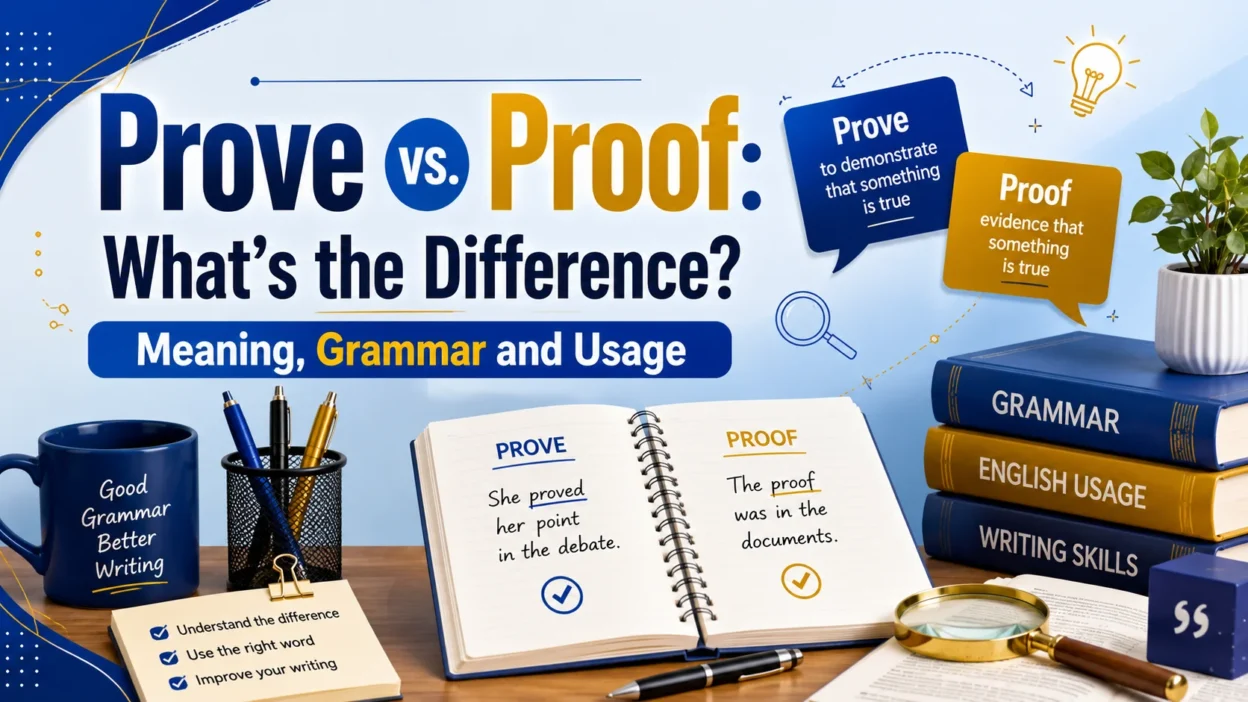
“Prove” is an action. It refers to proving, establishing, confirming, or demonstrating the veracity of something.
Proof is the result. It refers to the evidence, facts, or information that supports a claim.
Here’s the simplest comparison.
| Word | Part of Speech | Meaning | Example |
| Prove | Verb | To show something is true | She will prove her theory. |
| Proof | Noun | Evidence showing something is true | The video is proof of his claim. |
Think of it this way.
You prove something by presenting proof.
That single sentence captures the relationship between the two words.
The Core Difference in One Sentence
If your sentence describes doing something, choose prove.
If your sentence refers to evidence or confirmation, choose proof.
Consider these examples.
- Scientists prove hypotheses through careful testing.
- The experiment provided proof that the medicine worked.
- The lawyer tried to prove his client’s innocence.
- The fingerprint became important proof during the trial.
Notice how “prove” always expresses an action while “proof” names the evidence itself.
When to Use Prove
Use “prove” whenever someone performs the action of demonstrating or establishing truth.
Common situations include:
- Proving a theory
- Proving a point
- Proving innocence
- Proving guilt
- Proving ownership
- Proving identity
- Proving a mathematical statement
- Proving your skills
- Proving someone wrong
- Proving that an idea works
Examples:
- You must prove your identity before opening the account.
- The research aims to prove the connection between sleep and memory.
- She wanted to prove she could finish the project alone.
- The results prove that regular practice improves performance.
When to Use Proof
Use proof when talking about evidence, documentation, or facts that support a claim.
You’ll often encounter proof in situations involving:
- Legal evidence
- Scientific evidence
- Identity verification
- Financial documents
- Academic research
- Business transactions
- Insurance claims
- Online verification
Examples:
- Please provide proof of address.
- There is no proof that the rumor is true.
- The receipts serve as proof of purchase.
- DNA evidence became strong proof in the investigation.
Quick Comparison Table
| Feature | Prove | Proof |
| Part of speech | Verb | Noun |
| Function | Shows action | Names evidence |
| Answers the question | What happens? | What supports the claim? |
| Common after | Subject | Articles like a, the, this, that |
| Example | They proved the claim. | They presented proof. |
What Does Prove Mean?
At its core, prove means to establish the truth of something through facts, logic, observation, testing, or evidence.
People use this verb every day without realizing how flexible it is. You can demonstrate a scientific idea, your integrity, your credentials, or even disprove someone in a friendly argument.
The common thread is always the same. Someone performs an action that demonstrates truth.
Definition of Prove
The verb prove means:
- To demonstrate that something is true.
- To establish a fact with evidence.
- To verify a statement.
- To confirm through testing.
- To show that someone or something possesses a particular quality.
Depending on the context, “prove” can also mean:
- To test successfully.
- To turn out to be.
- To establish legally.
- To validate an argument.
For example:
- The new software proved reliable during testing.
- Time will prove whether the decision was correct.
- The evidence proved his innocence.
- She proved herself to be an excellent leader.
Each sentence shows an action that establishes truth or confirms a conclusion.
Is “prove” a verb?
Yes. “Prove” is a verb, which means it describes an action.
Unlike nouns that name people, places, or things, verbs explain what someone does.
Examples:
- Detectives prove cases using evidence.
- Teachers prove mathematical formulas.
- Scientists prove hypotheses through experiments.
- Athletes prove their abilities through performance.
Because “prove” is a verb, it changes form depending on tense.
| Tense | Form | Example |
| Base | prove | I want to prove my point. |
| Third person singular | proves | She proves her argument clearly. |
| Present participle | proving | They are proving the theory. |
| Past | proved | He proved his innocence yesterday. |
| Past participle | proved / proven | The claim has been proved. The claim has been proven. |
Notice that proved and proven both appear as past participles. You’ll learn the difference between them later in this guide.
How Prove Functions in a Sentence
Most often, “prove” takes a direct object. That object is the thing being demonstrated or established.
Examples:
- They proved the accusation false.
- Scientists proved the hypothesis.
- She proved her qualifications.
- The lawyer proved his client’s innocence.
Another common pattern uses a “that” clause.
Examples:
- The data proves that climate patterns are changing.
- The witness proved that the timeline was incorrect.
- Research proves that exercise improves concentration.
You can also use “prove” with an infinitive.
Examples:
- She proved herself to be dependable.
- The strategy proved to be successful.
- The investment proved to be worthwhile.
These patterns appear frequently in formal writing, academic papers, journalism, and everyday English.
Common Contexts for Using Prove
Although the meaning stays consistent, the way people use it proves changes across different fields.
Academic Writing
Students and researchers regularly use prove when discussing evidence, theories, and logical conclusions.
Examples:
- The experiment failed to prove the hypothesis.
- Researchers hope to prove the effectiveness of the treatment.
- Historical documents prove the event occurred earlier than expected.
Academic writing values evidence over opinion. As a result, “prove” often appears alongside words such as “research,” “data,” “analysis,” “findings,” and “evidence.”
Everyday Conversation
In daily life, “prove” often refers to demonstrating personal abilities or settling disagreements.
Examples:
- I’ll prove that I can do it.
- You don’t have to prove yourself to everyone.
- She proved me wrong.
- They proved their critics wrong.
These expressions are common because they describe ordinary situations where people demonstrate ability, honesty, or determination.
Business Communication
Businesses use proof when discussing results, performance, and measurable outcomes.
Examples:
- The report proves our strategy is working.
- Sales figures prove customer demand is increasing.
- The trial period proved the product’s value.
- The company proved its commitment to quality.
Clear communication matters in business. Using “prove” correctly helps reports and presentations sound precise and professional.
Legal Writing
Legal professionals depend heavily on the concept of proving claims.
In court, attorneys must prove facts using admissible evidence rather than assumptions.
Examples:
- The prosecutor must prove guilt beyond a reasonable doubt.
- The defense argued the evidence failed to prove intent.
- The witness helped prove the timeline.
Here, prove carries significant legal weight because decisions often depend on whether a claim has been established convincingly.
Scientific Writing
Science revolves around observation, experimentation, and verification.
Although scientists often avoid claiming absolute certainty, the verb prove still appears in educational writing and general explanations.
Examples:
- Multiple experiments helped prove the concept.
- New observations may prove previous assumptions incorrect.
- Additional testing will prove whether the material is durable.
In formal scientific publications, researchers sometimes prefer verbs like support, demonstrate, or indicate because scientific knowledge continues to evolve. Even so, prove remains widely understood and commonly used in educational contexts.
What Does Proof Mean?
While prove describes an action, proof names the evidence that supports or confirms a statement. It is one of the most useful nouns in English because it appears in everyday conversation, academic writing, legal documents, finance, science, technology, and many other fields.
Whenever someone asks for proof, they are asking for something tangible that backs up a claim. That proof might be a document, a photograph, a receipt, a scientific result, a witness statement, or even digital records. Unlike prove, which tells you what someone does, proof tells you what they use to establish the truth.
Understanding this distinction makes your writing more accurate and helps you avoid one of the most common grammar mistakes involving these closely related words.
Definition of Proof
Proof is a noun that refers to evidence, facts, or information showing that something is true, valid, or genuine. In everyday English, it often means convincing support for a statement or claim.
Depending on the context, proof can mean:
- Evidence that establishes truth
- Documentation that verifies identity or ownership
- Confirmation of a fact
- A logical demonstration in mathematics
- A trial copy of printed material before publication
- A measure of alcohol strength in certain countries
Although these meanings differ, they all share the same central idea: proof supports or confirms something.
Consider these examples:
- The email served as proof of the agreement.
- We need more proof before making a decision.
- Her diploma is proof of her qualifications.
- The signed contract provides proof of the transaction.
Each example uses proof as something you can present or examine.
Is Proof a Noun?
Yes. Proof is primarily a noun.
Unlike “prove,” which describes an action, “proof” names a thing. That thing may be physical, digital, written, spoken, or even mathematical.
Examples:
- The detective found proof.
- We collected enough proof.
- Their proof convinced the jury.
- This receipt is proof of payment.
Because it is a noun, proof commonly appears after articles and determiners.
Examples:
- The proof
- A proof
- Some proof
- Enough proof
- No proof
- Clear proof
- Strong proof
Different Meanings of Proof
The word “proof” has several specialized meanings. Understanding them helps you choose the right interpretation based on context.
Evidence
This is the most common meaning.
Here, proof means convincing evidence that establishes whether something is true.
Examples:
- There is no proof that the rumor is accurate.
- Police gathered enough proof to continue the investigation.
- Scientists presented proof supporting their findings.
Confirmation
Sometimes proof simply confirms a fact rather than proving it beyond all doubt.
Examples:
- The confirmation email is proof that your order was received.
- The passport serves as proof of citizenship.
- A birth certificate is proof of age.
Mathematical Proof
In mathematics, a proof is a logical sequence of statements demonstrating that a theorem or proposition is true.
Example:
- The student completed the geometric proof correctly.
- Every step in the mathematical proof must follow logical rules.
Unlike ordinary evidence, mathematical proofs rely entirely on logic rather than observation.
Printing Proof
Publishing professionals use proof to describe a preliminary version of a document before final printing.
Examples:
- Please review the page proof before publication.
- The editor corrected several errors in the final proof.
This is where the term proofreading comes from. A proofreader reviews a proof before it goes to print.
Alcohol Proof
In the United States, proof also measures the alcohol content of distilled spirits.
Examples:
- The whiskey is 100 proof.
- Higher proof usually means higher alcohol concentration.
Although this meaning is unrelated to grammar, you may encounter it on beverage labels.
Common Contexts for Using Proof
Because proof represents evidence, it appears in many areas of daily life.
Legal Documents
Law depends on evidence.
Examples include:
- Proof of ownership
- Proof of identity
- Burden of proof
- Proof beyond a reasonable doubt
Legal decisions often depend on whether enough proof exists.
Financial Transactions
Banks and financial institutions routinely request proof.
Examples include:
- Proof of income
- Proof of employment
- Proof of address
- Proof of payment
These documents help verify financial information.
Education
Teachers frequently ask students to support ideas with proof.
Examples:
- Provide proof from the text.
- Your answer needs more proof.
- Cite proof for your conclusion.
Although academic writing often prefers the word evidence, proof remains common in classroom discussions.
Technology
Modern technology relies on digital proof for security.
Examples include:
- Proof of identity
- Proof of authentication
- Proof of ownership
- Proof of purchase
Digital verification has become increasingly important as more services move online.
Prove vs Proof: Side-by-Side Comparison
Now that you’ve learned each word individually, it’s time to compare them directly.
Although they share the same linguistic family, they perform completely different grammatical jobs.
| Feature | Prove | Proof |
| Part of Speech | Verb | Noun |
| Primary Purpose | Shows an action | Names evidence |
| Meaning | Demonstrate truth | Evidence of truth |
| Usually Followed By | Object or clause | Of phrase or modifier |
| Answers | What happened? | What supports it? |
| Example | They proved the claim. | They presented proof. |
A helpful way to remember this relationship is:
You prove a claim by providing proof.
That sentence reflects standard English grammar every time.
Grammar Difference
The biggest distinction is grammatical.
Prove functions as a verb.
Examples:
- I can prove it.
- She proved the accusation false.
- They are proving their theory.
Proof functions as a noun.
Examples:
- We need proof.
- The proof is convincing.
- This document is sufficient proof.
If your sentence needs an action word, choose prove.
If your sentence needs a thing or idea, choose proof.
Meaning Difference
Although closely connected, the meanings are not interchangeable.
Prove describes the process.
Proof describes the supporting evidence.
Imagine a courtroom.
The attorney works to prove the defendant’s innocence.
The attorney uses witness testimony, documents, and video recordings as proof.
Without proof, proving something becomes much more difficult.
Part of Speech
Understanding parts of speech eliminates most confusion.
| Word | Part of Speech |
| Prove | Verb |
| Proof | Noun |
Notice the different sentence structures.
Correct:
- Scientists proved the theory.
- Scientists presented proof.
Incorrect:
- Scientists proof the theory.
- Scientists presented prove.
The incorrect examples sound awkward because the wrong part of speech has replaced the correct one.
Sentence Position
Another easy way to identify the correct word is by its position.
Prove usually appears after the subject.
Examples:
- They proved the allegation.
- Researchers prove theories through experiments.
- The evidence will prove the claim.
Proof usually follows an article, adjective, or preposition.
Examples:
- The proof was overwhelming.
- Strong proof convinced everyone.
- We asked for proof of residence.
Watching where each word appears in a sentence quickly reveals which one belongs.
Typical Collocations
Native English speakers naturally pair these words with certain expressions.
Common collocations with prove:
- Prove a point
- Prove a theory
- Prove innocence
- Prove guilt
- Prove eligibility
- Prove ownership
- Prove effective
- Prove useful
- Prove someone wrong
- Prove yourself
Common collocations with proof:
- Proof of identity
- Proof of payment
- Proof of purchase
- Proof of address
- Proof of concept
- Burden of proof
- Scientific proof
- Conclusive proof
- Documentary proof
- Physical proof
Learning these natural combinations improves both speaking and writing.
Comparison Table
The following table summarizes the most important differences.
| Question | Prove | Proof |
| Is it an action? | Yes | No |
| Is it evidence? | No | Yes |
| Part of speech | Verb | Noun |
| Can it change tense? | Yes | No |
| Can it be plural? | Rarely used as a verb only | Usually uncountable but “proofs” exists in specialized contexts |
| Used in everyday conversation? | Yes | Yes |
| Used in legal writing? | Frequently | Frequently |
| Used in academic writing? | Frequently | Frequently |
Prove vs Proof in Real Sentences
One of the fastest ways to master these words is by seeing them in realistic situations. Instead of memorizing grammar rules, notice how native speakers naturally choose prove when describing an action and proof when referring to evidence.
Everyday English Examples
Daily conversations include both words more often than many people realize.
Examples using prove:
- I’ll prove that I finished the work.
- You don’t need to prove yourself to everyone.
- Time will prove whether the decision was right.
- She hopes to prove her abilities during the interview.
- They worked hard to prove the critics wrong.
Examples using proof:
- Do you have proof of payment?
- The receipt is enough proof.
- There isn’t any proof supporting that story.
- We asked for proof before approving the request.
- The photo became valuable proof.
Notice how naturally each word fits its role. Replacing one with the other would immediately make the sentence grammatically incorrect.
Academic Examples
Schools, colleges, and universities rely heavily on evidence-based writing, making these words especially important in academic English.
Examples:
- Researchers hope to prove the hypothesis through repeated experiments.
- The collected data provides strong proof for the conclusion.
- Students must prove each mathematical statement logically.
- Historical records offer valuable proof about ancient civilizations.
- The professor asked the class to prove the theorem before discussing the next chapter.
Academic writing often favors precise language, so understanding this distinction strengthens essays, reports, and research papers.
Business Examples
Clear communication matters in the workplace. Whether you’re preparing a report, writing a proposal, or speaking with clients, using prove and proof correctly makes your message more professional and credible.
Examples using prove:
- The quarterly results prove our marketing strategy is working.
- Customer feedback helped prove the value of the new service.
- The trial period will prove whether the software meets our needs.
- Sales data proved that customers preferred the updated design.
- We need to prove the return on investment before expanding the project.
Examples using proof:
- Please attach proof of payment before processing the order.
- The signed contract serves as proof of the agreement.
- We require proof of insurance before work begins.
- Financial records provide proof of revenue growth.
- The invoice is acceptable proof of purchase.
Businesses rely on documentation every day. In most cases, someone must prove a claim by providing proof in the form of reports, receipts, contracts, or official records.
Legal Examples
Legal English places a strong emphasis on both words because court cases depend on evidence and the ability to establish facts.
Examples using prove:
- The prosecution must prove every element of the offense.
- The defense attempted to prove the defendant acted in self-defense.
- The attorney could not prove intent beyond a reasonable doubt.
- The witness helped prove the timeline of events.
- The evidence failed to prove negligence.
Examples using proof:
- DNA became crucial proof in the investigation.
- The judge requested additional proof before issuing a ruling.
- Video footage served as compelling proof.
- The burden of proof rests with the prosecution.
- There wasn’t enough proof to support the allegation.
In legal settings, the difference between these words is especially important because proof refers to the evidence presented while prove describes the act of establishing a fact.
Scientific Examples
Science depends on testing, observation, and repeatable results. Although researchers often use words such as support, demonstrate, or indicate, you’ll still encounter prove and proof in educational materials and scientific discussions.
Examples:
- Scientists hope to prove the theory through additional experiments.
- Laboratory results offered proof that the reaction occurred.
- Researchers cannot prove every hypothesis immediately.
- The experiment produced convincing proof of the chemical change.
- Independent studies helped prove the effectiveness of the treatment.
Scientific writing reminds us that strong claims require strong evidence. Reliable proof comes from careful observation, accurate data collection, and repeated testing.
How to Decide Between Prove and Proof Every Time
Many learners hesitate because both words relate to truth and evidence. Fortunately, choosing the correct one becomes simple once you ask yourself a single question before writing.
Ask Yourself One Simple Question
Ask:
Am I describing an action or naming evidence?
If you’re describing someone doing something to establish truth, use prove.
If you’re referring to the evidence itself, use proof.
That one question solves most grammar mistakes involving these words.
If You Need an Action, Choose Prove
Remember that verbs describe actions.
Choose prove when someone:
- Demonstrates a fact
- Verifies information
- Confirms a claim
- Establishes truth
- Shows ability
- Supports an argument through evidence
Examples:
- She wants to prove her point.
- The scientist will prove the hypothesis.
- We must prove ownership before selling the property.
If You Need Evidence, Choose Proof
Choose proof whenever you’re referring to something that supports a statement.
Examples:
- We need proof of ownership.
- The document provides proof of residency.
- There is little proof supporting that claim.
- The photographs became valuable proof.
If you can replace the word with evidence, documentation, or confirmation, proof is almost always the correct choice.
Decision Flowchart
Use this quick mental guide whenever you’re unsure.
| Question | Answer | Choose |
| Is someone performing an action? | Yes | Prove |
| Are you talking about evidence? | Yes | Proof |
| Does the sentence need a verb? | Yes | Prove |
| Does the sentence need a noun? | Yes | Proof |
This simple decision process works in nearly every situation.
Why People Confuse Prove and Proof
Despite their different grammatical roles, these words cause confusion for native speakers and English learners alike.
Several factors explain why.
Similar Meaning
Both words revolve around truth, evidence, and verification.
Because they belong to the same word family, people naturally assume they can replace one another. However, related meanings do not make words interchangeable.
Think about teach and teacher.
One describes an action.
The other names a person.
The relationship between prove and proof works in much the same way.
Shared Word Origin
Both words trace their history to Latin and Old French, where they developed from terms meaning to test, to examine, or to establish truth.
As English evolved, one form became the primary verb while the other developed into a noun representing evidence or confirmation.
Their shared origin explains why they still resemble one another today.
Influence of Informal Speech
People sometimes hear incorrect expressions in casual conversation.
Examples include:
- “Can you proof that?”
- “I need you to proof this fact.”
These sentences are grammatically incorrect unless proof refers to reviewing printed material, which is a specialized publishing term.
Hearing incorrect usage repeatedly can make mistakes seem acceptable, even though standard English grammar rejects them.
Common Learner Mistakes
English learners often make predictable errors, including:
❌ I need to proof my argument.
✅ I need to prove my argument.
❌ She gave me enough prove.
✅ She gave me enough proof.
❌ They proofed the accusation.
✅ They proved the accusation.
Learning each word’s grammatical role prevents these mistakes from becoming habits.
Can Proof Ever Be Used as a Verb?
Surprisingly, yes—but only in specific situations.
This exception often surprises learners because it doesn’t follow the everyday meaning of prove.
Proof in Printing
In publishing, to proof means to examine written material for errors before publication.
Examples:
- The editor will proof the manuscript.
- Please proof the final version before printing.
- She spent the afternoon proofing the magazine.
This specialized verb gave English the familiar word proofreading.
Even professional editors often say proofread rather than simply proof, but both are accepted within publishing.
Proof in Baking and Food Preparation
Bakers also use proof as a verb.
Here, it means allowing yeast dough to rise before baking.
Examples:
- Let the dough proof for one hour.
- The bread needs additional time to proof.
- Proper proofing improves texture and flavor.
This meaning has nothing to do with evidence. Instead, it refers to fermentation and rising dough.
Why This Doesn’t Replace Prove
Outside of publishing and baking, “proof” should not replace “prove.”
Compare these examples.
Correct:
- I can prove my claim.
- Scientists prove theories through research.
Incorrect:
- I can proof my claim.
- Scientists proof theories.
Unless you’re editing a document or preparing bread dough, prove remains the correct verb.
Prove, Proved, and Proven: Explained
One area that causes even more confusion is the relationship between “prove,” “proved,” and “proven.”
Fortunately, the rules are straightforward once you understand how English verb forms work.
Present, Past, and Past Participle Forms
The verb “prove” changes according to tense.
| Tense | Form | Example |
| Base | prove | They prove their point. |
| Present Simple | proves | She proves her argument. |
| Present Participle | proving | They are proving the claim. |
| Past Simple | proved | He proved his innocence. |
| Past Participle | proved / proven | The theory has been proved. The theory has been proven. |
Both “proved” and “proven” appear as past participles, although usage varies by region and style.
Proved vs Proven
Both forms are grammatically correct, but they aren’t always equally common.
Proved is the traditional past participle.
Examples:
- The claim has been proved.
- The theorem was proved decades ago.
“Proven” developed later and has become especially common in modern English.
Examples:
- The treatment has been proven effective.
- He has proven himself as a reliable leader.
- This is a proven strategy.
Today, many style guides accept both forms. However, “proven” frequently appears as an adjective before nouns.
Examples:
- A proven method
- A proven solution
- A proven leader
- A proven technique
These expressions sound natural in contemporary American English.
American English vs British English
Regional preferences also influence usage.
| American English | British English |
| Often prefers “proven” as the past participle and adjective | More commonly uses “proved” as the past participle, though “proven” is also accepted |
| Frequently says “has proven effective” | Often says “has proved effective.” |
If you’re writing primarily for an American audience, “proven” is generally the more familiar choice in everyday and business writing.
Conclusion
Choosing between “prove” and “proof” becomes much easier once you understand their different roles in English grammar. “Prove” is the verb that shows an action, while “proof” is the noun that refers to evidence or confirmation. Although the two words share a common root and look similar, they are not interchangeable. Paying attention to context, grammar, and sentence structure will help you use each word correctly. With regular reading, writing, and speaking practice, you’ll build confidence and use “prove” vs. “proof” naturally in academic, professional, and everyday communication.
FAQs
Q1. What is the main difference between “prove” and “proof”?
“Prove” is a verb that means to show or demonstrate that something is true. Proof is a noun that means the evidence or information that confirms something.
Q2. Can I use “proof” as a verb instead of “prove”?
In standard English, no. You should say “prove the statement,” not “proof the statement.” The word “proof” is generally used as a noun, while “prove” is the correct verb.
Q3. Why do people confuse “prove” and “proof”?
People often confuse them because they share the same linguistic root, have similar spellings, and are closely related in meaning. However, they perform different grammatical functions.
Q4. How can I remember when to use “prove” or “proof”?
A simple trick is to remember that “prove” is something you do (an action), while “proof” is something you have (evidence). This memory tip helps you choose the correct word quickly.
Q5. Is learning “prove” vs. “proof” important for English writing?
Yes. Understanding “prove” vs. “proof” improves grammar, sentence clarity, word choice, and overall communication. It also helps you write more accurately in essays, emails, reports, and everyday conversations.