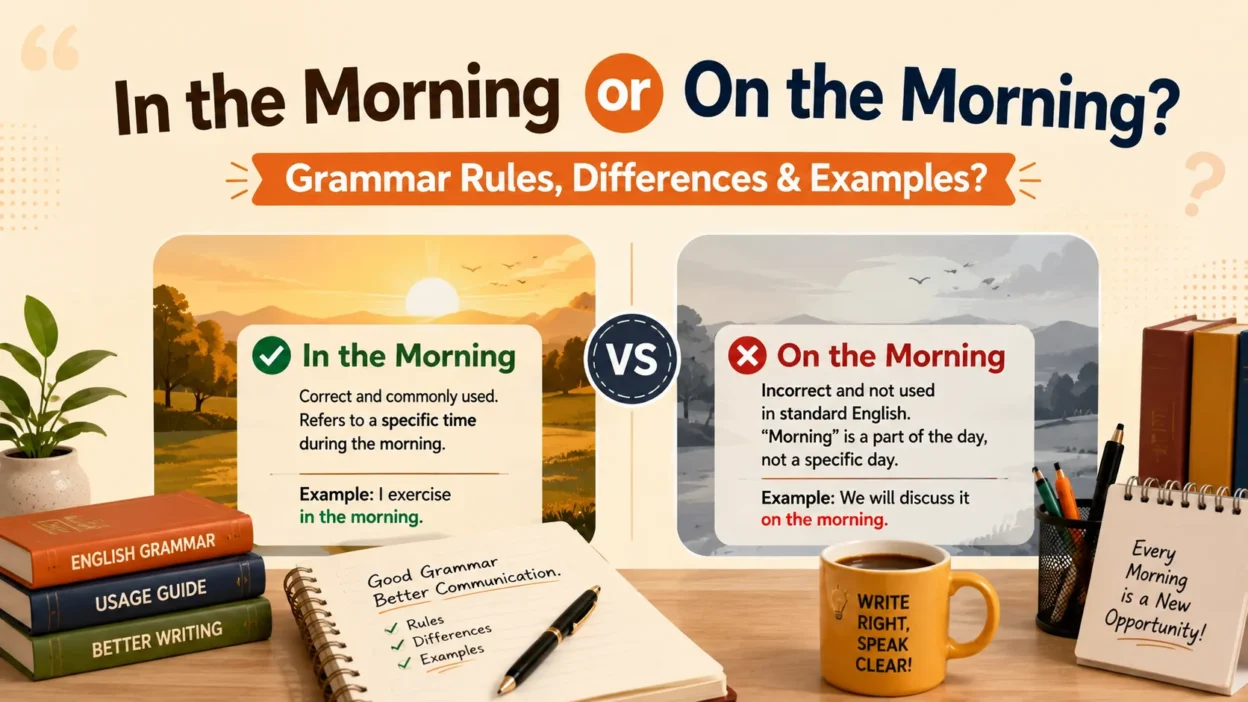
“In The Morning” or “On The Morning” may look similar, but choosing the right one makes your English sound more natural. In English grammar, the basic grammar rule is simple. Use in the morning for a general part of the day or a daily routine, and use on the morning for a specific morning connected to a specific day, date, event, or occasion, such as Monday morning. Many English learners make this grammar mistake, yet the right preposition choice quickly improves correct usage, grammatical accuracy, English usage, and your confidence in both English writing and English speaking.
A good grammar guide does more than explain a single phrase or expression. It shows how time prepositions, English prepositions, and grammar expressions work in real communication. Using examples, practical examples, and real-world examples helps you understand the difference, exact difference, and contextual meaning behind each choice. Whether you are writing an email, replying to a WhatsApp message, making plans for tomorrow, or talking with native speakers and other English speakers, these skills strengthen language learning, language comprehension, language mastery, communication skills, speaking skills, writing skills, clarity, fluency, accuracy, and confidence.
If you are also a German learner, whether a beginner German student or an advanced German learner, comparing German grammar, German syntax, German writing, and German communication with English can be helpful. Small words like im, am, um, bei, an, in, auf, and on often create common confusion and translation challenges, but they also improve comprehension when studied carefully. A trusted usage guide, instructional guide, reference guide, or learning resource supports learning English and learning German through resources like Mastering German. As you exercise these skills every day, you will avoid incorrect usage, understand proper usage, and dive in with greater confidence.
The Short Answer
If you’re looking for the quickest explanation, here’s the rule:
- Use in the morning when talking about mornings in general.
- Use on the morning when referring to a particular morning tied to a specific day or event.
Quick Examples
I usually drink coffee in the morning.
Birds are most active in the morning.
We left on the morning of July 4.
She arrived on the morning of her interview.
Notice the pattern. The first two sentences describe everyday situations. The last two point to one particular morning.
Simple Rule to Remember
| Expression | Use It When | Example |
| In the morning | Talking about mornings generally | I exercise in the morning. |
| On the morning | Talking about one specific morning | We met on the morning of the ceremony. |
Think of it this way:
- General time = In
- Specific day or event = On
That single idea explains most situations you’ll encounter.
Why “In the Morning” and “On the Morning” Cause So Much Confusion
English learners often struggle with prepositions because they rarely translate directly from one language to another. A phrase that sounds natural in one language may sound awkward or even incorrect in English.
Why Both Phrases Seem Correct
Both expressions include the word morning, so it’s easy to assume they’re interchangeable. They’re not.
Consider these sentences:
- I read the news in the morning.
- We received the results on the morning of the exam.
Both are grammatically correct, yet each describes a different type of time reference.
The first sentence talks about a regular time of day.
The second identifies one exact morning connected to an event.
The Role of Time Prepositions in English
English organizes time into different levels.
| Time Reference | Common Preposition | Example |
| Months | In | In May |
| Years | In | In 2026 |
| Seasons | In | In winter |
| Parts of the day | In | In the morning |
| Days | On | On Monday |
| Dates | On | On June 5 |
| Holidays (specific day) | On | On Christmas Day |
| Clock times | At | At 8:00 a.m. |
Notice the pattern.
As the time becomes more specific, English often changes the preposition.
How Context Changes the Meaning
Context matters more than the words themselves.
Compare these examples.
General context
I enjoy jogging in the morning.
This means any morning.
Specific context
We started our trip on the morning of December 24.
Now you’re talking about one identifiable morning.
The difference is subtle but important.
What Does “In the Morning” Mean?
The phrase in the morning refers to the morning as a general period of the day. It doesn’t point to one unique morning unless additional information changes the meaning.
Native speakers use this expression constantly in everyday conversation.
Definition
In the morning means during the morning hours, usually between sunrise and noon.
It answers questions like:
- When do you wake up?
- When do you study?
- When do you work out?
Common Situations
People use in the morning when discussing:
- Daily habits
- Routines
- Preferences
- General schedules
- Regular activities
- Typical events
Everyday Examples
- I feel more productive in the morning.
- Most stores open in the morning.
- Children usually leave for school in the morning.
- She likes taking long walks in the morning.
- We rarely eat heavy meals in the morning.
Every sentence refers to mornings generally rather than one particular date.
Why Native Speakers Prefer It
Native speakers naturally think of morning as one section of the day.
Imagine dividing the day into blocks.
| Part of the Day | Typical Expression |
| Morning | In the morning |
| Afternoon | In the afternoon |
| Evening | In the evening |
| Night | At night |
This pattern stays remarkably consistent.
Once you learn one phrase, the others become much easier.
Common Sentence Patterns
You’ll often see these structures:
Subject + verb + in the morning
- I study in the morning.
- They arrive in the morning.
Subject + usually + verb + in the morning
- She usually exercises in the morning.
- We usually cook breakfast in the morning.
Question + in the morning
- What do you do in the morning?
- Why do you wake up so early in the morning?
These patterns appear frequently in spoken and written English.
Common Collocations
Some words naturally pair with in the morning.
| Verb | Example |
| Wake up | I wake up early in the morning. |
| Exercise | She exercises in the morning. |
| Leave | They leave in the morning. |
| Drink | We drink coffee in the morning. |
| Study | Students study in the morning. |
| Begin | Classes begin in the morning. |
Learning these combinations helps your English sound more natural.
Tip: Native speakers often remember phrases instead of individual grammar rules. That’s why practicing complete expressions works so well.
When Is “On the Morning” Correct?
Many learners avoid on the morning because it feels unusual. In reality, it’s perfectly correct when used in the right context.
The key is specificity.
The Grammar Rule
Use on the morning when you’re referring to one particular morning associated with a known day, date, or event.
Instead of talking about mornings generally, you’re identifying one exact morning.
Examples
- We departed on the morning of April 12.
- The announcement came on the morning of the election.
- She felt nervous on the morning of her wedding.
- They met on the morning of the conference.
Each sentence points to one unique morning.
Why It Works
Think about these examples.
I always run on the morning.
This sounds incomplete because the listener doesn’t know which morning.
Now compare it.
I ran on the morning of the marathon.
Now the sentence identifies one specific morning.
That’s exactly what on is designed to do.
Situations Where It Sounds Natural
You’ll commonly hear on the morning with:
- Weddings
- Interviews
- Flights
- Birthdays
- Conferences
- Holidays
- Exams
- Sporting events
- Important announcements
- Medical appointments
Examples:
- We packed everything on the morning of our flight.
- He called on the morning of the interview.
- Snow started falling on the morning of Christmas Day.
Situations Where It Sounds Unnatural
Avoid on the morning when discussing routines.
Incorrect:
- I shower on the morning.
- We read newspapers on the morning.
- She studies on the morning.
Correct:
- I shower in the morning.
- We read newspapers in the morning.
- She studies in the morning.
If there’s no specific date or event, in almost always wins.
“On the Morning Of” vs. “In the Morning”
These expressions often appear together in grammar discussions because they describe different kinds of time.
Understanding this distinction makes choosing the right phrase much easier.
The Key Difference
| Expression | Meaning |
| In the morning | During mornings generally |
| On the morning of | During one particular morning connected to an event or date |
That’s the entire rule in one table.
Side-by-Side Comparison
| In the Morning | On the Morning Of |
| I work better in the morning. | We signed the contract on the morning of July 8. |
| Birds sing in the morning. | It rained on the morning of the parade. |
| She drinks tea in the morning. | He arrived on the morning of his birthday. |
| I usually read in the morning. | They canceled the meeting on the morning of the conference. |
Notice how every example using on includes an identifiable event.
Which Expression Refers to an Event?
The easiest way to remember the difference is this:
Ask yourself one question.
Can I point to one exact morning on a calendar?
If the answer is yes, use on the morning of.
If the answer is no, use in the morning.
A Practical Example
Imagine your friend asks:
“When do you normally go to the gym?”
You’d answer:
I go in the morning.
Now imagine another question.
“When did you leave for your vacation?”
A natural answer would be:
We left on the morning of July 15.
The first answer describes a habit.
The second identifies one specific moment in time.
Grammar Rule Behind These Time Prepositions
English prepositions aren’t random. They follow a system based on how broad or specific the time reference is.
Understanding this pattern helps far beyond in the morning vs. on the morning.
Why English Uses In for Parts of the Day
The preposition in usually refers to larger periods that contain many smaller moments.
Examples include:
- In January
- In summer
- In 2026
- In the morning
Each phrase describes a broad time frame rather than a single point.
Why English Uses On for Specific Days
The preposition on narrows the focus.
Examples include:
- On Monday
- On Tuesday morning
- On July 4
- On Christmas Day
- On the morning of the ceremony
Here, the speaker identifies one precise day or event.
How Specificity Changes Everything
Think of time like a zoom lens.
- In shows the wide view.
- On zooms closer.
- At zooms in even further.
| Level | Preposition | Example |
| Broad | In | In the morning |
| Specific | On | On Monday morning |
| Exact | At | At 8:30 a.m. |
This simple progression explains dozens of English grammar rules.
Sentence Patterns You Can Copy
One of the fastest ways to improve your English is to learn complete sentence structures instead of isolated grammar rules.
Here are some natural patterns you can use immediately.
Pattern With “In the Morning”
Subject + verb + in the morning
- I meditate in the morning.
- They study in the morning.
- She writes emails in the morning.
Pattern With “On the Morning”
Subject + verb + on the morning of + event/date
- We arrived on the morning of the conference.
- He called on the morning of the interview.
- They left on the morning of Independence Day.
Pattern With “On Monday Morning”
Sometimes you don’t need of.
Examples:
- We met on Monday morning.
- She arrived on Friday morning.
- The package came on Tuesday morning.
This construction is common because Monday morning already identifies a specific time.
Conclusion
Choosing between “In The Morning” and “On The Morning” becomes much easier once you understand the basic grammar rule. Use in the morning for general routines or parts of the day, and use on the morning when referring to a specific date, event, or occasion. With regular practice and exposure to natural English, you’ll make better preposition choices and write with greater clarity, accuracy, and confidence. Keep reading, listening, and using these expressions in real conversations, and they will soon become second nature.
FAQs
Q1. What is the difference between “in the morning” and “on the morning”?
In the morning refers to mornings in general or daily routines. On the morning refers to one specific morning connected to a particular day, date, or event.
Q2. Is “on the morning” grammatically correct?
Yes. On the morning is grammatically correct when it refers to a specific occasion, such as “on the morning of the wedding” or “on the morning of July 4.”
Q3. Why do English learners confuse these expressions?
Many English learners confuse them because both phrases mention morning, but they follow different time preposition rules. Understanding the context makes the correct choice much easier.
Q4. Can I use “in the morning” with a specific date?
No. If you’re talking about a specific date or event, use on the morning instead. Use in the morning only for general time references or everyday habits.
Q5. How can I remember the correct usage easily?
A simple trick is to remember general time = in and specific day or event = on. Practicing this rule with real-life examples will help you use both expressions naturally.