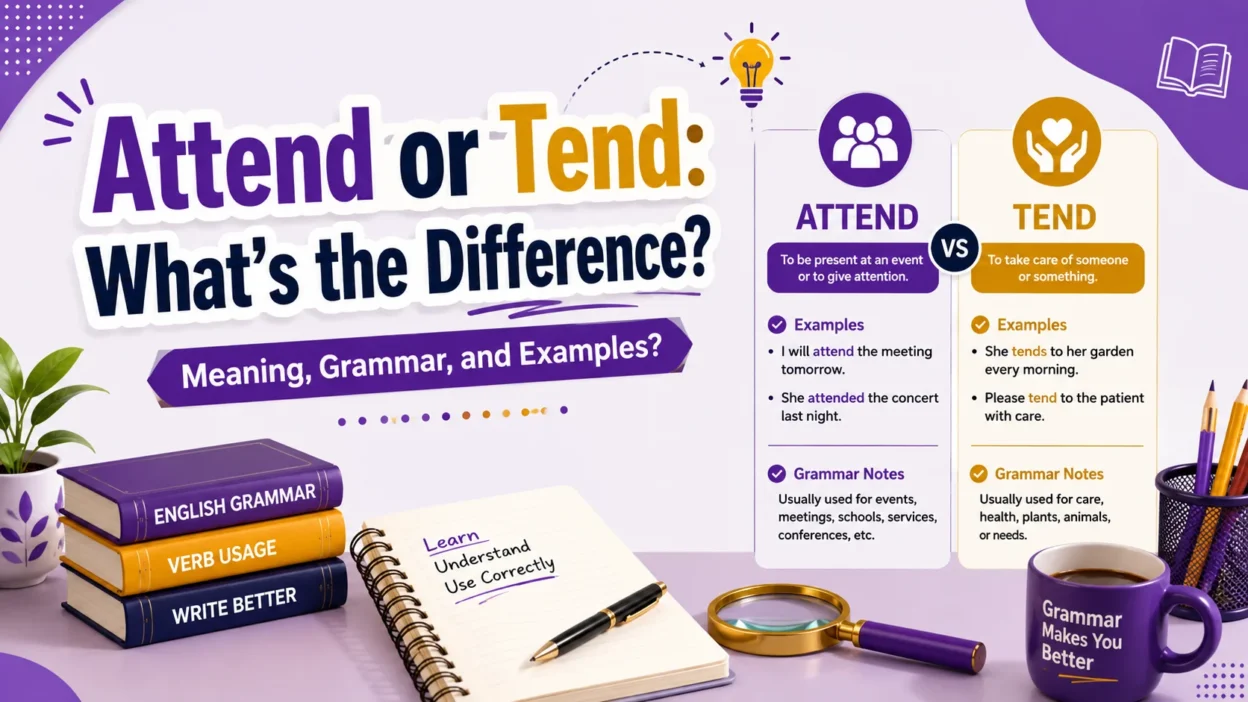
Attend or Tend helps English learners improve English grammar and English communication by choosing the correct verb for every situation. Although these Similar sounding words have Similar spelling, they have Different meanings and different Grammatical functions.
Attend means Being present at an Event, meeting, conference, Class, English exam, or Project discussions, while Attend to means Take care of something. Tend means Look after, Care for, or Maintain a Patient, Garden, or Project tasks, and Tend to describes a Natural tendency over a Period of time.
Good Writing and Speaking depend on using the right Word in the right Context. A practical Guide with Practical examples, Easy examples, Simple explanation, Memory tricks, and a Side by side comparison builds Confidence, helps Language learners Understand, Learn, and Improve. This approach reduces Common vocabulary mistakes, strengthens Professional communication, and helps you use Words correctly in Real-life English..
Attend or Tend? The Quick Answer
If you’re looking for a simple answer, here’s the difference.
- Attend means to be present at an event, meeting, class, appointment, or activity.
- Tend means to care for someone or something or to usually do something when used as tend to.
Here’s a quick comparison.
| Word | Meaning | Example |
| Attend | Be present | I attended the seminar yesterday. |
| Tend | Care for | Nurses tend patients every day. |
| Tend to | Usually do | Children tend to learn quickly. |
Quick examples:
- She attended the conference.
- Farmers tend their crops.
- Students attend school every weekday.
- Older cars tend to require more maintenance.
Although these words look alike, they are not interchangeable in normal English.
Why Do People Confuse Attend or Tend?
Many English learners struggle with Attend or Tend because the words have similar spelling but completely different meanings.
Let’s look at the main reasons.
Their Spellings Are Very Similar
The only noticeable difference is the beginning of the word.
- Attend
- Tend
Because attend contains all the letters found in tend, many learners mistakenly believe both words have related meanings.
However, English treats them as separate verbs with different purposes.
Both Words Appear in Formal English
You’ll often see both verbs in workplaces, schools, hospitals, and official documents.
For example:
- Employees must attend training.
- Nurses tend patients.
- Managers attend meetings.
- Gardeners tend flowers.
Since both verbs appear in professional writing, learners sometimes choose the wrong one.
Adding “To” Creates More Confusion
Things become even more confusing because both verbs can be followed by to.
Consider these examples.
- Please attend to the customer.
- People tend to arrive early.
Although both expressions contain to, their meanings are completely different.
- Attend to means deal with, respond to, or take care of something immediately.
- Tend to means usually do something or have a habit of doing it.
Understanding this difference prevents many common grammar mistakes.
What Does Attend Mean?
The verb attend usually means to be present at an event or activity.
It comes from the Latin word attendere, meaning to direct attention toward something. Over time, the meaning expanded to include showing up for meetings, classes, appointments, and public events.
Today, attend has three common uses.
Attend Means “Be Present”
This is the most common meaning.
Whenever someone goes to an event, they attend it.
Examples include:
- Attend school
- Attend class
- Attend a meeting
- Attend a conference
- Attend a seminar
- Attend church
- Attend a wedding
- Attend an interview
- Attend an appointment
Example sentences
- More than 500 people attended the technology conference.
- Sarah attends university in Boston.
- Every employee must attend the safety workshop.
- Thousands attended the music festival.
Notice that attend focuses on being present, not participating.
Attend Means “Pay Attention”
Although less common today, attend can also mean listen carefully or focus on something.
Examples:
- Please attend carefully to the speaker.
- Students should attend to every instruction.
- Judges attend closely to the evidence.
In everyday American English, people usually say pay attention instead because it sounds more natural.
Attend Means “Deal With or Handle”
When followed by to, the verb changes meaning.
Attend to means:
- Handle
- Respond to
- Deal with
- Take care of
Examples:
- I’ll attend to your request shortly.
- The receptionist attended to every guest.
- Someone needs to attend to the broken printer.
- The technician attended to the network issue immediately.
This expression appears frequently in customer service, healthcare, and business communication.
Real-Life Examples of Attend
Imagine a typical workday.
You attend a morning meeting.
Then you attend to customer emails.
Later, you attend an online training session.
Each sentence uses attend correctly, but the meaning changes slightly depending on whether to follows the verb.
Common Situations Where You Use Attend
People regularly use attend in situations involving presence.
- School
- College
- University
- Business meetings
- Conferences
- Workshops
- Training sessions
- Medical appointments
- Court hearings
- Weddings
- Funerals
- Religious services
- Sporting events
- Online webinars
A simple rule works almost every time.
If you need to show up somewhere, you attend it.
What Does Tend Mean?
The verb tend has a completely different meaning from attend.
Instead of showing up somewhere, tend usually refers to taking care of someone or something or describing something that usually happens.
Both meanings are extremely common in modern English.
Tend Means “Care For”
This is one of the oldest meanings of tend.
When you tend something, you look after it, maintain it, or care for it over time.
Examples include:
- Tend a garden
- Tend livestock
- Tend children
- Tend patients
- Tend wounds
- Tend crops
Example sentences
- Farmers tend their fields throughout the year.
- Nurses tend patients around the clock.
- She spends every weekend tending her vegetable garden.
- Veterinarians carefully tend injured animals.
Unlike attend, this verb emphasizes ongoing care, not simply being present.
Tend Means “Usually”
When followed by to, the meaning changes.
Tend to describes habits, patterns, or things that commonly happen.
Examples:
- Children tend to ask lots of questions.
- Prices tend to increase during holidays.
- Experienced writers tend to edit their work twice.
- People tend to remember emotional experiences.
Notice that tend to doesn’t describe certainty.
Instead, it expresses what generally happens.
For example:
People tend to spend more money during the holiday season.
This means it happens often, not always.
Tend Means “Move Toward”
Although less common, tend can also describe movement in a certain direction.
Examples:
- Temperatures tend upward during spring.
- The road tends east after the bridge.
You’ll mostly see this meaning in scientific or technical writing.
Real-Life Examples of Tend
Imagine a hospital.
Doctors attend a medical conference.
Afterward, nurses tend patients in the emergency department.
Although both actions occur in the same place, the verbs describe completely different responsibilities.
Everyday Examples
| Sentence | Correct Word |
| I will ______ the conference tomorrow. | Attend |
| Nurses ______ injured patients every day. | Tend |
| Most people ______ check their phones often. | Tend to |
| Employees must ______ the workshop. | Attend |
| Farmers ______ crops throughout the growing season. | Tend |
Attend or Tend: Side-by-Side Comparison
The easiest way to master Attend or Tend is to compare them directly.
| Feature | Attend | Tend |
| Primary meaning | Be present | Care for |
| Secondary meaning | Handle (attend to) | Usually do (tend to) |
| Common objects | Meetings, classes, events | Patients, gardens, crops |
| Indicates presence | Yes | No |
| Indicates care | Sometimes | Yes |
| Indicates habits | No | Yes (tend to) |
| Common in business | Yes | Yes |
Quick Comparison
| Attend | Tend |
| Attend school | Tend a garden |
| Attend college | Tend livestock |
| Attend a meeting | Tend patients |
| Attend a wedding | Tend wounds |
| Attend an interview | Tend crops |
| Attend training | Tend to worry |
A helpful way to remember the difference is this:
- Attend = Go somewhere.
- Tend = Care for something.
- Tend to = Usually happens.
Attend, Attend To, Tend, and Tend To: What’s the Difference?
This is where many learners become confused because adding to changes the meaning of both verbs.
Let’s examine each one.
Attend
Attend means be present.
Examples:
- We attended the conference.
- She attends school every day.
- Hundreds attended the concert.
The emphasis is on showing up.
Attend To
Attend to means respond to, deal with, or take care of.
Examples:
- I’ll attend to your request immediately.
- Please attend to the customer.
- Engineers attended to the equipment before reopening the factory.
This phrase commonly appears in professional communication.
Tend
Tend means care for someone or something.
Examples:
- Nurses tend patients.
- Farmers tend livestock.
- Gardeners tend flowers.
Unlike attend, this verb emphasizes continuous care and maintenance.
Tend To
Tend to describes something that usually happens.
Sentence structure:
Subject + tend to + base verb
Examples:
- Students tend to study more before exams.
- Dogs tend to be loyal.
- Prices tend to rise during peak seasons.
- Children tend to imitate adults.
This structure is especially common in academic writing because it describes trends rather than absolute facts.
Which One Should You Use?
Ask yourself one simple question.
What do you want to express?
| Meaning | Correct Expression |
| Be present | Attend |
| Handle or respond | Attend to |
| Care for | Tend |
| Usually happens | Tend to |
Answering that question will help you choose the correct verb almost every time.
Can Attend Replace Tend?
In almost every case, no.
Although Attend or Tend look similar, they are not synonyms.
Consider these examples.
❌ She tended the conference.
✅ She attended the conference.
❌ The volunteers attended the injured hikers.
✅ The volunteers tended the injured hikers.
Replacing one word with the other either changes the meaning or produces an incorrect sentence.
Situations Where You Cannot Replace Them
Events
- Attend a conference ✔
- Tend a conference ✘
Education
- Attend school ✔
- Tend school ✘
Healthcare
- Tend patients ✔
- Attend patients (rare in modern English except in specific formal contexts)
Gardening
- Tend flowers ✔
- Attend flowers ✘
Cases That Cause Confusion
The phrase attend to sometimes overlaps slightly with tend because both involve taking care of something.
Compare these examples.
- The nurse attended to the patient.
- The nurse tended the patient.
Both sentences are correct, but the emphasis differs.
- Attend to highlights responding to an immediate need.
- Tend emphasizes providing ongoing care.
Understanding this subtle distinction makes your English sound much more natural, especially in professional and academic writing.
Common Situations Where You Use Attend
You use attend whenever your presence is required.
Education
- Attend school
- Attend college
- Attend online classes
Workplace
- Attend meetings
- Attend training sessions
- Attend interviews
Events
- Attend weddings
- Attend conferences
- Attend concerts
Healthcare
- Attend medical appointments
- Attend therapy sessions
Common Situations Where You Use Tend
Use tend when caring for someone or describing a common habit.
Caring for People
- Tend patients
- Tend children
- Tend the elderly
Gardening and Farming
- Tend flowers
- Tend crops
- Tend livestock
Habits and Patterns
- People tend to worry before exams.
- Prices tend to rise during holidays.
- Cats tend to sleep during the day.
Common Collocations with Attend
Some of the most common collocations include:
- Attend school
- Attend class
- Attend college
- Attend a meeting
- Attend a conference
- Attend a seminar
- Attend a workshop
- Attend church
- Attend a wedding
- Attend an appointment
Examples
- She attends college in California.
- We attended a business seminar yesterday.
- Every employee must attend the safety meeting.
Common Collocations with Tend
Frequently used collocations include:
- Tend to
- Tend patients
- Tend wounds
- Tend livestock
- Tend crops
- Tend a garden
- Tend machinery
Examples
- Farmers tend their fields daily.
- Nurses tend patients with great care.
- Children tend to imitate adults.
Grammar Rules for Attend or Tend
Remember these simple rules:
- Attend + noun → Attend a meeting.
- Attend to + noun → Attend to the customer.
- Tend + noun → Tend the garden.
- Tend to + base verb → People tend to forget names.
| Structure | Example |
| Attend + event | Attend a conference |
| Attend to + object | Attend to the complaint |
| Tend + person/thing | Tend patients |
| Tend to + verb | Tend to arrive early |
Common Mistakes
Here are mistakes many learners make.
❌ I tended the meeting.
✅ I attended the meeting.
❌ She attended the flowers.
✅ She tended the flowers.
❌ People attend to forget.
✅ People tend to forget.
Easy Memory Tricks
Here are three quick ways to remember Attend or Tend.
- Attend = Appear at an event.
- Tend = Take care of someone or something.
- Tend to = Typical behavior or what usually happens.
These simple associations make the difference much easier to remember.
Practice Exercise
Choose the correct word.
- We will ______ the conference tomorrow.
- Nurses ______ injured patients every day.
- Children ______ ask many questions.
- Please ______ to this email immediately.
- Farmers ______ their crops year-round.
Answers
- Attend
- Tend
- Tend to
- Attend
- Tend
Conclusion
Understanding “attend” or “tend” becomes much easier once you know what each verb expresses. Attend focuses on being present at an event, meeting, or class, while Tend refers to caring for someone or something or describing what usually happens with tend to. By practicing these differences and using them in everyday conversations, emails, and professional writing, you’ll improve your English grammar, sentence clarity, and communication skills with greater confidence.
FAQs
Q1. What is the difference between Attend and Tend?
Attend means to be present at an event, meeting, or activity. Tend means to care for someone or something or to describe something that usually happens.
Q2. When should I use Attend to and Tend to?
Use Attend to when you mean deal with or take care of a task immediately. Use Tend to when talking about a habit, general behavior, or something that happens most of the time.
Q3. Can Attend and Tend be used interchangeably?
No. Although they look similar, they have different meanings. Attend relates to presence, while Tend relates to care or habitual actions.
Q4. Why do English learners confuse Attend or Tend?
Many English learners confuse these verbs because they have similar spelling and pronunciation. Learning their meanings through examples makes them easier to remember.
Q5. What is the easiest way to remember Attend or Tend?
Remember this simple rule: Attend = Be Present, Tend = Take Care, and Tend to = Usually Happens. This memory trick helps you choose the correct word in everyday English.