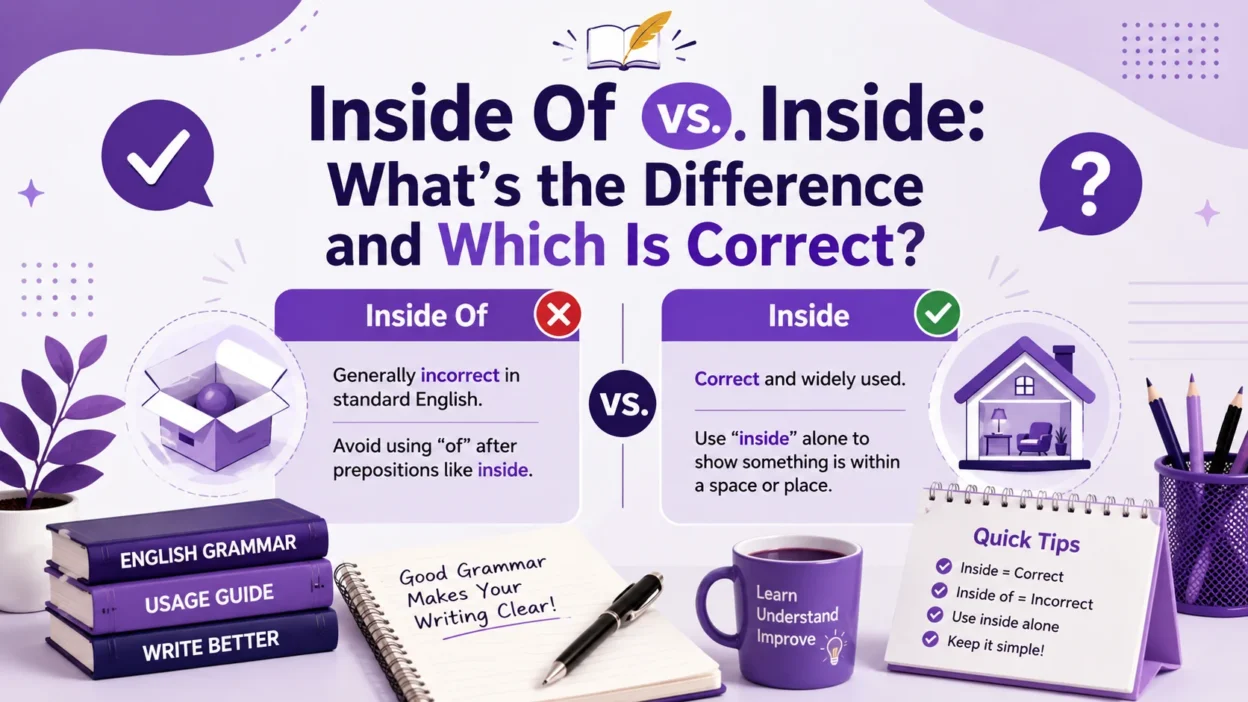
Inside Of vs. Inside can confuse many English speakers and learners because both expressions are common in modern English and American English. While Inside and Inside Of are often interchangeable, the right choice depends on context, tone, meaning, style, and usage. This guide explains the grammatical differences, stylistic differences, examples, rules, and practical applications to help you write, speak, and communicate with confidence.
Inside usually refers to a house, box, location, or place, while Inside Of may add emphasis or describe a time frame, such as within five minutes. Choosing the right tool depends on the details, understanding, and subtle differences. Building language intuition through learning English, reading aloud, listening, speaking practice, writing practice, and real conversations helps you sound more like native speakers.
Some expressions become commonly misused, debated, or seem similar at first glance, but regular practicing helps clarify confusion and improves natural communication. Keep talking, avoid overthinking, and use the preferred form that best fits your sentence, purpose, and context. This approach strengthens your English grammar, English usage, and everyday use of Inside vs. Inside Of.
Inside vs. Inside Of: The Quick Answer
If you only remember one thing, remember this:
- Inside is the preferred choice in most writing.
- Inside of is also grammatically correct but usually appears in conversational or expressive English.
- Neither expression changes the basic meaning of a sentence.
- The biggest differences involve tone, rhythm, and writing style.
Here’s a quick comparison.
| Feature | Inside | Inside Of |
| Grammatically correct | Yes | Yes |
| Formal writing | Preferred | Acceptable but less common |
| Everyday conversation | Common | Very common |
| Academic writing | Recommended | Rarely used |
| Business writing | Best choice | Usually avoided |
| Creative writing | Common | Often used for emphasis |
Side-by-Side Examples
| Inside | Inside Of |
| The documents are inside the folder. | The documents are inside of the folder. |
| Stay inside the building. | Stay inside of the building. |
| She looked inside the drawer. | She looked inside of the drawer. |
Both versions are correct. Most editors, however, would remove of unless it adds a more natural rhythm.
Which One Should You Choose?
As a simple rule:
- Choose inside for reports, articles, emails, essays, and professional documents.
- Choose inside of when writing dialogue, telling stories, or trying to create a relaxed conversational tone.
Is “Inside Of” Grammatically Correct?
Yes. Inside of is completely grammatically correct.
One of the biggest misconceptions in English grammar is that inside of is somehow wrong. It isn’t. Major dictionaries recognize both forms, and native English speakers use both every day.
The confusion comes from the fact that many style guides recommend removing unnecessary words. Since inside already functions as a preposition, adding of often doesn’t change the meaning.
Compare these examples:
- The keys are inside the drawer.
- The keys are inside of the drawer.
Both sentences communicate exactly the same message.
Why Many Writers Think It’s Incorrect
Many editing tools flag inside of because they encourage concise writing rather than because the phrase is grammatically wrong.
For example, an editor may suggest:
The package is inside of the box.
The package is inside the box.
The second version is simply shorter.
That recommendation is based on style—not grammar.
When Both Forms Are Acceptable
You can safely use either expression when:
- The meaning remains clear.
- The sentence sounds natural.
- The audience isn’t following a strict style guide.
- You want the writing to reflect everyday speech.
Inside vs. Inside Of: The Core Difference
If the meaning rarely changes, what actually separates these expressions?
The answer lies in five important areas.
Meaning
There is virtually no difference in meaning.
Both expressions indicate that something exists within the boundaries of another object, place, or space.
Examples:
- The cat is inside the house.
- The cat is inside of the house.
Both describe the same location.
Style
Professional writers usually prefer shorter constructions.
Because inside already performs the job perfectly, adding of often feels unnecessary in formal contexts.
Examples:
Formal:
Please place all receipts inside the envelope.
Less formal:
Please place all receipts inside of the envelope.
The second sentence isn’t wrong. It’s simply more conversational.
Tone
Tiny word choices influence how readers hear your voice.
Inside sounds:
- Direct
- Clean
- Professional
- Efficient
Inside of sounds:
- Relaxed
- Friendly
- Natural
- Slightly more expressive
Imagine these two movie lines:
Stay inside.
Now compare it with:
Stay inside of the house.
The second version feels slower and slightly more dramatic.
Sentence Rhythm
English is highly rhythmic.
Sometimes writers intentionally choose inside of because it creates a smoother cadence.
Consider these examples:
Hidden inside the old cabin was a forgotten journal.
Now compare:
Hidden inside of the old cabin was a forgotten journal.
The second sentence flows more gently because the extra syllable slows the reader down.
Creative writers often make decisions like this without consciously thinking about grammar.
Reader Expectations
Different audiences expect different writing styles.
| Audience | Better Choice |
| Students | Inside |
| Business professionals | Inside |
| Researchers | Inside |
| Fiction readers | Either |
| Everyday conversation | Either |
| Children’s books | Either |
Matching your audience matters more than following an absolute rule.
When to Use “Inside”
Although both expressions work, inside fits naturally in most situations.
Its concise structure makes writing easier to read and more polished.
Formal Writing
Formal writing values precision.
Extra words can distract readers and make sentences feel heavier than necessary.
Instead of writing:
The evidence is inside of the appendix.
Most editors would write:
The evidence is inside the appendix.
The shorter version communicates the same idea with greater clarity.
Academic English
Academic writing favors concise language.
Universities often encourage students to eliminate unnecessary prepositions whenever possible.
Examples:
- Information appears inside Chapter Four.
- The data remains inside the database.
- Definitions appear inside Appendix A.
Notice how clean each sentence sounds.
Business Communication
Professional communication benefits from straightforward wording.
Examples include:
- Your invoice is inside the attachment.
- The agreement is inside the folder.
- Additional details are inside the report.
These sentences feel confident without becoming overly casual.
Technical Documentation
Instruction manuals and technical documents prioritize efficiency.
Examples:
- Insert the battery inside the compartment.
- Store the cable inside the protective sleeve.
- Place the cartridge inside the printer.
Every unnecessary word increases reading time, especially in instructional writing.
News and Journalism
Journalists usually favor concise language because newspapers and websites value brevity.
For example:
Police discovered evidence inside the vehicle.
Instead of:
Police discovered evidence inside of the vehicle.
The shorter sentence reads faster while preserving the meaning.
When “Inside Of” Sounds More Natural
Although concise writing often wins, natural conversation doesn’t always follow the same rules.
That’s where inside of feels perfectly at home.
Everyday Conversations
People rarely analyze grammar while speaking.
Instead, they choose whatever sounds comfortable.
You might hear:
- Everything is inside of my backpack.
- Come inside of the house.
- There’s something inside of this box.
These expressions sound completely normal during casual conversation.
Storytelling and Dialogue
Novelists often write dialogue that mirrors real speech.
For example:
“There’s somebody hiding inside of that abandoned warehouse,” whispered Mia.
The phrase helps the dialogue sound authentic rather than overly polished.
Emotional Writing
Longer expressions sometimes create emotional emphasis.
Compare these two examples.
She carried hope inside her heart.
Now compare:
She carried hope inside of her heart.
The second version feels slightly softer and more reflective because the rhythm slows the sentence.
This subtle effect explains why many poets and fiction writers occasionally choose inside of, even though inside would also be correct.
Spoken American English
In everyday American English, you’ll hear both forms regularly.
Native speakers rarely stop to think about the difference because context naturally determines which version sounds better.
For instance:
Look inside the closet.
and
Look inside of the closet.
Both sound familiar, although the first is slightly more concise.
Inside vs. Inside Of in Different Types of Writing
Choosing between these expressions becomes much easier once you consider your purpose.
| Writing Type | Recommended Choice | Why It Works |
| Academic papers | Inside | Clear and concise |
| Business emails | Inside | Professional tone |
| Technical manuals | Inside | Eliminates unnecessary words |
| Journalism | Inside | Improves readability |
| Fiction | Either | Depends on dialogue and rhythm |
| Blogs | Mostly Inside | Easier to read online |
| Personal letters | Either | Writer preference |
| Dialogue | Often Inside Of | Sounds conversational |
Quick Rule
Think of it this way:
If you’re editing for clarity, choose “inside.” If you’re writing for voice, choose whichever sounds most natural.
That simple habit will help you make better decisions in nearly every writing situation.
Why Native Speakers Sometimes Prefer “Inside Of”
If inside is shorter and often recommended by editors, why do native speakers still say inside of?
The answer lies in how English naturally develops. People don’t always choose the shortest phrase. Instead, they choose the one that sounds the most comfortable in the moment. Rhythm, emphasis, and habit all influence everyday speech.
Natural Speech Patterns
Spoken English isn’t as strict as written English. Native speakers often add small words that make sentences feel smoother.
For example:
- There’s something inside of your bag.
- Stay inside of the circle.
- We found it inside of the cabinet.
None of these sentences sound unusual to an American listener. In fact, many speakers wouldn’t even notice the extra of.
Emphasis and Pacing
Sometimes a writer wants the reader to slow down.
Compare these examples:
He kept the letter inside his jacket.
Now compare:
He kept the letter inside of his jacket.
The second version has a slightly slower rhythm. That tiny pause can make a sentence sound more thoughtful or dramatic, especially in fiction.
Regional Differences
English varies across regions. Some dialects naturally favor inside of, while others almost always use inside.
Although the difference isn’t dramatic, you’ll often hear inside of more frequently in casual American speech than in carefully edited publications.
This doesn’t make one version better than the other. It simply reflects how language changes from one community to another.
Personal Writing Style
Many authors intentionally choose words based on voice rather than grammar alone.
For instance:
- A business consultant usually writes inside.
- A novelist may prefer inside of in dialogue.
- A memoir writer might alternate between both forms depending on emotion.
Good writing isn’t about following rigid rules. It’s about choosing the expression that best fits your audience.
The History of “Inside Of”
The phrase inside of isn’t a modern invention. It has existed for centuries.
Understanding its history explains why both forms remain acceptable today.
How the Phrase Developed
Originally, English contained many expressions that combined a location word with of.
Examples include:
- outside of
- ahead of
- because of
- instead of
Over time, inside of became another common construction.
As English evolved, writers gradually shortened many phrases. Even so, inside of survived because people continued using it in speech.
Why It Survived in Modern English
Language isn’t governed solely by grammar books.
Expressions survive when people keep using them.
That’s exactly what happened with inside of.
Although professional editors usually remove the extra of, millions of native speakers still include it naturally in conversation.
Changes in Usage Over Time
Modern writing generally favors concise language.
As a result:
- Newspapers often use inside.
- Academic journals overwhelmingly choose inside.
- Business communication usually prefers inside.
- Fiction and dialogue continue using both.
Today’s trend leans toward shorter wording, but inside of remains firmly established in everyday English.
What Major Style Guides Recommend
Professional style guides don’t label inside of as incorrect. Instead, they encourage writers to avoid unnecessary words whenever possible.
Here’s how different writing styles generally approach the issue.
AP Style
Associated Press (AP) writing emphasizes brevity.
News editors typically replace inside of with inside unless removing of creates an awkward sentence.
Chicago Manual of Style
Chicago style values readability and consistency.
Writers usually choose inside because it’s concise, but Chicago doesn’t prohibit inside of when it contributes to natural flow.
MLA and APA Writing
Students writing research papers should almost always choose inside.
Academic writing rewards clarity, precision, and economy of words.
Examples:
The survey appears inside Appendix B.
Instead of:
The survey appears inside of Appendix B.
Dictionary Guidance
Leading English dictionaries recognize both forms.
The important takeaway is this:
Grammar accepts both. Style determines which one sounds better.
How Grammar Checkers Treat “Inside Of”
Many people first encounter this question after seeing a grammar checker underline inside of.
That suggestion often creates unnecessary confusion.
Grammarly
Grammarly frequently recommends removing of because the sentence becomes shorter.
Example:
Original:
The files are inside of the folder.
Suggested:
The files are inside the folder.
Notice that the meaning doesn’t change.
Microsoft Editor
Microsoft Editor follows a similar approach.
Its recommendations focus on conciseness rather than grammatical correctness.
ProWritingAid
ProWritingAid often encourages stronger, cleaner writing by eliminating words that don’t add meaning.
Again, this is a stylistic suggestion—not a grammar correction.
Should You Always Accept the Suggestion?
Not necessarily.
Before accepting any automated recommendation, ask yourself three questions:
- Does removing of improve readability?
- Does the sentence still sound natural?
- Am I writing formally or conversationally?
If your answer is “yes,” then inside is probably the better choice.
If not, leaving inside of is perfectly reasonable.
Grammar Breakdown
Understanding how inside functions makes the difference much easier to remember.
Unlike many English words, inside can perform several grammatical roles.
Inside as a Preposition
This is its most common use.
Examples:
- The documents are inside the drawer.
- She waited inside the building.
- The batteries are inside the remote.
In these examples, inside introduces a location.
Inside as an Adverb
Sometimes inside doesn’t need an object.
Examples:
- Come inside.
- Let’s go inside.
- Everyone stayed inside.
Here, inside modifies the verb by describing where someone goes or remains.
Inside as an Adjective
Occasionally, inside describes a noun.
Examples:
- The inside wall needs painting.
- Check the inside pocket.
- Open the inside compartment.
Here, inside functions as an adjective because it modifies another noun.
Why “Of” Creates a Prepositional Phrase
When writers add of, they create a slightly longer expression:
- inside the room
- inside of the room
The additional word doesn’t change the grammatical role of the phrase. It simply affects style and rhythm.
Common Collocations with “Inside”
Certain expressions appear so frequently that native speakers instantly recognize them.
Here are some of the most common.
| Expression | Example |
| Inside the house | Everyone stayed inside the house. |
| Inside the box | The gift was inside the box. |
| Inside information | She had inside information about the merger. |
| Inside joke | Only close friends understood the inside joke. |
| Inside track | He has the inside track for the promotion. |
| Inside cover | Sign your name inside the cover. |
| Inside pocket | Keep your passport inside your jacket pocket. |
These combinations appear regularly in books, newspapers, and professional writing.
Common Collocations with “Inside Of”
Although less common in edited prose, several phrases frequently occur in everyday speech.
Examples include:
- inside of a room
- inside of a building
- inside of the house
- inside of your mind
- inside of an hour
- inside of my backpack
Notice that these expressions often sound more conversational than formal.
Sentence Comparisons That Show the Difference
Sometimes seeing both versions together makes the distinction obvious.
Formal Example
Preferred
All confidential documents remain inside the filing cabinet.
Less Formal
All confidential documents remain inside of the filing cabinet.
Business Example
Preferred:
Please place your receipt inside the envelope.
More conversational:
Please place your receipt inside of the envelope.
Academic Example
Preferred:
Figure 3 appears inside Appendix C.
Less common:
Figure 3 appears inside of Appendix C.
Creative Writing Example
She hid the photograph inside of her coat, hoping no one would notice.
Here, inside of creates a slightly softer rhythm that fits the narrative.
Emotional Example
Compare these two sentences:
Fear lived inside him.
Fear lived inside of him.
Both are correct. The second version lingers just a little longer, creating a stronger emotional effect.
Common Mistakes Writers Make
Even experienced writers occasionally misuse these expressions.
Fortunately, the mistakes are easy to avoid.
Using “Inside Of” in Every Sentence
Repeating inside of throughout an article makes the writing feel unnecessarily wordy.
Instead, vary your wording naturally.
Believing “Inside Of” Is Always Wrong
This is one of the biggest grammar myths.
Remember:
Both expressions are grammatically correct.
The choice depends on context.
Ignoring Tone and Audience
A phrase that sounds perfect in a novel may feel out of place in a legal document.
Always match your language to your readers.
Making Sentences Unnecessarily Wordy
Concise writing is usually stronger.
Instead of asking:
Can I remove of without changing the meaning?
Try removing it and reading the sentence aloud.
If nothing changes, the shorter version is often the better choice.
Here’s the concluding section in the same style.
Conclusion
Choosing between Inside and Inside Of is easier once you understand their usage, tone, and context. Both expressions are grammatically correct, but Inside is usually the preferred choice in formal writing, business communication, and academic English because it is shorter and more direct. Inside Of sounds more natural in casual conversations or when you want extra emphasis. By practicing with real examples and paying attention to sentence flow, you’ll use both expressions with greater confidence and write more natural English.
FAQs
Q1. Is Inside Of grammatically correct?
Yes. Inside Of is grammatically correct and commonly used in everyday English. However, Inside is often preferred in formal writing because it is more concise.
Q2. What is the difference between Inside and Inside Of?
The main difference is style, not meaning. Inside sounds more direct and formal, while Inside Of often adds a conversational tone or slight emphasis.
Q3. Which form should I use in professional writing?
For reports, emails, academic papers, and business documents, Inside is usually the better choice because it keeps your writing clear and concise.
Q4. Can Inside and Inside Of be used interchangeably?
Yes, in most situations they can. The meaning usually stays the same, but the choice depends on the context, tone, and the flow of the sentence.
Q5. How can I learn to use Inside and Inside Of naturally?
Read quality English content, listen to native speakers, practice writing, and notice how each expression is used in different situations. Over time, choosing the right form will become natural.