Mastering “Into” or “Onto” starts with knowing how small prepositions guide movement, direction, and meaning in every sentence. Learning English and American English becomes easier when you follow grammar rules instead of guessing. A reliable grammar guide uses definitions, comparisons, examples, and practical tips to explain correct usage, prepositional usage, and grammatical usage. Picture someone who walk into a room, walk onto a roof, jump into a pool, jump onto a platform, or walked into a building before they climbed onto a wall.
The simplest way to remember the difference is to imagine the physical world around you. Into describes movement toward the inside of a physical space, while onto describes surface movement toward on top of a surface. Imagine entering a house, becoming part of a state, moving from the exterior to the interior, or standing above and atop a surface after you have climbed onto it. This idea connects physical movement, directional movement, movement inside, transition, reaching, moving, toward, actions, thoughts, places, space, surfaces, inside versus surface, and state.
A practical teaching approach focuses less on memorizing and more on recognizing patterns through regular learning, practice, and memorization. That habit helps you understand every difference, avoid mistakes and common mistakes, and master these parts of speech. Compare meanings, keep choosing the correct preposition, and remember that function words support clear communication. Helpful resources connect the English language, language, language skills, grammar, usage, guide, preposition, rules, writing, writing skills, and write with memorable ideas such as crossroads, signpost, perplexing pair, misstep, curveball, beast, grip, titans, cousins, spelling, and punctuation, making the topic much easier to remember.
Why Into and Onto Confuse So Many Writers
English contains many word pairs that look alike but serve different purposes. Into and onto belong to that group because they both describe movement. The difference lies in where that movement ends.
Imagine two situations.
- You walk inside a building.
- You jump onto a stage.
Both actions involve movement, but your destination changes.
In the first sentence, you move from outside to inside. In the second, you move from one position to the top surface of something. That single difference determines which preposition you should use.
The confusion grows because English also includes the two-word forms in to and on to. Although they look almost identical to into and onto, they follow completely different grammar rules.
For example:
- She walked into the office.
- She logged in to her account.
Only one extra space separates these phrases, yet they don’t work the same way.
Many grammar mistakes happen because writers focus only on spelling instead of understanding how the words function within the sentence.
Why This Topic Matters
Using the correct preposition improves much more than grammar.
It also helps you:
- Write clearer sentences.
- Sound more professional.
- Avoid confusing readers.
- Improve academic writing.
- Strengthen business communication.
- Build confidence in spoken English.
- Perform better on English proficiency exams.
Editors often notice incorrect prepositions immediately because they interrupt the natural flow of a sentence.
Why Even Native Speakers Make Mistakes
Native speakers usually learn these expressions through conversation instead of formal grammar lessons. As a result, many people choose the correct form instinctively but struggle to explain why it’s correct.
Writing changes that.
When you see the words on paper, tiny differences become much more noticeable.
For example:
Please log into your account.
Please log in to your account.
The first sentence appears everywhere online, but many style guides prefer log in to because log in functions as the verb while to belongs with the infinitive phrase that follows.
Understanding these distinctions helps you write with greater accuracy.
The Simple Difference Between Into and Onto
If you remember only one rule from this article, remember this one.
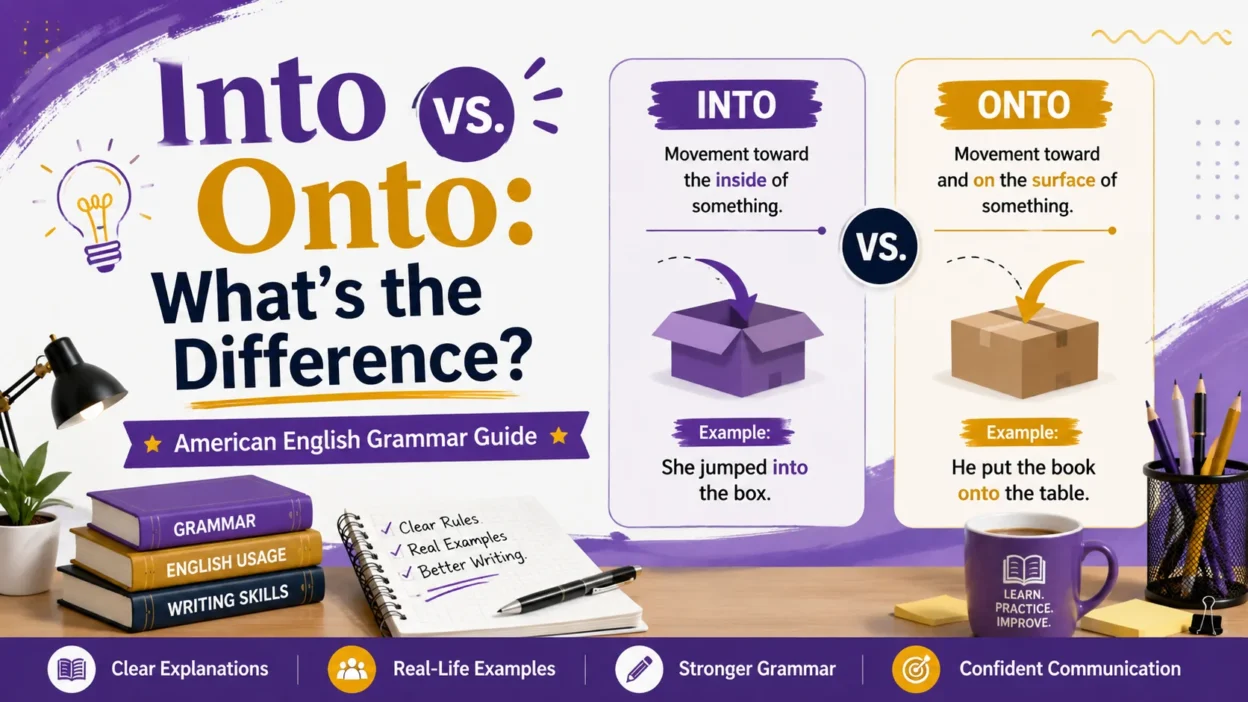
Into means movement inside. Onto means movement to a surface.
Everything else builds from that simple idea.
What Does Into Mean?
Into is a preposition that describes movement from outside to inside a place, object, space, or condition.
Think of crossing a boundary.
Once the movement finishes, the subject is inside something.
Examples include:
- She walked into the classroom.
- The dog ran into the backyard.
- Water poured into the glass.
- He slipped into the elevator.
- The letter fell into the mailbox.
Each example shows movement ending within an enclosed space.
You can picture an invisible line.
The subject starts outside.
Then it crosses that line.
Finally, it ends inside.
What Does Onto Mean?
Onto describes movement toward the top surface of something.
Instead of entering an object, you arrive on it.
Examples include:
- The cat jumped onto the couch.
- She climbed onto the roof.
- He placed the keys onto the table.
- Snow landed onto the windshield.
- The child stepped onto the stage.
Notice that nothing enters an enclosed space.
Instead, every action ends on a visible surface.
A Visual Way to Remember
Think about a cardboard box.
If you throw a toy into the box, the toy ends up inside it.
If you place the toy onto the box, the toy rests on top.
That simple image solves most grammar questions.
| Situation | Correct Preposition |
| Walking inside a house | Into |
| Jumping on a roof | Onto |
| Pouring coffee inside a mug | Into |
| Setting a book on a desk | Onto |
| Throwing a ball inside a basket | Into |
| Climbing on a rock | Onto |
The One-Sentence Rule to Remember
Whenever you hesitate, ask yourself one question.
Does the movement end inside something or on its surface?
If the answer is inside, use into.
If the answer is on top, use onto.
That quick test works in most everyday situations.
Into vs. Onto at a Glance
Sometimes seeing both words together makes the difference much easier to understand.
| Feature | Into | Onto |
| Primary Meaning | Movement inside | Movement to a surface |
| Direction | Outside → Inside | Lower or elsewhere → Surface |
| Indicates Entry | Yes | No |
| Indicates Contact with Surface | No | Yes |
| Used Figuratively | Frequently | Occasionally |
| Common in Everyday English | Very Common | Very Common |
Here are several side-by-side examples.
| Correct Use of Into | Correct Use of Onto |
| Walk into the bank | Step onto the sidewalk |
| Run into the garage | Climb onto the truck |
| Pour milk into the bowl | Put the bowl onto the shelf |
| Throw the ball into the basket | Toss the towel onto the chair |
| Crawl into bed | Sit onto the bench* |
Note: In American English, people usually say sit on the bench rather than sit onto the bench unless they’re emphasizing the movement of sitting down.
That detail highlights another important point.
English doesn’t always choose the most logical option. Some expressions become standard through everyday usage.
Learning those patterns takes practice.
When to Use Into
The word into appears far beyond sentences about entering buildings.
It also describes changes, emotions, interests, relationships, transformations, and abstract movement.
Understanding these different uses makes your writing much stronger.
Entering a Room, Building, or Container
This is the most common use.
Someone or something physically moves inside another place.
Examples:
- She walked into the library.
- The children ran into the playground.
- He climbed into the truck.
- They moved into a new apartment.
- The bird flew into the cage.
Notice that every destination surrounds the subject after the movement ends.
Moving Inside Objects
Objects also move into containers.
Examples:
- Pour the soup into the bowl.
- Put the groceries into the refrigerator.
- Slide the letter into the envelope.
- Drop the coin into the jar.
- Place the batteries into the remote.
These examples appear frequently in recipes, product manuals, and instruction guides.
Changes in State or Condition
One of the most interesting uses of into involves transformation rather than physical movement.
Instead of entering a place, someone or something changes from one state to another.
Examples:
- The caterpillar turned into a butterfly.
- Water changed into ice overnight.
- The company grew into an international brand.
- She developed into an excellent leader.
- Their hobby evolved into a successful business.
Nothing literally moves inside anything.
Instead, into describes a process of becoming.
Becoming Interested or Involved
American English often uses into to describe interests, hobbies, and enthusiasm.
Examples:
- I’m really into photography.
- He’s into classic cars.
- They’re into fitness.
- She isn’t into horror movies.
- My kids are into robotics.
In these sentences, into means interested in rather than physical movement.
This informal usage appears constantly in conversations.
For example:
“What kind of music are you into?”
Native speakers use this expression every day.
Entering a Situation
Sometimes into introduces difficult circumstances.
Examples include:
- They got into trouble.
- She fell into debt.
- He ran into problems.
- We got into an argument.
- The company slipped into bankruptcy.
Again, the movement isn’t physical.
Instead, someone enters a new condition.
Common Expressions with Into
Many English idioms depend on into.
Learning them improves both reading and speaking skills.
| Expression | Meaning |
| Look into | Investigate |
| Break into | Enter illegally or suddenly begin |
| Get into | Become involved |
| Run into | Meet unexpectedly or collide |
| Dive into | Begin enthusiastically |
| Talk someone into | Persuade |
| Come into | Receive or inherit |
| Fit into | Belong comfortably |
| Grow into | Develop gradually |
| Turn into | Become |
Examples:
- The police will look into the complaint.
- Someone tried to break into the house.
- Let’s dive into today’s lesson.
- She talked me into joining the club.
- He eventually grew into the leadership role.
Notice how into often signals movement toward a new situation, idea, or result.
Real-Life Example
Imagine you’re packing for a vacation.
You place your clothes into the suitcase.
Then you lift the suitcase onto the luggage rack.
The first action ends inside the suitcase.
The second ends on top of the rack.
Visualizing everyday situations like this helps reinforce the correct choice without memorizing dozens of grammar rules.
Quick Checklist for Using Into
Use into when the action involves:
- Entering a room, building, or container.
- Moving inside an object.
- Changing from one condition to another.
- Becoming interested in something.
- Entering a relationship or situation.
- Forming common idiomatic expressions.
- Showing movement across a boundary.
If you can replace the phrase with inside, within, or entering, there’s a good chance into is the correct choice.
When to Use Onto
Like into, the preposition onto describes movement. The difference is simple but important. Instead of moving inside something, the subject moves to the surface of something.
Picture a skateboarder riding up a ramp. The rider doesn’t enter the ramp. Instead, they land on top of it. That’s exactly what onto expresses.
Whenever the destination is a surface rather than an enclosed space, onto is usually the correct choice.
Moving to a Surface
This is the most common use of onto.
Examples:
- She stepped onto the balcony.
- The cat jumped onto the kitchen counter.
- He climbed onto the ladder.
- Snow settled onto the roof.
- The child crawled onto the bed.
Every sentence ends with the subject resting on a surface.
Climbing or Jumping Onto Something
Many action verbs naturally pair with onto.
These include:
- Climb
- Jump
- Step
- Leap
- Crawl
- Pull
- Lift
- Hoist
Examples:
- The firefighter climbed onto the roof.
- The horse jumped onto the platform.
- She pulled herself onto the dock.
- The actor stepped onto the stage.
- They lifted the boxes onto the truck.
These verbs describe upward or directional movement that ends on a surface.
Placing Objects on Surfaces
You also use onto when one object is placed on another.
Examples:
- Put the laptop onto the desk.
- Place the dishes onto the table.
- Hang the painting onto the wall.
- Set the groceries onto the counter.
- Lay the blanket onto the grass.
Notice that the action emphasizes movement.
After the object reaches its destination, you usually switch to on.
For example:
- She placed the phone onto the table.
- The phone is now on the table.
The first sentence describes movement.
The second describes location.
Figurative Uses of Onto
Although onto usually refers to physical movement, American English also uses it figuratively.
Examples include:
- The detective is onto the suspect.
- You’re onto something interesting.
- We moved onto the next chapter.
- The discussion shifted onto another topic.
Here, no one actually climbs onto anything.
Instead, onto suggests moving toward a new idea, discovery, or stage.
These expressions are especially common in conversation.
For example:
“I think you’re onto something.”
This means someone has discovered an important clue or good idea.
Common Expressions with Onto
| Expression | Meaning |
| Hold onto | Keep firmly |
| Move onto | Continue to the next item |
| Get onto | Begin discussing or contacting |
| Be onto | Discover or suspect |
| Climb onto | Move to the top of |
| Step onto | Move onto a surface |
Examples:
- Hold onto the railing.
- Let’s move onto the next question.
- I’ll get onto that project tomorrow.
- The journalist was onto the story before anyone else.
Learning these fixed expressions makes everyday English feel much more natural.
Into vs. In To: What’s the Difference?
Many writers know the difference between into and onto, yet they still struggle with into versus in to.
The confusion comes from appearance.
They look almost identical.
Grammatically, however, they’re completely different.
Why In To Is Not the Same as Into
Into is a single preposition.
In to consists of two separate words.
- In belongs with the verb before it.
- To belongs with the infinitive or phrase that follows.
That tiny space changes the grammar.
Compare these sentences.
- She walked into the office.
- She walked in to greet everyone.
In the first sentence, into functions as one preposition.
In the second, in completes the verb phrase while to introduces the infinitive greet.
When In To Is Grammatically Correct
Use in to when to belongs naturally with the following verb.
Common examples include:
- Log in to access your account.
- Sign in to continue.
- Come in to see the manager.
- Drop in to say hello.
- Check in to the hotel.
Notice what happens if you remove the infinitive.
“Log in.”
“Sign in.”
“Come in.”
Each verb still makes perfect sense.
That tells you in belongs with the verb.
The Infinitive Test
A quick grammar trick solves most problems.
Ask yourself:
Does “to” introduce another verb?
If yes, use in to.
Example:
She logged in to download the report.
Here, to download is an infinitive.
Therefore:
- Logged in ✔
- To download ✔
Not:
- Logged into
Another example:
They came in to help.
Again:
- Came in ✔
- To help ✔
Sentence Pairs Showing the Difference
| Into | In To |
| Walk into the room. | Walk in to introduce yourself. |
| Dive into the water. | Dive in to rescue the swimmer. |
| Go into the office. | Go in to speak with the director. |
| Drive into the garage. | Drive in to unload the boxes. |
| Step into the elevator. | Step in to assist the customer. |
Notice how the second column always contains an infinitive after to.
That pattern rarely fails.
Case Study: A Common Business Email
Consider these two instructions.
Log into review your account.
Log in to review your account.
The second sentence follows modern grammar because:
- Log in is the verb.
- To review is the infinitive.
Many websites still write log into, and some dictionaries now accept it in everyday usage. However, many professional editors and major style guides continue to prefer log in to whenever an infinitive follows.
If you’re writing for business, academic, or professional audiences, following this rule is the safest choice.
Onto vs. On To: What’s the Difference?
This pair follows the same principle.
Onto is one word.
On to is two.
Once you understand the grammar, choosing correctly becomes much easier.
Why Two Words Sometimes Matter
Like in to, on to appears when each word serves a separate purpose.
- On belongs with the previous verb.
- To belongs with what follows.
For example:
Let’s move on to the next chapter.
Here:
- Move on ✔
- To the next chapter ✔
The phrase move on already exists.
Therefore, to should remain separate.
When On To Is Correct
Use on to after these common phrasal verbs:
- Move on
- Go on
- Hold on
- Carry on
- Pass on
Examples:
- Let’s move on to today’s lesson.
- Please go on to the next page.
- Hold on to your ticket.
- Carry on to the finish line.
- Pass on to the next speaker.
In every example, on completes the verb.
Easy Tests to Tell Them Apart
Ask yourself:
Can I remove everything after “to” and still have a complete phrasal verb?
If yes, use on to.
Example:
Let’s move on.
Perfect.
Now continue:
Let’s move on to chapter five.
The grammar works naturally.
Now compare this sentence:
The child climbed onto the chair.
Removing to makes no sense because onto is one preposition.
Side-by-Side Examples
| Onto | On To |
| Jump onto the bed. | Move on to the next subject. |
| Climb onto the horse. | Hold on to the railing. |
| Place it onto the shelf. | Go on to explain your answer. |
| Step onto the platform. | Carry on to the next section. |
One table often explains more than several pages of grammar.
Into, Onto, In To, and On To Compared
The easiest way to master these expressions is to compare them all together.
| Expression | Function | Example | Key Idea |
| Into | Preposition | She walked into the office. | Inside |
| Onto | Preposition | The cat jumped onto the sofa. | Surface |
| In to | Verb + infinitive | Sign in to continue. | Separate words |
| On to | Phrasal verb + to | Move on to chapter three. | Separate words |
Think of it this way.
One word usually describes direction.
Two words usually separate a phrasal verb from an infinitive or following phrase.
That simple observation eliminates most mistakes.
Physical Movement vs. Figurative Meaning
One reason these prepositions confuse writers is that English often extends physical movement into abstract ideas.
The grammar stays the same.
Only the meaning changes.
Physical Movement Examples
These examples describe actual movement.
Into
- Walk into the museum.
- Pour juice into the glass.
- Crawl into the tent.
- Throw the ball into the basket.
Onto
- Step onto the bridge.
- Jump onto the dock.
- Lift the suitcase onto the bed.
- Climb onto the tractor.
Every sentence describes a visible action.
Abstract and Figurative Uses
English also uses movement to explain thoughts, emotions, and progress.
Examples with into:
- She fell into despair.
- He went into politics.
- The business expanded into Europe.
- They entered into an agreement.
- We looked into the issue.
Examples with onto:
- You’re onto a great idea.
- The investigators are onto him.
- Let’s move onto another possibility.
- She moved onto a leadership role.
Although nothing physically moves, the same directional idea remains.
Which Expressions Cannot Be Swapped?
Many learners assume into and onto are interchangeable.
They’re not.
Compare these examples.
The child jumped into the roof.
The child jumped onto the roof.
Pour the water onto the bottle.
Pour the water into the bottle.
The first mistake changes the destination.
The second makes the action almost impossible.
Always visualize the final location before choosing your preposition.
Common Grammar Mistakes and How to Avoid Them
Small prepositions cause surprisingly large mistakes.
Fortunately, most follow predictable patterns.
Using Into Instead of In To
Incorrect:
- Sign into continue.
- Log into update your profile.
Correct:
- Sign in to continue.
- Log in to update your profile.
Remember the infinitive test.
Confusing Onto with On To
Incorrect:
- Move onto chapter six.
Correct:
- Move on to chapter six.
The phrase move on already exists.
That makes the answer easy.
Mixing Surface and Interior Movement
Incorrect:
- Put the apples onto the basket.
Correct:
- Put the apples into the basket.
Ask yourself:
Inside or on top?
That question solves most problems instantly.
Forgetting Context
The same verb may require different prepositions depending on the sentence.
Compare:
- She climbed onto the truck.
- She climbed into the truck.
The first means she reached the top.
The second means she entered the cab.
One small preposition creates two completely different images.
A Four-Step Editing Checklist
Before you finish writing, check these questions:
- Does the action end inside something? Use into.
- Does it end on a surface? Use onto.
- Does “to” introduce another verb? Use in to.
- Does the sentence contain a phrasal verb like “move on” or “hold on”? Use on to.
Professional editors often use this exact thought process. Once it becomes a habit, choosing the correct form takes only a second.
Memory Tricks That Actually Work
Grammar rules become much easier to remember when you connect them to simple mental images instead of memorizing definitions. The following memory tricks are practical, easy to recall, and effective in everyday writing.
Think “Inside” for Into
Whenever you see into, imagine crossing a doorway.
The action always ends inside something.
For example:
- Walk into the office.
- Put the keys into your pocket.
- Pour the juice into the glass.
A simple question helps:
Does the action finish inside something?
If the answer is yes, into is almost always correct.
Think “Surface” for Onto
Picture placing a book on a table.
The book doesn’t enter the table. It rests on top of it.
Examples:
- Jump onto the platform.
- Place the package onto the porch.
- Climb onto the horse.
Ask yourself:
Does the action end on a surface?
If it does, choose onto.
The Infinitive Test
This trick solves almost every into vs. in to problem.
Look at the word after to.
If it’s a verb, you’re probably dealing with in to.
Example:
- Log in to update your password.
Here:
- Log in ✔
- To update ✔
Since to update is an infinitive, in and to stay separate.
The Phrasal Verb Test
This works for onto vs. on to.
Ask yourself whether the words before to form a complete phrasal verb.
Example:
- Move on to the next chapter.
You can say:
“Move on.”
That means on belongs with the verb.
Therefore:
Move on to ✔
Not:
Move onto ✘
A Quick Decision Tree
Use this simple guide whenever you’re unsure.
Does the action involve movement?
│
▼
Does it end inside something?
│
Yes ─────► INTO
│
No
│
▼
Does it end on a surface?
│
Yes ─────► ONTO
│
No
│
▼
Does “to” begin another verb?
│
Yes ─────► IN TO
│
No
│
▼
Does the sentence contain a phrasal verb
like move on, hold on, or go on?
│
Yes ─────► ON TO
Many professional editors use this exact thought process while proofreading.
Real-Life Examples in Everyday American English
Learning grammar through real situations makes the rules stick.
Here are examples you’ll actually hear and read.
Home and Family
- Put the groceries into the pantry.
- Hang your coat onto the hook.
- Walk into the kitchen.
- Place the dishes onto the drying rack.
- Throw your clothes into the laundry basket.
School and College
- Students walked into the classroom.
- The teacher wrote notes onto the whiteboard.
- Log in to access the online course.
- Move on to the next chapter.
- Turn in to receive feedback.
Workplace
- Step into the conference room.
- Upload the files onto the company server.
- Sign in to your account.
- Move on to the next agenda item.
- Look into the customer’s complaint.
Travel
- Get into the taxi.
- Climb onto the train platform.
- Check in to your hotel.
- Walk into the airport terminal.
- Load the luggage onto the bus.
Sports
- Run onto the field.
- Dive into the pool.
- Climb onto the podium.
- Step onto the court.
- Throw the ball into the net.
Technology
Technology creates some of the most common grammar mistakes.
Correct examples include:
- Log in to your account.
- Sign in to continue.
- Upload the document onto the website.
- Save the file into a new folder.
- Move on to the next screen.
These examples appear in software documentation, websites, and user manuals every day.
Popular Idioms and Fixed Expressions
English contains dozens of expressions that use these prepositions naturally.
Learning them improves both your vocabulary and your writing.
Common Idioms with Into
| Expression | Meaning | Example |
| Look into | Investigate | We’ll look into the issue tomorrow. |
| Get into | Become involved | She got into photography. |
| Break into | Enter illegally | Someone broke into the house. |
| Run into | Meet unexpectedly | I ran into an old friend. |
| Turn into | Become | The idea turned into a business. |
| Dive into | Begin eagerly | Let’s dive into today’s lesson. |
| Talk into | Persuade | They talked him into applying. |
| Grow into | Develop gradually | She grew into a strong leader. |
| Come into | Receive | He came into a large inheritance. |
| Enter into | Begin formally | The companies entered into an agreement. |
Common Expressions with Onto
| Expression | Meaning | Example |
| Hold onto | Keep firmly | Hold onto the rope. |
| Move onto | Proceed | We moved onto another subject. |
| Get onto | Contact or begin discussing | I’ll get onto the supplier today. |
| Be onto | Discover or suspect | The police are onto him. |
| Catch onto | Understand | She caught onto the joke quickly. |
| Latch onto | Attach or adopt | Children often latch onto new trends. |
Notice that many of these expressions no longer describe physical movement. Instead, they express ideas, progress, or understanding.
American English vs. British English Usage
Both American and British English recognize into, onto, in to, and on to.
However, editorial preferences sometimes differ.
American English
American publications generally prefer:
- onto
- into
These one-word forms appear frequently in newspapers, business writing, and educational materials.
Examples:
- Jump onto the stage.
- Walk into the office.
British English
British English sometimes favors on to where American English uses onto, especially in formal publishing.
For example:
American English:
The airplane taxied onto the runway.
British English:
The airplane taxied on to the runway.
Both versions are widely understood.
Modern British usage, however, increasingly accepts onto in many contexts.
Should You Worry About the Difference?
Not really.
If you’re writing for an American audience, simply follow standard American conventions consistently.
Consistency matters more than switching styles halfway through an article.
Quick Quiz: Test Yourself
Choose the correct answer before checking the explanations.
Question 1
She walked _____ the library.
- into
- onto
Answer: into
She entered the building.
Question 2
The cat jumped _____ the fence.
- into
- onto
Answer: onto
The fence is a surface.
Question 3
Please log _____ your account to continue.
- into
- in to
Answer: in to
“To continue” is an infinitive.
Question 4
Let’s move _____ the next topic.
- onto
- on to
Answer: on to
The phrasal verb is move on.
Question 5
Pour the soup _____ the bowl.
- into
- onto
Answer: into
The soup goes inside the bowl.
Question 6
The children climbed _____ the tree house.
- into
- onto
Answer: into
They entered the tree house.
Question 7
The children climbed _____ the roof.
- into
- onto
Answer: onto
They reached the roof’s surface.
Question 8
The manager came _____ explain the new policy.
- into
- in to
Answer: in to
“To explain” is an infinitive.
Question 9
Hold _____ the railing.
- onto
- on to
Answer: on to
The phrasal verb is hold on.
Question 10
She transformed _____ a confident speaker.
- into
- onto
Answer: into
The sentence describes a change of state.
Cheat Sheet: Into, Onto, In To, and On To
Keep this table handy whenever you edit your writing.
| If You Mean… | Correct Choice | Example |
| Move inside | Into | Walk into the house. |
| Move onto a surface | Onto | Jump onto the table. |
| Verb + infinitive | In to | Log in to continue. |
| Phrasal verb + following phrase | On to | Move on to chapter five. |
| Become interested | Into | She’s into music. |
| Become something | Into | Ice turned into water. |
| Continue | On to | Go on to the next page. |
| Discover | Onto | The detective is onto the thief. |
Conclusion
Choosing between into, onto, in to, and on to becomes much easier once you understand what each expression actually does. Into shows movement inside something, while onto describes movement to a surface. The two-word forms, in to and on to, follow different grammar rules because they separate a phrasal verb from the word to. Instead of memorizing dozens of examples, focus on the destination and the sentence structure. With regular practice, you’ll recognize the correct choice naturally. Whether you’re writing an academic paper, a business email, or a casual message, using these prepositions correctly will make your English clearer, more accurate, and more professional.
FAQs
Q1. What is the main difference between into and onto?
The main difference is the destination. Use into when something moves inside a place or object. Use onto when something moves to the top surface of something. For example, you walk into a room but step onto a stage.
Q2. Can into and onto ever be used interchangeably?
No. Although both describe movement, they point to different destinations. Into refers to entering an enclosed space, while onto refers to reaching a surface. Using the wrong one can change the meaning of your sentence.
Q3. What is the difference between into and in to?
Into is a single preposition that shows movement or change. In to consists of two separate words. Use in to when in belongs to the verb and to begins an infinitive, as in “Log in to access your account.”
Q4. When should I use onto instead of on to?
Use onto when movement ends on a surface, such as “The cat jumped onto the table.” Use on to when on is part of a phrasal verb, such as “Let’s move on to the next topic.”
Q5. How can I remember the correct usage quickly?
Remember this simple rule:
- Into = Inside
- Onto = Surface
- In to = Verb + to
- On to = Phrasal verb + to
This quick memory trick helps you choose the correct form in most everyday writing situations.