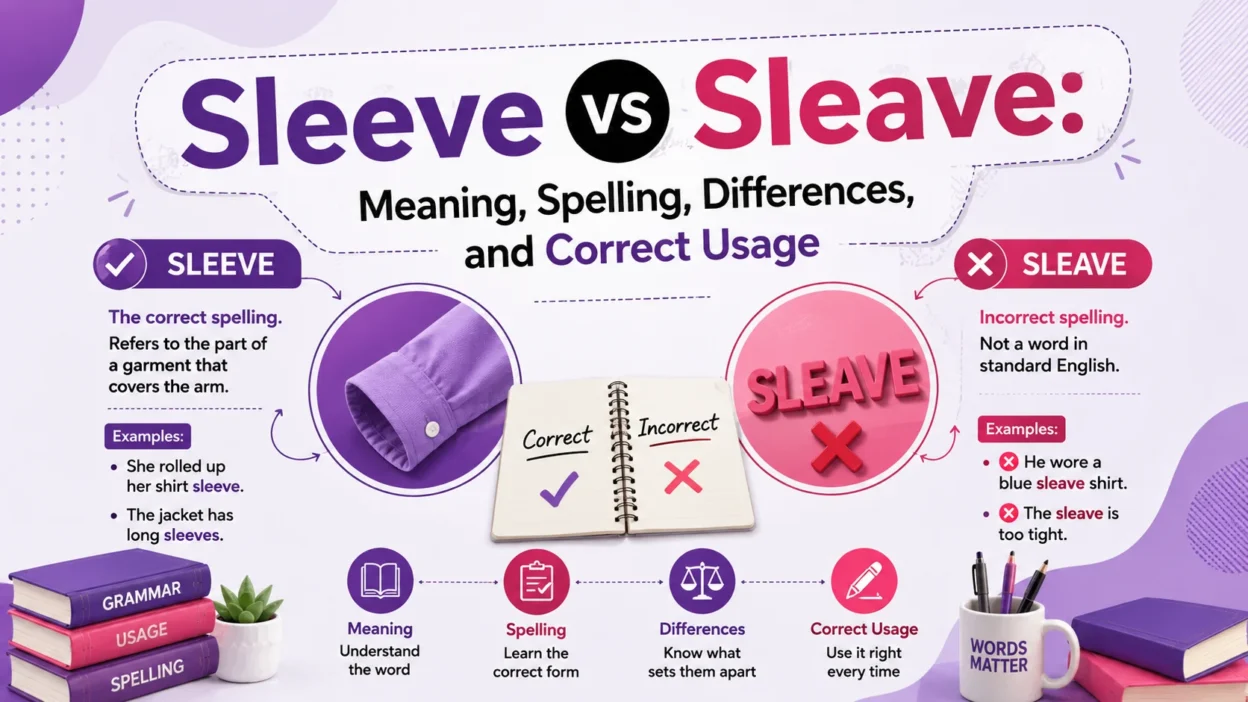
“Sleeve” vs. “sleave” explains a small spelling difference with a big impact. This guide uses simple English to help English learners, native English speakers, students, writers, and readers improve writing, communication, grammar, vocabulary, and reading comprehension. Although the word pair has similar spelling, identical pronunciation, and a similar sound and look, the two words have different meanings. Learning the difference, meaning, usage, examples, and context clues helps you choose the correct word with confidence.
In modern English, sleeve is the familiar word for a clothing part that covers the arm on shirts and jackets. Sleave is a historical word, literary term, and textile term connected to thread, separating, untangling, classic literature, and Shakespeare. Its origin, history, and historical usage make it a real English word rather than a simple misspelling. Understanding these facts makes the comparison much easier.
A good guidebook includes a clear explanation, practical tips, memory tricks, and usage examples to help you identify, distinguish, and remember each word. Always check the context, sentence, and purpose before you write so you can avoid common mistakes, writing mistakes, confusion, and error. With regular practice, you’ll improve your understanding, build confidence, and use the correct spelling naturally in everyday writing.
Sleeve vs Sleave: Quick Answer
Here’s the simple answer.
- Sleeve is the standard modern English word for the part of a garment that covers the arm.
- Sleave is a rare and archaic English word that refers to fine silk thread, untwisted silk, or something delicate and fibrous. It appears mainly in historical and literary works.
| Word | Modern English | Meaning | Common Usage |
| Sleeve | Yes | Part of a garment covering the arm | Everyday speech and writing |
| Sleave | Rare | Fine silk thread or untwisted silk | Literature and historical texts |
For everyday communication, sleeve is almost always the correct choice.
What Does Sleeve Mean?
A sleeve is the section of clothing that covers all or part of your arm. It appears on shirts, dresses, jackets, sweaters, coats, uniforms, and many other garments.
Most dictionaries define sleeve as a sewn extension attached to the armhole of a garment. Depending on the design, it may reach the shoulder, elbow, wrist, or somewhere in between.
Common Types of Sleeves
Fashion designers use many sleeve styles to create different looks and improve comfort.
Some of the most common include:
- Short sleeve
- Long sleeve
- Three-quarter sleeve
- Cap sleeve
- Bell sleeve
- Puff sleeve
- Raglan sleeve
- Dolman sleeve
- Bishop sleeve
- Flutter sleeve
- Batwing sleeve
- Kimono sleeve
Each style changes both the appearance and function of the garment.
Sleeve in Everyday Life
The word sleeve isn’t limited to fashion. It also appears in engineering, technology, sports, and manufacturing.
Examples include:
- Protective cable sleeves
- Laptop sleeves
- Document sleeves
- Golf club sleeves
- Compression sleeves for athletes
- Bearing sleeves in machinery
The shared idea is simple. A sleeve surrounds, protects, or covers something.
Examples of Sleeve in Sentences
- She rolled up her sleeves before painting the fence.
- His winter jacket has insulated sleeves that keep his arms warm.
- The tailor shortened both sleeves by two inches.
- Always store your laptop in a protective sleeve while traveling.
- The baseball player wore a compression sleeve during the game.
What Does Sleave Mean?
Unlike sleeve, sleave is rarely used in modern English.
Historically, sleave referred to fine silk fibers, untwisted silk thread, or soft strands prepared for spinning. The word belongs mostly to historical dictionaries, literary criticism, and discussions of Shakespeare.
Today, very few people use it in everyday conversation.
Historical Meaning
Centuries ago, textile workers produced delicate silk fibers before twisting them into stronger thread. Those loose fibers were often called sleave.
Because the fibers were soft, thin, and fragile, the word later gained poetic and symbolic meanings.
Literary Meaning
Authors often used sleave as a metaphor for something delicate, gentle, or capable of weaving together separate parts.
Rather than describing clothing, writers used the word to create imagery involving thread, fabric, sleep, or human emotions.
Why You Rarely See Sleave Today
Several factors caused the word to disappear from everyday language.
- Textile terminology changed.
- Modern manufacturing adopted new technical vocabulary.
- Everyday speakers stopped using the word.
- Literature preserved it long after common speech abandoned it.
As a result, most modern dictionaries label sleave as archaic, obsolete, or literary.
Examples of Sleave in Sentences
- The old manuscript described sleave as delicate silk fiber.
- The poet compared hope to a strand of sleave.
- Literary scholars still discuss Shakespeare’s use of sleave.
- Medieval textile workers handled fine sleave before spinning silk.
- The rare word survives mainly in historical writing.
Sleeve vs Sleave Comparison
The differences become much clearer when viewed side by side.
| Feature | Sleeve | Sleave |
| Meaning | Garment covering the arm | Fine silk thread or untwisted silk |
| Frequency | Extremely common | Extremely rare |
| Modern Usage | Daily | Mostly historical |
| Fashion Context | Yes | No |
| Literary Context | Occasionally | Frequently |
| Dictionary Label | Standard English | Archaic English |
| Easy to Find in Modern Writing | Yes | Rarely |
Although they differ by only one letter, they belong to completely different vocabulary groups.
Why People Confuse Sleeve and Sleave
Several factors make these words easy to mix up.
Nearly Identical Spelling
The two spellings differ by only one letter.
When reading quickly, your brain often fills in familiar patterns instead of examining every letter.
For example:
- sleeve
- sleave
That tiny difference is enough to create confusion.
Identical Pronunciation
Both words are generally pronounced the same way.
IPA: /sliːv/
Since they sound identical, pronunciation offers no clue about which spelling belongs in a sentence.
Autocorrect and Spell Check
Modern spell checkers sometimes ignore sleave because it’s a legitimate dictionary word.
That means software may not correct the mistake if someone accidentally writes sleave instead of sleeve.
Reading Classic Literature
Many readers first encounter sleave while reading Shakespeare or studying English literature.
Without historical context, it’s easy to assume the unusual spelling simply reflects older English spelling conventions.
Typing Errors
Fast typing often swaps nearby letters or omits them.
Because sleeve is far more common, writers occasionally create accidental spelling errors when editing quickly.
Origin and Etymology
Understanding where each word came from makes their meanings much easier to remember.
Origin of Sleeve
The word sleeve has existed for well over a thousand years.
It comes from Old English slēfe, which referred to the arm covering of a garment. Linguists trace related forms through Germanic languages, showing that the word has remained remarkably stable throughout history.
Related words appear in several languages.
| Language | Word |
| Old English | slēfe |
| Old High German | slouf |
| Dutch | sloof (historical forms) |
| Germanic roots | Related arm-covering terms |
Although spelling changed slightly over time, the meaning remained consistent.
Origin of Sleave
The history of sleave follows a completely different path.
The word developed from older textile vocabulary associated with silk fibers, fine thread, and spinning materials.
Rather than referring to clothing, it described raw material used in textile production.
Over the centuries, the textile industry evolved and newer terminology replaced many traditional words.
As factories modernized, sleave gradually disappeared from everyday speech.
How Their Meanings Diverged
Even though the spellings look similar, the two words never shared the same definition.
Here’s a simple comparison.
| Sleeve | Sleave |
| Clothing | Textile fiber |
| Everyday object | Rare literary term |
| Modern English | Historical English |
| Widely used | Mostly preserved in classic literature |
This explains why replacing one with the other changes the meaning completely.
A Helpful Way to Remember
Think about what each word represents.
- Sleeve belongs in your closet.
- Sleave belongs in old books.
That simple association helps most writers choose the correct spelling instantly.
Quick Tip: If you’re talking about shirts, jackets, dresses, coats, uniforms, sweaters, or anything you wear, the correct word is almost certainly sleeve. If you’re reading Shakespeare or studying historical textile terms, sleave may be the intended word.
How to Pronounce Sleeve and Sleave
One reason Sleeve vs Sleave causes confusion is that both words share the same pronunciation. Whether you’re speaking casually or reading a passage aloud, they sound identical.
| Word | IPA Pronunciation | Sounds Like |
| Sleeve | /sliːv/ | sleev |
| Sleave | /sliːv/ | sleev |
Because pronunciation doesn’t distinguish the words, context becomes the deciding factor. If you’re discussing clothing, use sleeve. If you’re reading historical literature or older textile references, sleave may be correct.
Is Sleave a Misspelling of Sleeve?
The answer depends on the context.
In modern writing, most uses of sleave are accidental spelling mistakes. Someone writing about a shirt, jacket, or sweater almost certainly means sleeve.
However, sleave isn’t a fake word. It appears in respected dictionaries and historical works. That means it isn’t automatically an error.
Use this quick guide.
| Situation | Correct Word |
| Clothing | Sleeve |
| Fashion article | Sleeve |
| Product description | Sleeve |
| Shakespeare analysis | Sleave |
| Historical textile discussion | Sleave |
A good editor always looks at the surrounding sentence before deciding whether sleave is intentional.
Sleave in Shakespeare and Classic Literature
The word sleave survived largely because of one famous author—William Shakespeare.
One of its best-known appearances is in Macbeth, where Shakespeare writes:
“Sleep that knits up the ravelled sleave of care.”
Here, sleave doesn’t refer to clothing. Instead, it symbolizes tangled threads of worry and anxiety. Shakespeare compares sleep to something that untangles life’s knots and restores peace.
The image is memorable because weaving and spinning were familiar activities during his time. Readers immediately understood the metaphor.
Today, literature students still study this passage because it demonstrates Shakespeare’s rich imagery and vocabulary.
Why Shakespeare Chose “Sleave”
The word creates a stronger visual image than a modern substitute.
It suggests:
- Fine strands woven together
- Delicate fibers
- Tangled thoughts
- Emotional burdens
- Restoration through sleep
Although modern English rarely uses sleave, the quotation continues to keep the word alive.
Common Idioms That Use Sleeve
Unlike sleave, sleeve appears in many everyday expressions. Learning these idioms also reinforces the correct spelling.
Wear Your Heart on Your Sleeve
Meaning: To openly show your emotions.
Example:
- You always know how she feels because she wears her heart on her sleeve.
Ace Up Your Sleeve
Meaning: A hidden advantage or secret plan.
Example:
- The company still has an ace up its sleeve before launching the new product.
Roll Up Your Sleeves
Meaning: Prepare to work hard.
Example:
- It’s time to roll up our sleeves and finish the project.
Have Something Up Your Sleeve
Meaning: To keep a surprise or backup plan.
Example:
- The coach had something up his sleeve for the second half.
Laugh Up Your Sleeve
Meaning: To secretly find something amusing.
Example:
- He laughed up his sleeve after winning the friendly bet.
These expressions all use sleeve, never sleave.
Common Mistakes to Avoid
Many spelling errors happen because writers rely on sound rather than meaning.
Watch out for these common mistakes.
Using Sleave for Clothing
❌ The jacket has long sleave.
✅ The jacket has long sleeves.
Assuming Every Rare Word Is Wrong
Not every unfamiliar word is a typo.
While sleave is uncommon, it remains a legitimate English word in literary and historical contexts.
Ignoring Context
Always ask yourself one simple question:
Am I talking about clothing or historical thread?
The answer almost always reveals the correct spelling.
Trusting Spell Check Too Much
Spell check recognizes many real words.
Because sleave exists in dictionaries, software may not flag it even when you’ve chosen the wrong word.
An Easy Memory Trick
Simple memory devices make confusing words easier to remember.
Try this one.
- Sleeve has V, just like Vest, another piece of clothing.
- Sleave appears mainly in Shakespeare and Silk, both beginning with S.
Another helpful comparison looks like this.
| Think About… | Use |
| Shirt | Sleeve |
| Jacket | Sleeve |
| Dress | Sleeve |
| Coat | Sleeve |
| Silk thread | Sleave |
| Shakespeare | Sleave |
| Old literature | Sleave |
The more you connect each word with its natural setting, the easier it becomes to remember.
Example Sentences Using Sleeve
Here are examples that show the standard modern usage.
- She folded the sleeves of her sweater before washing it.
- My raincoat has waterproof sleeves.
- The tailor repaired the torn sleeve in less than an hour.
- He grabbed my sleeve to get my attention.
- The football player wore a protective arm sleeve.
- This shirt has adjustable sleeves for extra comfort.
- She embroidered flowers onto each sleeve.
- The child tugged on his father’s sleeve.
- Long sleeves provide better sun protection.
- His favorite jacket has leather sleeves.
Example Sentences Using Sleave
Although rare, these examples reflect the historical meaning.
- The old document mentioned sleave as fine silk fiber.
- Scholars debated the meaning of sleave in Shakespeare’s play.
- The museum displayed ancient spinning tools used with sleave.
- The poet compared fragile dreams to strands of sleave.
- Textile historians still recognize the word sleave.
Incorrect and Correct Usage
These examples show how easy it is to mix the words.
| Incorrect | Correct |
| The shirt has short sleave. | The shirt has short sleeves. |
| She ironed the jacket sleave. | She ironed the jacket sleeve. |
| The tailor shortened both sleave. | The tailor shortened both sleeves. |
| Shakespeare described tangled sleeves of care. | Shakespeare described the tangled sleave of care. |
Reading your sentence aloud won’t help because both words sound the same. Instead, focus on the meaning.
American and British English
Unlike many spelling differences between American and British English, Sleeve vs Sleave isn’t a regional variation.
Both American and British dictionaries agree on their meanings.
| English Variety | Sleeve | Sleave |
| American English | Standard word | Rare literary word |
| British English | Standard word | Rare literary word |
Neither variety replaces sleeve with sleave in everyday writing.
If you’re writing for readers in the United States, Canada, the United Kingdom, or Australia, the same rule applies.
When to Use Sleeve
Choose sleeve whenever you’re writing about:
- Shirts
- Jackets
- Dresses
- Sweaters
- Uniforms
- Fashion
- Protective covers
- Sportswear
- Medical compression garments
- Laptop sleeves
- Packaging sleeves
- Engineering sleeves
If the object covers or surrounds something, sleeve is usually the correct word.
When to Use Sleave
Use sleave only in specialized situations such as:
- Literary criticism
- Shakespeare studies
- Historical research
- Textile history
- Dictionary discussions
- Academic writing about older English
Outside these settings, readers generally expect sleeve.
Quick Comparison Summary
| Feature | Sleeve | Sleave |
| Meaning | Arm covering on clothing | Fine silk thread |
| Modern Usage | Very common | Extremely rare |
| Everyday Writing | Yes | No |
| Fashion | Yes | No |
| Literature | Occasionally | Frequently in older works |
| Shakespeare | No | Yes |
| Safe Choice for Daily Writing | Yes | No |
Conclusion
Understanding “sleeve” vs. “sleave” becomes much easier once you know what each word means. Sleeve is the correct choice when talking about clothing or anything that covers the arm, while “sleave“ is a rare historical word linked to thread, textiles, and classic literature. Paying attention to the context instead of the pronunciation will help you avoid common spelling mistakes. Once you remember where each word belongs, you’ll write with more confidence and choose the correct spelling every time.
FAQs
Q1. Is “sleave” a real English word?
Yes. Sleave is a real English word, but it is archaic and rarely used today. It mainly appears in historical writing and literary works, especially those by Shakespeare.
Q2. Which word should I use in everyday writing: sleeve or sleave?
Use sleeve in everyday writing. It refers to the part of a shirt, jacket, dress, or other garment that covers the arm. Sleave is not used in modern everyday English.
Q3. Why do people confuse Sleeve vs Sleave?
People confuse them because they have similar spelling and the same pronunciation. However, their meanings are completely different, so the context determines the correct word.
Q4. Does “sleave” mean the same thing as “sleeve”?
No. Sleeve refers to a part of clothing, while sleave means fine silk thread or untwisted fiber in historical and literary contexts.
Q5. How can I remember the difference between “sleeve” and “sleave”?
A simple trick is to connect sleeve with shirts and jackets and sleave with Shakespeare and silk thread. This memory tip makes it easier to choose the correct word in any situation.