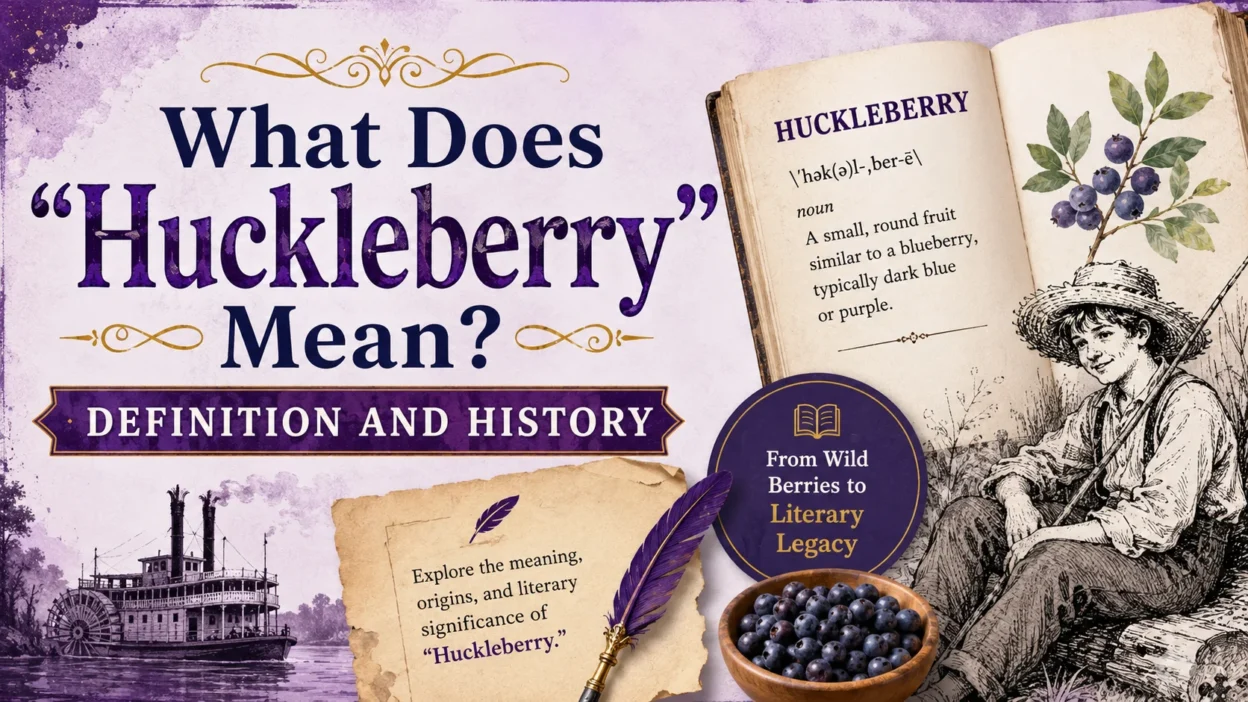
What Does “Huckleberry” Mean? It describes much more than a small, wild, round berry found in North America. In English, the term has several meanings, and its meaning changes with the context in which it appears. The definition begins with a fruit that grows on bushes and looks similar to a blueberry. Different species produce blue, black, and red berries with a sweet, slightly tart flavor. Rich in antioxidants and vitamins, these berries offer several health benefits and are commonly used in desserts, jams, and other fruit dishes. This simple fruit has become an important part of American culture, making it far more interesting than many people first expect.
Beyond the fruit, Huckleberry has become a well-known expression in literature, movies, and everyday language. One of its strongest connections comes from Huckleberry Finn, where the famous character represents freedom and adventure. Another comes from the 1993 Western film Tombstone, where Doc Holliday delivers the famous quote, “I’m your huckleberry.” That iconic line, spoken in his memorable Southern drawl, transformed the phrase into a lasting idiom. In this historical and literary context, the words no longer describe a fruit. Instead, they identify the right person for the job, someone who confidently accepts a challenge. Although some people still debate the huckle bearer theory, the accepted meaning remains tied to huckleberry, its origins, and its enduring cultural significance.
Over the years, the word has gained wider usage through popular media, pop culture, social media, texting, conversations, articles, and novels. Its figurative and literal interpretations show how language evolves through communication, semantics, pragmatics, and changing style. Looking at examples, sentences, and practical uses makes it easier to grasp the word’s unique qualities, interesting history, and linguistic roots. The expression continues to attract audiences because it sounds engaging, witty, and charming, while its vocabulary, wording, tone, and sentiment remain memorable. Whether you discover it through a favorite classic movie, a work of literature, or simple everyday language, Huckleberry remains a timeless word with rich history, multiple origins, lasting influence, and an unmistakable place in modern English.
What Does Huckleberry Mean?
At its simplest, huckleberry has two distinct meanings.
The first is literal. A huckleberry is a small, round berry that grows wild across parts of North America. Depending on the species, the fruit can appear dark blue, purple, red, or nearly black. It has a sweet yet slightly tart flavor and is commonly used in jams, pies, syrups, and desserts.
The second meaning is figurative. In American English, huckleberry came to describe the ideal person for a particular job or challenge. When someone says, “I’m your huckleberry,” they mean:
- I’m the right person.
- I’m exactly who you’re looking for.
- I can handle this.
- I’m ready for the challenge.
Although this figurative meaning sounds modern, it dates back well before the twentieth century.
Simple Definition
Huckleberry (noun)
| Meaning | Explanation |
| Literal | A small edible wild berry native to North America. |
| Figurative | A person perfectly suited for a task or challenge. |
| Informal | Someone who willingly accepts responsibility or competition. |
Pronunciation and Part of Speech
Pronunciation: HUCK-ul-ber-ee
Part of speech: Noun
The word can refer to either the fruit itself or a person, depending entirely on the context.
Consider these examples:
Literal
We picked fresh huckleberries during our hike.
Figurative
Need someone to solve the problem? I’m your huckleberry.
The surrounding words immediately reveal which meaning is intended.
Quick Meaning Table (Literal vs. Figurative)
| Usage | Meaning | Example |
| Fruit | A wild edible berry | We baked a huckleberry pie. |
| Idiom | The right person | I’m your huckleberry. |
| Informal | Someone confident | If you need help, he’s your huckleberry. |
One word. Two very different meanings.
That’s one reason the term continues to interest language lovers today.
Huckleberry as a Fruit
Long before the word became part of American idioms, it referred to an actual fruit growing naturally in forests and mountain regions.
Unlike many supermarket berries, huckleberries remain largely wild. Commercial farming has proven difficult because the plants have complex growing requirements and often rely on natural ecosystems.
For many Americans, especially those in the Pacific Northwest and Rocky Mountain regions, huckleberries are considered a treasured seasonal delicacy.
What Is a Huckleberry?
A huckleberry is the fruit of several shrub species belonging primarily to the Vaccinium and Gaylussacia plant groups.
The berries resemble blueberries but possess several unique characteristics.
Common features include:
- Small round shape
- Deep blue, purple, black, or red color
- Thin skin
- Sweet yet tangy flavor
- Numerous tiny seeds
The plants grow naturally in forests, mountains, and areas with acidic soil.
Unlike cultivated blueberries, many huckleberry species resist commercial cultivation. As a result, most huckleberries sold today are still harvested from the wild.
That rarity helps explain why they’re often considered a premium ingredient.
What Does a Huckleberry Taste Like?
Many people compare huckleberries to blueberries. While the comparison makes sense, the flavors aren’t identical.
Huckleberries typically offer:
- A stronger berry flavor
- More noticeable tartness
- Rich floral notes
- Slight earthiness
- Natural sweetness
The exact taste varies depending on the species and growing location.
Wild berries collected from higher elevations often develop more concentrated flavors because cooler temperatures slow the ripening process.
Food enthusiasts frequently describe fresh huckleberries as having a deeper, more complex flavor than cultivated blueberries.
Huckleberry vs. Blueberry: Key Differences
At first glance, the two fruits appear almost identical.
However, several important differences exist.
| Feature | Huckleberry | Blueberry |
| Growing habit | Mostly wild | Widely cultivated |
| Seed texture | Noticeable seeds | Tiny soft seeds |
| Flavor | Sweeter and tarter | Mildly sweet |
| Availability | Seasonal | Available year-round |
| Farming | Difficult | Commercially grown worldwide |
Although they’re related botanically, they aren’t the same fruit.
A common misconception is that every wild blueberry is a huckleberry.
That’s incorrect.
Different plant species produce the two fruits, even though they share similar appearances.
Where Do Huckleberries Grow?
Huckleberries thrive in cooler climates with acidic soils.
In North America, they’re especially common in:
- Montana
- Idaho
- Wyoming
- Washington
- Oregon
- Alaska
- British Columbia
Many species also grow throughout the Appalachian Mountains and parts of the eastern United States.
Wild huckleberry bushes often flourish after forest fires because the cleared landscape creates favorable growing conditions.
National forests in the western United States have become famous for their annual huckleberry seasons, attracting thousands of berry pickers each year.
Common Culinary Uses of Huckleberries
Despite their limited availability, huckleberries appear in many regional recipes.
Popular uses include:
- Fresh snacks
- Homemade pies
- Muffins
- Pancakes
- Ice cream
- Cheesecake toppings
- Syrups
- Fruit preserves
- Jellies
- Smoothies
- Candies
- Barbecue sauces
Many restaurants in Montana and Idaho proudly feature seasonal huckleberry desserts on their menus.
The berries also pair surprisingly well with savory foods, especially roasted meats and game dishes.
Nutritional Benefits of Huckleberries
Like many berries, huckleberries contain several valuable nutrients.
They provide:
| Nutrient | Benefit |
| Vitamin C | Supports immune function |
| Fiber | Helps digestion |
| Manganese | Supports metabolism |
| Anthocyanins | Powerful antioxidants |
| Polyphenols | Help fight oxidative stress |
Researchers continue studying berries because their natural antioxidants may contribute to overall health when consumed as part of a balanced diet.
While no single fruit serves as a miracle food, berries consistently rank among the most nutrient-dense fruits available.
What Does “I’m Your Huckleberry” Mean?
Few American expressions create as much curiosity as “I’m your huckleberry.”
Today, the phrase usually means:
I’m exactly the person you’re looking for.
It expresses confidence without necessarily sounding arrogant.
Someone who says it volunteers for a challenge or signals that they’re fully capable of handling a situation.
Imagine these conversations:
Example 1
“We need someone who understands old Western history.”
“I’m your huckleberry.”
Example 2
“Who’s ready to fix this problem?”
“I’m your huckleberry.”
In both examples, the speaker confidently accepts responsibility.
Modern Meaning of the Expression
Modern English speakers generally interpret the phrase as:
- I’m qualified.
- I’m available.
- I’m ready.
- Count me in.
- You’ve found the right person.
It’s often playful rather than formal.
Friends may use it jokingly, while movie fans frequently quote it as a nod to Tombstone.
When People Use It Today
Although uncommon in everyday conversation, the expression still appears in several contexts.
People use it when:
- Accepting a challenge
- Volunteering for work
- Showing confidence
- Quoting classic movies
- Making humorous remarks
- Referencing the American West
The phrase carries a distinctly American flavor, especially among audiences familiar with Western history or classic films.
Common Situations Where the Phrase Fits
Here are some natural examples.
At work
“Need someone to lead the presentation? I’m your huckleberry.”
Among friends
“Who’s driving to the airport?”
“I’m your huckleberry.”
Sports
“We need someone to take the final shot.”
“I’m your huckleberry.”
Notice that the phrase always suggests willingness combined with confidence.
Example Sentences
Here are additional examples showing how the idiom works naturally.
- If you’re looking for a software expert, she’s your huckleberry.
- Need someone who enjoys public speaking? He’s your huckleberry.
- When everyone hesitated, Jake smiled and said, “I’m your huckleberry.”
- The experienced mechanic proved he really was the team’s huckleberry.
- Whenever difficult projects appeared, Maria became everyone’s huckleberry.
Although these examples sound modern, the expression itself is much older than many people realize.
Where Did the Word “Huckleberry” Come From?
The history of huckleberry stretches back hundreds of years.
Originally, the word referred only to the berry itself. Over time, however, speakers began using it in figurative ways. That transformation reflects a common pattern in language. Ordinary words often acquire symbolic meanings as people use them creatively in conversation.
Etymology of Huckleberry
Linguists believe the word huckleberry entered American English during the seventeenth century. Its exact origin isn’t completely certain, but many language historians trace it to dialect words brought by English settlers to North America.
As settlers encountered unfamiliar native berry species, they adapted existing names to describe them. Eventually, huckleberry became the accepted common name for several related wild berries.
The earliest uses focused entirely on the fruit. There was no idiomatic meaning attached to the word at that stage.
Earliest Recorded Uses
By the eighteenth century, huckleberry regularly appeared in American writings, newspapers, and agricultural records.
Historical references commonly described:
- Wild berry harvesting
- Local food traditions
- Forest landscapes
- Trade in seasonal fruit
- Regional plant life
As the word became more familiar, speakers started using it in colorful expressions. American English has a long tradition of turning everyday objects into vivid idioms, and huckleberry followed that pattern.
How the Meaning Expanded Beyond the Fruit
The shift from fruit to figurative language didn’t happen overnight.
Instead, the word gradually developed symbolic meanings through regional speech and informal expressions. During the nineteenth century, Americans increasingly used huckleberry to describe something small, ordinary, or perfectly suited to a particular purpose.
Eventually, that figurative sense evolved into the familiar expression:
“I’m your huckleberry.”
By then, the word no longer referred only to berries growing in the woods. It had become part of the colorful vocabulary that still gives American English much of its character.
Why Does “Huckleberry” Mean “The Right Person”?
One of the most interesting parts of the word huckleberry is how it evolved from the name of a fruit into an expression that means the perfect person for a job. Language changes over time, and this is a classic example of how everyday words can develop entirely new meanings.
The figurative sense of huckleberry didn’t appear overnight. It grew through decades of informal speech in the United States, especially during the nineteenth century. Americans often created colorful expressions using familiar objects, plants, and animals. Over time, these sayings became part of everyday conversation.
Today, when someone says, “I’m your huckleberry,” they’re expressing confidence and willingness. They’re saying they have the skills, experience, or courage needed for the task.
Historical Dictionary Definitions
Early American dictionaries recorded huckleberry with meanings that extended beyond the fruit.
In nineteenth-century slang, the word could refer to:
- A suitable person
- Someone equal to a challenge
- An ideal match
- A person capable of completing a task
Some dictionaries also recorded another figurative use in which huckleberry referred to something small or insignificant. Context determined which meaning applied.
This flexibility wasn’t unusual. Many English words developed multiple meanings as speakers used them in different situations.
The Expression “A Huckleberry Above My Persimmon”
One of the earliest expressions involving the word is:
“A huckleberry above my persimmon.”
To modern readers, the saying sounds mysterious.
During the nineteenth century, however, it meant someone or something slightly better than another person or thing.
Imagine two people comparing their abilities.
One might jokingly say:
“He’s a huckleberry above my persimmon.”
In other words:
- He’s a little better than I am.
- He’s slightly more capable.
- He has the advantage.
Although this expression has largely disappeared, it helped shape the later meaning of huckleberry as someone particularly well suited for a task.
How American English Changed the Meaning
American English is full of expressions that began with literal objects before becoming idioms.
For example:
| Literal Word | Figurative Meaning |
| Ace | The best person |
| Heavy hitter | An influential person |
| Big fish | An important individual |
| Huckleberry | The right person for the job |
Over time, Americans shortened conversations by using colorful phrases instead of lengthy explanations.
Rather than saying:
“I’m fully qualified and willing to help.”
Someone could simply say:
“I’m your huckleberry.”
The phrase became memorable because it was short, distinctive, and easy to remember.
The Famous Quote: “I’m Your Huckleberry”
Although the expression existed long before Hollywood, millions of people first encountered it through the Western film Tombstone.
The movie transformed an old American idiom into one of cinema’s most quoted lines.
Even people who have never studied the phrase’s history often recognize the quote immediately.
Who Said It?
The famous line comes from Doc Holliday, portrayed by Val Kilmer in the 1993 film Tombstone.
During a tense confrontation, Holliday calmly declares:
“I’m your huckleberry.”
The delivery is confident, fearless, and unforgettable.
Rather than sounding boastful, the line suggests complete certainty. Holliday knows he’s the right man for the situation, and he leaves no room for doubt.
What the Quote Means in Context
Within the film, the phrase communicates several ideas at once.
It means:
- I’ll take the challenge.
- I’m the opponent you’re looking for.
- I’m prepared.
- I’m not afraid.
- Let’s settle this.
Because the dialogue fits the character so perfectly, audiences remembered it long after the movie ended.
The phrase became larger than the film itself.
Why It Became an American Pop Culture Icon
Several factors helped the quote achieve legendary status.
Exceptional acting
Val Kilmer delivered the line with remarkable confidence and subtle humor.
Perfect timing
The phrase appears during one of the movie’s most memorable scenes.
Unique wording
Unlike many action movie catchphrases, “I’m your huckleberry” sounded unusual. Viewers wanted to know what it meant.
Historical flavor
The expression felt authentic to the American West, even though many audience members had never heard it before.
These elements combined to create one of the most recognizable movie quotes in modern cinema.
Common Misinterpretations
Because the phrase became famous through Tombstone, many people mistakenly believe the film invented it.
That’s incorrect.
Historical evidence shows the expression appeared in American speech decades before the movie.
Another common misunderstanding involves the claim that the line should actually be:
“I’m your hucklebearer.”
Supporters of this theory argue that hucklebearer referred to someone who carried coffin handles, making the line a threat.
However, surviving dictionaries, newspapers, and written records overwhelmingly support huckleberry as the authentic expression.
The debate continues online, but most language historians reject the hucklebearer theory because contemporary evidence simply doesn’t support it.
The Doc Holliday Connection
Understanding the phrase also means understanding the man who made it famous.
Who Was Doc Holliday?
John Henry “Doc” Holliday was an American dentist, gambler, and gunfighter who lived during the late nineteenth century.
Although trained as a dentist, he became better known for life on the American frontier.
He developed a close friendship with lawman Wyatt Earp and became involved in several famous events of the Wild West, including the conflict surrounding the Gunfight at the O.K. Corral in Tombstone, Arizona.
Doc Holliday earned a reputation for:
- Exceptional intelligence
- Calm demeanor under pressure
- Sharp wit
- Loyalty to friends
- Fearlessness in dangerous situations
These qualities made him one of the most fascinating figures in Western history.
The Role of Tombstone (1993)
Released in 1993, Tombstone introduced a new generation to Doc Holliday.
Although the film dramatizes historical events, it portrays Holliday as charismatic, confident, and remarkably articulate.
Val Kilmer’s performance remains one of the movie’s defining strengths.
Many critics and movie fans consider it among the greatest supporting performances in a Western film.
How the Film Revived the Phrase
Before Tombstone, relatively few people used the expression outside historical circles.
After the film’s release, everything changed.
The phrase appeared in:
- Television shows
- Internet memes
- T-shirts
- Social media
- Books
- Podcasts
- Everyday conversations
Many people began quoting it simply because it sounded cool, even if they didn’t fully understand its history.
That’s the power of popular culture.
A single memorable performance can preserve an old expression for future generations.
Why People Still Quote It Today
The phrase continues to endure because it communicates confidence in just four words.
It also feels timeless.
Whether someone is volunteering for a project or joking with friends, saying “I’m your huckleberry” instantly conveys readiness.
Movie fans also enjoy recognizing the reference.
Quoting the line creates an immediate connection among people familiar with Tombstone.
“Huckleberry” vs. “Hucklebearer”: Fact or Fiction?
Few language debates generate as much online discussion as the difference between huckleberry and hucklebearer.
Some people insist the famous quote has been misunderstood for decades.
Others argue that historical evidence clearly favors huckleberry.
So what’s the truth?
The Origin of the Theory
The hucklebearer theory gained popularity years after Tombstone was released.
According to supporters, hucklebearer referred to a person who carried a coffin by holding the handles, sometimes called huckles.
If true, saying:
“I’m your hucklebearer.”
would imply:
“I’ll carry your coffin because you’re about to die.”
It’s certainly dramatic.
However, drama doesn’t automatically make a theory historically accurate.
Historical Evidence Examined
Researchers have examined:
- Nineteenth-century newspapers
- American dictionaries
- Slang dictionaries
- Personal letters
- Literary works
- Regional speech records
The overwhelming majority contain huckleberry, not hucklebearer, when referring to the idiom.
The figurative meaning already existed before Doc Holliday’s lifetime.
That historical record strongly suggests the familiar wording is correct.
What Language Experts Say
Most etymologists and historians agree on several points:
- The idiom predates Tombstone.
- The phrase historically used huckleberry.
- The figurative meaning already existed during the nineteenth century.
- No convincing evidence proves hucklebearer replaced huckleberry in common American speech.
Language experts generally rely on documented evidence rather than appealing stories.
In this case, written records consistently favor huckleberry.
Why the Myth Continues to Spread
Despite the evidence, the myth remains popular.
Why?
Several reasons explain its persistence.
- It sounds dramatic.
- It fits a Western gunfight.
- It spreads easily on social media.
- Many people repeat it without checking historical sources.
- People enjoy discovering what appears to be a “hidden truth.”
The internet often rewards surprising claims.
Unfortunately, surprising claims aren’t always correct.
Huckleberry in Literature
Long before movie audiences embraced the word, readers encountered Huckleberry in one of America’s greatest novels.
That literary connection helped preserve the name for generations.
Why Mark Twain Chose the Name “Huckleberry Finn”
Published in 1884, The Adventures of Huckleberry Finn remains one of the most influential works in American literature.
Mark Twain carefully selected character names.
The name Huckleberry reflected Huck Finn’s personality.
Like the wild berry itself, Huck was:
- Independent
- Natural
- Unpolished
- Resourceful
- Closely connected to the American landscape
His name immediately suggested someone outside conventional society.
Symbolism of the Character
Throughout the novel, Huck represents freedom.
Rather than following society’s expectations, he chooses his own moral path.
His journey explores themes such as:
- Friendship
- Personal growth
- Justice
- Courage
- Individual conscience
These ideas helped transform Huck Finn into one of literature’s most enduring characters.
Influence on American Literature
The novel influenced countless writers.
Its conversational language changed how American fiction was written.
Many literary scholars view Huckleberry Finn as a turning point because it embraced authentic American speech instead of formal European writing styles.
Today, the character remains a symbol of youthful independence and adventure.
Symbolic Meanings of Huckleberry
Beyond dictionaries and literature, huckleberry carries symbolic meaning.
Its associations have expanded over time, making it more than just the name of a fruit.
Independence
Wild huckleberries grow naturally without careful cultivation.
That characteristic has made them symbols of self-reliance and independence.
The image fits both Huck Finn and the American frontier.
Humility
Huckleberries are small compared to exotic fruits.
They’re small, often hidden among forest shrubs, yet highly valued by those who know where to find them.
That contrast gives the berry symbolic meaning.
Great value doesn’t always come in flashy packaging.
Adventure
Because huckleberries usually require hiking into forests or mountain trails, they often represent exploration.
For many families, picking huckleberries is more than gathering fruit.
It’s an outdoor tradition passed from one generation to the next.
Rural American Identity
Few fruits are more closely connected with the American wilderness.
The berry evokes images of:
- Mountain trails
- Pine forests
- National parks
- Family camping trips
- Frontier history
For many people, huckleberry represents a uniquely American experience.
Is Huckleberry Still Used Today?
Yes—but not always in the same way.
The fruit remains popular in certain regions, while the expression survives through movies, literature, and American culture.
Although it isn’t part of everyday vocabulary for most people, huckleberry certainly hasn’t disappeared.
Everyday American English
Most Americans rarely use the word in daily conversation unless discussing:
- The fruit
- Tombstone
- Mark Twain
- Western history
However, movie fans still recognize the phrase instantly.
Regional Usage Across the United States
The word appears more frequently in areas where wild huckleberries naturally grow.
States such as:
- Montana
- Idaho
- Wyoming
- Washington
- Oregon
continue celebrating annual huckleberry festivals, seasonal desserts, and local traditions.
In these regions, the word remains part of everyday life.
Usage in Movies, TV, and Social Media
Popular culture keeps the expression alive.
You’ll still find it in:
- Movie discussions
- Western-themed television
- Internet memes
- Gaming communities
- Social media captions
- Merchandise
- Podcasts
Each new generation discovers the phrase in a slightly different way.
Is the Word Becoming Rare?
Compared with common words like apple or blueberry, yes.
Compared with many historical expressions, however, huckleberry remains surprisingly resilient.
Its connection to classic literature, American history, and one of Hollywood’s most memorable movie quotes has helped preserve it for well over a century.
How to Use “Huckleberry” Correctly
Knowing the meaning of huckleberry is one thing. Using it naturally is another.
Since the word has both a literal and a figurative meaning, context matters. In everyday English, readers usually understand which meaning you intend by looking at the surrounding words.
Literal Usage
Use huckleberry literally when referring to the fruit.
Examples:
- We found fresh huckleberries during our hike.
- Huckleberry jam tastes amazing on homemade biscuits.
- The bakery sells huckleberry pies every summer.
- Wild huckleberries are difficult to cultivate commercially.
- The hikers filled their baskets with ripe huckleberries.
In these examples, the word simply refers to the berry.
Figurative Usage
Use huckleberry figuratively when talking about the right person for a task.
Examples:
- Need someone to organize the event? I’m your huckleberry.
- If you’re looking for an experienced guide, she’s your huckleberry.
- Our team needed a strong negotiator, and James proved to be the huckleberry.
- Looking for someone who enjoys public speaking? He’s your huckleberry.
The figurative meaning is informal, friendly, and confident.
Formal vs. Informal Contexts
Although the expression is widely recognized, it isn’t appropriate for every situation.
| Situation | Appropriate? | Example |
| Casual conversation | ✔ Yes | “I’m your huckleberry.” |
| Friends | ✔ Yes | “She’s your huckleberry.” |
| Movies | ✔ Yes | Frequently quoted |
| Business meeting | Usually No | Better to say, “I’m qualified.” |
| Academic writing | No | Use direct language instead. |
If you’re writing a professional report or speaking during a formal presentation, avoid relying on idioms. Clear language communicates more effectively.
Common Grammar Mistakes to Avoid
People occasionally misuse the expression.
Here are a few common mistakes.
❌ I’m the huckleberry for every job.
✔ I’m your huckleberry if you need help with this project.
❌ The fruit and blueberries are identical.
✔ Huckleberries and blueberries are related but different fruits.
❌ Tombstone invented the phrase.
✔ The movie made the phrase famous, but the expression existed long before the film.
Using the phrase in the right context makes it sound natural rather than forced.
Examples of Huckleberry in Sentences
Seeing the word in context makes its meaning much easier to understand.
Talking About the Fruit
Here are examples using the literal definition.
- Wild huckleberries grow throughout the Rocky Mountains.
- We made homemade huckleberry syrup for breakfast.
- The chef decorated the cheesecake with fresh huckleberries.
- Every August, families gather to pick wild huckleberries.
- Huckleberry muffins are popular throughout Montana.
Using the Idiom
Now compare those with the figurative meaning.
- Need someone who can finish the project? I’m your huckleberry.
- Sarah has years of experience. She’s your huckleberry.
- Looking for someone who enjoys challenges? Mark is your huckleberry.
- If the job requires patience, she’s definitely the huckleberry.
- Everyone knew who to call because Tom was their huckleberry.
Literary Examples
Classic American literature also helped preserve the word.
Examples include:
- The Adventures of Huckleberry Finn by Mark Twain.
- Historical Western novels.
- American frontier stories.
- Regional folklore throughout the nineteenth century.
In literature, the word often evokes freedom, nature, or rural America.
Everyday Conversation Examples
Although the phrase isn’t heard every day, people still use it in casual speech.
Friend: Who knows how to fix computers?
Alex: I’m your huckleberry.
Coworker: We need someone to lead the meeting.
Emma: I’m happy to do it. I’m your huckleberry.
These conversations sound natural because the phrase expresses confidence without becoming overly formal.
Similar Words and Expressions
English offers several expressions with meanings similar to “I’m your huckleberry.”
While none carries exactly the same historical flavor, they communicate a similar idea.
Expressions That Mean “The Right Person”
Common alternatives include:
- I’m your person.
- Count me in.
- Leave it to me.
- I’ve got this.
- I’m up for it.
- I’m the one you need.
- I can handle it.
- I’m ready.
- You’ve found the right person.
- Consider it done.
Each expression communicates willingness and confidence.
Related American Idioms
American English includes many colorful idioms with comparable meanings.
- Right up my alley
- Fit the bill
- Just the ticket
- The perfect match
- Up to the task
- Ready for anything
- Rise to the occasion
Although these expressions differ slightly, they often fit similar situations.
Comparison Table
| Expression | Meaning | Formality |
| I’m your huckleberry | I’m the right person | Informal |
| Count me in | I volunteer | Informal |
| Leave it to me | I’ll handle it | Neutral |
| Fit the bill | Meets the requirement | Neutral |
| Right up my alley | Matches my skills | Informal |
| Up to the task | Capable of succeeding | Neutral |
Common Misconceptions About Huckleberry
Because the word appears in history, literature, and movies, several myths continue to circulate online.
Let’s separate fact from fiction.
Is Every Wild Blue Berry a Huckleberry?
No.
Although they look similar, huckleberries and blueberries belong to different plant groups.
Some species share botanical relationships, but they aren’t interchangeable.
Did Tombstone Create the Phrase?
No.
Historical records show the expression existed decades before the film.
Tombstone simply introduced it to a much larger audience.
Is “Hucklebearer” Historically Correct?
Most evidence says no.
While the theory remains popular online, historians and language experts generally conclude that “huckleberry” is the historically documented expression.
Is Huckleberry Finn Named After the Fruit?
Indirectly, yes.
Mark Twain chose the name Huckleberry intentionally. It reflected the character’s humble, adventurous, and independent nature.
The name wasn’t random.
Interesting Facts About Huckleberries
The more you learn about huckleberries, the more interesting they become.
Here are a few facts you may not know.
Most Huckleberries Are Still Wild-Harvested
Unlike blueberries, most huckleberries sold today come from wild plants.
Commercial cultivation remains difficult because many species depend on specific soil conditions and natural forest ecosystems.
They’re Difficult to Cultivate Commercially
Researchers have spent years studying ways to grow huckleberries on farms.
Despite those efforts, large-scale cultivation remains limited.
That’s one reason fresh huckleberries often cost more than blueberries.
Several Species Exist Across North America
The name huckleberry doesn’t describe just one plant.
Instead, it refers to multiple species found across North America.
Some produce:
- Blue berries
- Purple berries
- Black berries
- Red berries
Each species has its own growing habits and flavor profile.
The Word Is More Than 300 Years Old
Historical records trace huckleberry back to colonial America.
The fruit and its name have been part of American English for centuries.
The figurative meanings developed later through regional speech.
The Phrase Outlived Its Original Meaning
Many people recognize:
“I’m your huckleberry.”
without ever realizing it originally referred to a wild berry.
That shift demonstrates how language evolves over time.
Words often survive long after their original meanings fade from everyday life.
Huckleberry vs. Blueberry at a Glance
The two fruits share several similarities, but important differences remain.
| Feature | Huckleberry | Blueberry |
| Scientific groups | Vaccinium and Gaylussacia species | Mostly Vaccinium species |
| Growing method | Mostly wild | Widely cultivated |
| Flavor | Rich, sweet, and tart | Mildly sweet |
| Seed texture | Noticeable seeds | Soft seeds |
| Availability | Seasonal | Year-round |
| Commercial farming | Limited | Extensive |
| Typical habitat | Mountains and forests | Farms and wild areas |
Although people often confuse the two, they remain distinct fruits with unique characteristics.
Conclusion
The answer to What Does “Huckleberry” Mean? depends on the context in which you encounter the word. Literally, it refers to a small wild berry native to North America that is known for its sweet yet slightly tart flavor and nutritional value. Figuratively, it has become a memorable expression that means the right person for the job, especially through the famous line, “I’m your huckleberry.” Its journey from a simple fruit to a well-known cultural phrase shows how language evolves over time through literature, history, and popular culture. Whether you discover the word in Huckleberry Finn, the film Tombstone, or everyday conversations, understanding its origins and meanings helps you appreciate one of the most distinctive expressions in American English.
FAQs
Q1. What does “huckleberry” mean in simple English?
A huckleberry is a small wild berry that grows mainly in North America. In informal English, it also means the right person for a particular task or challenge.
Q2. Why is the phrase “I’m your huckleberry” so famous?
The phrase became widely recognized after Doc Holliday said it in the 1993 Western film Tombstone. However, the expression existed long before the movie and was already part of American English.
Q3. Is a huckleberry the same as a blueberry?
No. Although huckleberries and blueberries look similar and belong to related plant groups, they differ in flavor, seed texture, growing habits, and species.
Q4. What does “I’m your huckleberry” mean?
It means “I’m the right person for the job,” “I’m ready,” or “I’m the one you’re looking for.” People use it to express confidence and willingness to take on a task.
Q5. Why is the word “huckleberry” still used today?
The word remains popular because of its connection to American literature, Huckleberry Finn, the film Tombstone, and its unique place in everyday expressions and popular culture.